

Peptide Purity Testing for CROs: 2026 Verdict
Peptide purity testing for CROs in 2026: the HPLC, mass spec, COA, and reference standard

Peptide storage for core facilities means running temperature-controlled, access-logged, multi-user inventory systems that keep 99%-pure research peptides stable across dozens of concurrent PIs and grant-funded projects. A single-PI lab can get away with one freezer and a lab notebook. A core facility can't — shared equipment, rotating personnel, and audit trails for multiple funding sources change the entire storage calculus.
A core facility isn't one lab — it's ten or twenty labs sharing freezer space, biosafety cabinets, and reagent budgets. When a peptide reference standard degrades because it sat at the wrong temperature for three months, the cost isn't one failed experiment. It's every downstream project that cited that batch in a grant report or manuscript.
Core facilities also answer to institutional oversight that single labs don't face as often: environmental health and safety audits, grant compliance officers, and shared-equipment usage logs. Storage isn't just a science question here — it's a documentation question. Peptide storage containers built for shared-facility use need to support labeling systems that survive staff turnover, not just keep samples cold.
The research peptide market has also gotten crowded with suppliers of varying quality since 2024, which means core facility managers now spend more time verifying certificates of analysis than they did five years ago. Storage discipline only matters if what went into the freezer was 99% pure to begin with.
Before reorganizing anything, know what's actually in your freezers and who touches them.
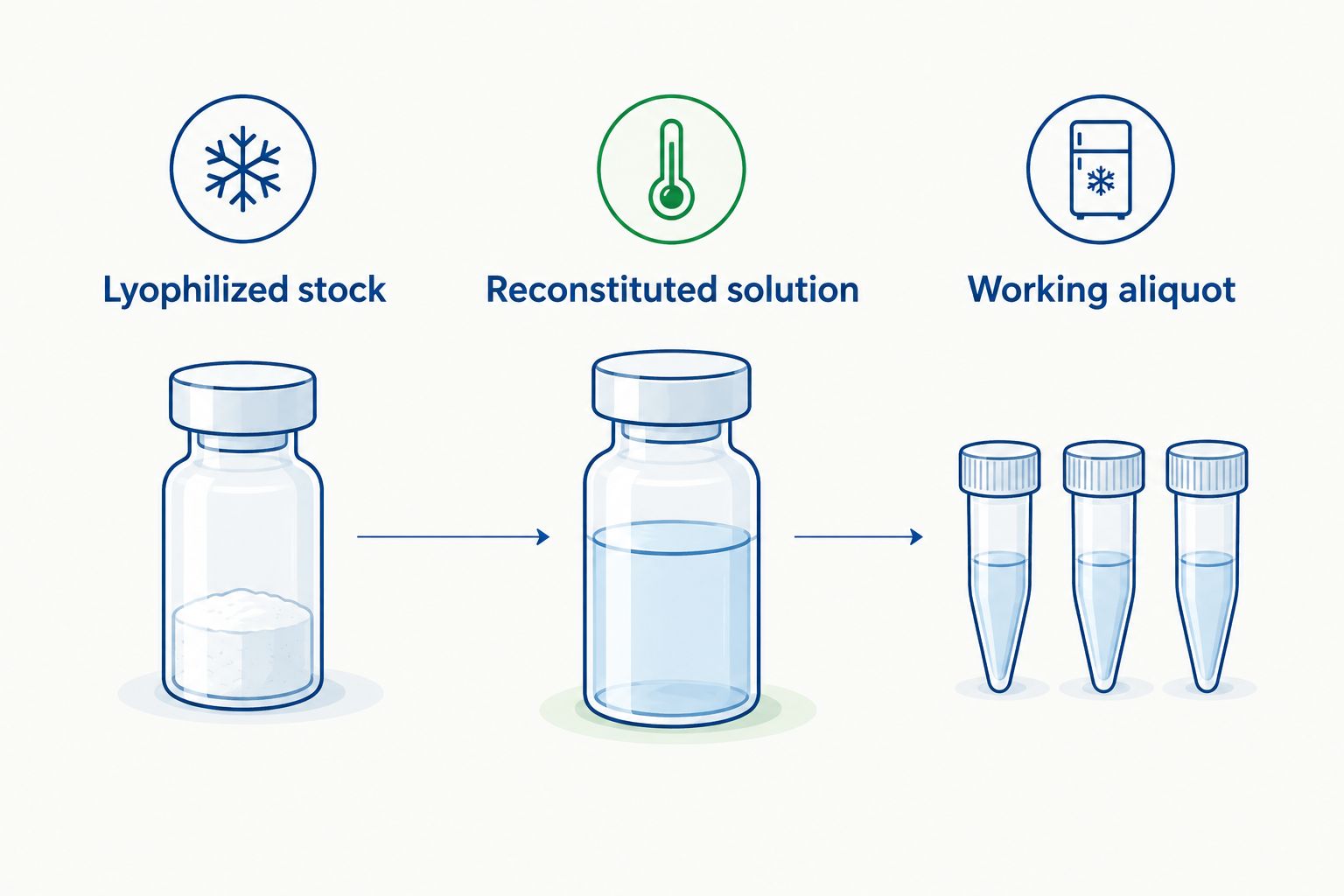
Most core facilities organize freezers by PI or grant number. That's an administrative shortcut, and it's the wrong axis for peptide stability. Lyophilized peptides and reconstituted solutions have different degradation curves and different optimal temperatures.
If your facility is manually tracking reconstitution dates on masking tape, that's the gap. Ordering pre-verified, 99%-pure lyophilized stock from Celonyx Labs reduces the guesswork on starting purity, but the storage discipline after delivery is still on your team.
A freezer without continuous monitoring is a liability, not storage. Core facilities running shared equipment across multiple labs need monitoring that catches excursions even when nobody is physically present at 2 a.m.
Staff turnover is constant in academic core facilities — grad students graduate, postdocs move on, techs rotate between labs. Labels and logs have to survive people leaving.
Shared freezer access is where most core facility storage problems start. One PI's grad student leaves the door open for ninety seconds looking for a vial, and three other labs' samples take the temperature hit.
Core facilities that stock research peptides for multiple ongoing studies need a reorder system that doesn't rely on someone noticing an empty vial mid-experiment.
Grant compliance officers and institutional review boards increasingly ask for documented storage conditions, especially on federally funded projects. A facility that can't produce a temperature log for a specific date range is a facility with a compliance gap.
Source verified research peptides
99% purity, third-party tested, with documentation ready for core facility logs.
| Option | Best for | Key limitation |
|---|---|---|
| Standalone -20°C freezer | Small core facilities with under 5 active PIs | Limited zoning, hard to segment by peptide state |
| Shared ultra-low (-80°C) freezer bank | Multi-PI facilities storing long-term reference standards | Requires strict access control to avoid cross-contamination of logs |
| Monitored freezer farm with centralized alarms | Facilities managing 10+ concurrent grant-funded projects | Higher setup effort to configure alarm routing correctly |
| Cryogenic dewar storage | Facilities storing rarely-used, high-value reference peptides long-term | Not practical for peptides in active weekly use |
Verdict: a monitored freezer farm with segmented zones by peptide state is the right call for any core facility serving more than a handful of active PIs — standalone freezers work only until the second lab starts sharing yours.
What is the best temperature for peptide storage in core facilities?
Lyophilized research peptides store best at -20°C, while reconstituted solutions generally hold stability for 2-4 weeks at 4°C. Long-term reference standards used across multiple projects often go into -80°C ultra-low freezers.
How long do reconstituted research peptides last?
Most reconstituted peptide solutions remain stable for 2-4 weeks when refrigerated at 4°C, though this varies by specific compound. Core facilities should document a hard discard date per batch rather than relying on estimates.
Do core facilities need separate freezers for different PIs?
Not necessarily separate freezers, but separate zones with access logs and clear labeling. Segmenting by peptide state, lyophilized versus reconstituted, matters more for stability than segmenting purely by PI.
What documentation should accompany peptide storage in a core facility?
Certificates of analysis for each lot, temperature logs covering the storage period, and reconstitution protocol records. This documentation is what grant compliance officers and IRB reviewers typically request.
Is Celonyx Labs suitable for core facility peptide sourcing?
Celonyx Labs sells 99%-pure, third-party-tested research peptides with documentation that supports chain-of-custody logging, which fits the reporting needs of academic core facilities.
How often should freezer temperature logs be reviewed?
Monthly review is the practical minimum for facilities storing peptide inventory across multiple labs. Waiting until a problem is reported means the excursion has already happened.
What causes most peptide storage failures in shared facilities?
Undocumented freezer access and inconsistent labeling cause most storage failures, not equipment malfunction. A freezer that logs every door-open event and enforces access control prevents most of these incidents.
The single biggest predictor of a core facility's peptide storage failure isn't freezer quality — it's whether reconstitution dates get written down consistently. Facilities that enforce a mandatory label-at-reconstitution rule report far fewer discarded batches than ones relying on memory or verbal handoffs between rotating staff. Fix that one habit before buying new freezers.
Peptide purity testing for CROs in 2026: the HPLC, mass spec, COA, and reference standard

Research peptides for independent researchers: verify CoAs, purity, reconstitution, and storage without institutional backup. Full

Peptide storage for core facilities in 2026: temperature zones, access control, and documentation for multi-PI
FOR RESEARCH USE ONLY. Products sold by Celonyx Labs are intended exclusively for laboratory and scientific research. They are not intended for human or veterinary use, consumption, diagnosis, treatment, cure, or prevention of any disease. By purchasing from this site, you acknowledge that you understand the intended research purpose of these materials and agree to comply with all applicable laws and regulations.