

Integrity Research BPC 157: How to Judge Vendor Claims
The advice you'll hear most often about buying BPC-157 for the bench is short: demand

Peptide sequence length by class is an exact residue count, not a measure of quality: the three selected research peptides in this 2026 reference set average 4 amino acid residues, with a 3–5 residue range. This table compares a copper-binding tripeptide, a synthetic tetrapeptide, and a synthetic pentapeptide; the average describes these selected examples, not all research peptides.
A peptide’s class tells you something specific about its structure. A tripeptide contains 3 amino acid residues, but that label does not establish its purity, biological activity, or suitability for your assay.
For laboratory work, distinguish a structural description from a material specification. Start with the sequence, then evaluate the supporting documentation; a peptide reference standard serves a different purpose from a general research reagent.
Sequence length is the number of amino acid residues in a specified peptide chain. Across the three selected examples below, the unweighted arithmetic mean is 4 residues, the shortest chain contains 3 residues, and the longest contains 5 residues.
| Structural class | Selected research example | Sequence length | What the class establishes | What it does not establish |
|---|---|---|---|---|
| Tripeptide | GHK-Cu | 3 amino acid residues | A peptide component containing three residues | Copper occupancy, purity, or assay performance |
| Tetrapeptide | Epithalon | 4 amino acid residues | A chain containing four residues | Identity, terminal chemistry, or biological activity |
| Pentapeptide | Ipamorelin | 5 amino acid residues | A chain containing five residues | Receptor selectivity, potency, or experimental suitability |
| Overall selected set | Three examples, equally weighted | 4 residues average; 3–5 residues range | A summary of these three structural examples | A population average for research peptides |
Ipamorelin is the longest selected example at 5 residues; GHK-Cu is the shortest at 3 residues. Epithalon sits between them at 4 residues. Longer and shorter are structural descriptions here, not better and worse.
Source and methodology: this 2026 reference table uses the supplied Celonyx Labs product descriptions, which identify GHK-Cu as a tripeptide, Epithalon as a tetrapeptide, and Ipamorelin as a pentapeptide; the overall mean gives each example equal weight. The selected set is not a representative sample of peptide families and cannot establish typical lengths across the research-peptide market.
The overall row gives you a yardstick for this table, not a target for experimental design. A peptide outside the selected range is not unusual or unsuitable simply because it falls outside these examples.
The mean also does not describe a molecule. No laboratory receives an average of several unrelated peptide structures; you receive a particular material with its own sequence, chemical form, and analytical record.
For your 2026 comparison sheet, retain the individual residue count alongside the compound name. Use the overall figure only when describing this defined reference set, and keep its scope attached whenever you reproduce it.
Use these counts to check terminology and organize records. Do not use them to choose a compound independently of your research question.
These recommendations separate a useful classification shortcut from the evidence needed to accept a reagent. Keep both, but do not let one stand in for the other.
A structural class describes molecular construction. A research class describes an investigative context, target, pathway, or other scientific grouping; those categories do not impose one universal sequence length.
The distinction matters when you search for peptide sequence length by class. A table organized by tripeptide, tetrapeptide, and pentapeptide answers a counting question. A table organized by metabolic, neurological, or cellular-signaling research answers a different question and requires compound-specific sequences.
GHK-Cu is described in the supplied product information as a naturally occurring copper-binding tripeptide. The peptide component therefore contains 3 amino acid residues; copper coordination does not add an amino acid residue to that chain.
The benefit of the tripeptide label is precision. Its limitation is equally clear: it does not describe every chemical feature of the material, and it cannot distinguish GHK-Cu from every other tripeptide.
Epithalon, also referred to as Epitalon in the supplied description, is a synthetic tetrapeptide. Its structural class establishes a length of 4 amino acid residues.
That count makes the entry easy to classify, but it is not an identity test. Different sequences can have the same residue count, so matching the word tetrapeptide is insufficient when you compare materials or reproduce an experiment.
Ipamorelin is described as a synthetic pentapeptide studied in laboratory environments for its interaction with growth hormone signaling pathways. Its peptide chain contains 5 amino acid residues.
The pentapeptide label is useful for structural indexing. It does not establish how the material will behave in your experimental system, and the additional residues relative to the other selected examples do not establish greater activity.
Use the exact molecular identity as your primary record; treat length as a searchable attribute. This approach keeps an abbreviated name or a broad class from becoming the only identifier in your laboratory documentation.
A useful sequence record separates the following fields rather than combining them into one description:
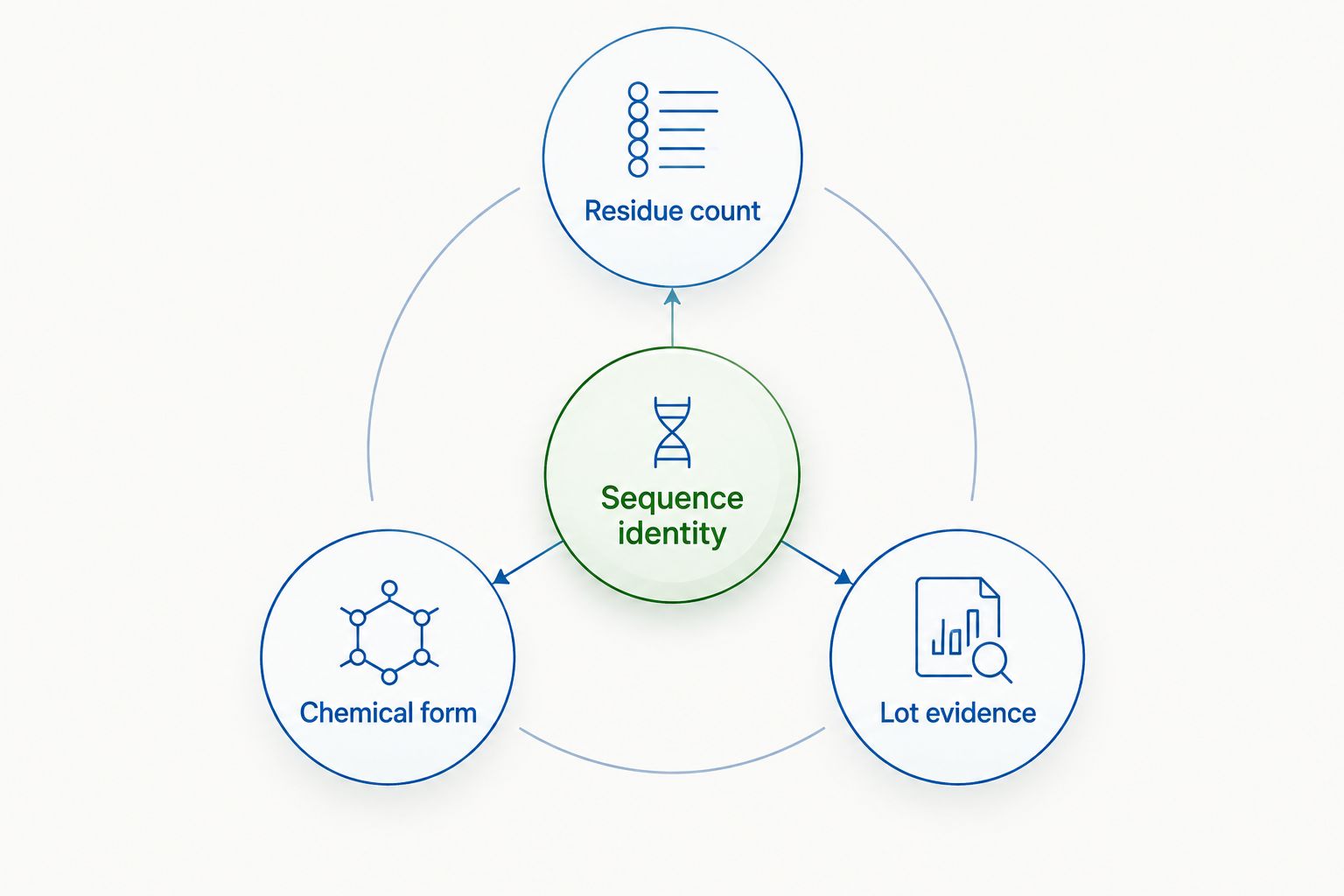
These fields support different checks. Sequence identity describes the intended molecule, while lot evidence documents the particular material under review; neither becomes redundant because the residue count matches.
For 2026 laboratory records, preserve the supplier’s exact product designation as well as your normalized compound name. Keep sequence information in a separate field so that changes in shorthand do not silently change your structural interpretation.
A sequence written in single-letter amino acid notation can support a residue count, but punctuation and modification labels are not amino acids. Three-letter notation requires a different reading approach because each residue name contains several characters.
D-amino acid annotations, terminal modifications, and conjugated groups also require interpretation. Do not count every printed symbol as a residue, and do not remove annotations merely to make an automated count easier.
For a copper-binding peptide such as GHK-Cu, distinguish the peptide sequence from the coordinated metal. That distinction preserves the correct tripeptide classification without treating the full chemical specification as irrelevant.
Two peptides with the same residue count can have different molecular weights because their amino acid compositions differ. Chemical modifications add another reason to calculate from the specified structure rather than from length alone.
Use sequence length for classification and molecular weight for molar calculations. Replacing a compound-specific molecular weight with a chain-length estimate introduces an avoidable error into the calculation.
The distinction also separates vial content from molecular structure. A mass designation on a product describes an amount of material; it does not tell you how many amino acid residues make up each molecule.
For compound-level comparisons, consult the peptide molecular weight benchmarks alongside your sequence record. Keep the chemical form consistent between the molecular weight you use and the material your protocol specifies.
Celonyx Labs describes its research peptides as 99%-pure and third-party-tested. Those are quality statements, not sequence-length measurements, and they belong in a different part of your material assessment.
A purity percentage does not independently establish molecular identity. Likewise, identifying a compound as a tripeptide or pentapeptide does not establish what else is present in the sample or whether the material suits a specific assay.
Celonyx Labs research peptides are best suited to laboratory researchers and scientists, not human or veterinary use. Evaluate each material against the documentation and acceptance criteria relevant to your work rather than treating a class label as approval.
Confirm that each entry refers to a defined molecule, not an abbreviated family name. Then check that the reported count refers to the same molecular entity throughout the comparison.
Next, separate the analytical questions. Identity, purity, peptide content, and other application-specific attributes are distinct; a result addressing one question does not automatically answer the others.
Finally, retain the source of each structural assignment. This 2026 benchmark uses explicit product-description classifications, while a protocol-specific acceptance decision requires the evidence appropriate to that protocol.
What does peptide sequence length by class mean?
Peptide sequence length by class means grouping peptides by the number of amino acid residues in their chains. A tripeptide has 3 residues, a tetrapeptide has 4, and a pentapeptide has 5; research-area categories do not define one fixed length.
What is the average sequence length in this benchmark?
The three selected examples average 4 amino acid residues, with a range of 3–5 residues. This is an equally weighted summary of GHK-Cu, Epithalon, and Ipamorelin, not an average for all research peptides.
How many amino acids are in GHK-Cu?
The peptide component of GHK-Cu contains 3 amino acid residues. The supplied product description identifies it as a copper-binding tripeptide; coordinated copper is not an additional amino acid residue.
Is Epithalon longer than Ipamorelin?
No. Epithalon is a tetrapeptide with 4 residues, while Ipamorelin is a pentapeptide with 5 residues. That difference establishes chain length, not relative biological activity or experimental suitability.
Does a longer peptide mean better research quality?
No. Sequence length describes structure, not research quality. Assess identity, purity, chemical form, and application-specific requirements separately from the residue count.
Can I calculate molecular weight from residue count alone?
Residue count alone does not establish an exact molecular weight. Use the specified amino acid sequence and relevant chemical modifications or coordination state for compound-specific calculations.
Does 99% purity prove that a peptide has the correct sequence?
A purity percentage alone does not prove sequence identity. Evaluate identity evidence separately and connect the analytical documentation to the material and lot under review.
Are these peptide benchmarks instructions for human use?
No. These benchmarks support structural classification and laboratory documentation only. All materials discussed are for research use only, not human or veterinary use.
A matching residue count is a useful check, but a weak identity test. Before treating two materials as interchangeable, compare their exact sequences and chemical forms—not just their class names.
For your 2026 material register, add separate fields for residue count and sequence identity. That small distinction prevents a correct length label from concealing a different molecule. All peptides discussed are for research use only, not human or veterinary use.
The advice you'll hear most often about buying BPC-157 for the bench is short: demand

Can cagrilintide be combined with GLP-1 peptides? Yes, in controlled research. Understand mechanisms, study controls,

Can Selank be combined with nootropic peptides? Yes, in controlled laboratory studies. Learn the controls,
FOR RESEARCH USE ONLY. Products sold by Celonyx Labs are intended exclusively for laboratory and scientific research. They are not intended for human or veterinary use, consumption, diagnosis, treatment, cure, or prevention of any disease. By purchasing from this site, you acknowledge that you understand the intended research purpose of these materials and agree to comply with all applicable laws and regulations.