

How to Get Tesamorelin for Research Safely and Legally
A common shortcut says that you can find tesamorelin by searching online and choosing a
Most buyers meet a peptide supplier through one persuasive number: 99% purity. That figure can help with initial screening, but it doesn't prove peptide identity, assay, sterility, endotoxin control, stability, or suitability for a particular experiment. This roundup evaluates seven peptide supplier reviews and one supplier through signals a procurement team can verify, including batch-specific certificates of analysis, named testing laboratories, analytical methods, shipping terms, published policies, and reachable support. It also separates independent review evidence from supplier-published claims, because a vendor's own testimonial or product-page statement shouldn't be treated as independent confirmation. Review platforms are useful for finding patterns in fulfillment and communication, but technical purchasing decisions require more than star ratings. A 2021 PowerReviews study summarized by Search Engine Journal reported that more than 99.9% of online shoppers read reviews, while BrightLocal's results found that 50% trusted online reviews as much as personal recommendations. For peptide procurement, the practical question is not which supplier has the highest rating. It's which claims survive documentation checks.
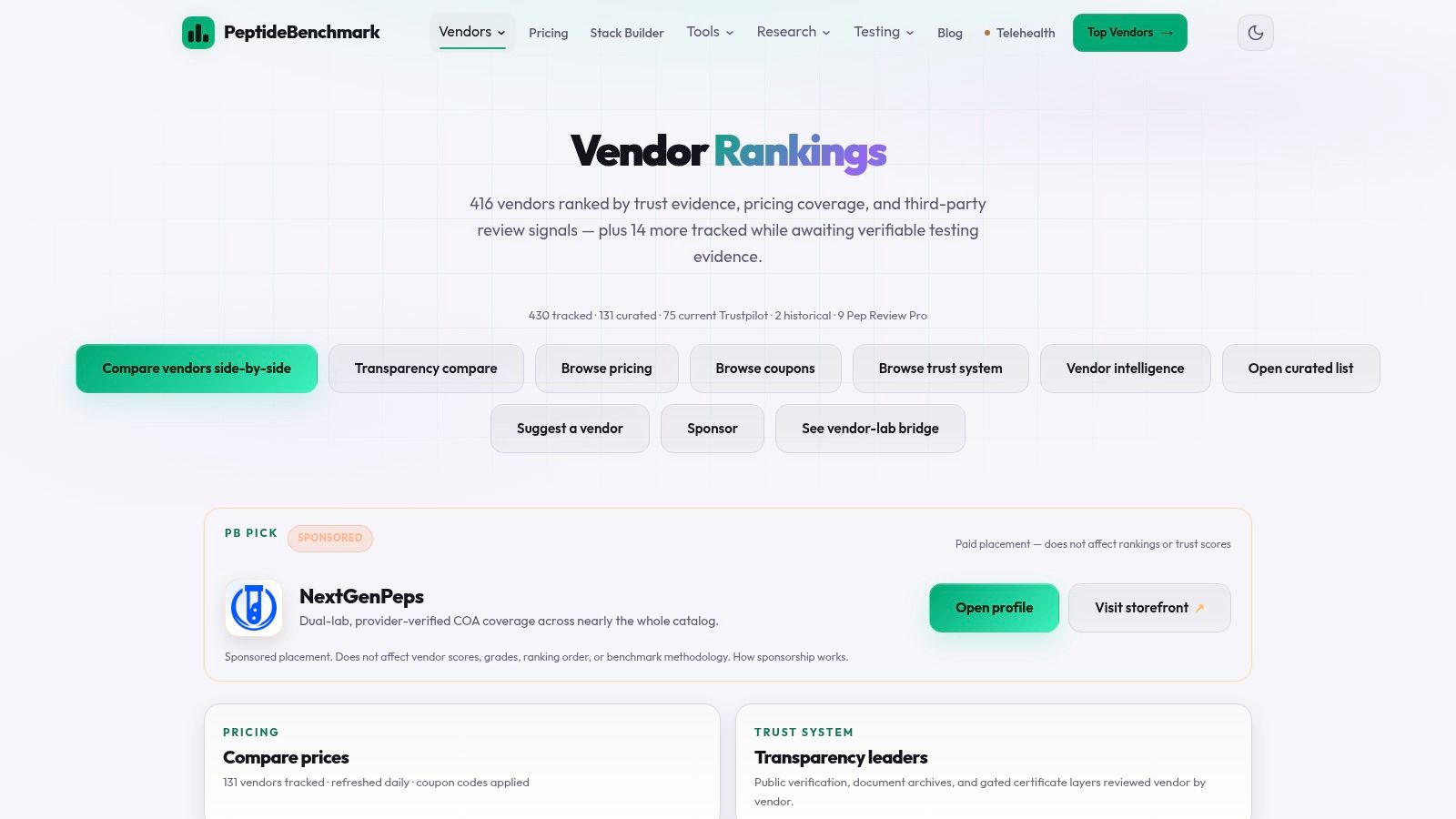
PeptideBenchmark's vendor directory takes an evidence-first approach to peptide supplier reviews. Its profiles organize supplier information around certificates of analysis, laboratory verification, business signals, and sourcing context, rather than treating customer anecdotes as a complete quality assessment. The US-focused vendor map can help domestic buyers distinguish a clearly listed US address from a less specific US footprint, a useful distinction when shipping and procurement requirements matter.
The platform's strongest feature is the way it connects vendor write-ups with supporting documentation where available. A buyer can look for a product-linked COA, a named testing laboratory, and a verification path instead of accepting “third-party tested” as a standalone assurance. Its profiles also disclose affiliate or discount relationships, which improves transparency without eliminating the possibility of selection bias.

Procurement use: Treat a vendor-hosted COA as a starting document. Ask whether the report identifies the exact lot, test date, method, sample, and laboratory before assigning it meaningful verification value.
PeptideBenchmark can surface stronger documentation than a generic review page, but some entries still depend on material supplied by the vendor when independent verification isn't available. That limitation matters because HPLC peak-area purity doesn't independently establish molecular identity, sterility, endotoxin control, potency, or suitability for human use. Guidance on peptide purity testing with HPLC and mass spectrometry supports using orthogonal evidence, including chromatographic data and LC-MS identity confirmation.
For labs building a US-centered shortlist, this is one of the more useful discovery tools. Use its research peptide supplier reviews from Celonyx Labs as a separate vendor-specific reference, then verify every quality claim against lot documentation and direct supplier communication.
Compare Peptide is designed for breadth. Its provider index gives buyers a way to survey a wide range of peptide vendors, including suppliers that may not appear in smaller US-focused directories. Individual pages discuss vendor-published testing information, transparency, and stated regulatory positioning, allowing a procurement team to see how consistently a supplier explains its own quality controls.
That broad coverage is valuable during the first research pass. A buyer can identify repeated claims, compare whether vendors publish COAs or merely advertise purity, and flag missing information before opening accounts or requesting quotations. The platform also discloses paid partnerships on listings, which means readers can interpret rankings with more context than they could from an undisclosed commercial placement.
Compare Peptide's global scope is both its advantage and its constraint. It can reveal suppliers outside a buyer's usual search results, but an international listing may not answer practical questions about domestic fulfillment, customs exposure, storage conditions, or institutional purchasing requirements. A high placement therefore shouldn't be treated as a purchase recommendation without a separate operational check.
The platform is most useful when paired with a documented vendor qualification process. Ask each shortlisted supplier for a lot-specific COA, original chromatogram, LC-MS result, test date, and testing laboratory identity. Also record whether the vendor responds clearly to technical questions. A review platform can expose a claim. It can't validate a batch that the supplier hasn't connected to the order.
VialVerdict's vendor dashboard prioritizes speed of comparison. It places vendor ratings, origin information, testing visibility, and storefront links in a side-by-side format, helping buyers filter domestic and international options before they invest time in detailed diligence. Its visibility indicators are particularly useful when they show whether HPLC or COA evidence is accessible on a vendor page.
The dashboard also surfaces payment options and shipping origin. Those details don't establish peptide quality, but they can expose procurement friction early. A lab may decide that a supplier with clear domestic fulfillment and visible documentation deserves a direct inquiry, while a vendor with limited origin information requires more verification before it enters the shortlist.
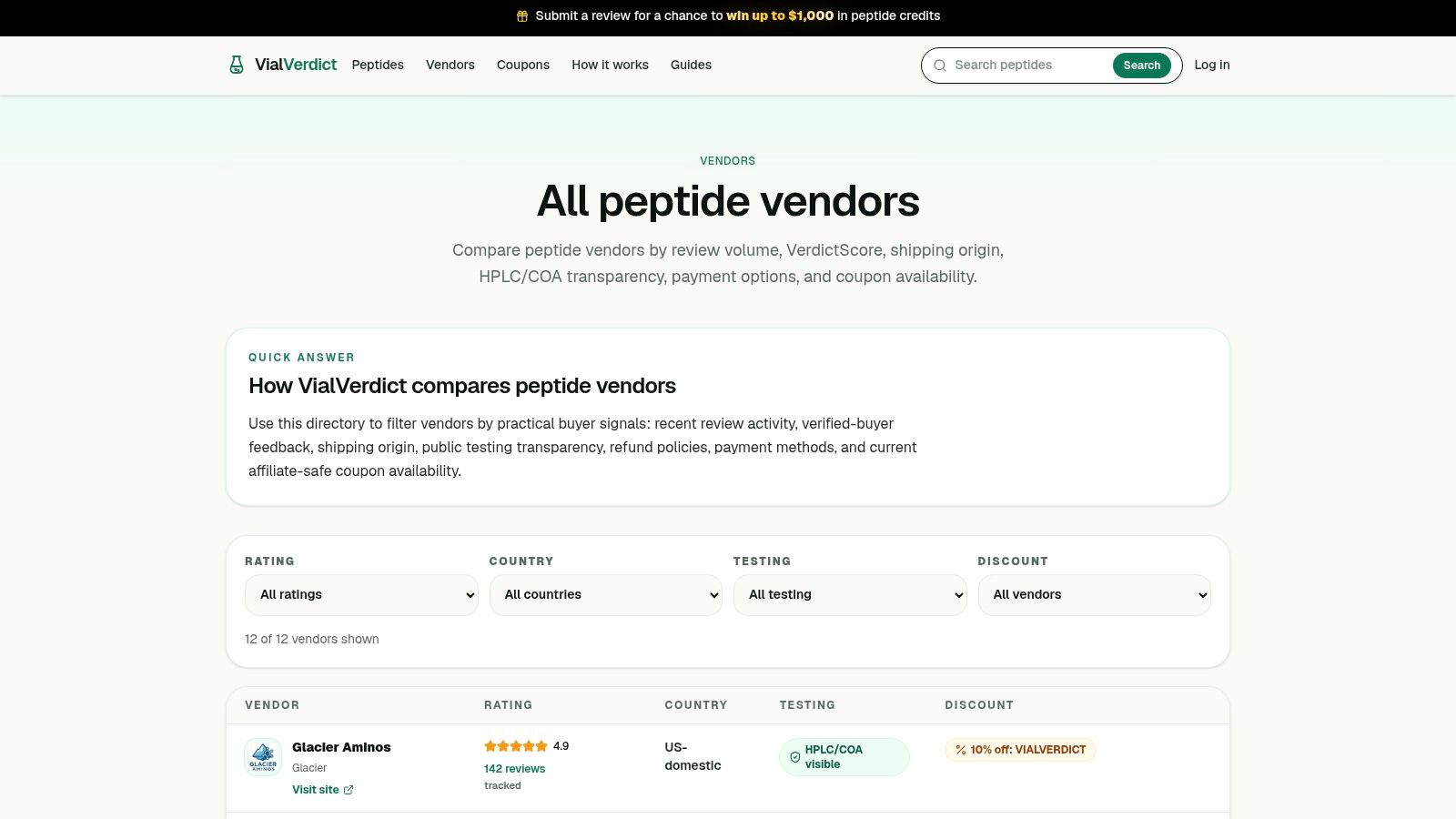
VialVerdict's internal VerdictScore is convenient, but the public methodology isn't thoroughly detailed on every listing page. That creates a clear analytical boundary. The score can prioritize which suppliers to investigate first, but it shouldn't replace direct review of test records, shipping terms, or support performance.
Sparse review counts create another risk. BrightLocal's 2024 consumer survey found that 59% of consumers expected a business to have between 20 and 99 reviews before trusting its average rating. The result comes from general consumer behavior, not scientific procurement, but it illustrates why a small rating sample shouldn't carry the same weight as a consistent record across independent sources. For peptide buyers, operational evidence and technical documentation deserve separate scores.
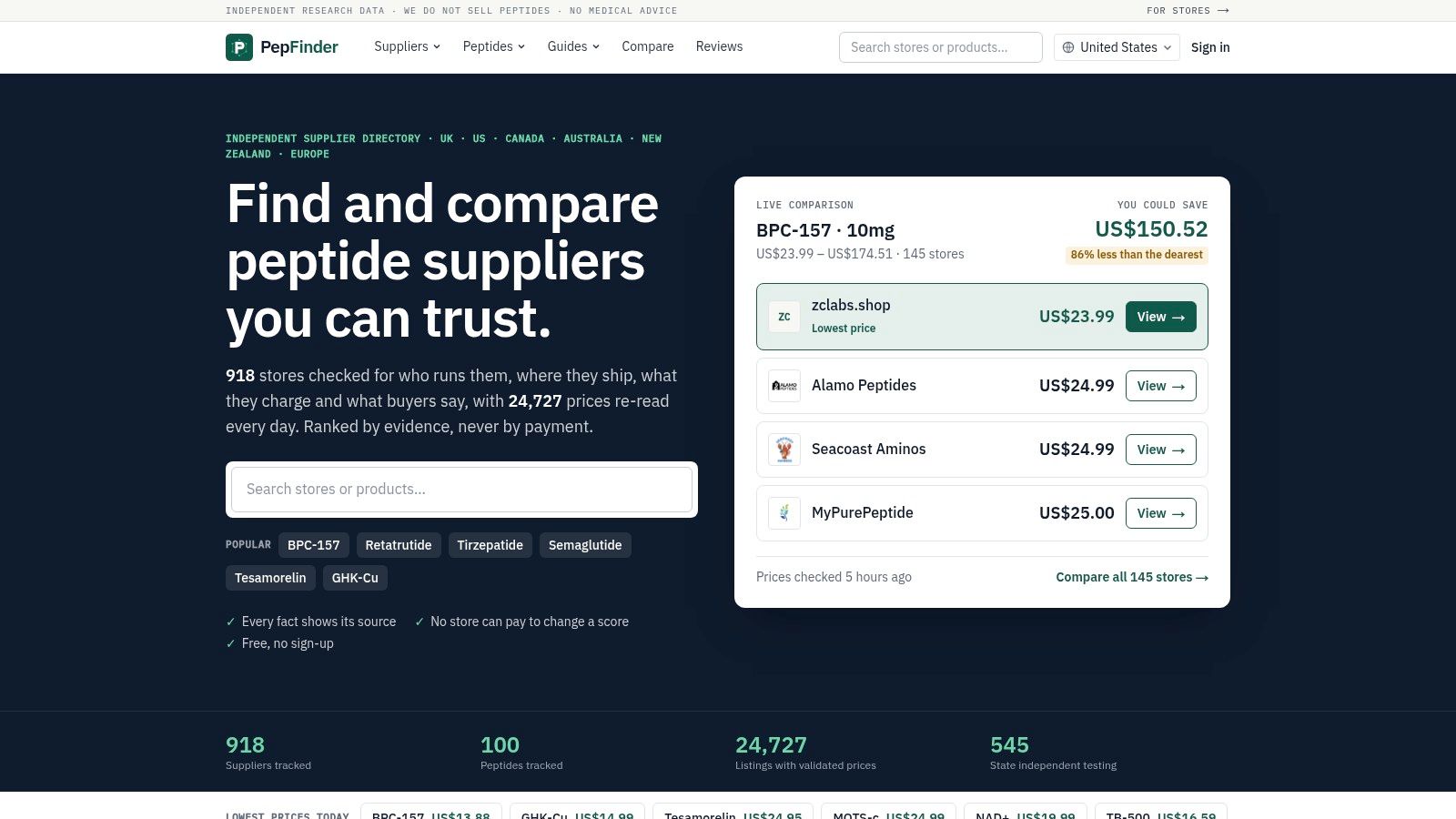
PepFinder combines signals that buyers often examine separately. Its vendor pages bring together external ratings, testing and COA references, and product-level price comparisons, while its educational material explains how to interpret a COA. That combination makes the platform practical for early procurement research, especially when a team needs to compare several peptide SKUs rather than assess a supplier in the abstract.
The price comparison feature can support a basic price-per-milligram cross-check, but cost shouldn't become a proxy for quality. A lower listed price may reflect differences in concentration, packaging, testing scope, shipping, or documentation. PepFinder's value lies in exposing those differences for follow-up, not in producing a final ranking from price and ratings alone.
PepFinder aggregates external ratings such as Trustpilot alongside supplier claims. That separation helps readers distinguish customer experience from technical evidence, although the review platform's affiliate links introduce a selection-bias risk even when disclosed. Coverage also varies by vendor and product, so the absence of a detailed COA discussion shouldn't automatically be interpreted as evidence that a supplier has no documentation.
Independent reviews can reveal fulfillment and communication patterns. They cannot independently prove peptide identity, concentration, sterility, or experimental suitability. A procurement record should therefore preserve the exact product, lot, report, method, and storage information reviewed, rather than saving only the aggregator's rating. That distinction turns a convenient market scan into an auditable supplier comparison.
Peptalks leans more heavily on community feedback and editorial interpretation. Its vendor pages combine ratings and review volume with buying guides and science explainers, giving readers context for terms such as HPLC, COA, and purity. That editorial layer can help purchasing committees identify questions they might otherwise miss when reading a product page.
The claimed volume of “verified community reviews” may improve the usefulness of operational screening when posts contain dates, product names, delivery details, and support interactions. Still, the verification methodology isn't always explained thoroughly on each page. Buyers should distinguish a verified purchaser identity from verified product quality. The first may support confidence in an ordering experience. It doesn't confirm the analytical result for the material received.
Mixed experiences often provide more information than uniform praise. Look for criticism, supplier responses, and evidence that the reviewer distinguishes delivery performance from laboratory performance.
The site's global scope can broaden discovery, but highly rated international vendors may not fit a US laboratory's shipping, documentation, or purchasing requirements. A useful review from Peptalks should lead to a question set: Does the supplier provide a batch-specific COA? Is the testing lab named? Does the report include an original chromatogram and mass result? Are refund and shipping policies published?
The ConsumerAffairs review research found that 90% of consumers considered fake reviews a concern and that 76% were more likely to trust mixed ratings than exclusively five-star ratings. Those figures describe general purchasing behavior, not peptide validation, but they reinforce a sensible reading practice. A credible supplier profile should withstand scrutiny of negative feedback, not depend on a flawless-looking rating pattern.
The Peptide Talk Forum vendor and laboratory category offers a different type of evidence. Instead of a standardized directory, it captures ongoing buyer reports about shipping speed, packaging, support responsiveness, COA quality, and specific batch details. That makes it useful as an early-warning channel, particularly when several recent posts describe the same fulfillment problem.
Forum discussions can also contain details that static vendor profiles omit. Buyers may report whether labels matched the order, whether packaging arrived intact, how quickly support replied, and whether a supplier addressed a suspected quality issue. Those observations are operationally relevant, but they remain anecdotal until the buyer can connect them to a dated order, lot documentation, and an independent analytical record.
Forums require more work than dashboards. Posts may contain incomplete methods, vendor self-promotion, outdated information, or conclusions based on one shipment. A careful reader should separate what the author personally observed from what the author inferred about identity or purity.
For technical follow-up, use third-party testing laboratory guidance for peptide procurement to frame questions about accreditation, acceptance criteria, chain of custody, and method scope. A forum can tell you that a batch raised concerns. It can't resolve those concerns without verifiable testing.
The forum is best used for recency and operational context. It should complement, not replace, a supplier's named laboratory records, published policies, and direct support exchange.
A supplier page should not be read like an independent review page. Celonyx Labs is the only vendor in this comparison, so the standard is different. Claims on a seller's own site can help a buyer frame questions, but they do not carry the same weight as an outside review source or a named laboratory record tied to a specific batch.
Celonyx presents itself as a research-use supplier with an online storefront, cart and checkout flow, New Arrivals and Bestsellers sections, a peptide reconstitution calculator, a blog, and a newsletter. It also publishes Terms and Conditions, Privacy, Refund and Return, and Shipping policies. For procurement teams, those published policies matter because they can be checked before an order is placed and compared with how the company handles a support request or a shipping problem in practice.
The site also refers to independent third-party testing and states 99% purity across its peptide catalog. A buyer should treat that as a preliminary claim unless it is connected to lot-specific records. The useful question is not whether a storefront mentions purity. It is whether the ordered batch comes with a certificate of analysis, original chromatograms where relevant, a named testing laboratory, a test date, and identity data that can be matched to the product received.
Celonyx publishes a business address, 1194 Twin Stacks Drive, Unit B, Dallas, PA 18612, phone support at 570-761-6154, and email support at [email protected]. Those are practical signals. They give a buyer clear contact points and make it easier to test responsiveness before committing to a purchase.
That matters more than testimonials.
The supplier also describes shipping and displays customer feedback, including named reviewers. Those details may help with an initial operational read, but they remain supplier-controlled content. A stronger review file comes from direct checks: ask how packaging is handled, what storage instructions are provided, whether expiration or retest information is available, and what happens if a shipment arrives damaged or outside expected temperature conditions.
Evidence threshold: A stated purity figure becomes decision-useful only when it is tied to the exact lot ordered, supported by batch documentation, and linked to a named lab or original analytical output.
Public product pages do not display pricing, even though the site supports cart and checkout functions. The available supplier information also does not show formal GMP or cGMP certification details or awards. That does not establish weak controls, but it does mean institutional buyers may need to request more documentation before approval.
Celonyx states that its products are for research use only, not for human or veterinary use. That narrows fit. The supplier is easier to place in academic, biotech, CRO, startup, and other preclinical research workflows than in translational or clinical procurement, where documented batch verification and formal quality records usually carry more weight.
| Tool | Complexity 🔄 | Resource needs ⚡ | Expected outcomes 📊⭐ | Ideal use cases 💡 | Key advantages ⭐ |
|---|---|---|---|---|---|
| PeptideBenchmark | Moderate verification workflow; 🔄🔄 | Moderate time to review COAs and records; ⚡⚡ | High verifiable quality signals; ⭐⭐⭐⭐ 📊 Evidence‑centric | Labs needing documented COAs and US supplier mapping; 💡Verify named lab links | Evidence‑first COA DB; US vendor map; named testing lab links |
| Compare Peptide | Moderate curation of vendor‑published info; 🔄🔄 | Broad index requires scanning many listings; ⚡⚡ | Wide market visibility for claim cross‑checks; ⭐⭐⭐ 📊 Broad coverage | Surveying many suppliers globally or initial market scans; 💡Use to shortlist vendors | Large provider index (400+); affiliate disclosure; narrative reviews |
| VialVerdict | Low, quick side‑by‑side comparisons; 🔄 | Low time per vendor, high triage speed; ⚡⚡⚡ | Fast vendor triage with testing visibility flags; ⭐⭐⭐ 📊 Quick filtering | Rapid shortlist for domestic vs. international options; 💡Filter then deep‑dive | VerdictScore summary; HPLC/COA visibility flags; shipping/origin highlights |
| PepFinder | Moderate, product‑level tools and tracking; 🔄🔄🔄 | Ongoing monitoring and price checks; moderate effort; ⚡⚡ | Aggregated signals plus price comparisons; ⭐⭐⭐ 📊 Procurement‑oriented | Price‑per‑mg checks and ongoing vendor monitoring; 💡Use COA how‑to guides | SKU price comparisons; Trustpilot aggregation; how‑to procurement content |
| Peptalks | Moderate editorial + community moderation; 🔄🔄 | Time to read long‑form guides and many reviews; ⚡⚡ | Rich qualitative insights and educational context; ⭐⭐⭐⭐ 📊 Good for committees | Purchasing committees needing education and user experience context; 💡Combine with COA checks | High review volume; editorial buying guides; science explainers |
| Peptide Talk Forum, Vendor Reviews, Labs & Purity | Low access but high vetting effort for anecdotes; 🔄 | Ongoing manual monitoring and vetting required; ⚡ | Timely operational/recency feedback but anecdotal; ⭐⭐ 📊 Early‑warning signals | Detect shipping delays, QC slips, batch issues; 💡Treat as anecdotal, verify independently | Real‑time buyer experiences; granular packaging/lead‑time reports |
| Celonyx Labs | Low, vendor e‑commerce ordering flow; 🔄 | Low procurement friction; direct contact for COAs may be needed; ⚡⚡⚡ | High‑purity product supply with fast fulfillment; ⭐⭐⭐⭐ 📊 Operational supplier | Labs needing high‑purity, fast delivery and direct support; 💡Request batch certificates when needed | 99% stated purity; third‑party testing references; fast shipping; direct phone/email support |
The most reliable peptide supplier reviews don't end with a star rating. They produce a record of what a buyer could verify, what remained unverified, and which claims came from an independent review source versus the supplier itself. That distinction prevents a polished profile, a named testimonial, or a high purity figure from carrying more evidentiary weight than it deserves.
Start with the product and lot. Request a batch-specific certificate of analysis, the original HPLC chromatogram with integration data, LC-MS identity confirmation, test date, sample or lot identifier, and the name of the laboratory that performed the work. A supplier's reported percentage isn't directly comparable across vendors when methods, columns, wavelengths, integration rules, and impurity definitions differ. EMA guidance on synthetic peptide manufacture distinguishes purity from peptide-related impurities, non-peptide impurities, assay or content, and other quality attributes. That's why “99%” should be recorded as one field in the review, not as the final verdict.
A practical shortlist should keep technical and operational categories distinct:
Shipping deserves particular attention. Current scientific discussion links peptide degradation during manufacturing or storage with peptide-related impurities and emphasizes stability studies and stress testing to understand degradation pathways. A fast shipment isn't automatically the safer shipment if the supplier doesn't explain packaging, storage, temperature exposure, or replacement procedures.
Use review platforms to identify patterns, not to outsource judgment. PeptideBenchmark and Compare Peptide can broaden discovery, VialVerdict can accelerate side-by-side triage, PepFinder can combine ratings and product comparisons, Peptalks can add editorial and community context, and the Peptide Talk Forum can surface recent operational problems. Then reassess the shortlist at every reorder. A supplier that documented one batch well hasn't automatically demonstrated lot-to-lot consistency, and a supplier that delivered quickly once hasn't established stable shipping performance.
Celonyx Labs offers research peptides with stated 99% purity, referenced independent third-party testing, published store policies, direct phone and email support, and an online ordering workflow for laboratory buyers. Review those claims against the lot-specific documents and shipping details you need, then visit Celonyx Labs to assess its catalog and contact the supplier with your procurement questions.
A common shortcut says that you can find tesamorelin by searching online and choosing a

Choose the best KPV peptide by research model. Compare identity, purity, endotoxin documentation, and vehicle

Choose full-length thymosin beta-4 peptide for native-molecule research. Compare fragments and reference standards, then check
FOR RESEARCH USE ONLY. Products sold by Celonyx Labs are intended exclusively for laboratory and scientific research. They are not intended for human or veterinary use, consumption, diagnosis, treatment, cure, or prevention of any disease. By purchasing from this site, you acknowledge that you understand the intended research purpose of these materials and agree to comply with all applicable laws and regulations.