

Integrity Research BPC 157: How to Judge Vendor Claims
The advice you'll hear most often about buying BPC-157 for the bench is short: demand
Your receiving clerk signs for a box, opens it, and finds three vials intact and one cracked at the neck. The packing slip matches the order. The lot number on the broken vial matches the batch certificate of analysis you filed with the purchase order. Now a lab manager, a finance officer, and a supplier are all asking a version of the same question: what happens next, and who pays for it?
That moment is where a returns and refunds policy either works or doesn't. Most labs meet the policy for the first time in the middle of a problem, which is the worst possible time to read it. The text itself is usually short. The judgment calls behind it are not.
Three questions run through every return, and they tangle together the moment a shipment goes wrong. Product integrity asks whether the material is still fit for use. Delivery proof asks what the carrier's record shows and what evidence you hold. Refund eligibility asks what the written terms allow once the first two are settled. Separate them and the path is clear. Blur them and a lab ships back material it shouldn't have opened, or writes off a batch it could have replaced.
A lab receives a shipment that appears intact, but the contents are incorrect. The purchase order, delivery record and return terms now answer different questions: what was ordered, what arrived, and which remedy the seller's rules allow.
A returns and refunds policy sets out who may request a remedy, what evidence is needed, who pays return shipping, whether an inspection is required, and how an approved refund, replacement or credit is handled. Those details matter because returns make up a large share of U.S. retail sales. Written terms also matter for late or unshipped orders. The FTC's guide to the Mail, Internet, or Telephone Order Merchandise Rule explains sellers' obligations in those cases.
For laboratory buyers, distinguish the reason for a return from the condition of the material. An unopened item may be resellable; an incorrect item raises a fulfillment issue; transit damage concerns delivery; and a shipment with a possible temperature excursion raises a product-integrity question. Each circumstance can call for different evidence and a different remedy. The written policy determines which requests qualify.

Celonyx Labs links to a Refund and Return Policy, a Shipping Policy and Terms and Conditions. Its terms state that purchases are for research-only purposes and that buyers agree to comply with applicable laws and regulations. For procurement staff, the practical task is to check how those published terms fit the purchase order and the records needed for budget reconciliation.
A shipment can arrive late, damaged, incomplete, or intact but unsuitable for return. The remedy depends on which problem occurred, what evidence you can provide, and what the published policy allows. Use the table to separate those questions before contacting support.
| Case | Remedy | Window and evidence | Return shipping |
|---|---|---|---|
| Order not shipped by the promised date | Refund, or a revised date you accept in writing | The ship date stated in the offer; the federal default applies when none is stated. Refund timing is set by the FTC rule | Not applicable |
| Damaged in transit | Replacement or refund after inspection | Photograph the parcel before opening, then report immediately with photos, the label and the lot number | Usually none, since the damaged unit isn't sent back; confirm with support |
| Wrong or missing item | Replacement or refund | Report with the packing slip, the carrier label and the lot number before the policy deadline | Confirm with support before shipping |
| Quality nonconformance | Replacement or refund after review | Match the lot number to the batch certificate of analysis; provide evidence of the nonconformance | Confirm with support before shipping |
| Lost parcel marked delivered | Carrier investigation, then replacement or refund | Tracking record, delivery proof and a receiving-dock log; report the day the discrepancy appears | Not applicable |
| Change of mind, unopened and resellable | Refund where the law permits | Contact support before shipping back; check the published policy for the applicable window | Confirm with support before shipping |
| Opened, reconstituted or temperature-excursion material | Not returnable unless nonconformance is proven | Not applicable | Not applicable |
The remedy, reporting window, evidence and return-shipping arrangements are separate questions. A complete evidence file cannot make an expired claim timely, and a timely report may still need documentation before the case can be assessed.
For a late, unshipped order, the remedy may be a refund or a revised date you accept. For damage or a quality concern, inspection helps establish product integrity. A replacement may resolve the issue when suitable material is available; a refund may be the appropriate outcome when it cannot be.
A parcel marked delivered raises a different question: whether the delivery record matches what the receiving dock actually received. For opened, reconstituted or temperature-excursion material, keep the handling and condition records, because those details help distinguish a product nonconformance from a change that occurred after delivery.
Practical rule: Match the problem to a row, gather the listed evidence, and confirm return instructions with support before shipping anything back.
Contact support with the order number and a plain description of the issue before sending material back. Confirm the return instructions first, and keep the response with the purchase-order file so the receiving and procurement teams can reconcile the case.
A late order is the one case where the seller's obligation isn't written by the seller at all. It's set by federal rule.
The Mail, Internet, or Telephone Order Merchandise Rule, issued by the Federal Trade Commission in 1975, requires a seller to have a reasonable basis for believing it can ship within the time stated in its advertising. Where no shipping period is stated, the default expectation is shipment within 30 days. When a seller learns it can't meet the promised or 30-day deadline, it must notify the customer, provide a revised shipment date, and explain the right to cancel for a full and prompt refund, as the Federal Register text of the Mail or Telephone Order Merchandise Rule sets out. If the buyer doesn't agree to the delay, the seller must refund all money paid for the unshipped merchandise rather than substituting store credit.
The refund mechanics have their own deadlines. For certain canceled orders, refunds paid by methods other than creditor-issued credit must be sent within seven working days, while creditor-issued credit must be credited or prevented from charging within one billing cycle. That distinction matters to a procurement officer reconciling a card statement against a PO, because the seller's obligation ends when the instruction leaves, not when the issuer posts it.
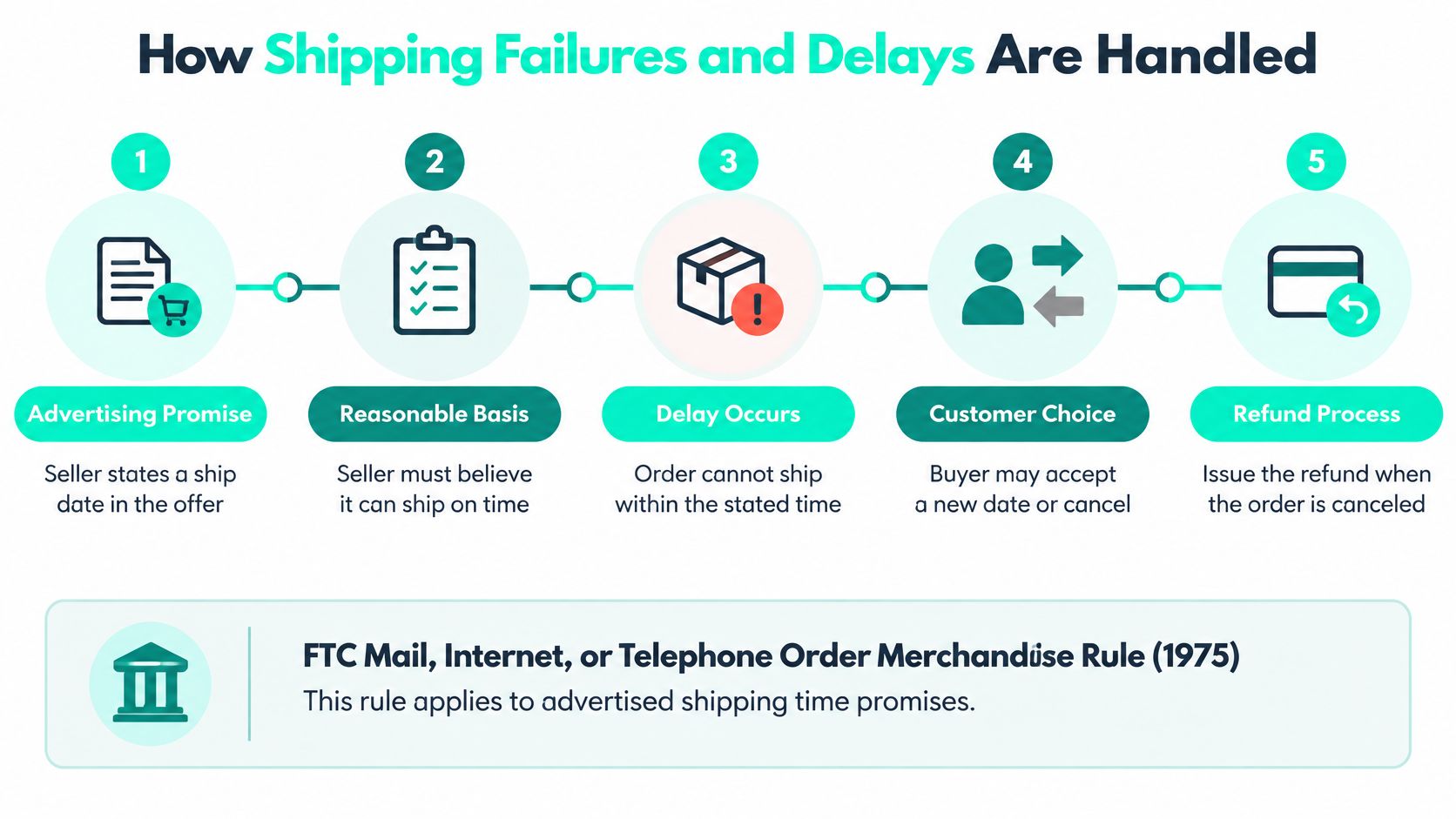
The rule produces three practical options, and the buyer picks rather than the seller.
Estimated delivery times shown at checkout are estimates only, which is why a "guaranteed" date in a confirmation email is worth asking about in writing. Carrier-caused delays sit outside the seller's control, so the useful move is to request a carrier investigation with the tracking number rather than wait for the parcel to reappear. Accurate shipping information is the customer's responsibility, and a transposed suite number that sends a box to the wrong building isn't a shipping failure the seller caused. The shipping policy sets out how dispatch and delivery estimates work before an order goes wrong, and it's worth reading once while everything is calm.
Most returns pages state a time window and a refund method, then go quiet on the questions that decide a damage claim. Does accepting the parcel void your eligibility? What proof is required? Does the seller replace the material or refund it? Those three answers determine whether a compromised shipment costs you a week or a quarter.
The decision path is short, and order matters. Inspect the parcel at the dock before anyone opens it, photograph the exterior, the label and the seal, then photograph the contents once opened. Report the damage immediately, which is exactly what the terms ask of you: if an order is lost or damaged in shipping, contact Celonyx Labs right away so the team can work with the carrier to investigate and resolve it. Keep the box, the cold packs and the labels until the case closes, and don't use material you doubt. A vial that arrived warm or with a broken seal belongs in quarantine, not in a reconstitution buffer.
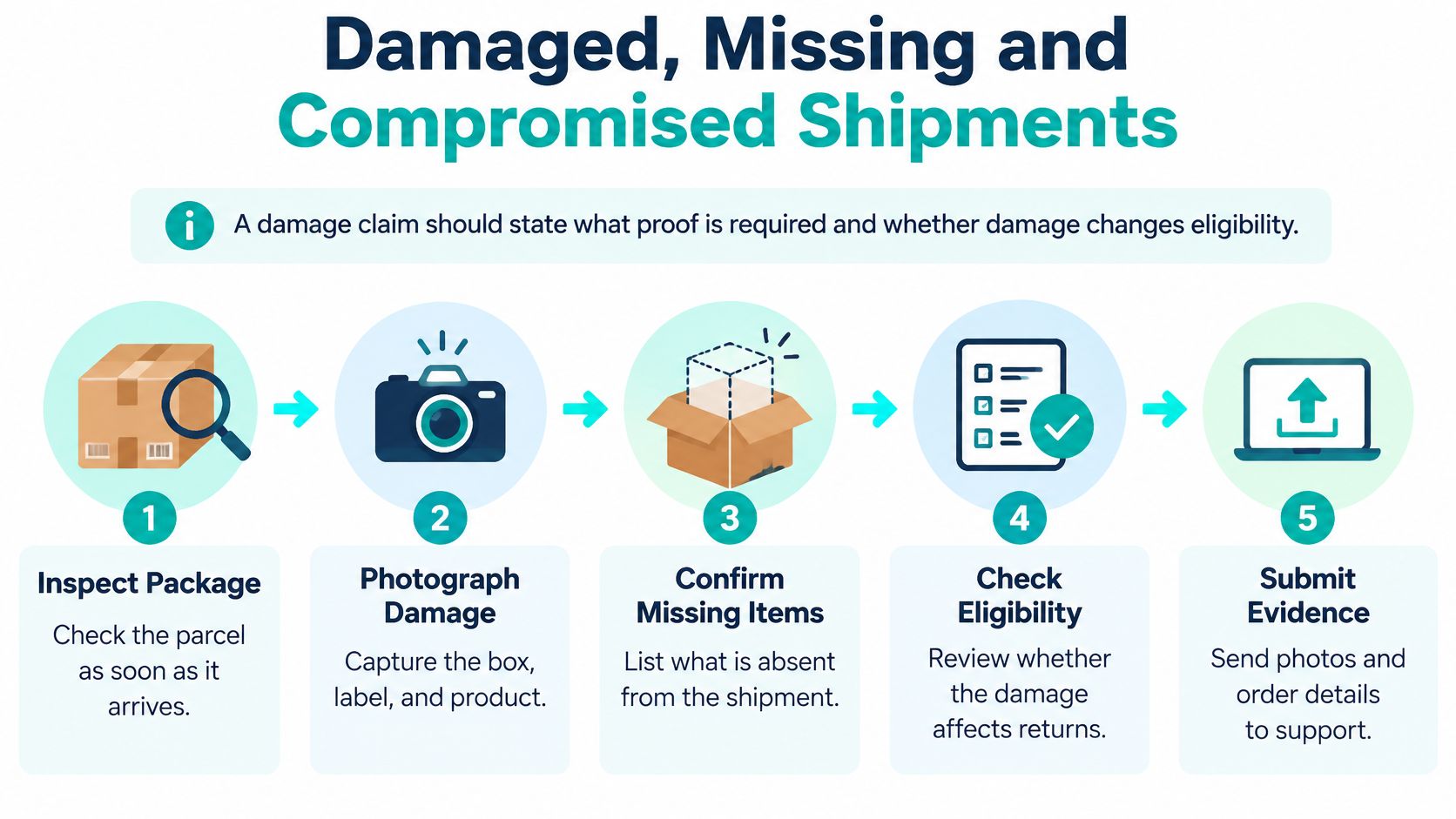
The outcome depends on which thing failed. If the product failed, a replacement restores the experiment. If the delivery failed but the material is intact and its integrity can be verified from the label and the batch documentation, a refund may be the cleaner resolution. Say which you need when you report the problem, and expect inspection to confirm it.
A carrier scan is evidence, not proof of receipt. The investigation starts with the delivery record: signature, photo, GPS pin, and the time stamp against your dock log. Ask your receiving team for the same day's entries and any camera coverage of the delivery window.
False non-receipt claims affect about half of merchants globally, and manipulation of delivery or tracking information affects roughly 30% to 40% of merchants, according to Visa's 2025 global fraud report. Those figures describe merchants generally, not research suppliers, and they explain why evidence requests have become standard rather than suspicious.
Stricter evidence rules deter abuse and can equally burden an honest institutional buyer whose parcel genuinely never arrived. Proportional documentation, matched to the value and the risk of the shipment, serves both sides better than a blanket denial.
Keep these six items together and the claim resolves faster than any phone call can.
For a lab, a return involves two separate records: evidence that supports the product concern and proof of what happened during shipping. Keep them together so procurement can track the case against the order.
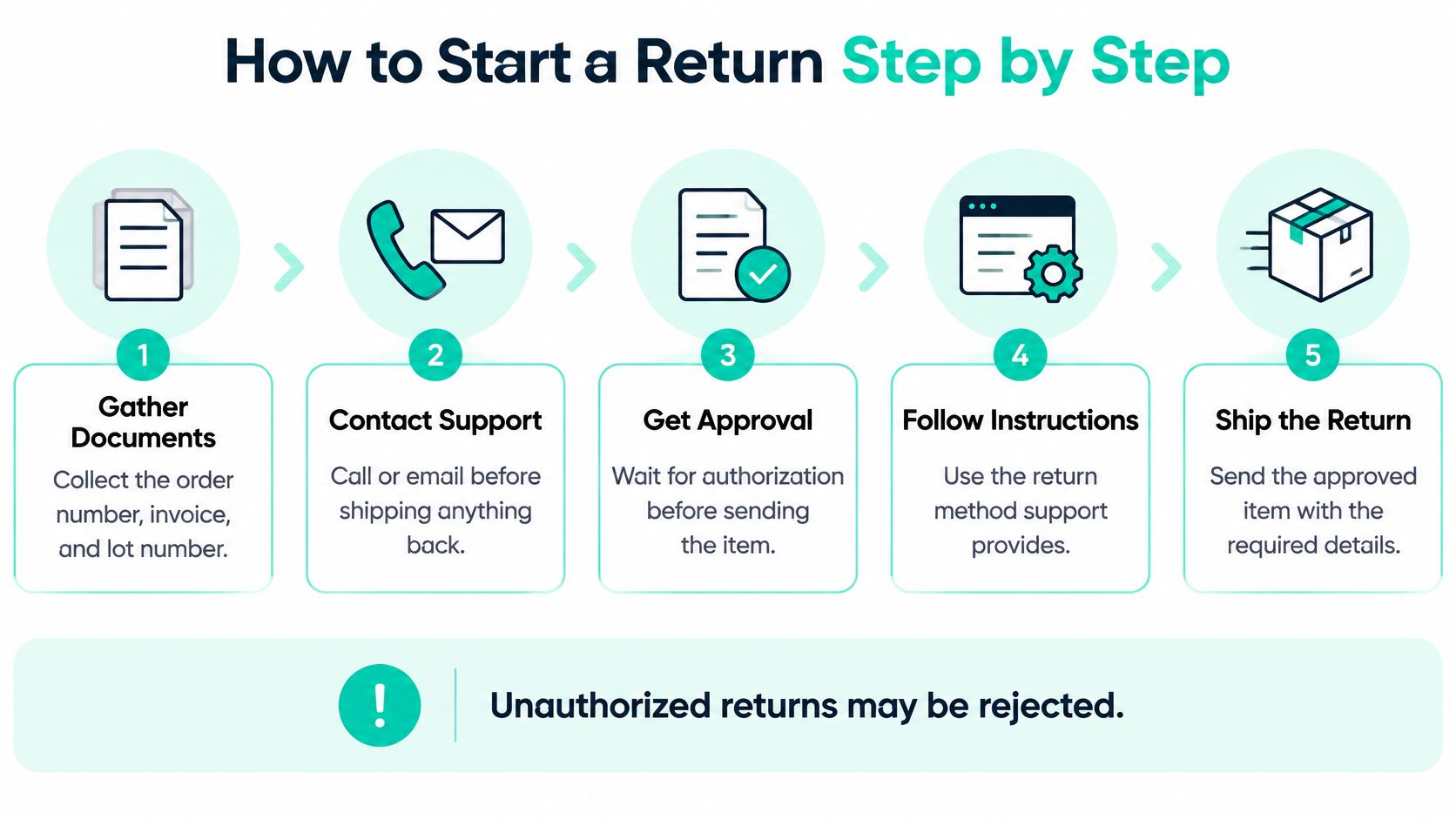
Keep the order number and invoice, lot number, photos, correspondence, tracking number and drop-off receipt together. Add the inspection decision and any refund or replacement confirmation when received. This file separates evidence about product integrity from proof of delivery and gives finance a clear record to reconcile against the purchase order.
A lab that needs a refund to reconcile against a purchase order should identify each date that affects the payment. A request date, carrier scan, delivery scan, inspection decision, and payment posting are separate milestones. The policy should specify which milestone starts each stated period.
Order processing and refund processing follow different timelines. Celonyx Labs typically processes orders within 1 business day of receiving payment. That period concerns order processing, not the time needed to assess returned material or issue a refund.
| Milestone | Trigger | Timing to confirm |
|---|---|---|
| Return requested | You contact support by phone or email | A reference number for the case, logged against the order |
| Carrier scan | You hand the parcel to a tracked service | The first scan date, which documents the return shipment |
| Arrival | Carrier delivery scan at the seller | The policy's stated transit expectation for the return leg |
| Inspection passed | Seller decision against stated criteria | The maximum review period stated in the policy |
| Refund issued | Seller initiates the refund | Whether the policy starts this period at the inspection decision |
| Creditor-issued credit | Card issuer posts the credit | The issuer's posting period after the refund instruction |
Each date answers a different question: when the case opened, when the return entered transit, when it arrived, when the seller made a decision, and when the funds became available. For a lab, that distinction affects which fiscal period receives the credit and how finance reconciles it against the purchase order.
Shipping is free on every order, so there is no delivery charge to subtract from a refund. For a partial refund, confirm whether it covers only the affected units or the entire line.
While a case is open, ask what remedy is being considered. A replacement may keep an experiment running; store credit may not meet the project's needs. Confirm the proposed outcome and any decision date in writing.
Start with the date the funds need to be available for the next purchase order. Then account for the inspection period and the card issuer's posting period. If the policy does not state a maximum review period, ask support to confirm one in writing before relying on a refund for a project deadline. A replacement may suit the schedule better, while documented inspection helps clarify how a quality claim was assessed.
A blanket "no returns" line doesn't survive contact with multiple jurisdictions, and it doesn't need to. The workable approach separates buyers by type and by law, then states the exclusions precisely enough that nobody discovers them at checkout.
For consumers in the European Union, the statutory distance-selling withdrawal right generally allows cancellation of a goods purchase within 14 days after delivery without giving a reason, subject to specified legal exemptions, as Your Europe's summary of shopping and consumer rights explains. When withdrawal applies, the seller generally refunds the purchase price and the original standard delivery charge, may withhold the refund until the goods come back or the customer supplies evidence of return, and normally uses the original payment method.
In the United States, no federal rule creates a change-of-mind return right, so the written policy sets the terms. That's the gap a commercial policy has to fill for domestic buyers, and the reason the policy has to be visible before checkout rather than buried in a footer.
| Buyer type | Withdrawal or return right | Refund scope | Return postage |
|---|---|---|---|
| U.S. commercial buyer | No federal change-of-mind right; the written policy sets the terms | Per the published policy, usually the purchase price of the affected items | Customer, unless the published policy says otherwise |
| EU consumer, distance sale | Cancel within 14 days after delivery, no reason needed | Purchase price and original standard delivery charge | Customer, unless the seller agrees to pay |
| Institutional buyer under a signed agreement | Set by the agreement | Per the agreement, including any handling terms | Per the agreement |
| Opened or custom-prepared material, any buyer | Excluded only if the exclusion is stated before checkout | None unless nonconformance is proven | Not applicable |
Exclusions are legitimate and have limits. Opened, contaminated, custom-prepared or legally restricted material can be excluded, provided the exclusion is stated clearly before the sale. A commercial policy can't override mandatory statutory withdrawal, conformity or refund rights, so any clause that tries to do so invites a dispute it will lose. Celonyx Labs may also cancel an order that violates legal or regulatory shipping restrictions, which is a different mechanism from a return and applies before dispatch.
Customs duties, taxes and fees imposed by the destination country are the responsibility of the recipient, so an international refund that includes the product price will not cover charges from a border agency. Budget for those separately.
Read your own purchase agreement before you rely on the standard website policy. Many institutions negotiate delivery, acceptance and remedy terms that supersede the published version, and a buyer who invokes the website policy instead of the contract wastes a week on the wrong argument. Send support the agreement reference with the order number and ask which terms control.
An order file that closes cleanly has five entries following the shipment from promise to payment. The promised ship date from the offer. The delay notice, if one arrived. Your written consent to a revised date, or your cancellation. The refund or replacement amount. And the date the refund was initiated. With those five, a credit memo reconciles to a PO line without a phone call.
Tie every vial to its lot number and the batch certificate of analysis at the moment of receipt, not later. A quality claim that cites the certificate matches the document everyone agreed on; a claim that cites a chain of emails from three weeks afterward invites a review that takes longer and settles less.
Revised website terms apply from the date they're published, so the version you read at checkout is the version that governs your order. Save it and attach it to the order file.
Reconcile before project close. A partial refund, a shipping adjustment, or a replacement that changes the invoiced amount has to land on the right line before the books close, and the credit memo is the document that proves it. Ask for written confirmation of any non-standard arrangement, such as a negotiated return window or a replacement in place of a refund, and attach that confirmation to the purchase order so it survives staff turnover.
If procurement has to justify the purchase to a grant officer, the paperwork that supports it is easier to assemble before the order than after the material ships. The guide to procurement documents shows how the policy pages fit into that file. Questions about a specific case go to 570-761-6154 or the Contact Us form, and information submitted through that form is kept confidential.
Celonyx Labs supplies research peptides to laboratories and preclinical teams, with a published Refund and Return Policy, Shipping Policy, and Terms and Conditions you can attach to an order file before anything ships. If your lab needs terms it can reconcile against a purchase order, a lot number, and a grant budget line, review the catalog and the policy pages at Celonyx Labs and send any case-specific question to support with your order number in hand.
The advice you'll hear most often about buying BPC-157 for the bench is short: demand

Can cagrilintide be combined with GLP-1 peptides? Yes, in controlled research. Understand mechanisms, study controls,

Can Selank be combined with nootropic peptides? Yes, in controlled laboratory studies. Learn the controls,
FOR RESEARCH USE ONLY. Products sold by Celonyx Labs are intended exclusively for laboratory and scientific research. They are not intended for human or veterinary use, consumption, diagnosis, treatment, cure, or prevention of any disease. By purchasing from this site, you acknowledge that you understand the intended research purpose of these materials and agree to comply with all applicable laws and regulations.