

1500 Mg Glutathione: What That Strength Really Means
You're comparing two bottles on a supplement shelf. One says 500 mg glutathione. The other
Have you ever seen “acetic acid peptides” in a catalog or method and wondered whether it describes a chemically acetylated peptide, a peptide dissolved in acetic acid, or an acetate salt? Those are related ideas, but they aren't interchangeable. Confusing them can lead to the wrong reconstitution solvent, an unsuitable assay buffer, or an incorrect interpretation of a mass spectrum.
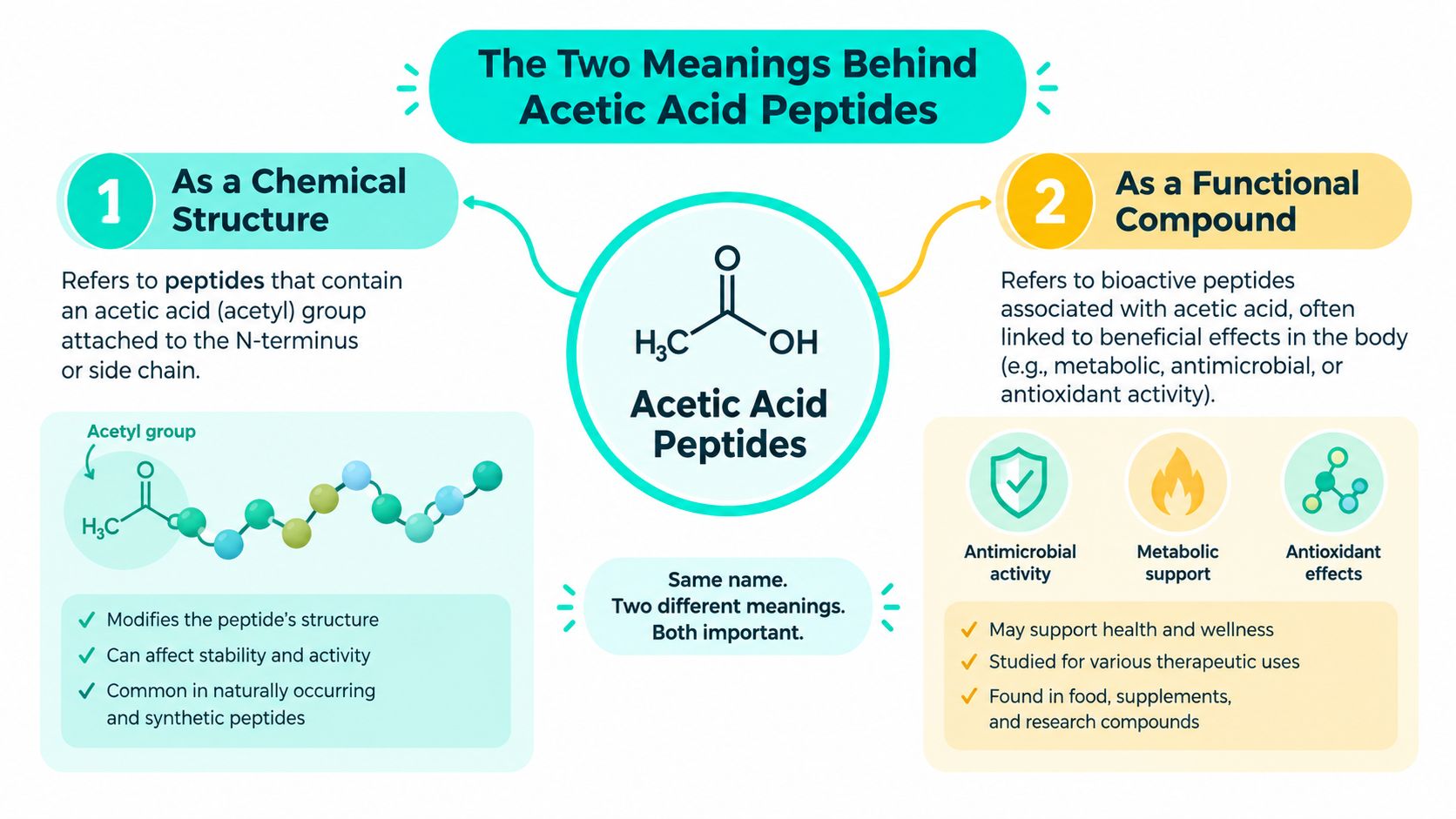
The practical distinction is simple. Acetylation changes the peptide molecule itself, while acetic acid changes the chemical environment around the peptide. Acetic acid can also remain associated with a positively charged peptide as a counter-ion, which creates a third point of confusion when reviewing product descriptions and certificates of analysis.
The sections below separate those meanings, explain how acetylation affects identity and behavior, examine acetic acid in LC-MS, and build a sequence-aware approach to reconstitution. They then connect purification, QC, storage, and bench documentation into one workflow.
The phrase acetic acid peptides creates confusion because it can describe several different laboratory situations. A supplier may use it to indicate an acetate salt form, a researcher may use it to describe a peptide reconstituted in dilute acetic acid, and a proteomics method may mention acetic acid only as an LC-MS additive. The peptide may be chemically acetylated in one case, chemically unchanged in another, or associated with acetate as a counter-ion in a third.
Start by asking one question: what changed, the peptide or the solution?
An acetylated peptide contains a covalently attached acetyl group. That modification is part of the molecule's identity and should appear in the expected mass and QC documentation. A peptide dissolved in acetic acid hasn't necessarily been acetylated. The acid may just protonate basic residues and improve dissolution. An acetate form can sit between those descriptions because acetic acid may associate ionically with a positively charged peptide without becoming a covalent modification.
These meanings produce different decisions:
The ambiguity becomes especially troublesome when a lab member treats “acetate” as a synonym for “acetylated.” It isn't. Acetate usually refers to the associated acetic acid component or counter-ion, whereas acetylated describes a covalent chemical change.
A reliable workflow therefore separates chemical structure, formulation history, and analytical method conditions. That distinction leads from terminology to molecular chemistry, then to LC-MS behavior, sequence-dependent reconstitution, purification, QC acceptance, and storage.
N-terminal acetylation and acetic acid handling differ in the way that matters most at the bench: one creates a covalent bond, while the other describes a formulation or analytical condition.
Acetylation transfers an acetyl group to an amine. In peptide chemistry, the usual site is the alpha-amino group at the N-terminus, although side-chain amines can also be modified. Capping the N-terminus removes its free amino group, changes the peptide's charge behavior, and creates a defined synthetic or post-translational modification. That change belongs to the molecular structure and remains part of the peptide after solvent exchange.
Acetic acid belongs to the surrounding chemical environment. It is a volatile, weak acid used for aqueous reconstitution, peptide processing, and chromatographic mobile phases. In solution, it can protonate basic residues such as lysine, arginine, and histidine, which may improve dissolution for some sequences. Its volatility also suits LC-MS workflows, where solvent components must leave the droplets during electrospray.
As described in Section 1, acetate can accompany a positively charged peptide as an ionic counter-ion, affecting the material balance recorded for the sample without changing the peptide's covalent sequence.
That distinction determines the evidence a lab should request:
Practical rule: Never infer acetylation from acetic acid in a vial or method. Confirm the modification through the stated structure and measured mass.
The two meanings therefore require two lines of interpretation. Structural data identifies what the peptide is, while formulation records and method conditions explain how that material behaves during reconstitution, chromatography, and detection. This dual view prevents a solvent choice from being mistaken for a chemical modification.
What changes when a peptide's free N-terminus receives an acetyl group? The answer reaches beyond a small mass shift. Acetylation changes the terminus's charge, its chemical reactivity, and the way the molecule behaves in assays.
N-terminal acetylation replaces a hydrogen on the free amino group with an acetyl group. This adds 42.011 Da to the peptide's mass, a modification mass used in peptide and proteomics calculations. In a properly calibrated mass spectrum, that difference separates an acetylated species from its unmodified counterpart. Treat the mass shift like a new label on the same molecular package. The sequence remains related, but its analytical identity has changed.
The free N-terminal amine can contribute a positive charge when protonated. Acetylation removes that terminal contribution, which may alter charge-state distributions, electrophoretic mobility, predicted isoelectric point, protease susceptibility, and binding to antibodies or other partners. It also blocks reactions that require a free terminal amine, including Edman degradation and some colorimetric assays. These effects are separate from acetate carried as a counter-ion or acetic acid used during handling.
During solid-phase peptide synthesis, the terminal amine may be acetylated after the sequence is assembled. A route can use acetic anhydride as a capping reagent or an appropriately protected, pre-acetylated building block. The exact process depends on the sequence and manufacturing strategy. QC must still answer two questions: did the intended modification occur, and is unmodified material absent or controlled?
Check the theoretical masses rather than trusting the product name. For a hypothetical free peptide with a monoisotopic mass of 1,000.000 Da, the N-acetylated form would have a calculated mass of 1,042.011 Da:
1,000.000 Da + 42.011 Da = 1,042.011 Da
For a real sample, compare the observed mass with the theoretical value for the actual sequence and modification state.
| Property | Free N-terminus | N-acetylated |
|---|---|---|
| Terminal group | Free amino group | Acetyl-capped amino group |
| Mass | Reference sequence mass | +42.011 Da |
| Charge contribution | Can contribute a positive charge | Positive terminal contribution is removed |
| Edman degradation | Compatible with a free N-terminus | Blocked |
| Exopeptidase behavior | More exposed to aminopeptidases | Often less accessible to aminopeptidases |
| QC interpretation | Compare with the unmodified theoretical mass | Compare with the acetylated theoretical mass |
Acetylation can change epitope recognition and the way an aminopeptidase approaches the terminus. Neither effect is automatically beneficial. The desired outcome depends on whether the experiment requires a blocked terminus, a natural protein-like modification, or a particular stability profile.
In peptide LC-MS, acetic acid belongs to the method environment, not necessarily to the peptide structure. A volatile acid can help maintain a reproducible protonation environment and support electrospray ionization while remaining suitable for reversed-phase separations. The best concentration depends on the instrument, column, peptide mixture, and sensitivity goal.
The most important comparative evidence comes from a 2022 proteomics study. Replacing formic acid with acetic acid as the ion-pairing additive produced an overall approximately 2.2 to 2.5 times increase in mass spectrometry signal and an average approximately 0.7% decrease in reversed-phase liquid chromatography retention (Journal of Proteome Research). That result doesn't mean acetic acid is universally superior. It means the additive can materially change detector response and chromatographic behavior.
A stronger signal can help when low-abundance peptides approach the instrument's detection limit. A small retention shift can still affect peak assignment, gradient transfer, scheduled windows, and comparison with historical methods. You should therefore validate the additive with representative standards rather than swapping acids casually.
For general method development, many laboratories begin with formic acid because it provides a familiar baseline. If sensitivity is limiting, an acetic-acid comparison can be worthwhile. Confirm identity with MS2 fragmentation, especially when the additive changes precursor intensity or retention.
| Parameter | 0.1% Formic Acid | 0.1 to 1% Acetic Acid |
|---|---|---|
| Primary role | Volatile acid and ionization aid | Volatile acid and ion-pairing additive |
| Signal behavior | Establishes a common baseline | Produced approximately 2.2 to 2.5 times higher overall MS signal in the cited comparison |
| Retention behavior | Reference method | Produced approximately 0.7% lower average RP-LC retention in the cited comparison |
| Best use | Routine peptide mapping and established methods | Sensitivity-focused comparison and method optimization |
| Validation need | Confirm existing method performance | Recheck retention, peak assignment, and MS2 behavior |
A useful reference for method planning is this HPLC-MS peptide analysis guide. Treat any additive change as a method change, even when the chromatogram looks broadly familiar.
Acetic acid is a sequence-dependent reconstitution tool, not a universal solvent. Dilute solutions can help when protonated basic residues improve hydration or disrupt aggregation, but the same acidic environment may offer little advantage for an acidic sequence.
Start with the peptide's composition. Sequences rich in arginine, lysine, or histidine often respond well to acidic conditions because protonation increases their positive charge. Hydrophobic peptides may also benefit if the acidic environment reduces intermolecular association. By contrast, a peptide rich in acidic residues such as aspartate or glutamate may not dissolve better in acetic acid and could require a neutral or mildly basic strategy instead.
A cautious workflow avoids adding acid automatically:
The appropriate concentration should come from a validated protocol rather than a generic recipe. Guidance for peptide handling describes dilute acetic acid solutions around 0.6% as a common approach for difficult-to-dissolve lyophilized peptides, particularly those rich in basic residues (peptide reconstitution guidance).
Acid can solve a physical problem while creating a chemical one. Acid-labile sequences may be vulnerable to cleavage or rearrangement, and prolonged exposure can complicate stability interpretation. Methionine and tryptophan oxidation also need attention, although the actual rate depends on oxygen, light, temperature, impurities, and the sequence.
Preservative status matters too. An acetic-acid solution may be unpreserved, so repeated handling and room-temperature holding can introduce contamination risk. Compare the formulation requirements directly with the distinction described in this acetic acid versus bacteriostatic water guide.
Bench decision: Choose the solvent that satisfies solubility, pH, detector compatibility, and storage requirements together. A clear vial alone doesn't prove that the formulation suits the assay.
Acetylated peptides require QC that answers two separate questions: is the sample chemically pure, and does it contain the intended modification? Reversed-phase HPLC can show separation and relative purity, but it doesn't by itself prove that a peak is acetylated rather than a co-eluting des-acetyl species.
For that reason, pair chromatographic purity with mass spectrometry. The expected molecular mass should include the 42.011 Da acetyl increment for each intended acetyl group. The manufacturing guidance from Serox peptide synthesis FAQs describes orthogonal HPLC and MS or MALDI-TOF/LC-MS verification, with acetylation efficiency stated as exceeding 98% by analytical HPLC and pooled fractions reaching at least 98% purity by area at 214 nm.
An acetyl cap can change retention and peak shape because it removes a free terminal amine. That may reduce some secondary interactions, but peak appearance still depends on the sequence, column, gradient, solvent, and sample load. Use UV to locate and quantify chromatographic material, then use MS to verify the identity of collected fractions.
| QC Parameter | Non-Acetylated Peptide | Acetylated Peptide |
|---|---|---|
| Theoretical mass | Unmodified sequence mass | Sequence mass plus the intended acetyl increment |
| HPLC assessment | Purity and related impurities | Purity, related impurities, and possible des-acetyl material |
| Identity method | LC-MS or an equivalent validated method | LC-MS or MS/MS matched to the acetylated theoretical mass |
| Terminal chemistry | Free N-terminal amine expected | N-terminal amine should be blocked |
| Orthogonal confirmation | Used when material risk warrants it | Particularly useful when modification status affects the assay |
For reference materials and assay-critical work, orthogonal evidence can include amino acid analysis or nuclear magnetic resonance, provided the method suits the peptide. Review the peptide purity testing resources alongside the supplier's actual chromatograms, mass data, and specification language.
A certificate of analysis should also distinguish residual solvent or counter-ion content from covalent modification. If the report lists acetate, TFA, or another formulation component, don't read that entry as evidence of N-terminal acetylation.
Good handling starts before the vial is opened. Record the sequence, modification state, lot identifier, stated salt or counter-ion form, and intended solvent. That information prevents a common error, treating a formulation component as though it were part of the peptide's covalent structure.
Reconstitute only the amount needed for the immediate experiment whenever possible. Working from aliquots limits repeated exposure to air, light, moisture, and freeze-thaw cycles. It also makes an unexpected LC-MS shift easier to investigate because you can compare a fresh aliquot with the stored working solution.
Acidic reconstitution can improve dissolution, but a preservative-free formulation may still require prompt dilution, refrigerated storage, or single-use handling. The Bachem peptide handling and storage guidance emphasizes that solvent choice and storage need to match the individual peptide rather than follow a one-size-fits-all rule.
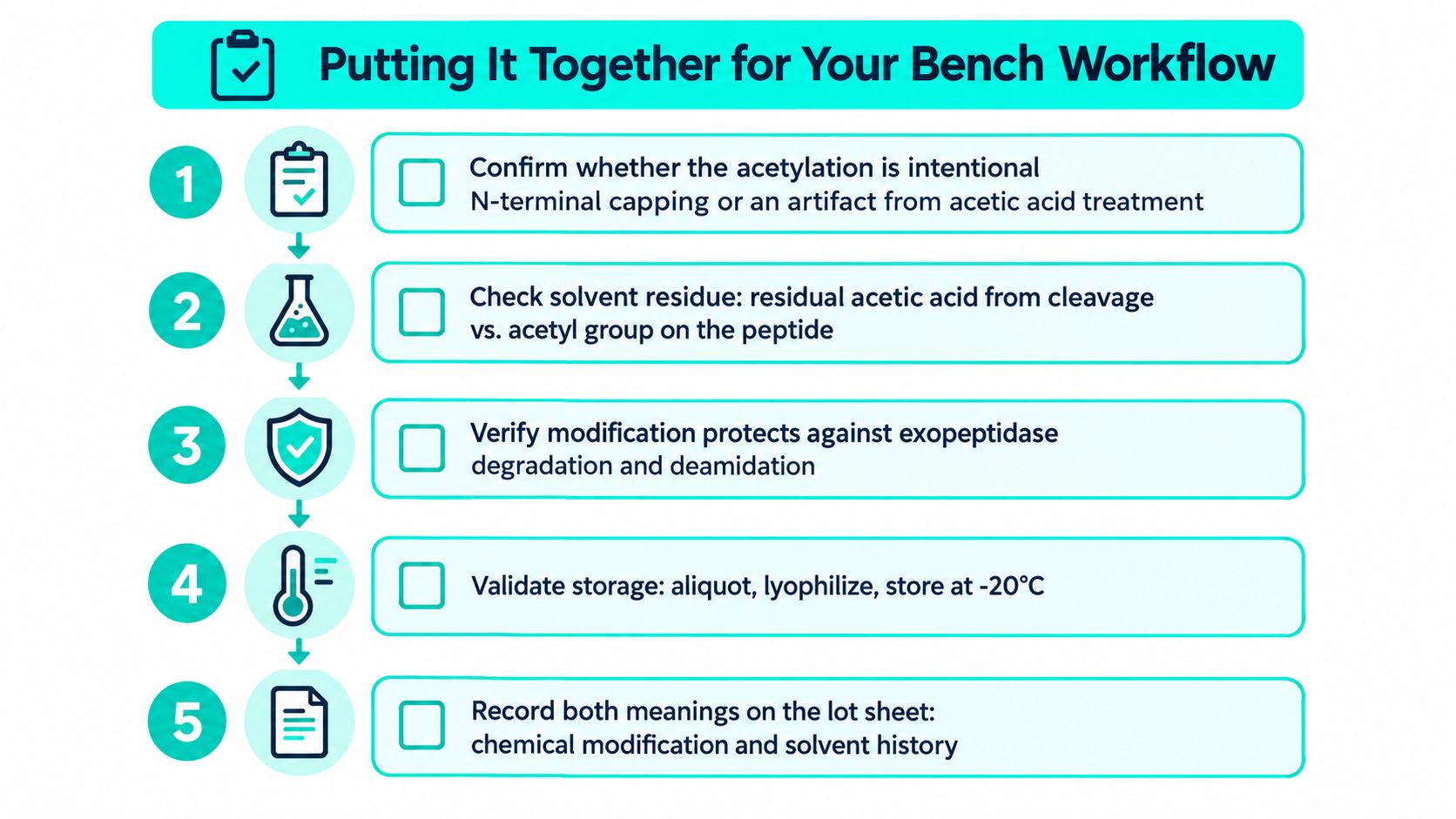
Don't discard the original solvent history when a sample is transferred into assay buffer. Residual acid, dilution order, temperature, and hold time can affect solubility and detector response. If a later chromatogram changes, those records give the reviewer a way to distinguish sample degradation from a method or formulation change.
The safest way to work with acetic acid peptides is to treat the phrase as a decision point, not a product definition. Before ordering or opening a vial, identify whether the intended material is N-acetylated, supplied as an acetate-associated form, or merely intended for reconstitution in dilute acetic acid.
Use this checklist:

The key interpretation is straightforward. Acetylation belongs to peptide identity. Acetic acid belongs to formulation and method conditions. Acetate can describe an ionic association between the two. Keeping those categories separate reduces failed reconstitutions, misleading mass assignments, and assay variability.
For research teams sourcing peptide materials, Celonyx Labs offers an online catalog of research peptides, ordering support, and product documentation that can be reviewed alongside your laboratory's solvent and QC requirements. Visit Celonyx Labs to compare available materials and contact the team about product and documentation questions.
You're comparing two bottles on a supplement shelf. One says 500 mg glutathione. The other

Is bacteriostatic water the same as sterile water? No. Compare preservatives, vial handling and peptide

How do you know if a peptide vial has gone bad? Quarantine changes, check storage
FOR RESEARCH USE ONLY. Products sold by Celonyx Labs are intended exclusively for laboratory and scientific research. They are not intended for human or veterinary use, consumption, diagnosis, treatment, cure, or prevention of any disease. By purchasing from this site, you acknowledge that you understand the intended research purpose of these materials and agree to comply with all applicable laws and regulations.