
Integrity Research BPC 157: How to Judge Vendor Claims
The advice you'll hear most often about buying BPC-157 for the bench is short: demand
Stop looking for a reputable vendor and then glancing at a certificate. That advice has failed more junior buyers than any bad synthesis. A polished storefront proves someone can sell, not that the vial in your hand is the compound on its label. When you're evaluating 5 Amino 1MQ for Sale, your job isn't shopping. It's building a file that survives a principal investigator, a sponsor, or an auditor asking you to prove identity, lot, and intended use months later.
Availability and clinical standing are separate questions, and most product pages deliberately muddy them. A vendor can ship a chemically characterized powder tomorrow. That tells you nothing about human safety, an established dose, or regulatory approval.
5-amino-1MQ is a preclinical small-molecule inhibitor of nicotinamide N-methyltransferase (NNMT), not an approved therapy. In the 2017 foundational mouse study, controls gained 0.6 ± 0.4 grams over 11 days while treated mice lost 2.0 ± 0.6 grams, with reductions also reported in white adipose tissue, adipocyte size, and plasma total cholesterol, as detailed in the selective NNMT inhibitor study in diet-induced-obese mice. Those are short-term animal results. They don't establish long-term effectiveness, toxicity, or reproducibility in humans.
If you're an academic lab manager, CRO procurement lead, or biotech operations buyer, someone will eventually ask why this material entered your facility. Your answer can't be a product page claim about metabolism. It has to show intended laboratory use, lot-level documentation, and handling under your institution's procedures.
A compound can be analytically characterized and still have no meaningful human safety profile. Don't let a chemical-quality claim do the work of clinical evidence.
That's why the useful question behind a purchase isn't where to click. It's what claims you can responsibly make after buying. Background material such as Bulk Aussie Peptides 5-Amino-1MQ research can help you frame the research context, but it doesn't replace your own vendor file. Treat every listing as research-use-only until documentation, and your institutional review, say otherwise. Then audit the seller before money moves.
Grade the storefront before you open a single certificate. If a vendor hides basic business facts, don't expect rigorous batch records later.
Use this five-minute pre-screen for every supplier on your list.
The infographic below turns those signals into a scorecard you can reuse.
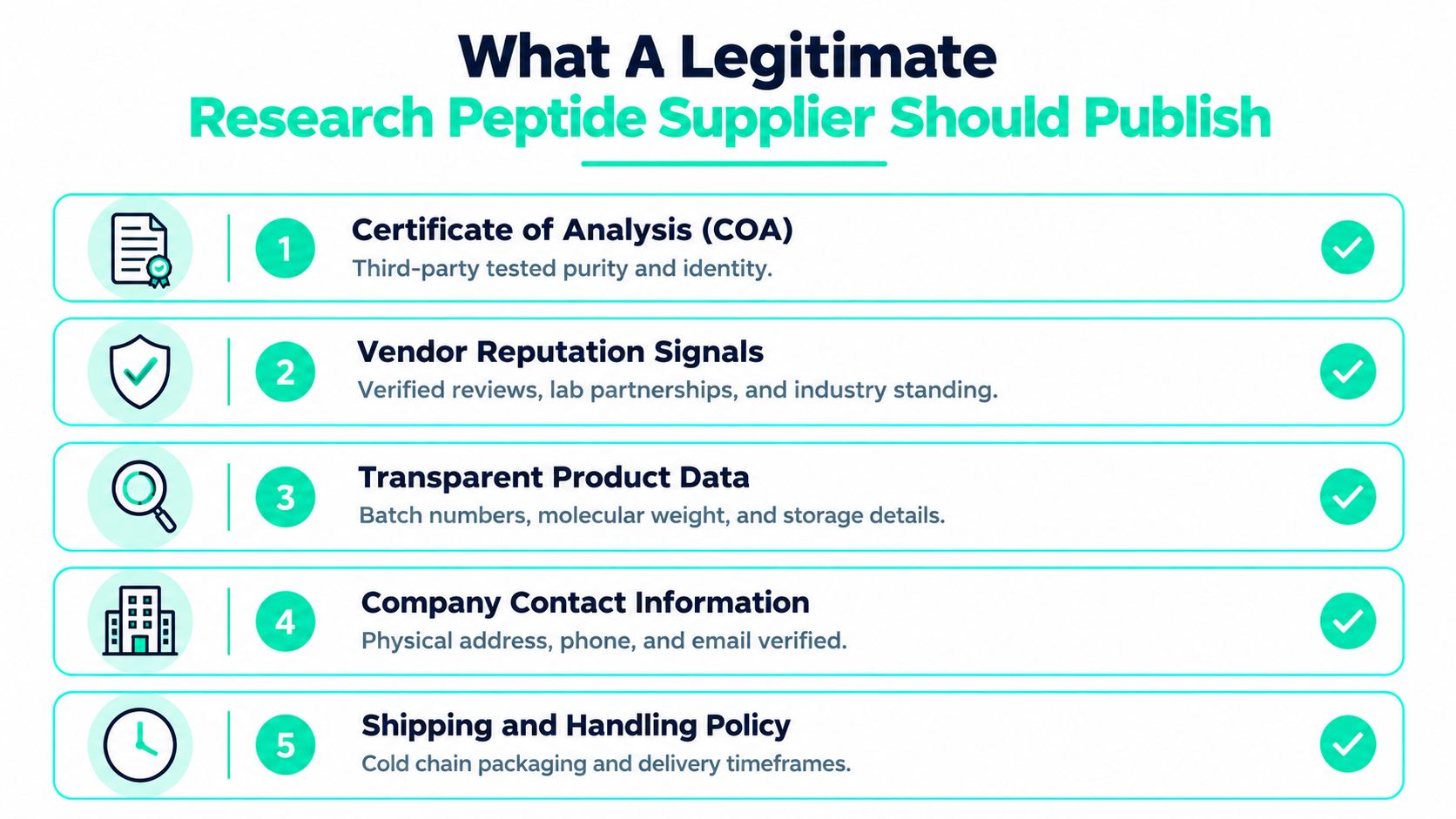
Celonyx Labs, for instance, lists 1194 Twin Stacks Drive, Unit B, Dallas, PA 18612 and phone 570-761-6154, and publishes Terms, Refund, Shipping, and Privacy policies. That doesn't qualify a lot by itself. It means the business exposes facts you can verify, which is the entry ticket for further review under a documented vendor qualification process for research suppliers.
Apply the same discipline you'd use to find laboratory furniture suppliers or any other vendor category. Verify the entity, keep screenshots or saved policy pages with dates, and record who answered your questions. If a seller only repeats a headline purity figure and won't name its testing arrangement, score it down and move on. Documentation language beats adjectives every time.
A certificate of analysis isn't a trophy. It's a claim about one lot, made by one laboratory, using stated methods on a stated date. Read it that way.
Identity comes first. A name printed on a vial proves nothing. You need an orthogonal identity method, such as LC-MS, tied to the exact lot you'll receive. Purity comes second, and it's meaningful only when the COA names a validated HPLC or UPLC method, an acceptance specification, and actual results.
| COA Field | What It Proves | Acceptance Signal | Red Flag |
|---|---|---|---|
| Lot number | Links document to vial | Same number on vial, COA, and invoice | Generic or missing lot |
| Chemical name and form | Defines material and counterion or salt form | Full name and form stated | Abbreviation only |
| LC-MS identity | Supports that material matches expected mass | Method, result, and date shown | No mass-spectrometry evidence |
| HPLC purity | Estimates chromatographic purity | Method, specification, and chromatogram | Headline percentage with no method |
| Testing laboratory | Shows who stands behind result | Named laboratory and test date | Unsigned, undated sheet |
| Storage guidance | Protects stability after receipt | Temperature and reconstitution notes | No handling instructions |
Ask one question vendors hate. Is that purity result an assay, or only an area-percent estimate from a chromatogram? Area percent can look impressive while saying little about water content, residual solvents, counterions, or biologically active impurities. It also says nothing about sterility or endotoxin status.
Auditor's rule: Two products with the same purity headline aren't equivalent if one lot has method-linked identity data and the other has a decorative PDF.
When fields are blank, don't fill them in with optimism. Email targeted questions, keep the replies in the lot file, and hold the purchase order until the answers arrive. If the vendor can't link its COA to the shipped lot, you don't have a COA. You have a sample document.
Documents are the start, not the finish. Run a layered protocol so a single weak check doesn't carry your whole study.
The process flow below shows the sequence from vendor screening through post-receipt testing.
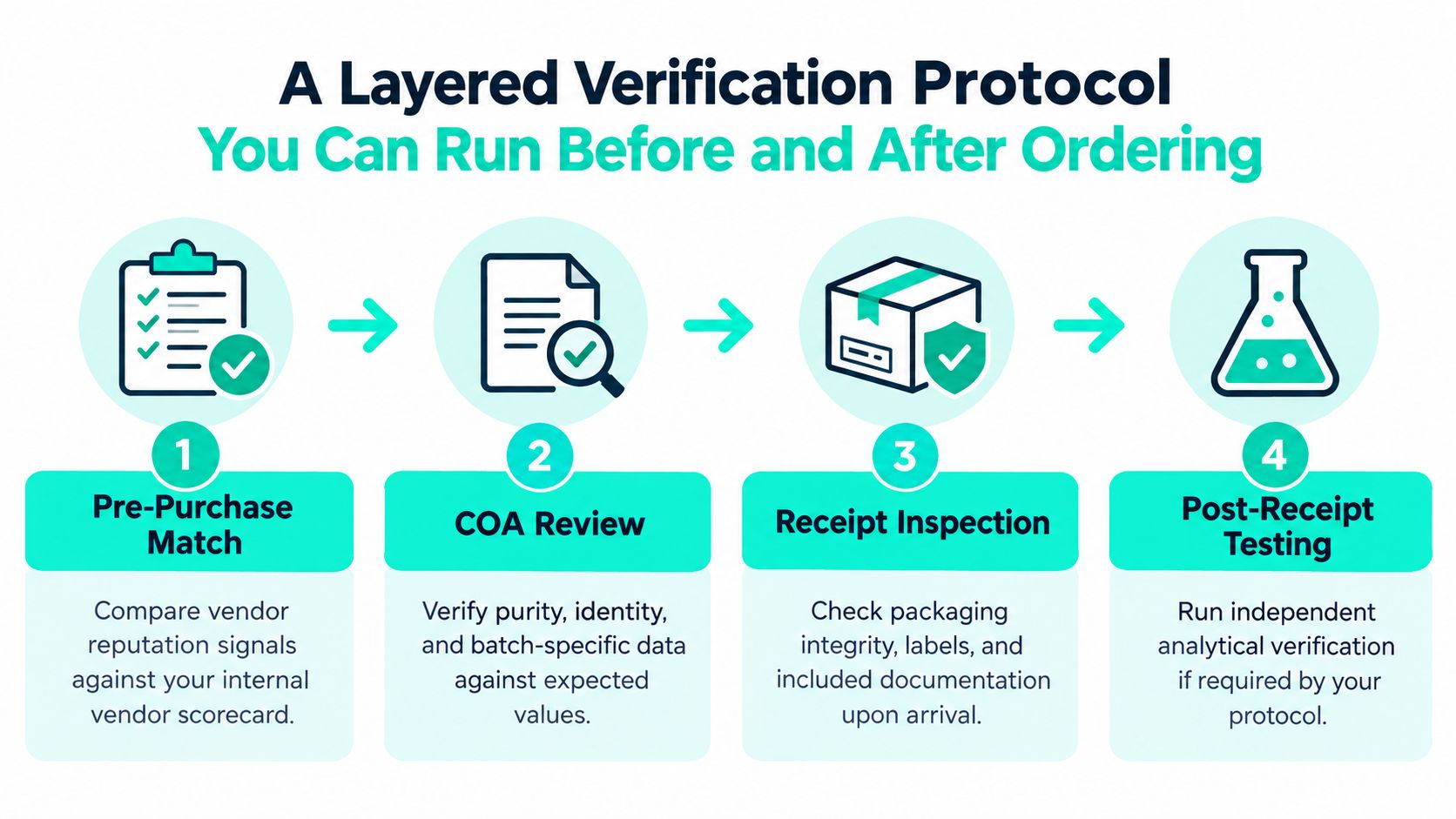
Score the vendor against your internal scorecard, then request the lot-specific COA in advance. Confirm the chemical name, molecular form, mass, storage requirements, and acceptance criteria before finance releases payment. Decide now, not after arrival, whether this lot needs independent confirmation because it will support cell work, animal work, or publication-quality data.
The historical literature explains why that discipline matters. NNMT proof of concept began with antisense knockdown work in 2014, then dedicated small-molecule research followed in 2017, yet the compound still has no FDA-approved clinical indication, as summarized in the 5-amino-1MQ historical development review. Preclinical status raises your documentation burden. It doesn't lower it.
Log the shipment condition, packaging integrity, and any temperature monitor information before opening inner packaging. Match lot number, vial label, mass, COA, and invoice character by character. Photograph discrepancies immediately instead of trying to reconstruct them later.
The short video below is useful background for staff who are new to receipt inspection discipline.
Test representative samples from each lot rather than assuming vials are interchangeable. For routine repeat orders, a documented spot-check plan may be defensible if prior lots passed. For a new vendor, a new lot, or a study you'll publish, batch-level verification is the safer default.
You have three real options, and pretending they're equal will cost you either money or credibility.
Vendor COA only is the cheapest path and the weakest. It may suit early exploratory work where results won't leave the lab notebook, but it leaves you exposed to identity mismatch and purity overcalls you never tested. You're trusting the seller's laboratory, methods, and lot linkage without a check.
In-house checks usually mean an HPLC purity scan and a quick LC-MS identity confirmation. This path catches gross identity errors and obvious purity drift, and turnaround is controlled by your own queue. Its limits are real. Many labs can't assess residual solvents, water content, counterions, microbial status, or endotoxin with the same rigor, and your analysts may be reviewing material your own team is eager to use.
Independent retesting gives you an orthogonal release from a laboratory with no sales interest in the result. It's slower and costs more, but it's the strongest choice for regulated, sponsor-funded, or publication-quality work. Use independent third-party testing labs for research compounds as a starting point for structuring that conversation, then define acceptance criteria before samples ship.
Don't pay for every possible assay. Pay for the assays that match the failure modes of your study.
My default recommendation for non-regulated academic work is hybrid. Confirm identity and chromatographic purity in-house for every new lot, retain a reference aliquot, and send out for independent testing when the material enters cell or animal studies, when results look inconsistent, or when a manuscript is planned. Document why you chose that level. A PI or finance officer can accept a reasoned risk decision. Neither should accept silence.
When data gets questioned, nobody asks to see your shopping cart. They ask for the procurement file. Build it as if that meeting is already scheduled.
A clean file for each lot should contain vendor qualification notes, the lot-matched COA, invoice, receipt log, storage records, reconstitution notes, independent verification reports, and disposition of remaining material. If a step wasn't performed, write that down too. An honest gap is easier to defend than a reconstructed record.
Label internal storage for laboratory research only, consistent with research-use-only peptide handling expectations. Don't copy consumer benefit language into protocols, requisitions, or inventory systems. Words that sound therapeutic create compliance problems even when the bench work itself is legitimate.
Published refund, shipping, and terms policies also matter operationally. They tell purchasing how damaged shipments, delays, and returns will be handled before a dispute starts. Save the version in force on the order date, because webpages change.
Teams refining broader audit habits can adapt principles from 2026 compliance audit best practices, especially around traceability and evidence quality. The principle transfers cleanly to research procurement. If an outsider can't follow the lot from vendor claim to bench use without asking you to narrate missing steps, the file isn't finished.
Copy this into your SOP or vendor-qualification memo and use it for the next evaluation of 5 Amino 1MQ for Sale. Don't rely on memory.
The summary card below condenses the full audit into three blocks.
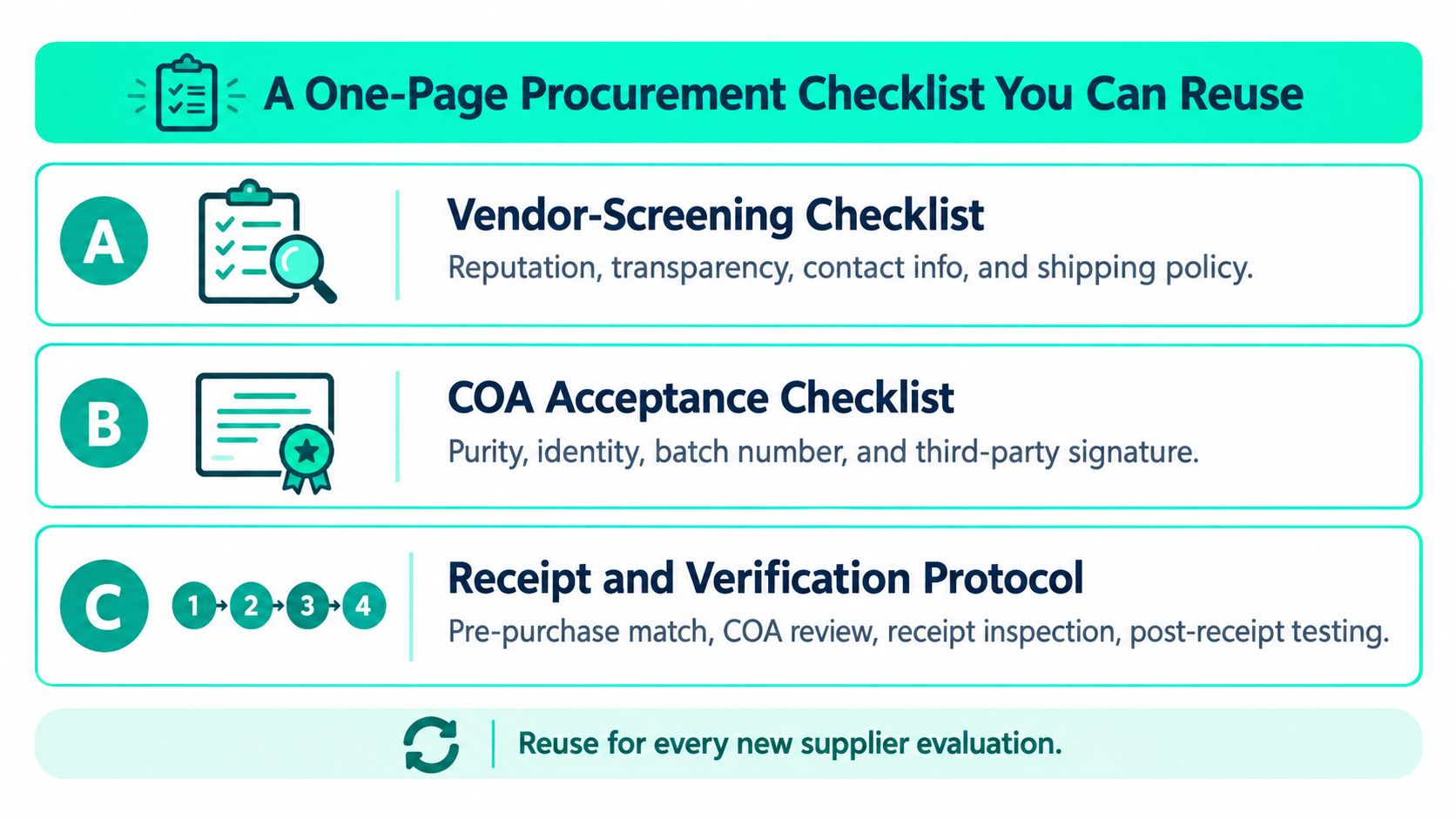
Remember the core distinction. A headline such as 99% purity is a chemical-quality claim, not proof of sterility, effectiveness, or human suitability, a point underscored in the discussion of 5-amino-1MQ FDA status. Never skip independent verification for publication-grade work, and never consume the last reference material from a lot. Buy the documentation first and the compound second. That's how a purchase stays defensible.
If you're sourcing 5-amino-1MQ for laboratory research, use the checklist above to compare lot documentation, testing disclosures, and published policies before you order. Celonyx Labs offers research compounds through an online catalog with product documentation, customer support, and stated shipping and store policies you can review during vendor qualification. Visit the catalog, request the lot-specific paperwork you need, and don't release any material into your study until your file is complete.
The advice you'll hear most often about buying BPC-157 for the bench is short: demand

Can cagrilintide be combined with GLP-1 peptides? Yes, in controlled research. Understand mechanisms, study controls,

Can Selank be combined with nootropic peptides? Yes, in controlled laboratory studies. Learn the controls,
FOR RESEARCH USE ONLY. Products sold by Celonyx Labs are intended exclusively for laboratory and scientific research. They are not intended for human or veterinary use, consumption, diagnosis, treatment, cure, or prevention of any disease. By purchasing from this site, you acknowledge that you understand the intended research purpose of these materials and agree to comply with all applicable laws and regulations.