
CJC 1295 Ipamorelin Buy Online: A 2026 Guide
“99% pure” is the most popular advice in the online peptide market, and it's one
What if the hardest part of evaluating a research peptide isn't the mechanism, but the gap between a promising cell biology story and what has been proven in people? That question matters here, because FOXO4 DRI peptide sits right at that intersection. It has a clear molecular rationale, a real preclinical paper trail, and no human clinical validation to anchor the hype.
A careful researcher starts with a simpler question than “does it work?” The first question is, what exactly is in the vial, and what has been demonstrated? For FOXO4 DRI peptide, that distinction matters at the bench because it separates the chemistry from the claims.
FOXO4-DRI is a 46-amino-acid synthetic D-retro-inverso peptide with the reported formula C228H388N86O64 and a molecular weight of about 5,358.15 g/mol. It was first described in a landmark 2017 Cell paper by Baar et al., which remains the core published in vivo foundation for the compound's research story, according to the source material on its technical profile. The same source also notes that it is not FDA-approved, has no registered human clinical trials, and is sold as research-use-only. For readers who want a broader definition of the category itself, what research peptides are helps frame how compounds like this are handled in preclinical settings. The Peptides Institute technical profile presents the same basic research-only framing.
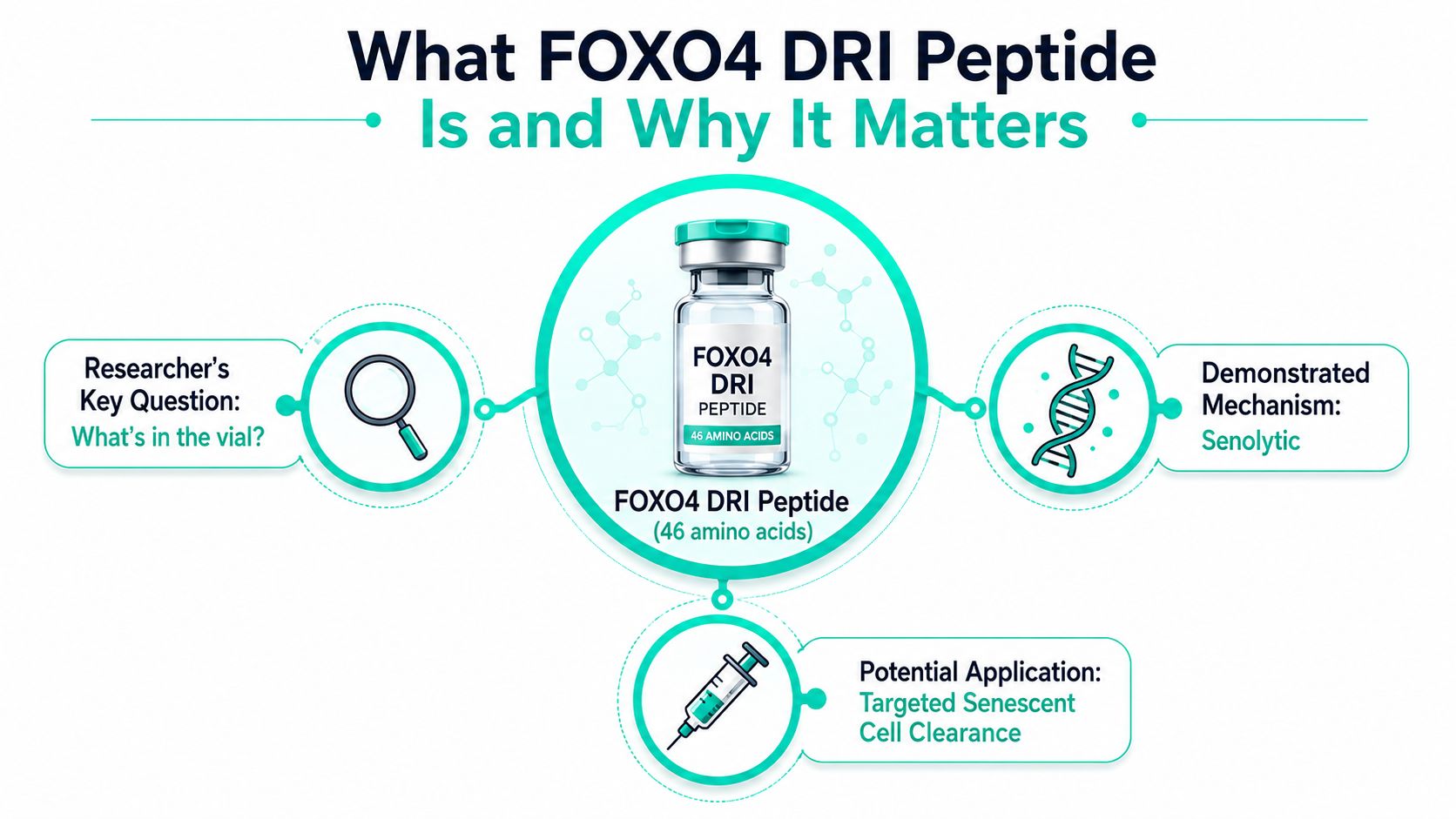
The core idea behind FOXO4 DRI peptide is mechanistic, not magical. It was designed to disrupt the FOXO4–p53 interaction in senescent cells, with the aim of selectively triggering apoptosis in those aged cells while leaving healthier cells less affected. That is why it became a notable name in longevity research. FOXO4-DRI represents a targeted senolytic strategy, built around a defined interaction instead of broad, nonselective cytotoxicity.
If you are new to research peptides, the important distinction is between a molecule used to test biology and a therapy that has already crossed into human use. FOXO4 DRI belongs in the first category. It is a preclinical tool for probing senescence biology, and the present literature still leaves a clear gap between promising mouse and cell data and proof in humans.
Practical rule: If the vial label sounds more exciting than the evidence base, slow down and read the preclinical data first.
Why does FOXO4 DRI peptide keep showing up in senescence papers even though it is still a preclinical tool? The answer sits in the design itself. D-retro-inverso sounds technical because it is, but the idea is straightforward once you break it apart. The peptide sequence is reversed, and the building blocks are D-amino acids rather than the usual L-amino acids. That preserves the side-chain arrangement that binding partners recognize, while making the backbone much less familiar to natural proteases.
A useful bench analogy is a glove turned inside out. The surface a binding partner contacts still presents the same general pattern, but the chemistry underneath is arranged differently. FOXO4 DRI peptide uses that design to keep the functional interaction profile while improving protease resistance.
In preclinical work, that choice changes how cleanly you can read the biology. Native L-peptides often disappear quickly in biological systems because proteases treat them like ordinary protein substrates. A D-retro-inverso peptide is harder to degrade, so researchers have a better chance of seeing whether the effect comes from the intended interaction rather than from rapid breakdown of the compound.
That durability also helps explain why FOXO4-DRI is described as a senolytic agent in research profiles. The format is intended to preserve interaction geometry, not to rely on broad chemical toxicity. If the peptide breaks down too quickly, the experiment stops testing the mechanism and starts testing unstable chemistry instead.
The structural details matter for another reason, quality control. The source material describes FOXO4 DRI peptide as about 46 amino acids, roughly 5.36 kDa, with the formula C228H388N86O64. Those details help separate a credible technical listing from vendor descriptions that can conflict on formula or mass when a product is described loosely instead of analytically. In the lab, that is not a cosmetic distinction. It affects how confidently you can interpret a result and whether the material you received matches the construct used in the literature.
The bigger picture is where the 2017 Baar et al. Cell paper and later mechanistic follow-ups meet. The original FOXO4-DRI work showed that a D-retro-inverso peptide could be used to probe senescent-cell biology in a targeted way. The newer literature keeps asking a narrower question, how much of the phenotype is really driven by that interaction, and how much still depends on the model system, delivery context, or readout chosen at the bench. That is the line researchers should keep in view. The design is real, the preclinical signal is real, and the leap to human relevance remains unproven.
Bench takeaway: The D-retro-inverso format is there to keep the peptide intact long enough for the biology to happen, while preserving a defined interaction surface for preclinical testing.
The mechanism begins with a senescence-specific survival loop. In senescent cells, FOXO4 helps retain p53 in the nucleus, which limits p53's ability to carry out its apoptotic program. That restraint can let a damaged cell persist even after it has crossed the point where normal growth control should have removed it.
FOXO4 DRI peptide interrupts that binding event. By disrupting the FOXO4–p53 protein-protein interaction, it frees p53 to shift toward the cytoplasmic apoptotic pathway and start cell death in cells already committed to senescence. The key idea is selectivity. Healthy cells do not seem to rely on the same FOXO4-linked p53 sequestration to the same degree, so the peptide is described as mechanism-dependent rather than broadly cytotoxic.
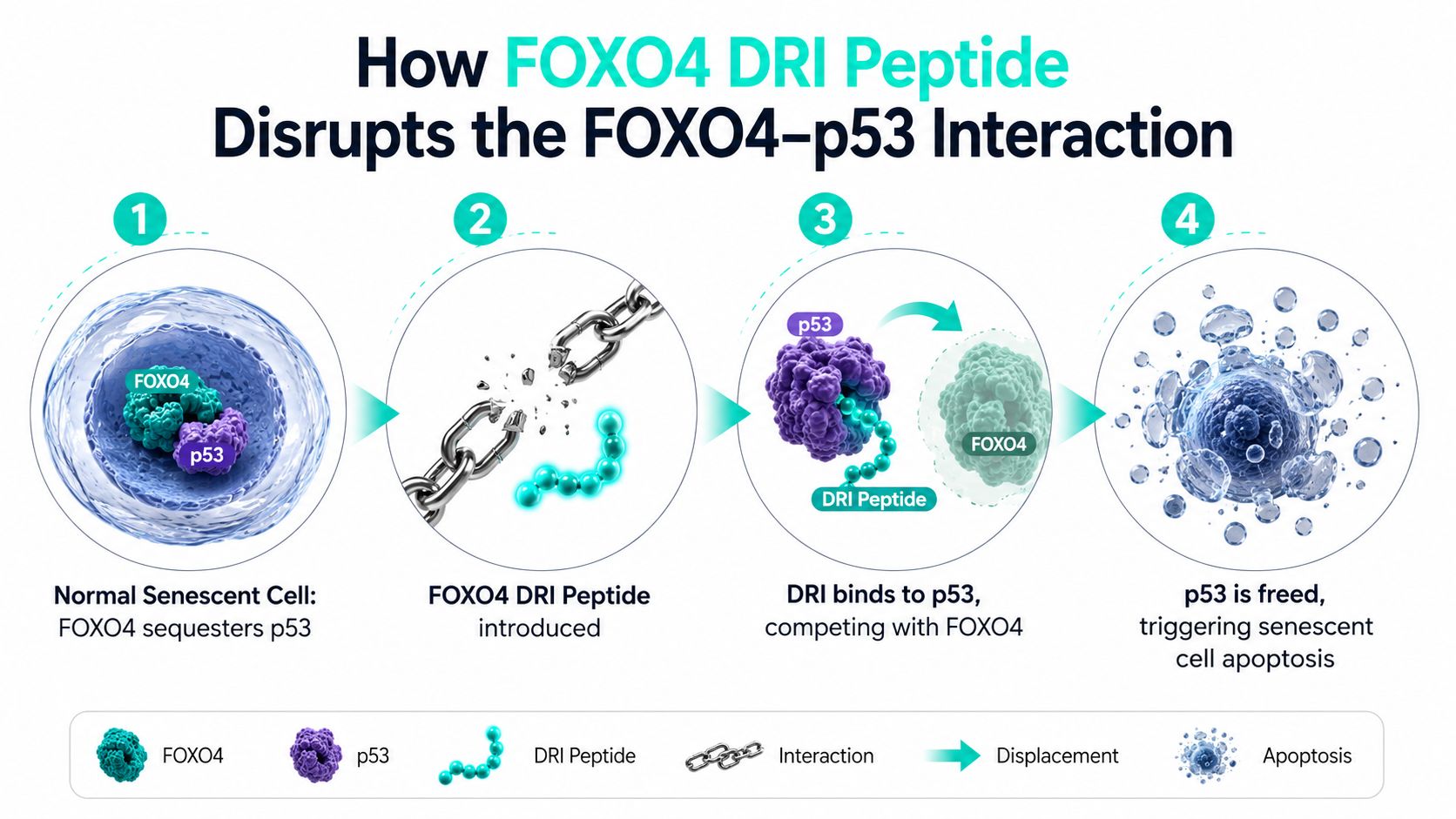
At the bench, the logic is straightforward. A senescent fibroblast has already assembled survival signaling that keeps it alive despite accumulated damage. FOXO4 helps maintain that state by holding p53 in check. When FOXO4 DRI peptide is introduced, that restraint weakens, p53 is no longer locked in the same inhibitory configuration, and the senescent cell becomes more likely to enter apoptosis.
That selective behavior is why the compound drew attention in the first place. Rather than acting as a general cell killer, FOXO4 DRI targets a specific senescence vulnerability through mechanism-dependent apoptosis. The distinction matters, because many compounds can kill cells in a dish, while far fewer appear tied to a defined biological state in a way that can be tested against senescence biology.
The literature starts with the 2017 Baar et al. Cell paper, and that paper still does the heavy lifting in the FOXO4-DRI story. The source material describes it as the foundational in vivo proof-of-concept, and that's the right framing. It gave the field a reason to treat the peptide as more than a theoretical binder.
The original work reported effects in aged mice that included accelerated hair regrowth, reduced liver senescence, and restored physical performance, according to the plan notes tied to the paper's historical role. Those outcomes mattered because they suggested that selective senescent cell clearance could produce visible organism-level change, not just a shift in one pathway marker.
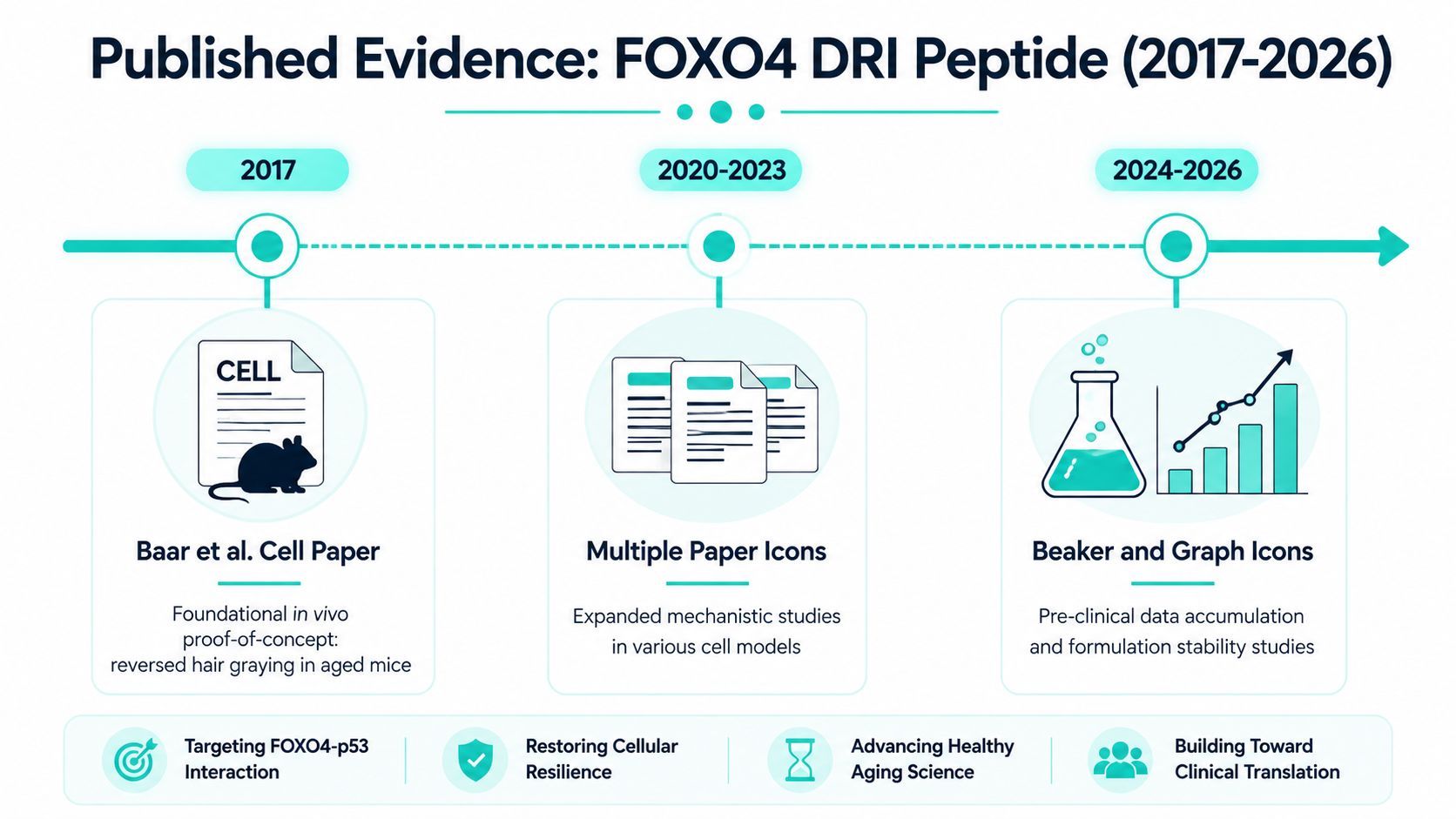
The newer literature doesn't overturn the 2017 work, it adds mechanistic depth. The source set points to 2025–2026 follow-up studies in endothelial senescence and keloid fibroblast models, and to additional animal and cellular evidence that keeps expanding the map of where FOXO4-DRI may be biologically active (PMC review and summary). Those models help researchers ask sharper questions about vascular aging, tissue fibrosis, and the signaling branches downstream of p53.
What they do not do is close the human gap. The same source material states there are no published human clinical trials and no established FDA-approved dosing pathway. That's the negative space that matters most if you're reading the literature. A peptide can be interesting, mechanistically coherent, and repeatedly active in preclinical systems without being validated for people.
So the timeline is straightforward. A strong 2017 in vivo proof-of-concept opened the door. Later work reinforced the mechanism in additional cell and animal contexts. But the bench story remains a bench story, because clinical translation has not been demonstrated in the public record provided here.
Reading rule: Treat later mechanistic papers as evidence that the hypothesis is being refined, not as proof that the compound works in humans.
FOXO4 DRI peptide is easiest to understand when it sits next to other senolytics, not when it's discussed in isolation. The main differentiator is the p53-sequestration axis. That makes it structurally and mechanistically different from compounds that work through BCL-family pathways or broader stress-response effects.
| Senolytic | Primary Mechanism | Representative Preclinical Use |
|---|---|---|
| FOXO4 DRI peptide | Disrupts FOXO4–p53 interaction, promotes senescent cell apoptosis | Senescence biology, aged mouse studies, endothelial and fibroblast models |
| Dasatinib plus quercetin | Targets BCL-2 and tyrosine kinase-related pathways | Mixed senescence models and combination senolytic studies |
| Navitoclax, ABT-263 | Direct BCL-2/BCL-xL inhibition | Senescent cell clearance in preclinical models |
| Fisetin | Broader senolytic and anti-inflammatory activity | Aging-related preclinical work and comparative senolytic studies |
The value of this comparison is practical. If a lab wants to study senescent cell survival through p53 retention, FOXO4 DRI is conceptually neat. If the question is broader apoptotic priming through BCL-family control, navitoclax is a different tool. Dasatinib plus quercetin works as a combination, not as a single-peptide mimic, and fisetin is often discussed more as a broad aging-related candidate than as a single-axis probe.
What you can't do is claim one is better across the board. There are no head-to-head human trials here, and the comparison space is still mostly preclinical. So the best choice depends on the question, not the marketing. If the aim is to probe the FOXO4–p53 dependency of senescent cell survival, FOXO4 DRI has a clearer mechanistic lane than the others.
The material around FOXO4 DRI peptide is usually presented as a 10 mg lyophilized vial with ≥99% HPLC-verified purity and third-party COA claims. That's not a trivial detail. Purity and handling determine whether you're studying the peptide or studying what degradation and aggregation do to your assay.
Long-term storage is generally recommended at −20°C, and reconstituted material is typically kept at 2–8°C and used within about 14 days (technical handling specs). Those numbers matter because peptides don't stay chemically still once they're out of the freezer. Cold-chain discipline reduces degradation, and that reduces one of the biggest sources of noise in dose-response work.
For researchers who need a practical reconstitution reference, this guide on peptide reconstitution is a useful companion. The key is to keep the solution handling boring and consistent. That's not glamorous, but it's how you avoid confounding a senescence assay with peptide instability.
Lab rule: If two plates disagree and the peptide was thawed three times, the thawing is part of the problem.
A strong mechanism doesn't excuse weak sourcing. With FOXO4 DRI peptide, the quality question isn't about price or packaging, it's about whether the material you bought matches the material you think you bought. That starts with batch-specific COAs, not a generic purity line on a product page.
A useful COA should tie the exact lot number on the vial to the analytical method, test date, and identity confirmation, usually through HPLC or LC-MS. If those elements don't line up, you can't cleanly connect a phenotype to the reagent. High purity matters because impurities can skew aggregation, stress responses, and apparent dose behavior, especially in cell-based senescence work.
The other mistake is assuming that a promising senolytic mechanism means clinical value. It doesn't. The source material is explicit that FOXO4-DRI is not FDA-approved and has no registered human clinical trials. That's why sourcing should be framed as a reproducibility decision, not a purchasing decision.
For an example of how vendors present these quality claims, some labs review public testing and policy documentation such as third-party tested peptides. The point isn't to treat any one vendor page as proof of efficacy. The point is to ask whether the supplier gives you enough traceability to trust the reagent in your own hands.
What can you conclude from the current FOXO4 DRI peptide literature, and what is still outside the evidence base?
FOXO4 DRI peptide is a research-use-only reagent. The current literature does not support a clinical dosing recommendation for people, and it remains not FDA-approved with no registered human clinical trials. Treat it as a laboratory tool for controlled experiments, and keep its use within institutional rules and local biosafety and procurement requirements.
What purity should I look for?
Look for ≥99% HPLC-verified purity and a lot-specific COA that matches the vial in hand. If the document does not tie the exact lot to the analytical result, the reagent is harder to interpret in a senescence assay.
What dose is used in preclinical work?
Published handling summaries describe investigational injection studies in preclinical models, but they do not create a standardized human dose. The main point for a new lab member is that the experimental literature informs bench use, while the human dosing question remains unanswered.
Is FOXO4 DRI peptide FDA-approved?
No. The source material states that it is not FDA-approved.
What should I verify before ordering?
Check the lot number, analytical method, identity confirmation, storage guidance, and whether third-party testing is documented. Those details help you decide whether the material is traceable enough for reproducible work, which matters more than any marketing claim about activity.
If you are comparing suppliers, look for clear documentation rather than a broad promise about quality. Public testing summaries and policy pages can help you judge whether a vendor treats sourcing as part of the experiment, but they do not replace your own verification of the specific vial you receive.
“99% pure” is the most popular advice in the online peptide market, and it's one

You're comparing two bottles on a supplement shelf. One says 500 mg glutathione. The other

Is bacteriostatic water the same as sterile water? No. Compare preservatives, vial handling and peptide
FOR RESEARCH USE ONLY. Products sold by Celonyx Labs are intended exclusively for laboratory and scientific research. They are not intended for human or veterinary use, consumption, diagnosis, treatment, cure, or prevention of any disease. By purchasing from this site, you acknowledge that you understand the intended research purpose of these materials and agree to comply with all applicable laws and regulations.