
1500 Mg Glutathione: What That Strength Really Means
You're comparing two bottles on a supplement shelf. One says 500 mg glutathione. The other
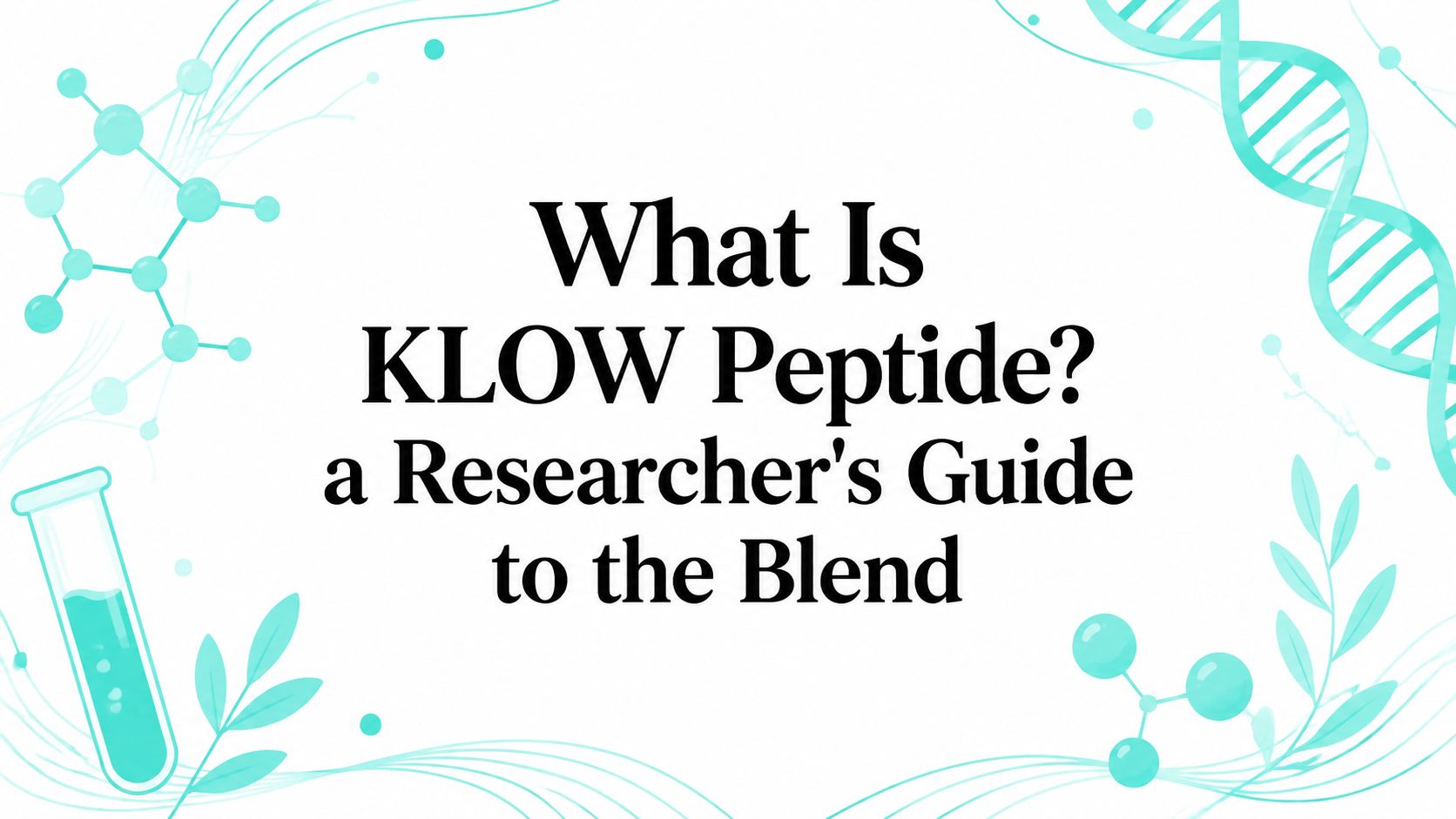
KLOW peptide is a research-only four-peptide co-formulation, not a single molecule, and the typical lyophilized vial is 80 mg total with GHK-Cu 50 mg, BPC-157 10 mg, TB-500 10 mg, and KPV 10 mg. If you've been asking what is KLOW peptide, the first mistake is to treat the name like it points to one active ingredient, because the formulation ratio is the primary object of study.
That distinction matters more than it sounds like it should. In peptide work, the label on the vial can tell you whether you're looking at a defined research blend, a brand name, or a completely different compound set, and those differences change how you interpret everything that follows.
KLOW peptide is a four-peptide research blend, and the most useful way to think about it is as a formulation class, not a single chemical entity. In the version described in independent research summaries, the vial is typically 80 mg lyophilized total, split as GHK-Cu 50 mg, BPC-157 10 mg, TB-500 10 mg, and KPV 10 mg. That fixed split matters because the blend's behavior is driven by the relative dose ratio of each component, not by one dominant active molecule. KLOW telehealth summary KLOW formulation overview
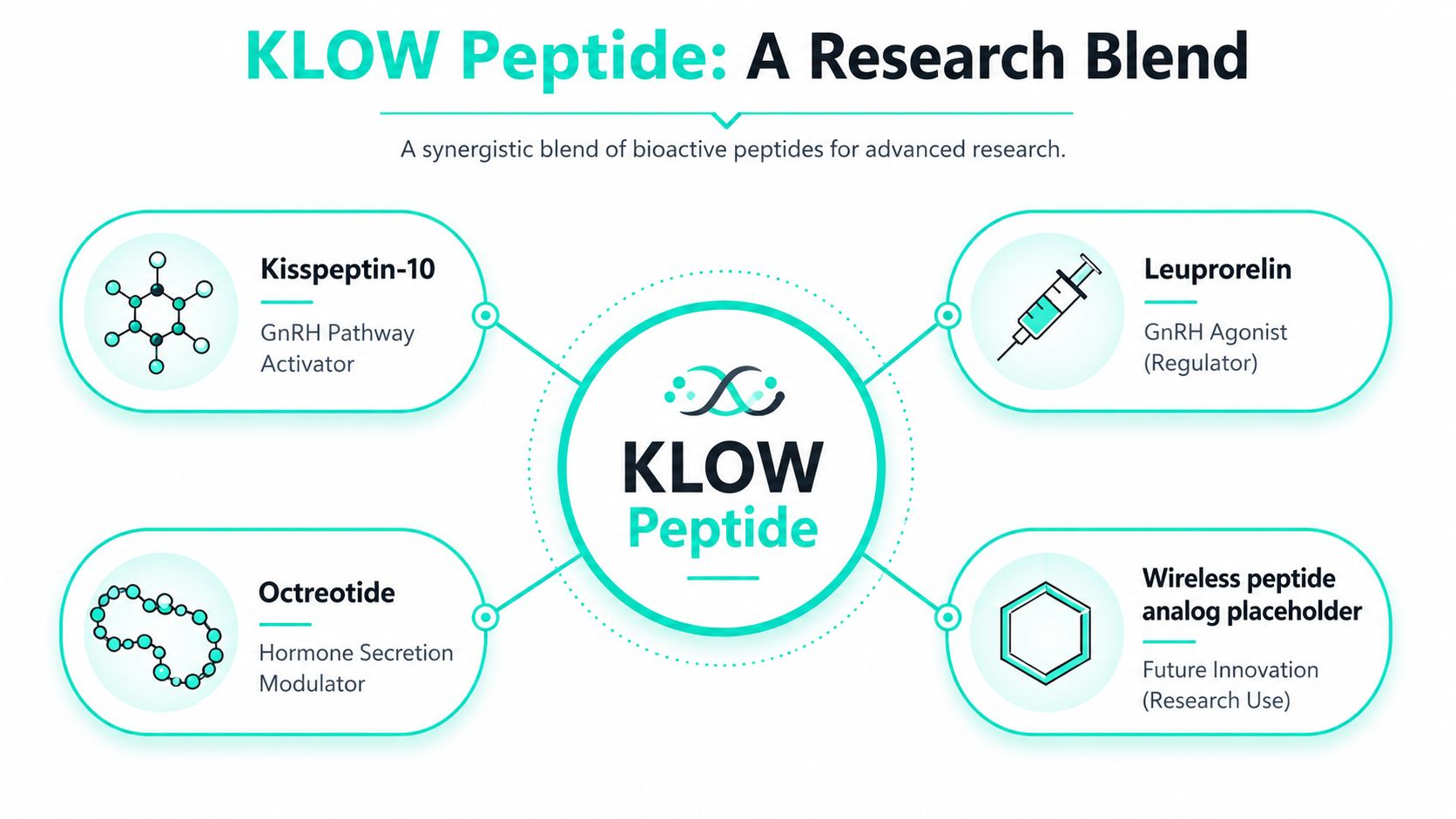
A junior researcher can make a clean mistake here. If you call KLOW a peptide, singular, you'll start looking for a single mechanism, a single dose-response curve, and a single set of handling assumptions. That's the wrong frame.
A better mental model is this, KLOW is a co-formulated research material made from four separate peptides that are already known in their own literatures. In a blend like this, the question isn't just “what does the peptide do,” it's “what does this exact ratio do when these components are combined in one vial?” That is why formulation identity is more important than the marketing name.
Practical rule: record the exact vial label, the component split, and the lot information before reconstitution. If you skip that step, you lose the ability to interpret later data with confidence.
For labs that are still learning about peptides, it helps to separate product literacy from mechanism literacy. A general primer on research peptides can help with that baseline, including how suppliers describe research-only materials and why documentation matters, such as the overview at research peptides explained.
The key takeaway is simple. KLOW is a formulation name, and in research settings the formulation is the unit of analysis. If the label doesn't tell you the ratio, you don't yet know what you have.
The easiest way to understand KLOW is to step through the four ingredients one by one. GHK-Cu is the copper-binding tripeptide most often discussed in connective-tissue and remodeling contexts. BPC-157 appears in preclinical summaries around tissue repair and recovery pathways. TB-500 is the fragment-associated peptide commonly linked to actin and migration biology. KPV is the anti-inflammatory tripeptide that shows up in signaling discussions tied to inflammation resolution. Those are broad research frames, not therapeutic claims.
The point of listing them separately is not to imply that the blend adds them together in a neat arithmetic way. It's to show that KLOW sits on top of four distinct literatures, and each one brings its own assumptions about exposure, timing, and endpoint selection.
GHK-Cu is usually the anchor for matrix and remodeling discussions, because copper coordination changes how people think about its activity profile. BPC-157 is often brought into injury and repair conversations because researchers associate it with recovery pathways in preclinical models. TB-500 is treated as a more systemic, actin-related research peptide, which is why it comes up in migration and tissue-response contexts. KPV is the piece that keeps the blend from being read as only a repair stack, since its role is usually framed through anti-inflammatory signaling.
A compact way to remember the blend is this:
That list is useful only if you keep the boundary clear between individual peptide evidence and blend-level evidence. A blend doesn't inherit a fully proven combined mechanism just because each ingredient has been studied on its own. It inherits a hypothesis space.
A blend is a research tool only if you keep asking which component could be responsible for the signal you see.
If you're mapping the literature, read each peptide separately first, then come back to the formulation. That order saves a lot of confusion later, especially when a result looks promising but you can't tell which molecule created it.
The biggest source of confusion is that KLOW doesn't always refer to the same composition. In one usage, it means the four-peptide research blend of GHK-Cu, KPV, BPC-157, and TB-500. In another, Klow/GLOW is used for a different compounded product centered on GHK-Cu, glutathione, and ascorbic acid. That mismatch is not a minor branding quirk, it changes the actual chemistry you're ordering. KLOW naming ambiguity discussion
Procurement teams get tripped up here. A vendor page can look consistent on the surface, yet the ingredient set underneath may be materially different. If two products share a name-family but not a composition, the label alone can't protect your study design.
The correct way to resolve the ambiguity is to read the Certificate of Analysis against the vial label and the stated composition. If the document doesn't tie the lot to the exact component list, you shouldn't assume the product matches your experimental need. The blend you want is the one that explicitly shows GHK-Cu, KPV, BPC-157, and TB-500 together.
A practical procurement check looks like this:
| Checkpoint | What to verify |
|---|---|
| Name | Does it match the intended research blend, not just a similar marketing term? |
| Components | Are GHK-Cu, KPV, BPC-157, and TB-500 all listed? |
| Lot tie | Is the COA tied to the specific vial lot? |
| Intended use | Is it clearly labeled for research rather than clinical use? |
That table sounds basic, but it prevents a lot of downstream pain. If a lab orders by brand name alone, it can receive a different formulation with the same family name and only discover the mismatch after the experiment is already underway.
The rule is straightforward. Never procure KLOW by name alone. Verify the component list, the lot, and the document trail before anyone opens the box.
The honest answer is that the four-peptide KLOW blend itself has never been tested in a controlled study. That means any claim about synergy, multi-pathway healing, or a combined effect is built by extrapolating from single-component research, not from direct blend-level proof. That distinction is easy to blur in marketing copy and hard to ignore in a serious bench notebook. KLOW FAQ on evidence limits
This is why strong-sounding language can be misleading. A result may be mechanistically plausible because each peptide has its own preclinical story, but plausibility isn't the same thing as controlled evidence for the blend. If you're reading a vendor description that implies integrated healing, ask yourself whether the claim comes from the combination or from the literature around the individual molecules.
There's also a design problem that gets overlooked. When you combine more actives in a fixed ratio, you may make the experiment easier to administer but harder to interpret. If a readout changes, you can't easily tell whether the effect came from GHK-Cu, KPV, BPC-157, TB-500, or an interaction among them.
That's not just an abstract concern. In a fixed-ratio blend, the variables move together, so attribution gets muddier. A blend can be useful for exploratory work, but it can also increase confounding variables when the actual question is mechanism.
Research judgment: if the goal is attribution, separate vials often tell a cleaner story than a four-component blend.
A stronger study design treats KLOW as a formulation-level variable and says so plainly in the write-up. If the goal is to probe pathway crosstalk, the blend makes sense. If the goal is to know which peptide did what, the blend makes that harder, not easier.
The practical takeaway is to match the material to the question. Don't ask a fixed-ratio blend to do the job of a dissection study.
At a high level, each peptide is synthesized and purified separately, then combined into the final formulation before lyophilization. That sequence matters because the blend inherits the quality of every component inside it. If one constituent is poorly purified, the whole vial carries that weakness forward.
In the lab, that means you don't treat reconstitution as the first quality step. The first quality step is upstream, at the synthesis and purification stage. The final dry powder is just the format that makes shipping, storage, and bench use practical.
Once the vial arrives, the handling logic is familiar but disciplined. Keep the dry material protected from moisture and unnecessary light exposure. Reconstitute with the buffer specified by your protocol, aliquot if you're going to use the material more than once, and avoid repeated freeze-thaw cycles. Those habits help preserve consistency across experimental runs.
For a practical guide on working with lyophilized materials and reconstitution workflows, see peptide reconstitution guidance.
A bench-side checklist should usually include:
Those steps are simple, but they keep the material interpretable. A multi-component blend is only as usable as the record you keep around it.
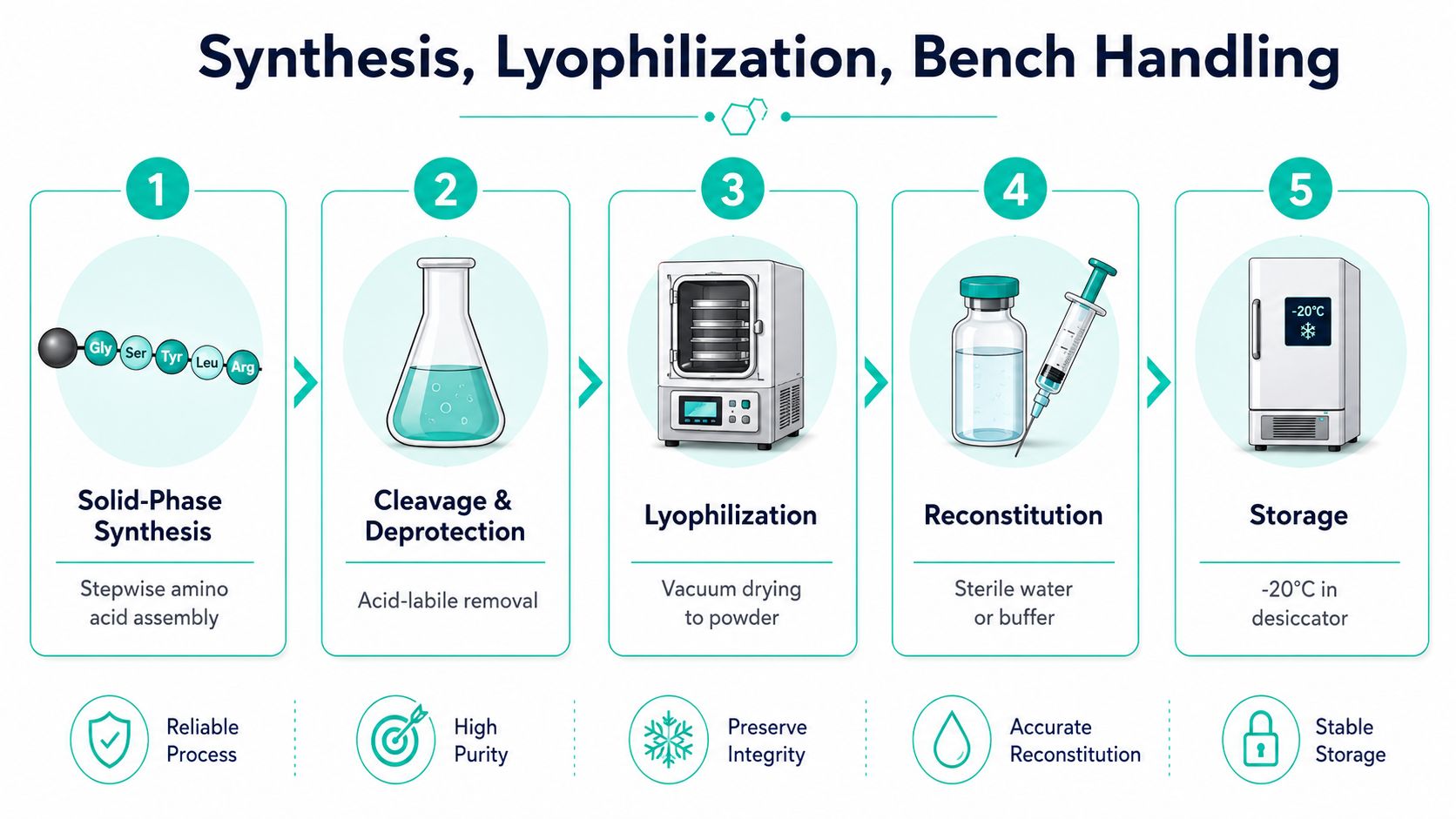
The main point is that synthesis, lyophilization, and storage aren't separate chores. They're part of the data integrity chain.
A Certificate of Analysis should let you tie the vial in your hand to a specific tested lot. At minimum, that means a lot number, a test date, an identity method, and a purity result that can be checked against the product's stated specification. If those fields are missing, the document does not tell you much about the material you are holding.
For research-grade material, the useful parts are usually the same each time. You want the lot number, the assay method, the identity confirmation, and whatever supporting analytical data the vendor provides. A generic COA with no lot traceability is weak evidence, not strong evidence.
A vendor can say a lot of things on a storefront. Procurement should care about what the document trail supports. That is where third-party testing matters, because it adds an external check instead of relying only on the supplier's internal statement. For more on how third-party testing works, see third-party tested peptides.
Celonyx Labs, for example, presents peptide products with stated 99% purity and independent third-party testing on its site, along with order and policy information that helps a lab document its purchase workflow. That kind of documentation should still be checked against the actual COA before payment is released, because the paper trail matters more than the headline claim.
A simple pass-fail review works well:
| Field | Pass condition |
|---|---|
| Lot number | Matches the vial exactly |
| Test date | Present and legible |
| Identity data | Confirms the named peptide components |
| Purity data | Matches the stated product spec |
| Supporting notes | Explain any exceptions or limitations |
If the COA cannot be tied to the vial, it is not strong enough for an audit trail.
That standard is the one I would use in a serious lab. The goal is not paperwork for its own sake, it is making sure the material you study is the material you think you studied.
KLOW peptide belongs in the research-only category. Vendors describe it that way because it is not approved by the FDA for human therapeutic use, and the practical implication is simple, it stays in the lab rather than moving into clinic use. Research-grade material is not the same thing as a pharmacy-compounded product, and it shouldn't be treated as interchangeable with one.
That distinction also shapes institutional oversight. Depending on the work, labs may need Material Transfer Agreements, biosafety review, or animal protocol review through IACUC or IBC pathways. The exact oversight depends on what you're doing, but the principle doesn't change, the material is handled as a research reagent with controlled use and documentation.
How do I tell the research blend from the Klow/GLOW telehealth product?
Check the component list. The research blend is the four-peptide formulation with GHK-Cu, KPV, BPC-157, and TB-500. The telehealth-compounded product uses a different composition, so the name alone doesn't settle the question.
Is a fixed-ratio blend good for mechanism studies?
Only if your question is about the blend as a whole. If you need to know which peptide drives the signal, a fixed-ratio formulation adds confounding and makes attribution harder.
What purity should I ask for?
Ask for a level that's documented on the COA and tied to the lot, then verify that the reported data match the vial. The number itself matters less than the ability to trace and confirm it.
What should I do if I think a vendor quality claim doesn't match the document?
Pause the study, contact the vendor with the lot number, and ask for the matching analytical record. If the answer doesn't resolve the discrepancy, don't treat the vial as validated material.
Should I assume more actives mean better interpretability?
No. More actives can mean more biological coverage, but they can also mean more confounding. In bench research, clarity often comes from fewer moving parts.
The most defensible summary is this. KLOW peptide is a research-only four-peptide blend, not a single drug-like molecule, and its value depends on whether your study needs a formulation or a mechanism dissection.
Celonyx Labs supplies research peptides for laboratory use, with product documentation, ordering support, and stated quality controls that fit procurement workflows. If you're comparing KLOW against other research materials or checking whether a vial aligns with your study design, visit Celonyx Labs to review the catalog and supporting policies before you buy.
You're comparing two bottles on a supplement shelf. One says 500 mg glutathione. The other

Is bacteriostatic water the same as sterile water? No. Compare preservatives, vial handling and peptide

How do you know if a peptide vial has gone bad? Quarantine changes, check storage
FOR RESEARCH USE ONLY. Products sold by Celonyx Labs are intended exclusively for laboratory and scientific research. They are not intended for human or veterinary use, consumption, diagnosis, treatment, cure, or prevention of any disease. By purchasing from this site, you acknowledge that you understand the intended research purpose of these materials and agree to comply with all applicable laws and regulations.