

Customer Support Email Contact for Celonyx Labs (2026 Guide)
Celonyx Labs customer support email is a practical first contact because 62% of customers used
You receive a peptide order with the expected name, sequence, and purity claim. The vial looks normal, the certificate of analysis appears acceptable, and the first assay proceeds as planned. Later, you order the same peptide again, but the dose-response curve shifts and the control range becomes harder to interpret. Nothing about the product name changed. The batch did.
For a research team, “batch or batches” isn't merely inventory language. It identifies a potential source of analytical and biological variation that can affect assay interpretation, procurement decisions, and longitudinal reproducibility. The practical question isn't only whether a peptide meets a headline purity specification. It's whether the material you received is analytically equivalent to the material used previously.
A lab team runs the same assay with the same protocol, instrument settings, cell passage strategy, and nominal peptide concentration. The earlier result produced a clear response. The repeat experiment, performed after a fresh order arrived, produces a flatter curve. The team checks pipetting records first, then cell handling, then plate layout. Eventually, someone compares the vial labels and notices that the lot numbers differ.
That discovery doesn't prove the new peptide caused the shift. It does identify a variable the team should investigate rather than ignore. Each synthesis run can develop a different impurity profile because synthesis steps, purification, and storage conditions aren't perfectly identical from run to run. Peptide purity testing guidance describes batch-to-batch variability as a normal feature of peptide manufacturing and recommends verifying each received batch instead of treating one lot's CoA as a prediction of every future lot.
The same peptide name tells you what the product is intended to be. It doesn't, by itself, tell you that two lots contain identical levels or types of minor impurities, identical salt loading, or identical degradation products. Those distinctions can matter when a sensitive assay responds to more than the target sequence.
HPLC can make the comparison look simpler than it is. Purity is commonly reported as the area percentage of the main chromatographic peak, but two samples with similar main-peak percentages can still differ in minor impurity composition or functional content. Technical discussion of HPLC purity and orthogonal identity testing explains why HPLC should be interpreted alongside mass spectrometry and lot-specific testing.
Practical rule: Treat every new lot as a new analytical input until your records show that it is comparable with the material already used.
The issue also has a broader manufacturing context. A Royal Society discussion of U.S. metalworking estimated that approximately 75% of U.S. metalworking manufacture was already performed in small-lot batches in 1973. The same discussion noted that a typical part spent only about 5% of its time on production machines, with only about 30% of that machine time productive, illustrating why batch boundaries, waiting, handling, and process conditions have long been central to manufacturing performance.
In peptide research, the consequence is more immediate. A small run-to-run difference can introduce assay noise, alter an apparent dose-response relationship, or complicate a study that compares results collected months apart. The earlier your team records and evaluates batch identity, the less likely it is that procurement history will become an unexplained part of the experimental story.
Start with a simple analogy. A baker uses the same recipe to make bread on different days. The ingredients, mixing instructions, and oven settings may be controlled, but the dough can still respond differently to small changes in mixing, temperature, proofing, or storage. The loaves made together during one controlled production run belong to one batch. Loaves made on another day belong to another batch, even if the recipe and product name are unchanged.
Peptide manufacturing uses the word in a similar way, but procurement documents can use related terms differently. Batch may refer to one production run, a grouped processing set, or a quality assurance unit. Lot often identifies the material released under a particular production and testing record. Group may describe items handled together without necessarily defining the formal release identity.
For practical lab work, you need to connect four things:
If the vial label and CoA show different identifiers, stop before using the material. If the supplier provides a generic CoA without a clear lot match, you can't confidently connect the reported result to the vial in your freezer.
A single lot's paperwork also has a limited scope. It describes the tested material from that lot. It doesn't establish that a later lot has the same impurity profile or functional behavior. That distinction is especially important for peptides, where synthesis, purification, drying, transport, and storage can each influence the received material.
A useful internal definition is: a batch is the specifically identified material covered by a particular manufacturing and quality record. That definition helps your team answer practical questions that a dictionary definition doesn't resolve.
Which vial was used in the assay? Which CoA applies to it? Was the vial opened before the recorded storage interval? Did the replacement shipment come from the same lot or a different one?
A product name identifies the intended peptide. A lot number identifies the material your experiment actually received.
Use “batch” when discussing manufacturing and release. Use “lot” when documenting the vial, order, CoA, and assay record. Your supplier may use the terms differently, so record the exact identifier printed on the received material rather than relying on informal wording.
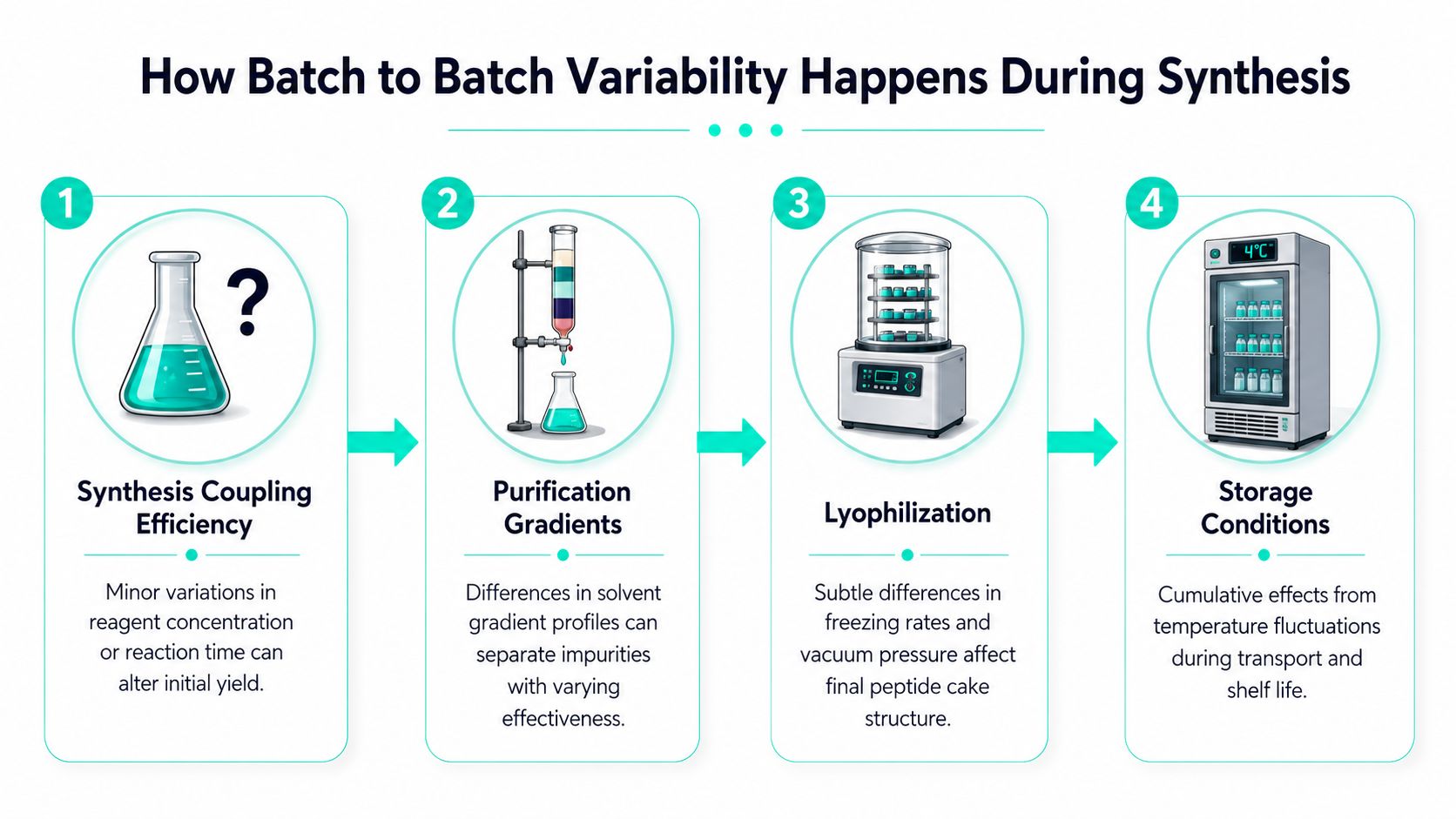
A peptide can leave the same production workflow with a different impurity pattern from one lot to the next. During synthesis, coupling efficiency may shift with reagent concentration, reaction time, mixing, or other process conditions. A small change at one step can create incomplete or modified sequences that must later be separated from the target.
Purification adds another control point. Solvent gradients, column behavior, loading conditions, and collection decisions determine how well related impurities are separated. Two runs can produce the intended sequence while carrying different minor components into the final material. For reproducibility, the key comparison is not only the label or purity headline. Compare the lot-specific HPLC and MS records, much as you would compare two fingerprints rather than two names.
Synthesis coupling efficiency influences which incomplete or modified sequences enter the crude mixture. A controlled process does not guarantee an identical crude profile every time. Review whether the resulting impurity pattern remains suitable for the assay and whether the same profile is seen across lots.
Purification gradients determine how compounds with similar chemical behavior are resolved. A strong main HPLC peak can coexist with different minor peaks between lots, especially when the report emphasizes total area percentage instead of identifying each secondary component. Examine the chromatogram itself, not just the reported number.
Lyophilization changes the physical form of the final material. Freezing behavior, vacuum conditions, and drying history can alter the peptide cake and affect how readily it reconstitutes. Reconstitution time, clarity, and handling therefore belong in the practical comparability assessment.
Storage and transport add a further source of variation. Temperature fluctuations, exposure history, and time before use may contribute to oxidation, deamidation, aggregation, or other changes relevant to the assay. The peptide stability and sourcing discussion recommends comparing lot-specific analytical records for longitudinal work and considering one reserved lot with archival storage.
Batch differences do not automatically indicate manufacturing failure. They do mean that batch-specific impurity profiles require verification. A headline purity value can remain high while the surrounding HPLC signals, mass profile, or reconstitution behavior changes. For longitudinal experiments, reserving one characterized lot reduces the number of variables that change during the study.
Batch size is an operations variable that can affect scheduling, inventory, lead times, and process control. Production research examines these trade-offs, as described in research on batch sizing and production planning. These findings do not define a universal peptide specification, but they support documenting how production decisions may influence comparability.
The practical rule is simple: record the lot identifier, retain the associated HPLC and MS files, and compare replacement material before using it in a longitudinal assay.
The following video provides additional visual context for thinking about production batches and process consistency:
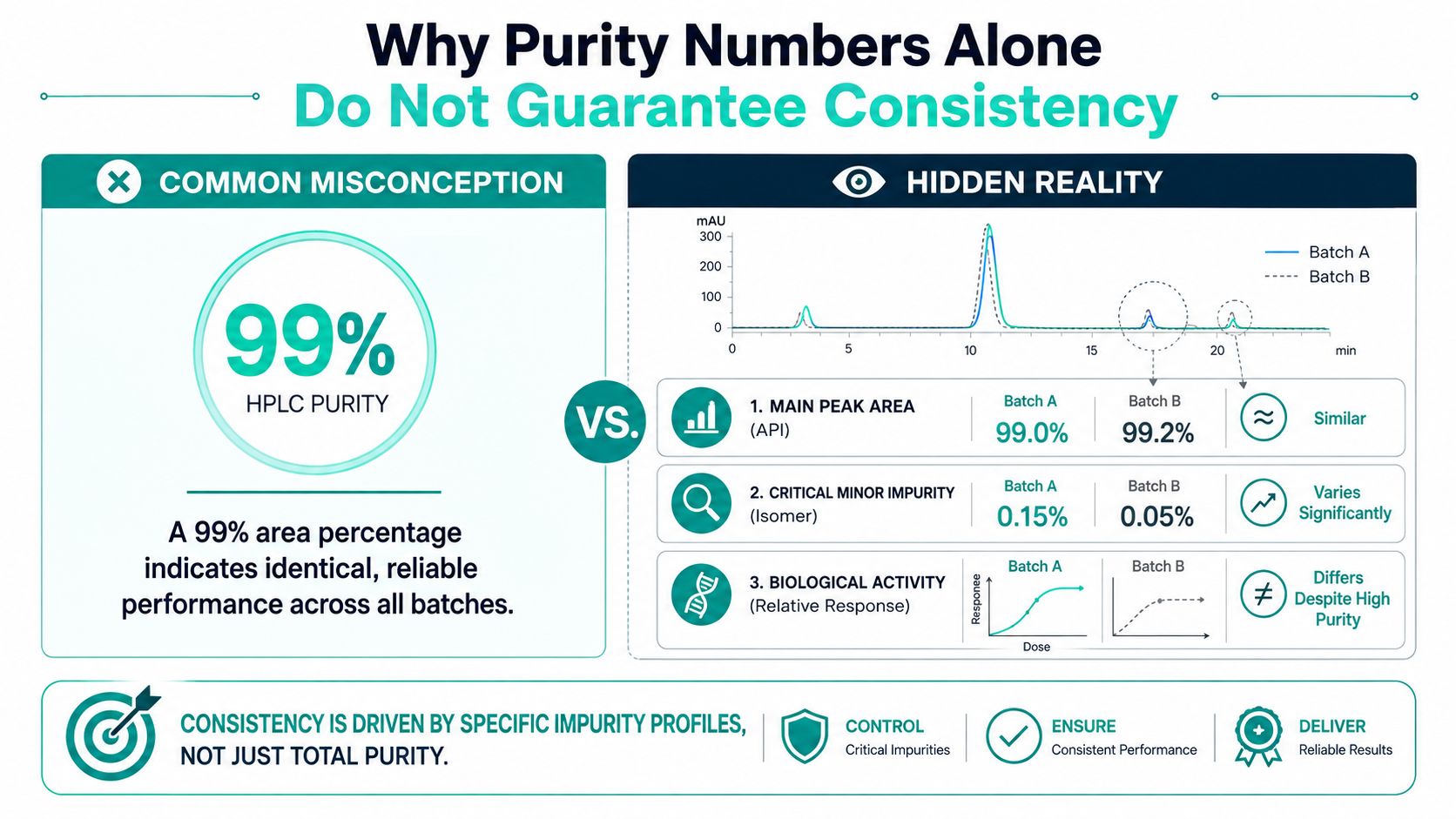
A purity number answers a narrower question than many researchers assume. In research peptide documentation, HPLC purity typically represents the area percentage of the main chromatographic peak. That value is useful, but it doesn't automatically establish identical functional content across lots.
Two batches may show the same headline purity while differing in salt loading, oxidation, deamidation, sequence isomers, or other minor components. They may also produce different chromatographic profiles around the main peak. If your assay responds to those differences, identical-looking purity labels won't guarantee identical experimental behavior.
HPLC helps you assess the chromatographic composition of the tested sample. It can show the dominant peak and reveal whether secondary peaks are present. But an area percentage alone generally doesn't tell you what every secondary signal represents, whether the target identity is correct, or whether a mass difference exists that isn't resolved by the selected method.
Mass spectrometry supplies a complementary identity check. It can help confirm that the detected material has the expected molecular mass and can flag differences that deserve further review. The point isn't to replace HPLC with MS. It's to use orthogonal methods so that one measurement isn't carrying more certainty than it can support.
Change the question: Don't ask only, “Is this batch pure?” Ask, “Is this batch analytically equivalent to the last one?”
For a longitudinal experiment, compare the actual records rather than copying a single value into a spreadsheet. Review the lot-specific HPLC trace or report, the MS identity result, the stated test date, and any available impurity information. If a supplier provides only a headline number, ask what analytical evidence supports it and whether the document belongs to the lot you received.
A different profile doesn't automatically mean the peptide is unusable. It means your team should decide whether the difference matters for the intended assay. A solid decision can include a small bridging experiment, matched preparation records, and a clear note explaining why the new lot was accepted.
For sensitive or long-running work, reserve enough material from one lot to cover the planned study when feasible. Store an archival portion under the recommended conditions, document each thaw or opening event, and keep the original CoA with the study file. This approach gives you a reference sample if later results become difficult to interpret.
A practical guide to peptide test results can help new team members understand how to read reported analytical findings, but your own acceptance criteria still need to match the assay, study purpose, and institutional quality requirements.
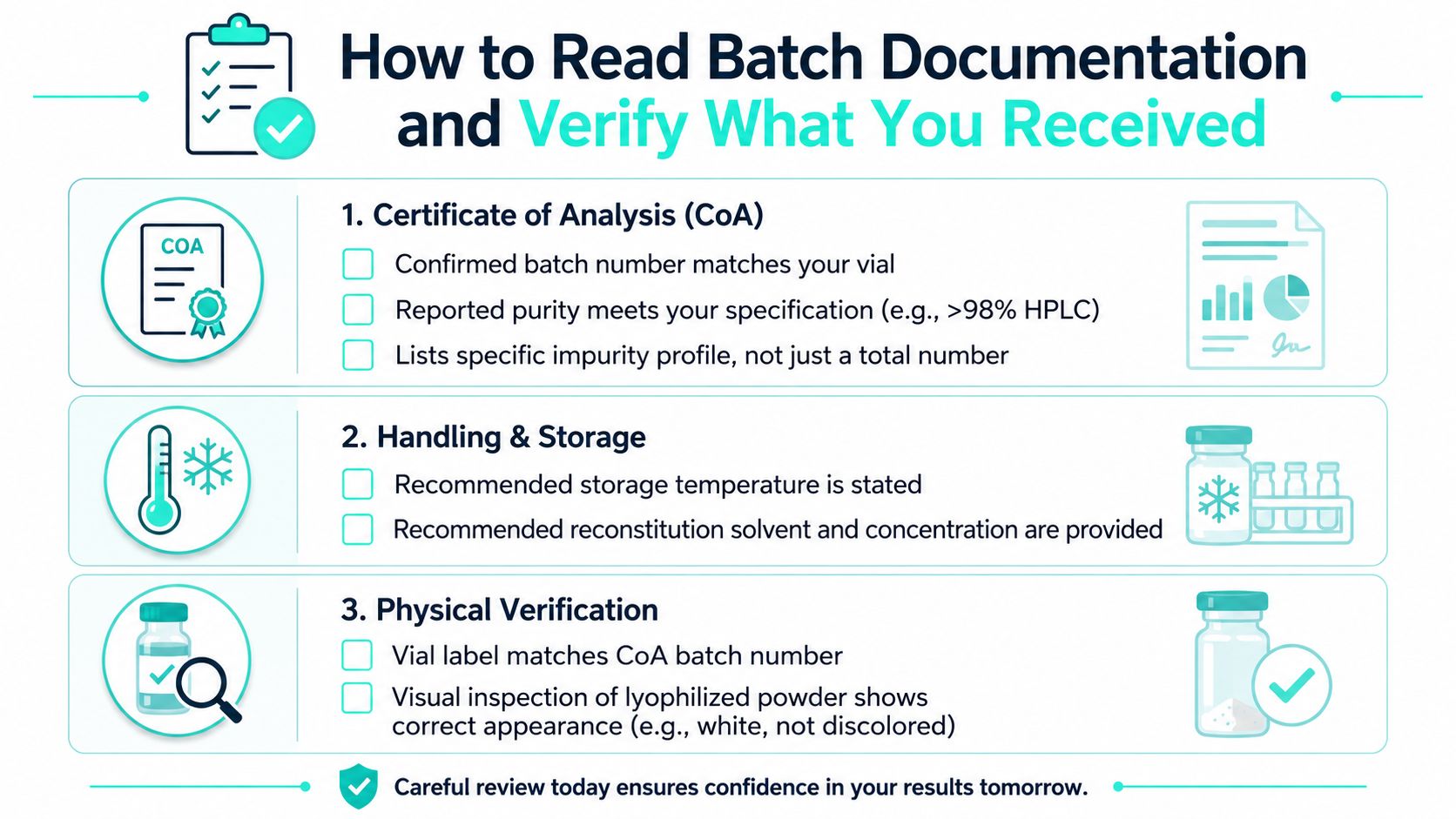
Begin with the physical container, not the catalog page. Record the peptide name, sequence or identifier, batch or lot number, vial size, received condition, and date received. Then compare each item with the CoA before the vial enters routine use.
The most important check is simple: the vial label must match the CoA batch number. If the identifiers don't match, quarantine the material and ask the supplier to resolve the discrepancy. Don't assume that a similar product name or shipment number provides sufficient traceability.
Review the CoA for the analytical method, test date, identity result, purity result, and any listed impurity information. A generic document that lacks a lot number or appears to describe a product family rather than the received material gives you weaker evidence than a lot-specific record.
Use this compact review sequence:
A missing chromatogram isn't the same as a failed purity test. It means you have less information for judging comparability. Likewise, a different appearance deserves investigation, but visual inspection alone can't establish identity or purity.
If your team needs stronger documentation, specify the requirement before ordering. Ask for the lot number, HPLC method or report, MS identity confirmation, storage information, and any available impurity profile. Keep the response with the procurement record so the next researcher doesn't have to reconstruct the decision.
Batch sizing can also appear in manufacturing or supplier discussions. Because production research treats batch size as a measurable variable tied to inventory, lead time, and throughput, you should ask what the stated size represents. It may describe a synthesis run, a processing window, or a packaging group, and those categories aren't interchangeable.
For a broader sourcing checklist, review third-party tested research peptides and compare the documentation practices with your lab's acceptance criteria. The supplier's testing language should support, not replace, your own record review.
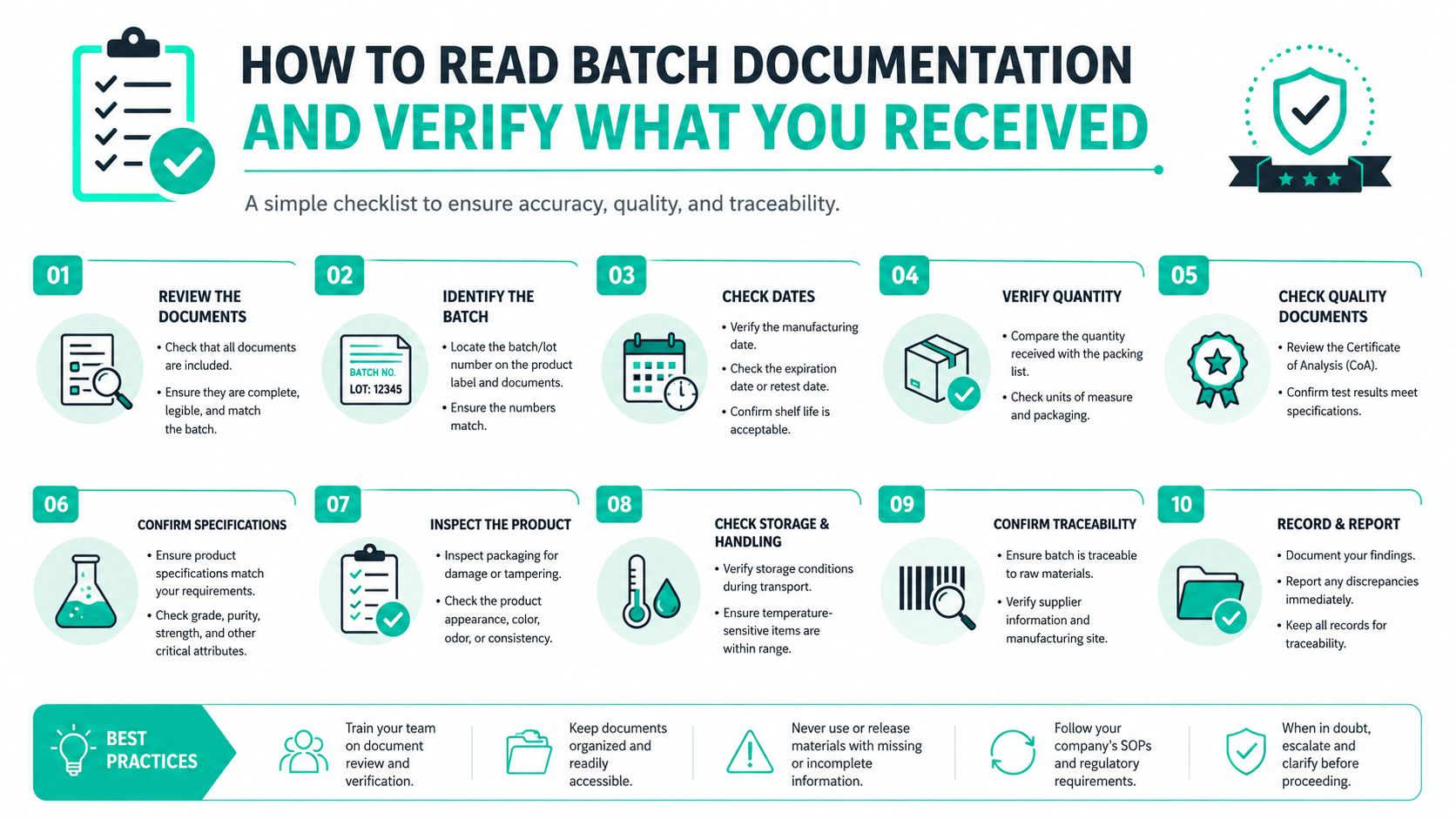
The strongest strategy is to design batch control before the study begins. If a project compares results across multiple time points, define whether all measurements need to come from one lot or whether a lot transition can be bridged experimentally.
For longitudinal work, single-lot reservation is often the clearest approach. Reserve enough material for the planned study, retain an archival portion, and document storage conditions from receipt through use. This reduces the chance that a later shipment introduces an unplanned analytical change into the time series.
Your laboratory information system or study spreadsheet should treat batch as a formal variable. Record:
When a new lot arrives, compare its lot-specific HPLC and MS information with the previous lot. If the profiles aren't available, record that limitation and decide whether a bridging test is needed. Do not treat a documentation gap as proof of equivalence.
A routine exploratory assay may need only documented lot matching and basic analytical review. A sensitive dose-response study, mechanistic experiment, or multi-month project may justify a retained reference aliquot and a predefined lot-change check.
Supplier communication should be specific. Instead of asking whether a peptide is “consistent,” ask whether the supplier can identify the manufacturing lot, provide lot-specific analytical documentation, and explain recommended storage and reconstitution conditions. Celonyx Labs is one supplier option that presents research peptides with stated purity and independent third-party testing information, but your lab should evaluate any supplier against its own documentation and assay requirements.
Write the decision down. A short note explaining why a lot was accepted, bridged, or rejected protects the study from memory-based interpretation later.
Reliable peptide research starts with a disciplined definition of material identity. The product name tells your team what was ordered. The batch or lot number tells you which production unit entered the experiment. The CoA and analytical records show what was tested, while your internal log connects that evidence to the vial, preparation, and assay result.
Treat each incoming lot as a distinct analytical entity. Review HPLC and MS information together, preserve the records, and avoid using a single purity number as a substitute for profile comparison. For longitudinal work, reserve one lot when practical and retain a properly stored reference portion.
A consistent sourcing program also gives researchers a shared response when results shift. Instead of starting with speculation, the team can check lot identity, storage history, reconstitution records, analytical comparability, and the timing of the lot transition. That process won't remove every source of experimental variation, but it makes batch-related variation visible and testable.
For procurement planning, the guide to sourcing GMP-adjacent research peptides can provide additional context for evaluating supplier documentation and quality expectations. Use it alongside your institution's procedures, study-specific acceptance criteria, and the analytical evidence attached to each received lot.
Your next step should be concrete. Create a batch log template, add the lot number as a required experimental variable, and define what evidence your team needs before accepting a new peptide lot. That small administrative change can prevent a major interpretive problem later.
Celonyx Labs supplies research peptides through an online catalog and presents product information that includes stated purity and independent third-party testing. Visit Celonyx Labs to review available materials and contact the team about lot-specific documentation for your research workflow.
Celonyx Labs customer support email is a practical first contact because 62% of customers used

Peptide purity testing for CROs in 2026: the HPLC, mass spec, COA, and reference standard

Research peptides for independent researchers: verify CoAs, purity, reconstitution, and storage without institutional backup. Full
FOR RESEARCH USE ONLY. Products sold by Celonyx Labs are intended exclusively for laboratory and scientific research. They are not intended for human or veterinary use, consumption, diagnosis, treatment, cure, or prevention of any disease. By purchasing from this site, you acknowledge that you understand the intended research purpose of these materials and agree to comply with all applicable laws and regulations.