

Epitalon Hair Growth: What the Research Actually Shows
No controlled human study has measured hair count or follicle density after Epitalon exposure, and

You can buy research peptides without a business account only when the seller accepts individual purchasers and your intended use meets its purchasing terms. A personal checkout account does not establish permission for human use, clinical use, or self-experimentation. For a 2026 laboratory purchase, confirm buyer eligibility before ordering and evaluate the material’s documentation separately from account access.
Account access answers who can place an order; it does not answer whether the material belongs in your experiment. Treat those as separate decisions. A successful checkout is not a substitute for purchasing authorization, analytical review, or an approved research protocol.
If you work outside an institutional purchasing system, start with the guide to research peptides for independent researchers. Your practical task is to establish an acceptable purchasing route without weakening the laboratory’s documentation requirements.
For your 2026 procurement checklist, distinguish the person ordering, the organization responsible for the work, and the intended application. Those details should agree across your inquiry, order record, and experiment file. Creating a business account does not resolve inconsistencies between them.
The deciding condition is the seller’s acceptance of your purchaser status and research purpose, not simply whether you have incorporated a business. Ask about the specific purchase you intend to make. Do not assume that access to a storefront establishes eligibility for every material listed there.
Use this sequence before placing an order:
This sequence makes account eligibility an early checkpoint rather than the entire purchasing decision. If the seller does not accept your purchaser status, stop there instead of trying a different identity or an inaccurate affiliation.
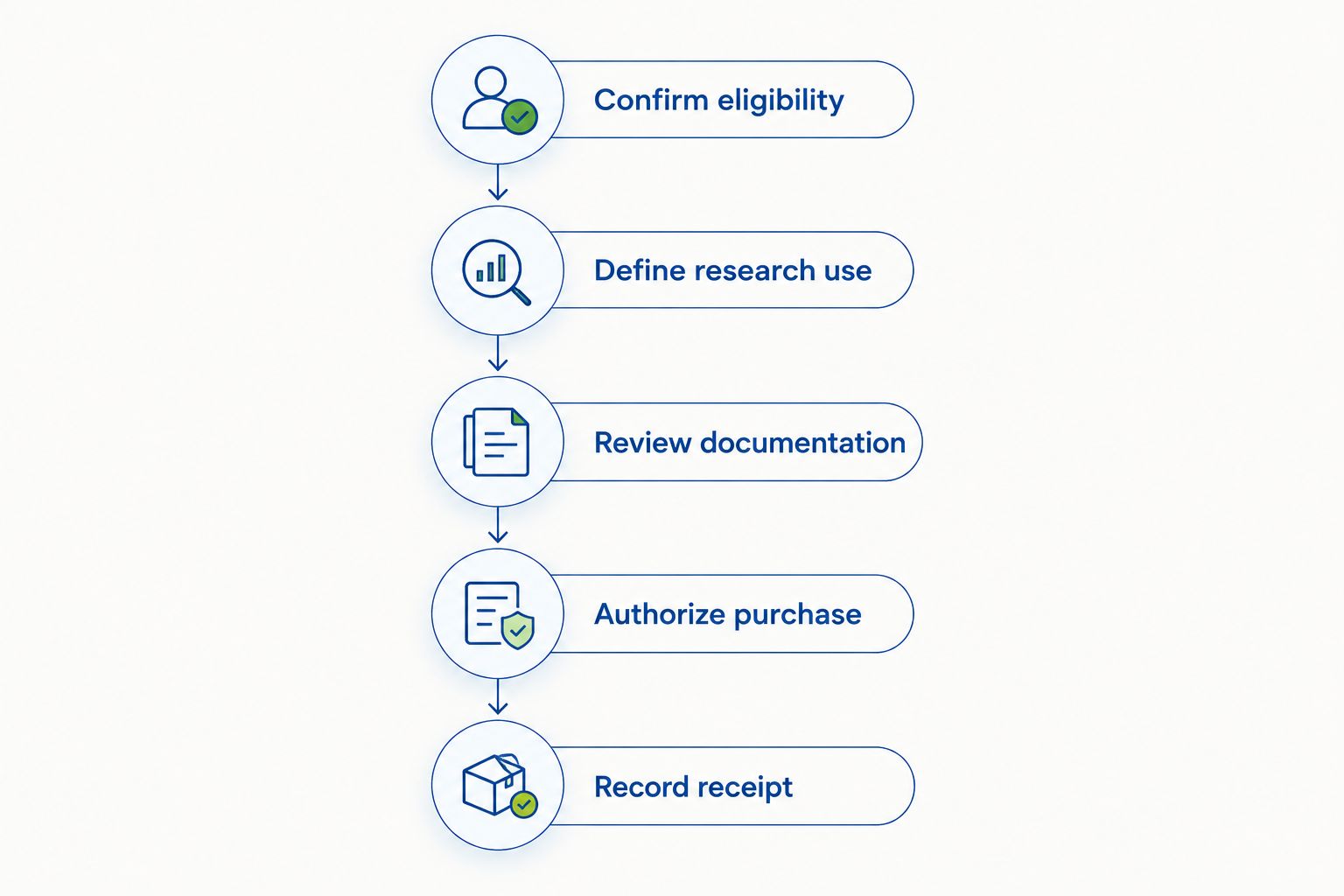
Compare purchasing routes by accountability and documentation, not by how few fields appear at checkout. The table below is a decision framework, not a statement that a particular supplier offers these account types.
| Purchasing route | Best for | Practical advantage | Limitation to resolve |
|---|---|---|---|
| Individual purchaser | Independent laboratory researchers whose status the seller accepts | Keeps the purchaser’s identity explicit | Does not establish institutional authorization or material suitability |
| Institutional purchasing route | Researchers buying for an organization that controls procurement | Keeps the order within the organization’s approval process | Requires you to follow that organization’s purchasing rules |
| Authorized business purchaser | Researchers purchasing on behalf of a business | Identifies the entity responsible for the purchase | Business status does not replace analytical review or research-use restrictions |
Choose the route that accurately represents who is responsible for the research. Do not use an individual account to bypass an institution’s approval process. Likewise, do not create a business identity solely to conceal the intended application.
A personal payment method and a personal purchasing account are also different questions. Establish both separately if your organization will reimburse the purchase. Reimbursement rules belong to your organization; seller acceptance does not settle them.
Send a focused inquiry that lets the supplier answer the eligibility question directly. Include the material you want to purchase, your actual affiliation, the intended laboratory application, and whether you need an institutional order record. Avoid unnecessary personal or experimental details.
Ask these questions in plain language:
Keep the response with your procurement records. A clear written answer is more useful than an assumption based on an account-registration screen. Recheck the applicable terms for a new purchase rather than treating an earlier acceptance as permanent permission.
For a 2026 order, make the inquiry specific to the current material and destination. Do not turn a response about one transaction into a general claim about every peptide or every jurisdiction.
The relevant distinctions are buyer identity, authorization, intended use, and delivery destination. These are the questions to resolve; they are not evidence that every supplier applies the same restrictions.
Resolve eligibility before payment, not after the shipment arrives. An account answers administrative questions about the transaction. It does not assess your experimental design, validate your handling procedures, or establish regulatory permission for an application.
Keep legal questions separate as well. Whether a storefront accepts an order and whether a particular transaction is lawful are not interchangeable conclusions. Obtain qualified advice when your purchase raises regulatory or import questions rather than treating checkout access as legal guidance.
A certificate of analysis describes the tests and results reported for the material it identifies. Read the document as analytical evidence with a defined scope. Do not treat the presence of a certificate as proof of every property your experiment requires.
Start by matching the material name and batch identifier to the item being purchased. Then examine the reported methods, results, and acceptance criteria. A document for a different batch cannot establish the characteristics of the batch you receive.
Purity, identity, and biological activity are distinct analytical questions. Chromatographic purity describes the result of a separation method; identity testing addresses whether the material is the expected compound. Neither should be silently substituted for an activity measurement when activity is relevant to the experiment.
A 99% purity statement does not mean 99% sterility, 99% biological activity, or suitability for human administration. Those are different properties requiring their own evidence. The same distinction applies when the result comes from third-party testing.
For your 2026 evaluation, define the measurements the study needs before judging whether the available documentation is sufficient. This prevents a prominent purity figure from becoming a shortcut around method selection and material qualification.
Celonyx Labs research peptides are suited to laboratory researchers and scientists sourcing research-use-only materials. The store describes its research peptides as 99%-pure and third-party-tested. Those stated quality characteristics are relevant to sourcing, but they do not establish an account policy or qualify a material for every experiment.
You can review Celonyx Labs as a research-peptide source while confirming buyer eligibility directly. Evaluate the applicable batch documentation against your protocol rather than extending a store-level statement to properties that have not been demonstrated.
The advantage is a clearly stated research audience and stated purity and testing characteristics. The boundary is equally important: research-use-only materials are not offered here as consumer treatments. Account access must remain separate from conclusions about sterility, clinical suitability, or experimental performance.
Build a procurement record that another researcher can follow without relying on your memory. The record should explain who bought the material, why it was selected, what batch arrived, and which experiment used it. A purchase receipt alone does not answer all of those questions.
Keep the following together:
Preserve the original files rather than keeping only a screenshot of a headline purity result. Record discrepancies between the order, vial label, and documentation before using the material. Resolve an unmatched batch identifier with the supplier instead of assuming the documents are interchangeable.
The goal is traceability, not a larger folder. Every record should help establish the connection between the purchase and the material used in the laboratory.
No. A personal account is a purchasing arrangement, not evidence of safety or approval for human administration. A research-use-only label does not become a clinical authorization when the buyer uses a personal email address.
Keep laboratory sourcing separate from treatment decisions. Do not interpret purity, third-party testing, or the ability to complete checkout as instructions for dosing, injection, or self-experimentation. Those conclusions do not follow from purchasing access.
Do not create a company merely to work around an unresolved eligibility question. Ask the seller whether your actual purchaser status is acceptable first. If an organization is responsible for the research, use its authorized purchasing process.
A business entity does not replace a suitable laboratory setting, appropriate oversight, or analytical qualification. The useful question is whether the purchasing route accurately reflects the work—not whether an additional account label makes checkout possible.
Third-party testing is evidence only for the properties and batch actually tested. Review what was measured, how it was measured, and whether the result applies to the material you will receive. A testing statement is not an automatic approval decision.
For a 2026 laboratory purchase, make acceptance criteria explicit before ordering. If your protocol depends on a property that the documents do not address, obtain the necessary evidence or select a material that meets the requirement. Do not replace an unanswered analytical question with confidence in an account type.
Can I buy research peptides without owning a company?
Only if the seller accepts your actual purchaser status and intended research use. Ask about individual researcher eligibility before ordering; do not assume that storefront access establishes permission.
Do I need a business email address to buy research peptides?
An email address alone does not establish purchasing eligibility. Confirm the seller’s account requirements and use an accurate affiliation rather than implying an institutional relationship you do not have.
Does Celonyx Labs require a business account?
Confirm business-account requirements directly with Celonyx Labs before placing an order. Its stated role as a research-peptide store does not by itself establish which purchaser account types it accepts.
Can I use a personal account for a university laboratory purchase?
Use a personal account only if both the seller and your institution permit that purchasing route. Seller acceptance does not replace institutional authorization or reimbursement rules.
Does 99% peptide purity mean the material is sterile?
No, 99% peptide purity does not establish sterility. Purity and sterility are different properties, and evidence for one does not prove the other.
What documents should I request before buying research peptides?
Request the applicable batch-specific certificate of analysis and confirmation of purchaser eligibility. Match the analytical document to the material and batch being purchased, then assess whether its tests meet your protocol’s requirements.
Can I use research peptides for personal treatment if checkout accepts my order?
No, checkout acceptance does not establish suitability or approval for personal treatment. Research-use-only purchasing access is not evidence of clinical safety or permission for human administration.
Ask whether you can evaluate the intended batch before asking whether you can pay for it. An easy checkout cannot fix a mismatch between the vial and its analytical records. Put eligibility, batch identification, and protocol fit ahead of account convenience in your 2026 purchasing decision.
No controlled human study has measured hair count or follicle density after Epitalon exposure, and

Can peptides be shipped in hot weather without spoiling? Yes, with supported conditions. Learn to

Can you buy research peptides without a business account? Check seller eligibility, laboratory-use rules, and
FOR RESEARCH USE ONLY. Products sold by Celonyx Labs are intended exclusively for laboratory and scientific research. They are not intended for human or veterinary use, consumption, diagnosis, treatment, cure, or prevention of any disease. By purchasing from this site, you acknowledge that you understand the intended research purpose of these materials and agree to comply with all applicable laws and regulations.