
Terms of Service vs Privacy Policy for Lab Suppliers
A common answer to terms of service vs privacy policy is that one is “the

No—you cannot reliably tell whether a peptide is fake without laboratory testing. Packaging, powder appearance, dissolution behavior, and supplier documents can reveal reasons to reject or investigate a vial, but they cannot establish its chemical identity. A credible test report strengthens the evidence only when it applies to the material you actually received.
You can identify warning signs without testing, but you cannot authenticate the contents of a vial by inspection. Treat visual checks as receiving controls, not chemical identification methods. A professional-looking label and an intact seal do not establish that the powder matches the stated peptide.
For the analytical distinction, see the guide to peptide purity testing for contract research organizations. The question determines the method: identifying the molecule is different from measuring impurities or assessing suitability for an experiment.
| Check or method | Best for | What it supports | Main limitation |
|---|---|---|---|
| Packaging inspection | Receiving checks | Finding damaged seals, inconsistent labels, or missing batch details | Cannot identify the material inside |
| Certificate of analysis review | Documentation screening | Assessing reported results and sample traceability | A report does not independently authenticate your vial |
| Dissolution observation | Checking preparation behavior | Detecting unexpected behavior under a documented protocol | Solubility depends on the peptide and preparation conditions |
| HPLC analysis | Chromatographic purity assessment | Separating and measuring detected chromatographic components | A dominant peak alone does not establish peptide identity |
| Mass spectrometry | Molecular identity assessment | Comparing measured mass and, when applicable, fragmentation with expectations | Matching mass alone does not prove every structural detail |
These checks answer different questions. You do not replace laboratory analysis with more photographs, more supplier badges, or more favorable reviews. You build an evidence trail that connects a defined material to appropriate analytical results.
A mislabeled, contaminated, or degraded research material can undermine an experiment even when it looks normal. If you cannot establish what entered the assay, an unexpected result becomes harder to interpret. The problem is experimental validity, not merely whether the packaging looks convincing.
For a 2026 research procurement checklist, separate three questions: Is the material the stated peptide? What impurities or other constituents are present? Is it suitable for the intended method? A single purity claim does not answer all three.
The word fake also combines several different problems. Deliberate substitution, incorrect labeling, degradation, and an unsuitable formulation are not interchangeable diagnoses. Without analytical evidence, describe the observed discrepancy rather than assigning a cause.
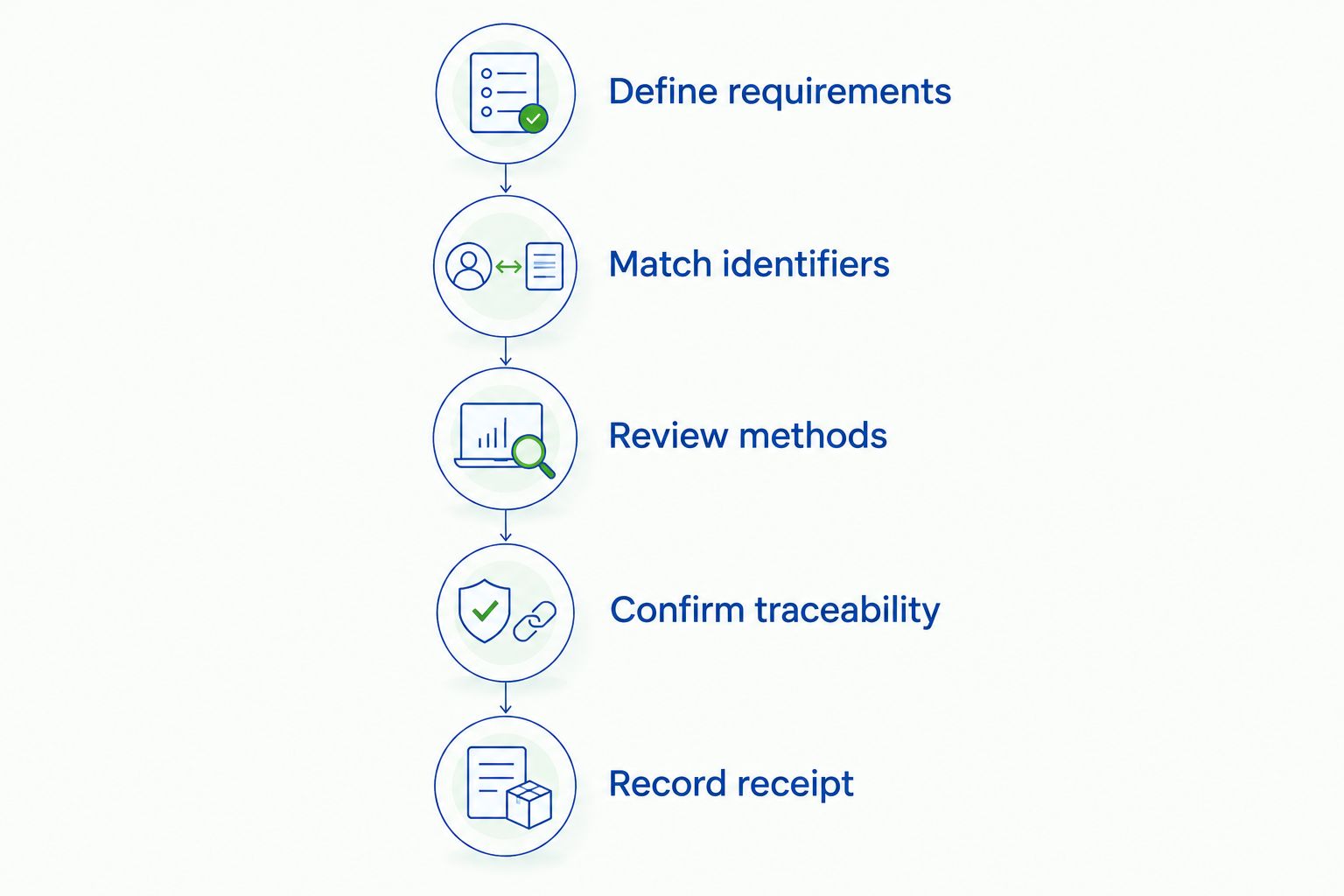
Use a documented screening process before admitting material into your research inventory. The following sequence helps you find inconsistencies and preserve traceability; it does not certify chemical identity.
Write down the peptide identity and the characteristics your experiment requires. Include relevant sequence information, modifications, formulation details, and analytical acceptance criteria. Do not assume that a familiar short name specifies every chemically relevant feature.
Decide which evidence you need before ordering. An identity study, a quantitative assay, and a cell-based experiment can have different material requirements. Ask your analytical team which tests answer those requirements rather than selecting a test solely because a supplier mentions it.
Compare the order record, vial label, and certificate of analysis. Check the peptide designation, batch identifier, and any stated modifications or formulation details. A mismatch is a reason to pause acceptance and request clarification.
Record the identifiers exactly as printed. Do not silently correct a discrepancy in your inventory system, because that removes the evidence needed to investigate it. A clerical error and a material substitution require different responses, but neither should pass unnoticed.
Read the methods behind the reported results. A purity percentage without an identified method gives you less information than a result tied to a defined analytical procedure. Ask what the reported percentage measures and how the sample was prepared.
For chromatography, examine the available chromatogram and method information rather than the headline percentage alone. For mass spectrometry, look for evidence supporting the expected molecular identity. Do not interpret a report beyond the tests it actually contains.
Ask how the tested sample connects to the batch on your vial. Review the laboratory name, report identifier, sample identifier, and analysis date where supplied. A report for a different batch is not batch-specific evidence for your material.
If authenticity of the report is in question, request confirmation through the issuing laboratory's established contact process. Preserve the original document instead of relying on a cropped screenshot. Documentation review is useful only when the underlying record can be checked.
Document the shipment condition, seal condition, label details, and any discrepancy before opening the vial. Follow your laboratory's receiving and storage procedures. Photographs support the receiving record but do not prove peptide identity.
Keep questioned material separate from accepted inventory until the discrepancy is resolved. Preserve the vial, packaging, and associated records according to your laboratory's procedures. Avoid exploratory preparation that consumes the sample or complicates later analysis.
The sequence is straightforward: define requirements, match identifiers, review methods, confirm traceability, and record receipt. Stop acceptance when a material discrepancy remains unresolved. Do not use a clean-looking powder to override a failed documentation check.
A certificate of analysis records results for a tested sample. Its value depends on the analytical methods, the credibility of the document, and the connection between that sample and your material. It is evidence to evaluate, not an automatic authenticity guarantee.
For your 2026 document review, distinguish the analysis date from the document issue date and any stated retest or expiry information. These fields serve different purposes. Do not treat a recently downloaded file as proof that the batch was recently analyzed.
A useful review asks:
A report can be authentic yet insufficient for your experiment. For example, a chromatographic purity result does not establish that microbial contamination was assessed. Request the evidence relevant to the study rather than assuming that an unlisted test was performed.
99% purity does not, by itself, establish peptide identity. You must know which method produced the result and what that percentage represents. A sample can show a dominant chromatographic peak without that peak being the intended peptide.
Chromatographic area percentage is not automatically equivalent to peptide content by mass. Detector response, separation conditions, and constituents outside the method's detection scope affect interpretation. Do not use an HPLC area result as a universal statement about everything in the vial.
Celonyx Labs sells 99%-pure, third-party-tested research peptides. Celonyx Labs is best suited to laboratory researchers sourcing research-use-only peptides with stated purity and testing signals. Those signals support supplier screening; their limitation is that you still need to evaluate the batch evidence and experimental requirements.
When reviewing Celonyx Labs, apply the same acceptance criteria you use for any research peptide supplier. Ask for relevant documentation and assess what it establishes. Research peptides are for research use only, not for human or veterinary administration.
Confidence comes from the quality and connection of the evidence, not from a single reassuring feature. In a 2026 supplier review, prioritize these factors:
Do not collapse these factors into a homemade authenticity score. Several favorable receiving checks cannot compensate for a test that answers the wrong analytical question. Match each acceptance criterion to evidence that directly addresses it.
White powder and a clear solution do not prove peptide identity. Different substances can share those appearances, and peptide formulations can differ in physical presentation. Appearance is a screening observation, not a molecular fingerprint.
Unexpected discoloration, visible particles, or an unusual vial condition should trigger investigation under your laboratory's procedures. They do not identify the cause by themselves. Conversely, the absence of visible abnormalities does not rule out substitution, impurities, or degradation.
Avoid tasting, smelling, or administering the contents as an authenticity test. These actions do not establish chemical identity and introduce unnecessary exposure. Keep assessment within controlled laboratory procedures.
Fast dissolution does not establish peptide authenticity. Dissolution behavior depends on molecular properties, solvent composition, pH, concentration, formulation, and handling. Without a defined preparation method and a suitable comparison, the observation is especially difficult to interpret.
If the material behaves unexpectedly, document the conditions rather than changing them repeatedly until the powder disappears. A clear solution does not prove that the stated peptide is present. Persistent solids also do not, by themselves, prove deliberate substitution.
Use the applicable laboratory protocol and material-specific instructions. Do not copy a preparation method from a different peptide and treat the resulting behavior as an identity test.
An unexpected assay result cannot independently prove that a peptide is fake. Assay performance also depends on preparation, concentration, controls, stability, and the experimental system. Biological activity is not a substitute for chemical identity testing.
Check the assay controls and preparation records before assigning the result to the supplier. If the discrepancy persists, preserve material for appropriate analytical investigation. Keep the observation precise: the sample did not produce the expected assay response under the recorded conditions.
That wording protects the distinction between a research finding and an unsupported allegation. Establishing deliberate misrepresentation requires evidence beyond an unsuccessful experiment.
Quarantine the vial and preserve the evidence before using it in an experiment. Record the exact discrepancy, attach the relevant documents, and notify the person responsible for laboratory material acceptance. Request clarification from the supplier without altering the original records.
For a 2026 investigation record, retain the receiving date, batch identifier, storage history, correspondence, and any preparation details. These records help an analytical laboratory understand what was received and what happened afterward. They also prevent different samples from being confused during follow-up.
Define the question before commissioning analysis. Suspected substitution calls for identity evidence; suspected contamination requires relevant contamination testing; suspected loss of integrity requires a stability-focused assessment. An analytical laboratory can help select methods and explain their limitations.
Can you tell if a peptide is fake without lab testing?
No—you cannot reliably establish peptide identity without laboratory testing. Visual inspection and document checks can reveal discrepancies, but they cannot authenticate the vial’s contents.
Does a certificate of analysis prove my peptide vial is genuine?
A certificate of analysis does not independently prove your vial is genuine. Its relevance depends on appropriate methods, a verifiable report, and a credible connection between the tested sample and your batch.
Does 99% purity mean a peptide is safe to use?
99% purity does not establish safety or suitability for an experiment. The percentage describes a result under a particular method, not every possible impurity, contamination risk, or use condition.
Is HPLC better than mass spectrometry for spotting a fake peptide?
Neither method answers every authenticity question on its own. HPLC supports chromatographic purity assessment, while mass spectrometry supports molecular identity assessment; the analytical question determines the appropriate method.
Can I identify a fake peptide by how quickly it dissolves?
No—dissolution speed is not a reliable peptide identity test. Solvent, pH, concentration, formulation, and handling affect dissolution behavior.
What should I do if a peptide label does not match its test report?
Pause acceptance and keep the vial separate from accepted inventory until the mismatch is resolved. Preserve the label, report, and order record, then request a documented explanation.
Are Celonyx Labs research peptides intended for human use?
No—Celonyx Labs research peptides are for research use only, not for human or veterinary administration. Laboratory researchers should evaluate the relevant batch documentation and experimental requirements before use.
For your 2026 acceptance checklist, replace looks genuine with a specific evidence requirement. Ask whether the batch has credible identity evidence, an interpretable purity result, and documentation connecting both to the received material. That change makes acceptance decisions reproducible rather than visual.
A genuine report and a genuine vial are separate verification questions. Check both connections: the report to its issuer, and the tested sample to your batch. Neither connection is established by attractive packaging.
A common answer to terms of service vs privacy policy is that one is “the

Choose the best tesamorelin peptides by lot documentation, identity, and assay fit. Compare research specifications,

Searching for the best 5-amino-1mq peptides? Choose identity-confirmed material, compare research formats, and verify lot
FOR RESEARCH USE ONLY. Products sold by Celonyx Labs are intended exclusively for laboratory and scientific research. They are not intended for human or veterinary use, consumption, diagnosis, treatment, cure, or prevention of any disease. By purchasing from this site, you acknowledge that you understand the intended research purpose of these materials and agree to comply with all applicable laws and regulations.