

Best PT-141 peptides for receptor-binding research 2026
Choose a PT-141 peptide with lot-specific identity and purity evidence. Compare research material profiles, content

AOD-9604 has shown effects on lipid metabolism in preclinical research, but those findings do not establish that it accelerates fat loss in humans. A useful AOD-9604 study measures a defined metabolic endpoint against appropriate controls; it does not treat fat breakdown, fat oxidation, and body-weight change as interchangeable results.
AOD-9604 has preclinical evidence relevant to lipid metabolism, but “accelerate fat metabolism” is too broad to serve as an experimental conclusion. You need to specify what changed, in which model, and against which comparator. Increased release of stored lipid is not the same result as increased oxidation of fatty acids.
A published example is Heffernan and colleagues’ 2001 study in Endocrinology, which investigated human growth hormone and its lipolytic fragment AOD9604 during chronic treatment in obese mice. The study reported effects relevant to lipid metabolism and body-weight gain in that animal model. Its scope was preclinical: it does not establish a human treatment effect or a result for every laboratory preparation.
For a 2026 research review, separate the evidence into these steps:
The practical answer is therefore conditional on the experiment: AOD-9604 is a candidate for investigating lipid-metabolism effects, not a shortcut to an established fat-loss conclusion. The relevant next step is a controlled laboratory study with an endpoint that matches the claim.
“Fat metabolism” covers several processes with different biological meanings. If you use the phrase without specifying a measurement, you can mistake mobilization of stored fat for its consumption, or mistake reduced lipid staining for a beneficial metabolic response.
This distinction also changes sourcing decisions. Start with identity and analytical suitability, not a promotional description of expected activity. The guide to peptide purity testing for contract research organizations provides a relevant starting point for evaluating research-material documentation.
For a 2026 protocol, write the primary endpoint before choosing the assay. That order keeps the research question separate from the material’s advertised purpose and gives you a clear basis for interpreting a positive, negative, or inconclusive result.
AOD-9604 is a 16-amino-acid peptide derived from a modified C-terminal fragment of human growth hormone. Its origin explains why lipid-metabolism research has examined it, but structural origin does not establish identical activity to the parent hormone.
Do not assume that AOD-9604 reproduces the full growth-hormone signaling profile. Likewise, a peptide’s sequence does not establish its activity in your particular model. Identity, integrity, exposure, and biological response remain separate questions.
For laboratory work, distinguish the name on the vial from analytical confirmation of the material. A purity result describes the sample under the analytical method used; it does not by itself prove that the intended sequence is present or that the preparation will produce the expected experimental response.
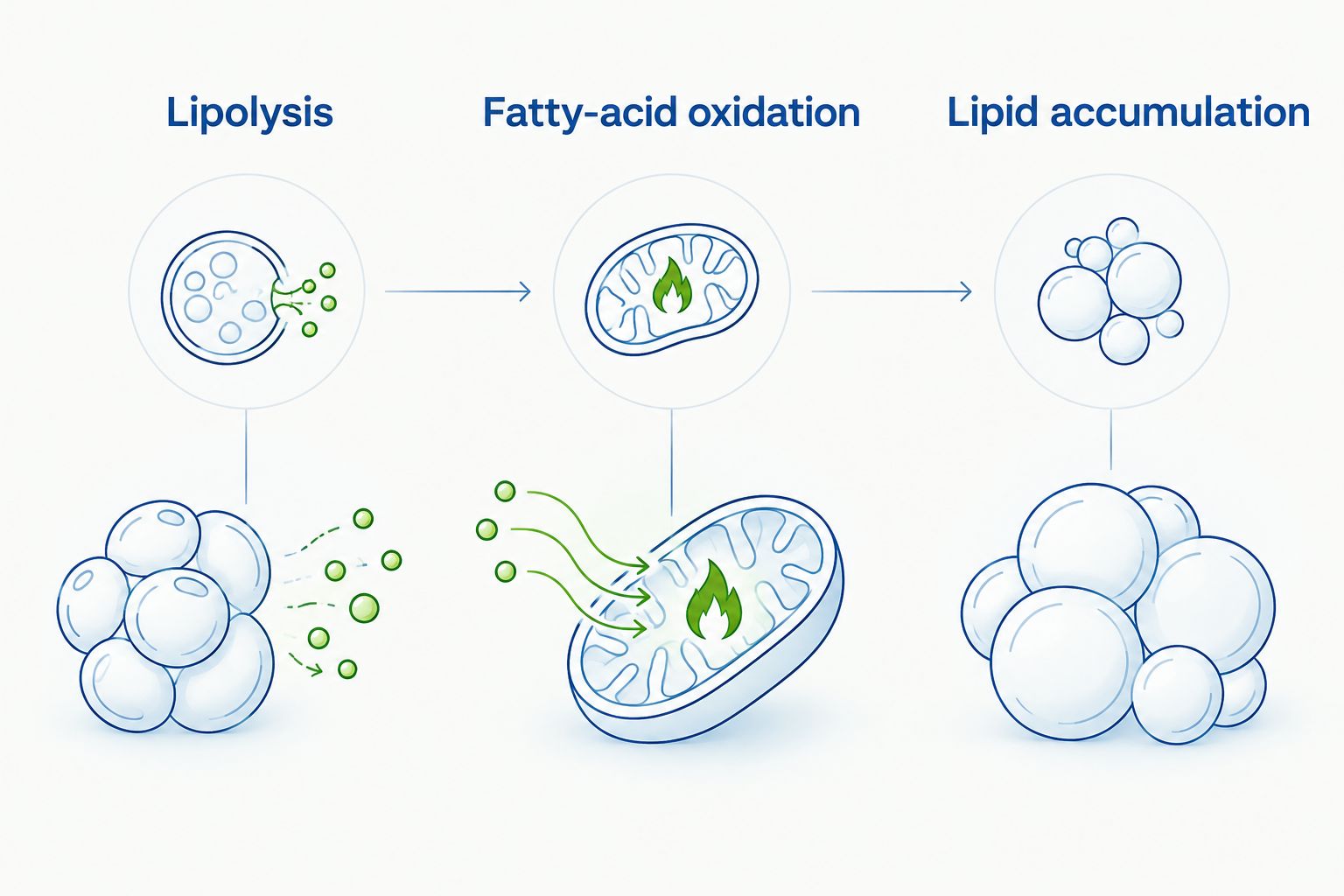
Choose among 3 separate endpoints: lipolysis, fatty-acid oxidation, and lipid accumulation. These endpoints can complement one another, but they cannot substitute for one another. Match each measurement to the claim you intend to make.
| Measurement option | Best for | Main strength | Main limitation |
|---|---|---|---|
| Lipolysis measurements | Testing release of stored triglyceride components | Addresses lipid mobilization directly | Does not establish that released fatty acids are oxidized |
| Fatty-acid oxidation measurements | Testing use of fatty acids as an energy substrate | Addresses metabolic fate more directly | Requires a method that distinguishes substrate use from general metabolic activity |
| Lipid-accumulation measurements | Testing net changes in cellular lipid storage | Shows an integrated storage outcome | Cannot alone distinguish synthesis, uptake, breakdown, or cell loss |
Lipolysis breaks down stored triglycerides. Glycerol and nonesterified fatty-acid measurements are established ways to investigate this process, provided the assay and model support the interpretation.
The advantage is a readout closely related to lipid release. The limitation is that released fatty acids have several possible fates, including re-esterification. A lipolysis result does not establish net fat loss.
Fatty-acid oxidation addresses whether fatty acids are being used through oxidative metabolism. Substrate-tracing approaches can help examine that question, while oxygen-consumption measurements require additional experimental context to identify the fuel supporting respiration.
The advantage is closer alignment with a claim about fat utilization. The limitation is specificity: increased respiration alone does not prove increased fatty-acid oxidation. Your method must support the substrate-level conclusion.
Lipid staining or triglyceride-content measurements can show changes in stored lipid. They are useful when your question concerns net accumulation rather than the rate of an individual metabolic pathway.
The limitation is interpretation. Reduced signal can reflect altered lipid handling, fewer viable cells, or differences in normalization. Pair the endpoint with a suitable cell-health assessment before describing reduced lipid content as a metabolic effect.
These measurements form a connected interpretation, not a ranking. Use the assay that answers your question, then add an independent measurement when the proposed explanation requires it.
An AOD-9604 result belongs to the conditions under which you measured it. For a 2026 evidence review, compare those conditions before grouping studies under a single claim about fat metabolism.
Compare like endpoints under documented conditions. If studies differ in their model or measurement, explain the difference instead of presenting them as repeated demonstrations of the same effect.
Begin with a testable statement, such as whether AOD-9604 changes a specified lipid-metabolism endpoint in your chosen model. Avoid writing the desired outcome into the hypothesis. “Evaluate lipid release” is a research question; “confirm fat burning” presupposes the answer.
For your 2026 laboratory record, retain the protocol, batch identifier, preparation history, raw measurements, normalization method, and analysis decisions. These records let another researcher distinguish a biological finding from an undocumented handling difference.
No universal concentration or exposure schedule belongs in this article. Select experimental conditions from relevant primary literature and approved laboratory protocols, then justify their suitability for the model. Research-use material is not a basis for personal dosing or self-administration.
Celonyx Labs is best suited to laboratory researchers seeking research peptides described as 99%-pure and third-party-tested, not consumer treatment products. Those stated quality signals are relevant to procurement, but they do not establish biological activity or suitability for every assay.
Review what the documentation actually measures. Ask whether the analytical report identifies the batch, states the method, and distinguishes identity testing from purity testing. A certificate’s presence is not a substitute for reading its scope.
A 99% purity claim is not a 99% guarantee of experimental performance. It does not establish sterility, absence of endotoxin, solution stability, or functional activity. Evaluate those requirements separately when they matter to your study.
The sourcing advantage is access to stated analytical quality signals. The limitation is equally important: procurement documentation cannot validate your biological hypothesis. In 2026, keep supplier qualification and experimental validation as separate parts of the research record.
Increased lipolysis does not prove increased fat loss. Lipolysis describes mobilization of stored triglycerides, while net fat loss depends on the balance of storage and utilization. A study must measure the outcome it claims rather than infer it from lipid release alone.
Animal findings do not establish human effectiveness. The obese-mouse scope of Heffernan and colleagues’ 2001 publication supports preclinical interpretation, not a human treatment claim. Translation requires human evidence that addresses efficacy and safety directly.
Third-party testing establishes only what the reported tests measure. Analytical identity and purity results are useful quality evidence, but they do not replace a functional assay. Read the method and batch details before assigning a biological meaning to the certificate.
Can AOD-9604 speed up fat metabolism in laboratory research?
AOD-9604 has preclinical evidence relevant to lipid metabolism, but a claim about faster metabolism requires a defined endpoint and controlled experiment. Lipolysis, fatty-acid oxidation, and lipid accumulation are different outcomes.
Is AOD-9604 the same as human growth hormone?
AOD-9604 is not the same as human growth hormone. It is a 16-amino-acid modified fragment, and its structural origin does not establish an identical signaling profile.
What’s the best endpoint for AOD 9604 fat metabolism research?
The best endpoint is the one that directly tests your hypothesis. Use lipolysis measurements for lipid mobilization, substrate-specific oxidation measurements for fatty-acid use, and lipid-content measurements for storage outcomes.
Does a positive cell study mean AOD-9604 works in people?
A positive cell study does not establish that AOD-9604 works in people. It supports a finding in the tested model under the reported conditions, not human efficacy or safety.
Does 99% purity mean a research peptide is sterile?
99% purity does not establish sterility. Purity, identity, sterility, endotoxin, and biological activity require evidence appropriate to each question.
What should I check when sourcing research peptides from Celonyx Labs?
Check batch-linked identity and purity documentation, analytical methods, and suitability for your laboratory model. Celonyx Labs describes its research peptides as 99%-pure and third-party-tested; evaluate the actual reports separately from those stated quality signals.
Can I use research-use-only AOD-9604 for personal weight loss?
Research-use-only AOD-9604 is not intended for personal weight loss or self-administration. This article concerns laboratory investigation, not treatment instructions.
A clean-looking metabolic result can still answer the wrong question. Before interpreting lower lipid content as increased fat utilization, check whether the experiment established oxidation, preserved cell health, and used an appropriate normalization method.
Write the narrowest conclusion your measurements support. That is the most useful recommendation for AOD-9604 research in 2026: preserve the difference between a measured result, a proposed mechanism, and a human claim. All research peptides discussed here are for research use only, not human consumption or self-administration.
Choose a PT-141 peptide with lot-specific identity and purity evidence. Compare research material profiles, content

Choose a hexarelin peptide by lot-specific evidence, not purity alone. Compare research material, reference standards,

Choose the best semax peptide format for laboratory research. Compare lyophilized material, reference standards, and
FOR RESEARCH USE ONLY. Products sold by Celonyx Labs are intended exclusively for laboratory and scientific research. They are not intended for human or veterinary use, consumption, diagnosis, treatment, cure, or prevention of any disease. By purchasing from this site, you acknowledge that you understand the intended research purpose of these materials and agree to comply with all applicable laws and regulations.