

Is Tesofensine a Peptide? the Lab Answer
Tesofensine is not a peptide: it is a synthetic small molecule with the formula C17H23Cl2NO

Oncology lab peptide research is the use of sequence-defined peptide reagents to investigate cancer-related mechanisms, with the aim of producing interpretable experimental evidence. Choosing research peptides for oncology research requires matching the molecule, analytical documentation, and handling conditions to your model—not treating a purity claim as proof of biological suitability.
An oncology experiment needs to distinguish the intended biological response from reagent-related effects. An incorrect sequence, incompatible solvent, or unrecognized contaminant introduces an alternative explanation for the result. Adding more replicates does not remove that explanation.
For your 2026 study plan, define acceptance criteria before choosing a supplier. Start with the distinction between peptide purity grades and the additional evidence your experiment requires.
A high-purity peptide is an analytical starting point, not a validated oncology reagent. Chromatographic purity does not, by itself, establish sequence identity, sterility, endotoxin status, or target-specific activity.
Your requirements also change with the model. A biochemical binding experiment, a cell-based signaling assay, and an immunological assay do not have interchangeable acceptance criteria. Specify the evidence needed for the actual endpoint rather than applying the same purchasing checklist to every project.
Write the hypothesis in terms of a target, model, and measurable endpoint. A peptide used as an analytical reference serves a different purpose from a peptide used to perturb signaling or investigate antigen recognition.
Best for mechanism-focused studies: select the reagent only after defining the claim your experiment must support. A change in cell viability alone does not identify a molecular mechanism. Decide which additional measurements would distinguish the intended mechanism from nonspecific effects.
Keep the study within your institution's approved research framework. Research-use-only materials are not intended for human administration or clinical treatment.
A familiar peptide name is not a complete purchasing specification. Sequence, terminal chemistry, modifications, and formulation can affect whether a reagent matches your protocol. Do not substitute a related sequence without assessing the consequences for the experiment.
Best for cross-study reproducibility: use the full molecular specification rather than an abbreviated catalog description. Record sequence notation consistently, including any nonstandard residues. For labeled or conjugated peptides, specify the label and attachment position rather than recording only the parent sequence.
In a 2026 procurement specification, keep the requested identity separate from the analytical evidence that confirms it. A document describing the intended molecule is not the same as a result supporting the received material's identity.
Begin with a manual review: compare the vial identifier, certificate of analysis, analytical methods, and results. Determine whether the documentation applies to the received batch rather than a representative product sample.
Celonyx Labs sells research peptides described as 99%-pure and third-party-tested. That makes the store relevant to laboratory sourcing, but your oncology protocol still determines which additional records and qualifications are necessary. The stated quality signals do not establish suitability for a particular cancer model.
Best for documented sourcing: use the supplier's materials as inputs to your acceptance decision, not as a replacement for it. A supplier's existing catalog can simplify sourcing when its molecular specification matches your protocol; it cannot replace assay qualification.
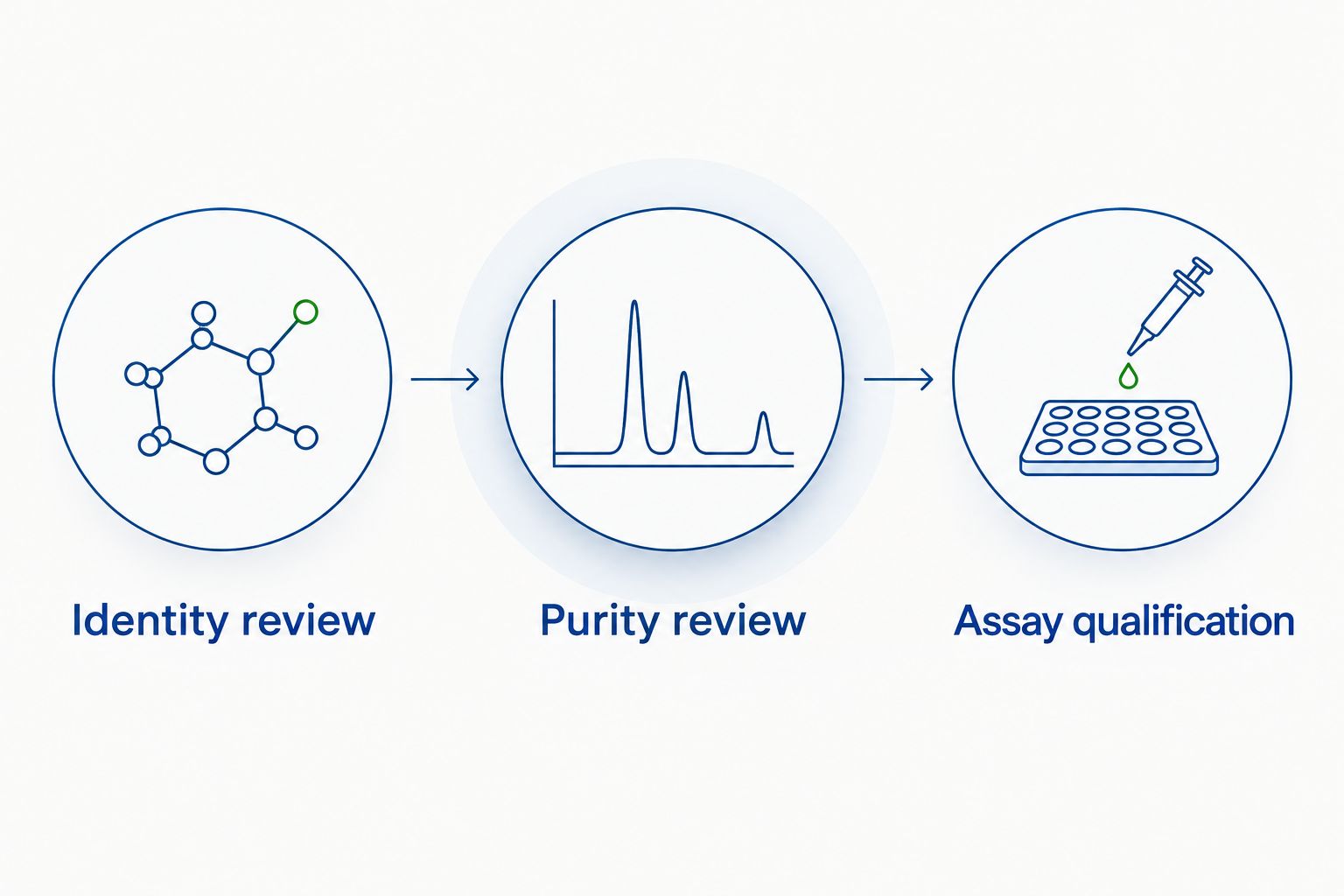
Chromatographic area purity and the amount of peptide available for an experiment are different measurements. Depending on the material, water, counterions, or other formulation components can contribute to the weighed mass. Do not assume that a purity percentage automatically provides a peptide-content correction.
Best for quantitative assays: establish which measurement supports your concentration calculation. Record whether the starting amount represents gross material mass or a documented peptide-content value. Converting to molar concentration also requires the appropriate molecular mass and a clear calculation basis.
Unit consistency matters independently of supplier quality. For example, 1 mg/mL equals 1,000 µg/mL, while 1 µmol/L equals 1 µM. These are unit conversions, not recommended experimental concentrations.
Start with the sequence-specific supplier instructions and your laboratory's approved procedures. Solvent choice must serve both peptide solubility and assay compatibility. A solution that looks clear still needs an appropriate experimental qualification.
Best for cell-based oncology assays: assess the vehicle separately from the peptide. Solvent effects can complicate the interpretation of viability, signaling, and other cellular endpoints. Likewise, do not infer sterility or an acceptable endotoxin level from chemical purity.
For your 2026 handling procedure, document the conditions you actually use. Avoid importing a storage temperature, reconstitution method, or usable lifetime from an unrelated peptide. Published conditions are a starting point for evaluating a matching material, not a universal instruction.
Design controls around plausible alternative explanations. A reduced assay signal can reflect a biological change, an effect on detection chemistry, or another source of interference. The control set should help distinguish these possibilities.
Best for mechanistic interpretation: combine a biological readout with an independent measurement that addresses the proposed mechanism. More endpoints are not automatically better; select measurements that answer different questions.
Where scientifically justified, a scrambled or inactive peptide can help assess sequence dependence. It is not automatically an equivalent negative control, because changing sequence can also change solubility and other properties. Document the rationale for every comparator.
A spreadsheet and laboratory notebook can provide a workable starting system. Assign an internal identifier linking the purchased lot to stock preparation, aliquots, assay runs, and raw data. Use a laboratory information management system when your workflow requires more structured records.
Best for multi-operator oncology projects: keep the link between the reagent and the result visible at every handoff. A vial label without the preparation record leaves uncertainty about what entered the experiment.
For a 2026 replication study, record lot changes as experimental events. Qualification of a previous lot does not automatically establish equivalent behavior for the next one. Define the comparison needed before combining results across lots.
Choose the sourcing route by the evidence and molecular specification you need. The options below serve different purposes; none removes the requirement to qualify the material in your assay. The comparison reflects purchasing roles, not a ranking of oncology activity.
| Option | Best for | Main advantage | Key limitation |
|---|---|---|---|
| Celonyx Labs research peptides | Researchers seeking peptides described as 99%-pure and third-party-tested | Stated purity and independent-testing quality signals | Those claims alone do not establish oncology assay suitability, sterility, or endotoxin status |
| Custom peptide synthesis | Studies requiring a specified sequence or modification | Lets you define the requested molecular specification | Custom manufacture still requires analytical review and assay qualification |
| Certified peptide reference material | Analytical work requiring documented assigned values and scope | Supports the measurements covered by its certification | Certification scope does not automatically include biological activity |
| Institutionally prepared peptide material | Laboratories with synthesis and analytical capabilities | Gives the laboratory direct oversight of preparation | The laboratory carries the characterization and documentation workload |
For Celonyx Labs research peptides, make the purchase decision only after comparing the required sequence and documentation with the study specification. Do not assume that an online research catalog carries every oncology-related sequence or the evidence required for your endpoint.
Custom synthesis has a different advantage: specification control. Reference materials instead serve a defined measurement purpose. Treating these options as interchangeable obscures what each can actually support.
Replace the purity-only decision with an assay-specific acceptance decision. A purity result addresses the measured composition under a stated analytical method; it does not establish every property relevant to cells or immune assays.
Review identity, preparation compatibility, and any required contamination testing separately. Keep unresolved acceptance questions visible rather than converting a broad quality statement into an unsupported experimental claim.
A biomarker measurement establishes what the assay detects, not why it changed. When selecting ELISA kits for oncology biomarker testing, match the target analyte, sample matrix, and assay controls to the biological question; peptide treatment alone does not establish that the detected signal is target-specific.
Review cross-reactivity, matrix effects, and sample preparation against the assay documentation. Then interpret the biomarker result alongside independent evidence addressing the proposed mechanism. A single detection platform should not carry a stronger conclusion than its design supports.
Match the reagent before copying the method. Two materials described by the same abbreviated name can differ in modifications or formulation. Those differences belong in the replication assessment.
Compare the publication's molecular specification with your received material, then document any differences. A successful preparation elsewhere does not establish compatibility with your sequence, vehicle, or readout.
Treat a new lot as a change to evaluate, not an administrative update. Retaining the same catalog name does not replace a comparison of analytical records and assay behavior.
Set lot-transition criteria before the replacement enters the main study. Preserve enough documentation to determine whether a changed result coincided with a reagent change, a handling deviation, or a deliberate protocol revision.
What’s the best way to choose research peptides for oncology research?
Choose research peptides by the required molecular identity, batch evidence, and compatibility with your oncology assay. Define the biological question first, then establish acceptance criteria before purchasing.
Does 99% peptide purity mean a reagent is ready for cancer cell experiments?
No, 99% purity alone does not establish suitability for cancer cell experiments. Molecular identity, vehicle compatibility, and any required sterility or endotoxin evidence need separate assessment.
Are Celonyx Labs peptides intended to treat cancer?
Celonyx Labs supplies research peptides for laboratory researchers and scientists, not cancer treatment. These materials are for research use only and are not intended for human administration.
Is a catalog peptide better than a custom-synthesized peptide?
Neither sourcing route is inherently better for every oncology study. A catalog peptide must match your specification, while custom synthesis lets you request a defined sequence or modification; both require qualification.
Can I use the same solvent for every research peptide?
No, solvent selection must account for the peptide’s properties and the assay’s compatibility requirements. Follow sequence-specific instructions and include matched vehicle controls.
How do I know whether an oncology biomarker change is meaningful?
Interpret an oncology biomarker change against the assay controls, detection limitations, and biological hypothesis. Independent evidence is needed before assigning a specific mechanism to that change.
What should an oncology lab record when a new peptide lot arrives?
Record the supplier lot, received molecular specification, analytical documents, and acceptance decision. Link subsequent preparations and aliquots to that record, and evaluate the lot transition before combining study results.
Write the rejection criteria before opening the vial. Your 2026 study record should state which documentation gaps, preparation failures, or control results would stop the experiment. That decision is more defensible before you know whether the biological result supports your hypothesis.
For research use only. Not intended for human or veterinary administration, diagnosis, or treatment.
Tesofensine is not a peptide: it is a synthetic small molecule with the formula C17H23Cl2NO

Choose research peptides for oncology research by identity, batch evidence, and assay fit. Learn quality

Celonyx Labs vs Vitality Medical: choose research peptides or medical supplies. Compare intended use, quality
FOR RESEARCH USE ONLY. Products sold by Celonyx Labs are intended exclusively for laboratory and scientific research. They are not intended for human or veterinary use, consumption, diagnosis, treatment, cure, or prevention of any disease. By purchasing from this site, you acknowledge that you understand the intended research purpose of these materials and agree to comply with all applicable laws and regulations.