

Automatically reorder bacteriostatic water when you reorder peptides
Automatically reorder bacteriostatic water with approval-gated requests. Check solvent requirements, usable stock, and pending orders
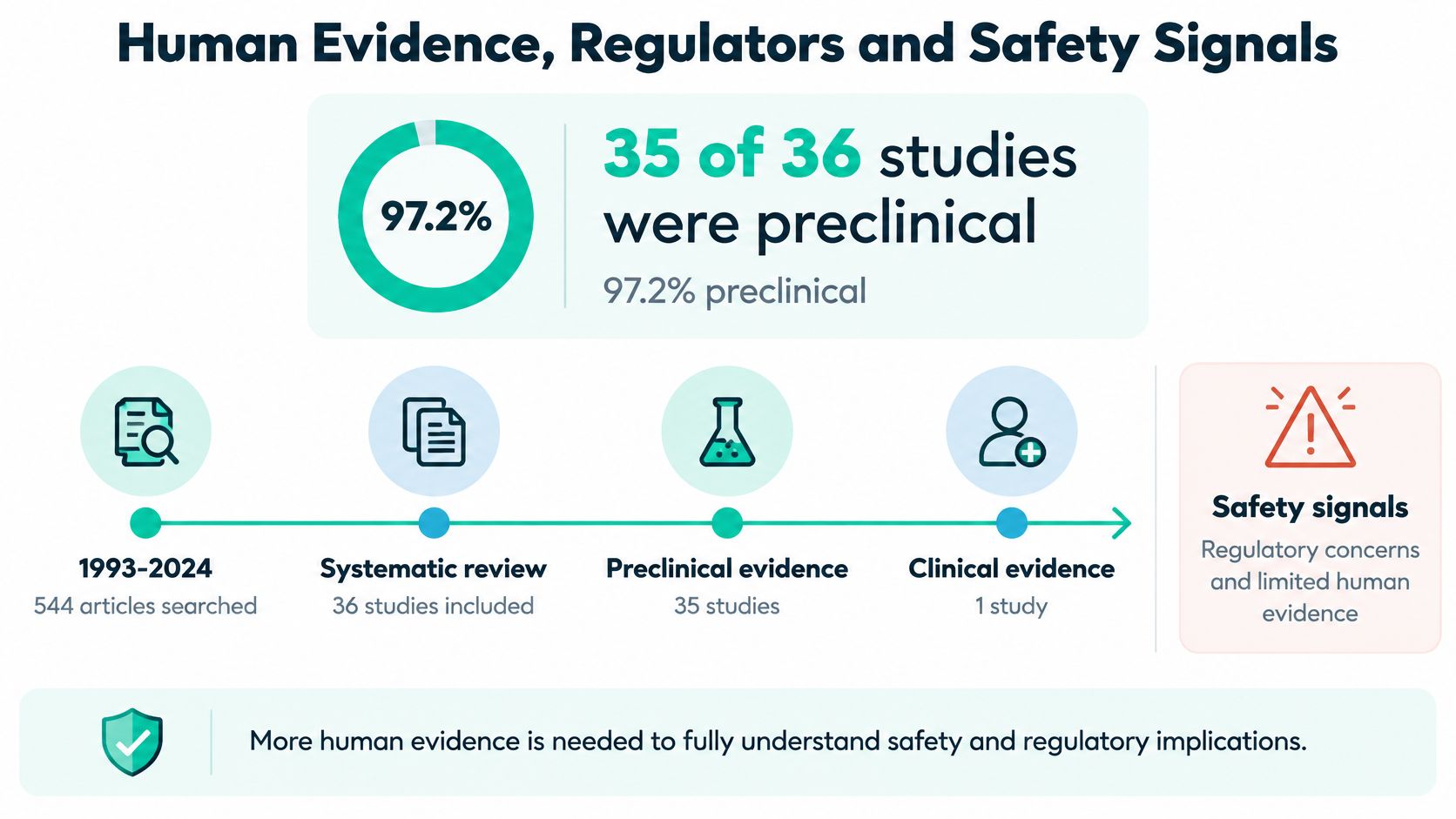
35 of 36 included studies were preclinical, and only one was clinical, in a 2025 systematic review of BPC-157 that searched 544 articles published between 1993 and 2024. That's the most useful starting point for comparing BPC-157 peptide and TB-500: laboratory interest has advanced much further than evidence establishing what these compounds do in people.
For investigators, the central question isn't which peptide has the stronger reputation for recovery. It's which specific compound, experimental model, and endpoint support the proposed experiment, and which uncertainties remain unresolved. This distinction changes how a laboratory should read a paper, qualify a vial, and interpret a favorable result.
BPC-157 and TB-500 aren't interchangeable research materials. Their differences concern molecular identity, the relevance of available models, and the evidence missing between an experimental observation and a clinical conclusion.
BPC 157 and TB 500 at a glance
| Attribute | BPC 157 | TB 500 |
|---|---|---|
| Structure | Synthetic peptide with a defined sequence | Marketed as a fragment of thymosin beta-4, not the full-length protein |
| Main preclinical models | Small-animal tendon, ligament, muscle, bone, gastrointestinal, and inflammatory injury models | Fragment-specific validation is weaker; related full-length thymosin beta-4 work includes eye, skin, and heart settings |
| Published evidence base | Predominantly preclinical, with a limited clinical component | No human exposure data identified in the cited FDA assessment |
| Human clinical data | Small, uncontrolled retrospective musculoskeletal case series | No identified human clinical evidence supporting proposed uses |
| Regulatory status | Regulatory concern under the interim compounding framework; no applicable USP or NF monograph | Regulatory concern under the interim compounding framework; no established approved indication |
| Long-term storage | Our BPC-157 storage specification is −20°C | Use a documented, formulation-specific stability specification; no temperature is established by the cited evidence |
The table exposes distinct gaps: translation to humans, fragment-to-protein equivalence, and product-specific characterization. A laboratory can have a sound reason to investigate a compound without having evidence that it treats an injury. Likewise, a related protein can have a broader literature without validating a fragment sold under another name.
BPC-157 provides a more direct starting point for some preclinical musculoskeletal questions. That doesn't establish superiority in patients, because a comparative clinical conclusion would require a different kind of study.
TB-500 requires particular care at the literature-selection stage. Investigators need to distinguish experiments using the marketed fragment from experiments using full-length thymosin beta-4 before considering whether the model is relevant.
For readers encountering peptides through wellness discussions, Medical Aesthetics And Lasers' overview of peptide treatments for aging concerns provides context for that broader conversation. It shouldn't serve as evidence that either research material has an established anti-aging indication.
Reading rule: A comparison table identifies where to investigate. It doesn't convert an experimental material into a treatment option.
A tendon experiment and a cell assay answer different questions. So do studies of a peptide fragment and studies of the full-length protein from which it is derived. These distinctions shape how BPC-157 and TB-500 research can inform a study rationale.
The comparative musculoskeletal evidence review indexed in PubMed describes BPC-157 as a synthetic 15-amino-acid peptide. TB-500 is generally marketed as a seven-amino-acid fragment of the 43-amino-acid thymosin beta-4 protein. Findings for the full-length protein do not establish biological or clinical equivalence for the fragment.
BPC-157's predominantly small-animal literature includes tendon, ligament, muscle, bone, gastrointestinal, and inflammatory injury models. Researchers have measured tissue structure, functional recovery, angiogenesis-related signaling, fibroblast activity, collagen formation, microvascular integrity, and inflammatory markers.
These endpoints are not interchangeable. A change in collagen formation does not establish restored mechanical function, and a change in an inflammatory marker does not independently show functional recovery.
For a proposed rat tendon experiment, BPC-157 studies can help researchers identify relevant tissue, outcomes, and controls. The rationale is to test a defined tendon endpoint, rather than assume that findings in other tissues predict the same result. The peptide's sequence is Gly-Glu-Pro-Pro-Pro-Gly-Lys-Pro-Ala-Asp-Asp-Ala-Gly-Leu-Val; the BPC-157 peptide product details provide a reference for the product name and sequence.
Full-length thymosin beta-4 has a broader research record in ophthalmic, dermatologic, and cardiovascular settings. Its musculoskeletal evidence is largely in vitro and rodent-based. Neither that research nor a shared association with repair biology establishes that TB-500 will produce the same results.
If a proposed TB-500 tendon experiment relies on a full-length thymosin beta-4 heart study, both the compound and tissue model differ. That study may motivate a hypothesis, but it cannot demonstrate an outcome for the fragment in tendon.
Clinical terminology should also remain distinct from preclinical research terminology. A clinical-care discussion, such as explore orthobiologic care for jaw pain, does not validate either peptide in a jaw-disorder model.
Before using a paper to support a study rationale, record:
The human evidence for BPC-157 and TB-500 does not establish clinical efficacy or safety. For BPC-157, the cited musculoskeletal evidence is a small, uncontrolled retrospective case series. Without a controlled orthopedic efficacy trial, validated dosing regimen, or established pharmacokinetic profile, it cannot determine a reliable treatment effect or human exposure-response relationship.
FDA briefing materials describe insufficient clinical safety information to characterize BPC-157 free base or acetate. Without a supporting source for claims about specific routes, the available record does not establish clinical safety or use for oral, subcutaneous, nasal, or transdermal administration.
Interpretation boundary: Sparse clinical evidence leaves uncertainty in both directions. It does not prove benefit or establish an absence of harm.
For TB-500, Drug Topics' coverage of FDA peptide deliberations describes no human clinical studies supporting proposed uses, limited or contradictory BPC-157 evidence, concerns about unwanted immune responses to injectable formulations, and adverse-event reports involving compounded injectables, including a BPC-157/TB-500 blend.
An adverse-event report establishes that an event was reported in association with an exposure. It does not, by itself, identify which ingredient or product characteristic caused it.
A blend makes it harder to identify the cause of a reaction. Investigators must consider each component, formulation, impurities, handling, and route rather than assigning the event automatically to the best-known ingredient.
The same limitation applies to favorable outcomes. Improvement after a combination exposure does not establish which component contributed, whether both were necessary, or whether the change exceeded what would have occurred without either compound.
The TB-500 peptide overview can help distinguish terminology. Experimental conclusions still depend on the test article's identity, protocol, controls, and recorded observations.
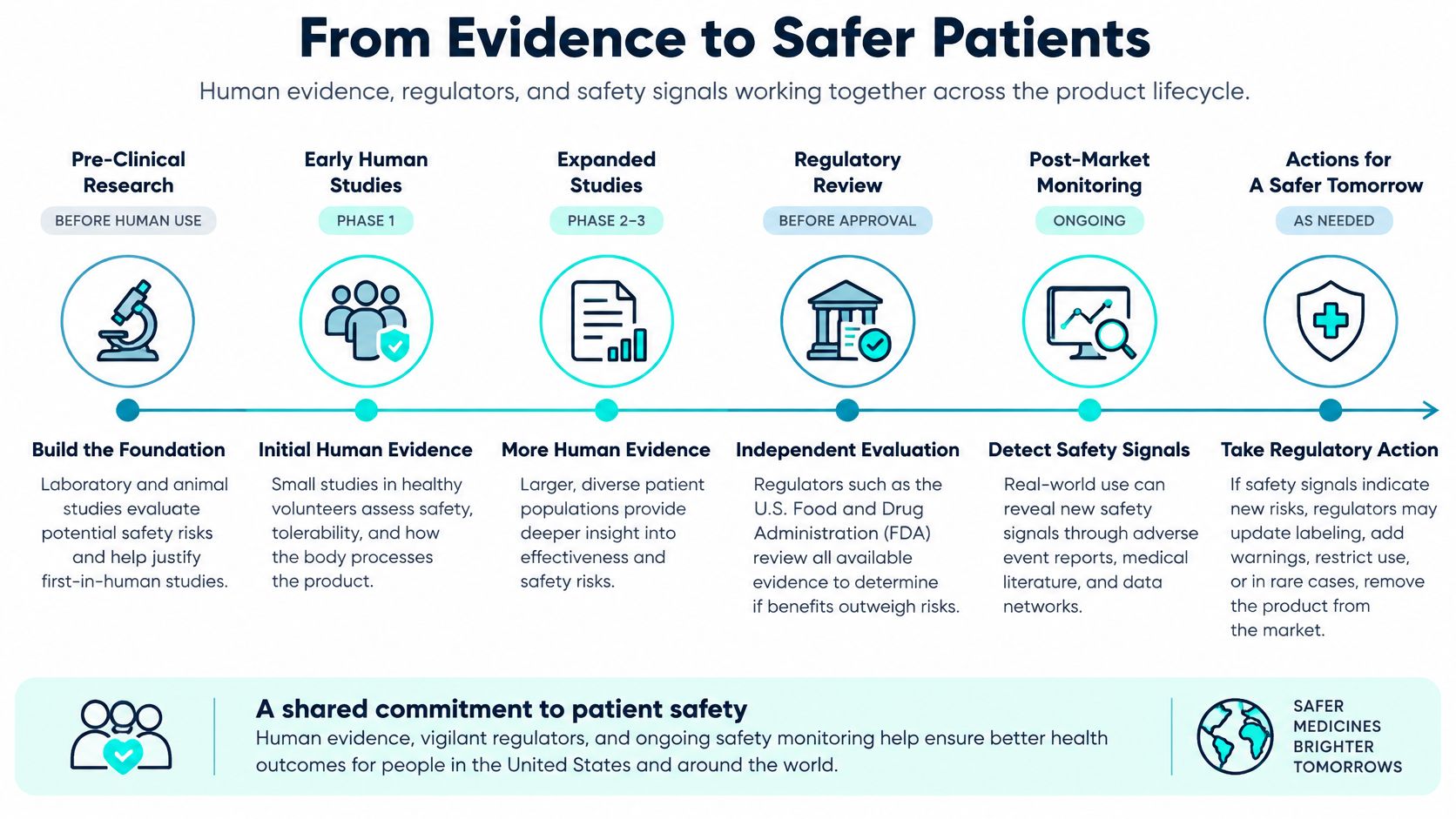
Regulatory proposals, committee discussions, or changes under consideration do not constitute FDA approval. They also do not supply missing clinical efficacy or safety evidence.
Before attributing an outcome to a compound, assemble records that let other investigators assess competing explanations.
For an unexpected inflammatory reaction in a rodent cohort, compare whether affected animals share a lot, preparation session, vehicle, route, or blend exposure. A contemporaneous record makes those comparisons possible.
A reaction associated with one preparation calls for a different investigation from one reproduced across independently characterized lots. Neither pattern establishes a mechanism, but each helps determine which explanation to test next.
“No adverse observation under tested conditions” is not equivalent to demonstrated safety. The finding is bounded by the model, observation period, measurements, and exposure.
Protocols should define adverse-observation fields and response procedures before experiments begin. Consistent recording of potential harms makes comparisons more interpretable alongside efficacy outcomes.
A study may identify a reproducible tissue response while leaving clinical usefulness, long-term safety, and route suitability unresolved.
Verification checks for either peptide
| Check | What to request or record | Why it matters |
|---|---|---|
| Identity | Lot-linked mass spectrometry results, with sequence confirmation appropriate to the method | Confirms consistency with the stated compound; nominal mass alone may not resolve every identity question |
| Purity | HPLC or UPLC trace, method, and test date | A percentage alone doesn't identify impurities or establish their biological relevance |
| Impurities and aggregation | Same-lot impurity characterization and relevant aggregation assessment | Addresses concerns beyond the main chromatographic peak |
| Endotoxin and sterility | Route-appropriate test results and institutional acceptance criteria | Supports assessment before injectable or other relevant in vivo research |
| Storage history | Temperature record from shipment onward | Our BPC-157 long-term storage specification is −20°C |
| Form | Document lyophilized material and container condition; log reconstitution date and solvent | Appearance and handling records help distinguish the original material from the prepared formulation |
The evidence review summarizing FDA safety assessments reports no identified human exposure data for TB-500 drug products and concerns involving immunogenicity, aggregation, and peptide-related impurities. It also describes the 2023 placement of BPC-157 and TB-500 in Category 2 of the interim 503A framework, and the absence of an applicable United States Pharmacopeia or National Formulary monograph for BPC-157.
That regulatory history supports careful material qualification, not a claim that a well-documented vial is clinically suitable. Analytical quality and clinical validation answer different questions.
Mass spectrometry and chromatography aren't interchangeable checks. Identity analysis asks whether the material is consistent with the intended compound; chromatographic purity measures the sample under the specified separation and detection conditions.
We perform HPLC, mass spectrometry verification, and batch consistency testing on every BPC-157 batch. Investigators should still align those records with the exact lot used and decide whether additional tests are necessary for the experiment.
A peptide certificate-of-analysis guide helps distinguish a summary certificate from its underlying analytical evidence. Retain method information and supporting results when they're necessary to interpret acceptance criteria.
A certificate that cannot be matched to the vial's lot cannot establish the analytical history of the material in hand.
White lyophilized powder is a physical description, not proof of identity or sterility. Inspect and record container condition, label information, and any visible discrepancy before releasing material into an experiment.
After preparation, log the solvent, preparation time, concentration, storage condition, and deviations from the protocol. Don't infer a reconstituted formulation's stability from a specification for dry material.
For aggregation or impurity questions, define what the analytical method can detect before interpreting a clean result. A method that wasn't designed to evaluate a particular risk cannot establish that the risk is absent.
A critical review of rodent ischemia-reperfusion studies reports BPC-157 doses from approximately 10 ng/kg to 10–20 micrograms/kg, a span of about three orders of magnitude. Similar reported outcomes across those nominal doses do not establish a dose-response relationship without validated pharmacokinetic and pharmacodynamic information.
The key distinction is between administered amount and biologically relevant exposure. A dose copied from one paper cannot show that a different route, formulation, or model produces comparable exposure.
An FDA safety-assessment evidence review reports no treatment-related effects in single-dose testing and generally good tolerance in repeated-dose dog studies. Its regulatory review also identified repeat-dose safety signals in rats and dogs, alongside insufficient clinical information to characterize human safety.
These findings apply to different study conditions and should not be averaged into a general conclusion that BPC-157 is safe or unsafe. Compare the test material, regimen, measurements, and conditions before deciding what each result supports.
Neither BPC-157 nor TB-500 has an FDA-approved musculoskeletal indication or a validated human orthopedic treatment protocol. Animal exposure ranges do not establish human dosing instructions.
For a rat tendon study comparing dose levels, set the exposure metric and sampling plan before administration. Define whether the primary comparison concerns administered mass, molar amount, measured exposure, or a prespecified pharmacodynamic response.
Matching mass alone does not create an equivalent molecular comparison between compounds. The protocol should explain why its chosen metric fits the hypothesis.
Batch characterization can reduce uncertainty about the test article, but it cannot provide missing exposure measurements or make an unsuitable comparator valid.
Design principle: Standardize what the experiment controls, measure what it claims to compare, and state any unmeasured exposure differences.
Choosing a peptide by research goal
| Research goal | Better-documented starting point | Check before starting |
|---|---|---|
| Musculoskeletal injury model in small animals | BPC-157 for direct tendon, ligament, and muscle precedents | Match the model, route, and endpoints to relevant experiments |
| Full-length thymosin beta-4 questions in eye, skin, or heart models | Full-length thymosin beta-4 literature, not assumed TB-500 equivalence | Confirm the studied compound is full-length |
| Fragment-based TB-500 musculoskeletal work | Compound-specific in vitro and rodent evidence, not a human efficacy claim | Verify sequence, aggregation assessment, and impurity profile for the lot |
| Comparing both peptides in a study | Separate experimental arms with justified route matching | Predefine exposure metrics, controls, and adverse-observation fields |
| Any human-use question | Clinical evidence assessment, not research-vial selection | Don't treat laboratory research materials as therapeutic products |
BPC-157 has more direct preclinical musculoskeletal evidence, but neither peptide has a strong human evidence base. Choose by the question the available models can answer, not by the breadth of repair claims attached to a compound.
A laboratory testing a tendon endpoint may reasonably prioritize BPC-157 because the published experimental context is closer to that question. A laboratory investigating fragment biology may choose TB-500 precisely because compound-specific uncertainty is the subject of the experiment.
These are different reasons to select a material. The first builds on a relevant model; the second investigates an unresolved distinction and needs controls capable of testing it.
A comparison study should also distinguish a question about individual effects from a question about combination effects. Separate-compound results don't establish combination benefit, and a blend-only experiment cannot isolate each component's contribution.
Our BPC-157 research peptide is not intended for human consumption, medical use, veterinary use, or therapeutic applications. That boundary should appear in procurement decisions, protocol documentation, and communications about findings.
The useful final question isn't which peptide is better overall. It's whether the selected material, documented lot, exposure plan, and endpoint allow the investigator to draw the intended conclusion without claiming more than the experiment measures.
Celonyx Labs supplies research peptides, including BPC-157 and TB-500, for laboratory investigators. Visit Celonyx Labs to review the catalog and contact our team about product documentation, then match the available analytical records to your protocol's identity, purity, and handling requirements before ordering.
Automatically reorder bacteriostatic water with approval-gated requests. Check solvent requirements, usable stock, and pending orders

Connect peptide invoices accounts payable system workflows through reviewed drafts, duplicate checks, and purchase-order matching

Peptide purity reports quality management system guide: match lots, retain original CoAs, route approvals, and
FOR RESEARCH USE ONLY. Products sold by Celonyx Labs are intended exclusively for laboratory and scientific research. They are not intended for human or veterinary use, consumption, diagnosis, treatment, cure, or prevention of any disease. By purchasing from this site, you acknowledge that you understand the intended research purpose of these materials and agree to comply with all applicable laws and regulations.