

Purity Ingredients Explained: How to Read a Peptide COA
The advice you'll see most often about peptide quality is to buy 99% purity and

Yes—Selank can be included alongside other nootropic peptides as an experimental condition in laboratory research, but each combination requires its own scientific rationale, compatibility assessment, and appropriate controls. Studying compounds together does not establish that they are chemically compatible, produce beneficial interactions, or are safe for human use.
Yes, provided the combination is treated as an unvalidated experimental condition rather than a proven nootropic pairing. Your protocol must distinguish the effect of Selank alone, the second peptide alone, and their combined exposure.
The appropriate design depends on the question. Testing a biological interaction is different from testing whether two compounds remain stable in the same preparation.
| Research approach | Best for | Main advantage | Main limitation |
|---|---|---|---|
| Single-peptide conditions | Establishing individual responses | Separates each compound's contribution | Does not measure a combination effect |
| Combined exposure | Testing a defined interaction hypothesis | Allows comparison against individual conditions | Requires additional controls and compatibility assessment |
| Sequential exposure | Testing whether exposure order matters | Separates timing from simultaneous exposure | Adds timing variables that complicate interpretation |
| Premixed preparation | Investigating mixture stability | Directly examines the prepared mixture | Chemical stability does not establish biological benefit |
For broader material-selection considerations, see the guide to research peptides for neuroscience labs. Select the research question before selecting a pairing.
A combination experiment can produce a different signal without demonstrating a useful interaction. Solvent differences, assay interference, preparation changes, and variation in the experimental model are alternative explanations that your controls must address.
For a 2026 laboratory protocol, document what the experiment can establish and what remains outside its scope. A cellular readout does not establish improved human cognition, and a supplier's quality claim does not validate a combination.
The central question is not simply whether Selank and another peptide can be studied together. It is whether your design can explain the result. That distinction determines whether an apparent response supports the hypothesis or requires further investigation.
Start with a specific, testable hypothesis. A statement such as “combined exposure changes the selected signaling endpoint relative to either compound alone” is testable; “the combination works better” leaves both the outcome and the comparison undefined.
Use the following sequence to separate material suitability from biological interpretation.
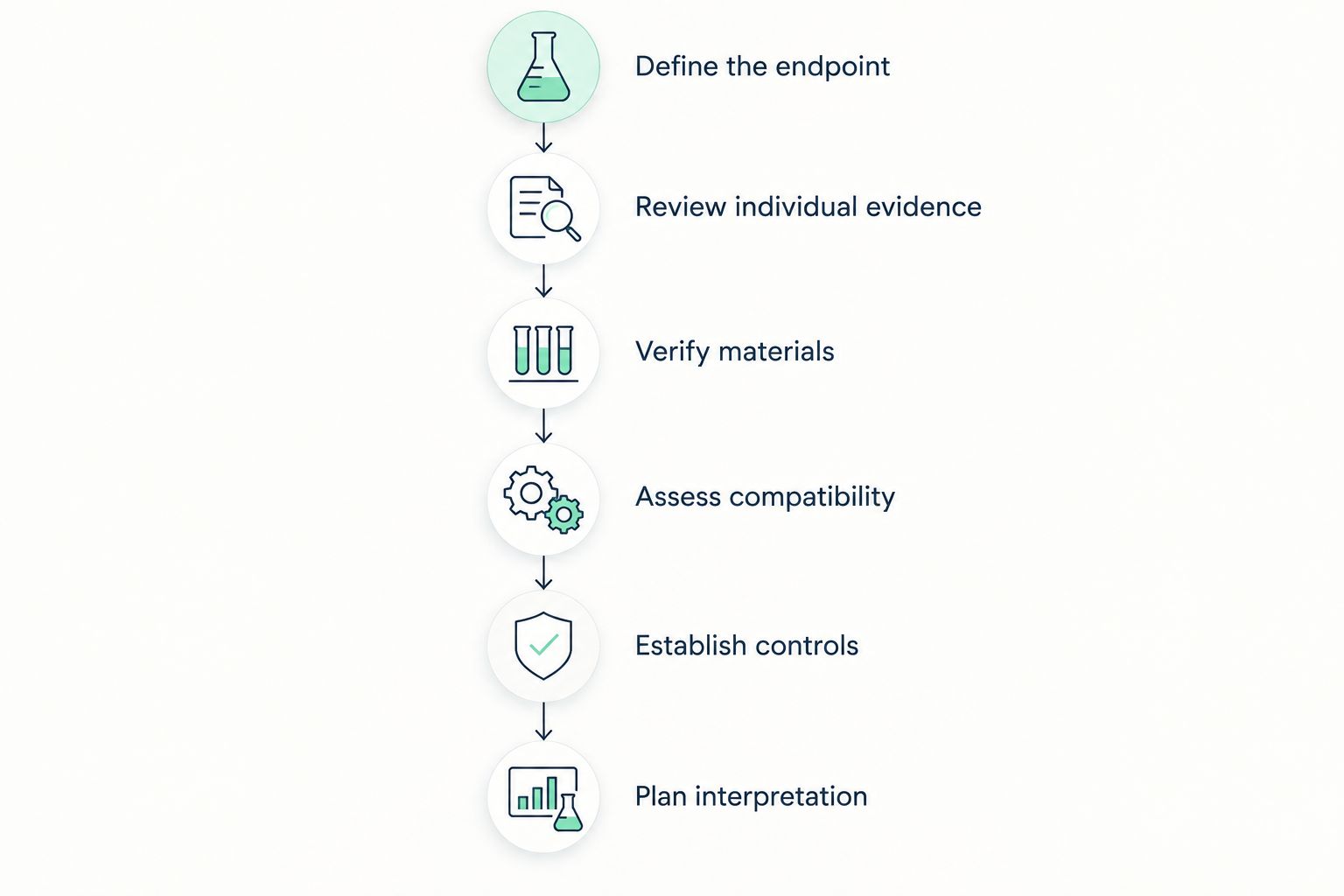
Your 2026 study record should preserve the rationale behind each decision, not just the final measurements. Another researcher needs enough detail to understand why the pairing was selected and how competing explanations were addressed.
For a basic comparison involving Selank and a second peptide, use a matched vehicle condition, Selank alone, the second peptide alone, and the combined condition. These conditions separate individual responses from the response observed during combined exposure.
Keep the surrounding experimental conditions comparable. Differences in solvent composition, handling, or measurement timing undermine attribution to the peptides themselves.
The vehicle control establishes the assay response under the preparation conditions without the test peptides. Match relevant solvent components across conditions rather than assuming the solvent has no effect.
If the combined condition contains a different vehicle composition, the comparison no longer isolates the peptide combination. Resolve that mismatch before interpreting a biological difference.
Individual-compound controls show what each peptide contributes under the same experimental framework. Without them, a response in the combined condition cannot be assigned to an interaction.
Include a suitable range of experimental conditions when the study question requires it. Determine that range from relevant evidence and assay validation, not from a commercial vial's labeled mass.
Assay controls establish that the detection system behaves as intended. Depending on the method, this includes controls for background signal, detection interference, or general loss of model viability.
A changed readout is not automatically a changed biological pathway. Check whether the compounds or preparation conditions affect the measurement itself.
The following factors change what a combination experiment measures and how confidently you can interpret it:
Record these factors consistently across the 2026 study series. If a later experiment changes several of them simultaneously, treat it as a new experimental configuration rather than assuming it confirms the original finding.
No—combining Selank with Semax does not, by itself, demonstrate synergy. Synergy requires a defined expectation for the combined response and evidence that the observed response exceeds that expectation under the selected analysis model.
A combination that differs from the vehicle control is not enough. Even a combination that produces a larger response than either compound alone requires further analysis before it can be described as synergistic.
Choose the interaction model before interpreting the data. State its assumptions and report uncertainty; if the experiment only supports a difference between conditions, report that difference without upgrading it to a mechanism or benefit claim.
No—physical mixing and combined experimental exposure answer different questions. A protocol can examine combined exposure without assuming that the compounds remain stable during storage in one preparation.
A clear solution is not proof of intact peptide identity or retained activity. Visual inspection detects some preparation problems, but analytical testing is needed to assess chemical integrity.
Do not transfer storage instructions from an individual compound to a mixture without supporting stability evidence. Record preparation history and follow the laboratory's validated procedures rather than treating a shared research category as evidence of compatibility.
Choose materials against the assay's requirements, then review the supporting documentation. Celonyx Labs sells 99%-pure, third-party-tested research peptides for laboratory researchers and scientists; those stated quality attributes do not establish a specific combination's compatibility or biological effect.
Celonyx Labs is best for laboratory researchers sourcing research-use-only peptides, not consumers seeking a nootropic regimen. Maintain that boundary when selecting materials and describing results.
The supplied catalog identifies the following research materials. Their inclusion here describes their stated research context, not a recommendation to combine them.
| Catalog material | Stated research context | Best fit for evaluation | Limitation |
|---|---|---|---|
| Selank 5mg | Neurochemical signaling pathways | A Selank-specific research question | The listed 5 mg amount does not establish an experimental concentration |
| Semax 5mg | Neurological signaling pathways | A separately justified Semax comparison | The listed 5 mg amount does not demonstrate compatibility with Selank |
For 2026 procurement records, retain the lot identifier and connect it to the analytical documentation and experimental record. Distinguish the labeled amount from verified composition and from the concentration used in the assay.
Neither third-party testing nor a purity percentage substitutes for assay-specific suitability checks. Review the actual methods and results rather than relying only on a summary label.
Match the wording of your conclusion to the experiment. Report the model, endpoint, preparation conditions, individual-compound comparisons, and limitations alongside the result.
Use a clear separation between observation and interpretation:
For a 2026 report, keep exploratory combination findings identifiable as exploratory. Repeating an experiment improves confidence in reproducibility, but it does not by itself establish the mechanism responsible for the response.
Can Selank be combined with nootropic peptides in laboratory research?
Yes, Selank can be included with another peptide as a controlled experimental condition. Each pairing requires a scientific rationale, individual-compound controls, and an assessment of preparation and assay compatibility.
Is Selank with Semax an established synergistic combination?
The pairing itself does not establish synergy. A synergy claim requires an appropriate interaction model and experimental evidence beyond a difference from the vehicle control.
Can I assume two research peptides are compatible if they dissolve clearly?
No, a clear solution does not establish chemical compatibility or retained biological activity. Assess compatibility using methods appropriate to the compounds and preparation conditions.
Does 99% purity mean a Selank combination is safe?
No, 99% purity does not establish combination safety, sterility, or suitability for human use. A purity result describes a measured quality attribute under the reported analytical method.
What controls does a Selank combination experiment need?
A basic comparison needs a matched vehicle condition, Selank alone, the second peptide alone, and the combined condition. Include additional assay-specific controls to address detection interference and other relevant sources of error.
Does a 5 mg Selank vial determine the experimental concentration?
No, a 5 mg vial label states the listed amount, not the concentration used in an experiment. Experimental conditions must follow the justified protocol and account for the material’s documented properties.
Can laboratory combination findings guide personal nootropic use?
No, laboratory findings do not establish a safe or effective personal nootropic regimen. Research-use-only peptides are not intended for human consumption.
A failed compatibility check is a useful result: it prevents a preparation problem from being reported as a biological interaction. Preserve that finding in the laboratory record instead of discarding it as an unsuccessful run.
When sourcing Celonyx Labs research peptides, keep material quality, mixture compatibility, and biological response as separate questions. A defensible combination study answers each question with its own evidence.
For research use only. Not for human consumption.
The advice you'll see most often about peptide quality is to buy 99% purity and

Can LL-37 be combined with antimicrobial peptides? Yes, for controlled laboratory research. Learn how to

Can GHK-Cu be combined with BPC-157? Learn how to frame a controlled laboratory study, verify
FOR RESEARCH USE ONLY. Products sold by Celonyx Labs are intended exclusively for laboratory and scientific research. They are not intended for human or veterinary use, consumption, diagnosis, treatment, cure, or prevention of any disease. By purchasing from this site, you acknowledge that you understand the intended research purpose of these materials and agree to comply with all applicable laws and regulations.