

Is Tesofensine a Peptide? the Lab Answer
Tesofensine is not a peptide: it is a synthetic small molecule with the formula C17H23Cl2NO

Neuroscience research peptide sourcing is the selection and qualification of peptide reagents with the aim of producing interpretable neurological experiments. This 2026 guide explains how to choose research peptides for neuroscience research, verify analytical evidence, and control preparation variables without confusing laboratory findings with clinical benefits.
Neuroscience experiments need more than a recognizable compound name. Your interpretation depends on the biological model, the measured endpoint, and the material that actually reaches the assay. A change in cell viability, for example, does not independently establish a specific neurological mechanism.
In your 2026 qualification checklist, separate analytical suitability from biological relevance. A peptide can meet a chromatographic purity specification without being suitable for your solvent system, experimental endpoint, or contamination requirements. The guide to peptide purity testing for contract research organizations provides a related documentation framework.
Choose the experiment first and the peptide second. This order keeps procurement tied to a testable question rather than a broad label such as cognitive research.
For neuroscience teams, the practical constraints include maintaining consistent exposure conditions, distinguishing pathway effects from assay interference, and preserving traceability across different operators. Those requirements apply whether you study cultured cells, isolated biochemical systems, or institutionally approved animal models.
Start with a protocol worksheet or shared document. Write the biological question, model, endpoint, and interpretation limits before reviewing supplier catalogs. This manual step requires no purchasing platform and prevents a product description from becoming your experimental rationale.
Make the question narrow enough to reject. Asking whether a peptide changes a defined signaling readout is more useful than asking whether it supports neurological health. The latter combines multiple possible outcomes and introduces clinical language that a laboratory assay cannot substantiate.
Specify what evidence would distinguish your proposed mechanism from a nonspecific response. If the endpoint changes alongside substantial loss of viability, your interpretation needs to account for that result rather than reporting the endpoint alone.
Build a literature worksheet using original studies and their methods sections. Record the exact compound identity, preparation conditions, experimental system, and endpoints. A compound mentioned in a review is a starting point for investigation, not a substitute for reading the underlying experiment.
Semax is described in the supplied catalog as a synthetic neuropeptide studied in neurological signaling research. Selank is described as a synthetic neuropeptide studied in neurochemical signaling research. These descriptions establish topical relevance; they do not establish equivalent mechanisms, validated conditions, or comparative effectiveness.
Do not treat neuropeptides as interchangeable because they appear in the same research category. Match each candidate to evidence relevant to your specific model. Where a paper uses a modified sequence or different chemical form, resolve that difference before transferring its methods.
Use a spreadsheet to compare supplier documentation against your protocol requirements. Request the certificate of analysis, identify the tested batch, and determine which analytical methods support each claim. A generic example report cannot establish the characteristics of the vial assigned to your experiment.
For 2026 sourcing, Celonyx Labs offers 99%-pure, third-party-tested research peptides for laboratory researchers and scientists. Celonyx Labs is best for laboratory researchers seeking 99%-pure, third-party-tested research peptides for experimental evaluation. The limitation is clear: those quality statements do not independently establish suitability for a particular neuroscience assay.
Celonyx Labs research peptides still require the same protocol-specific review as any other laboratory reagent. Confirm identity, relevant impurity information, and any additional testing your experiment requires; do not infer sterility, endotoxin control, or certified reference-material status from a purity claim.
Review the analytical report manually before calculating a stock solution. Chromatographic purity describes the measured composition under a particular analytical method. It is not automatically a measurement of peptide content by mass, biological activity, or the concentration of the solution you prepare.
The catalog names Semax 5mg and Selank 5mg. Those quantities identify the listed vial amounts; they are not experimental doses or recommended working concentrations. Determine the calculation basis from the documentation and your validated protocol rather than assuming all reported mass represents the same chemical basis.
For molar calculations, confirm the molecular weight and whether the documented material includes a salt or other specified form. Also record the final solution volume, not just the nominal volume of solvent added. These details make a preparation record interpretable when another researcher repeats the work.
Begin with the compound-specific handling information and your laboratory's approved procedure. Do not select a solvent simply because it is commonly sold alongside research peptides. Solubility and compatibility depend on the material and the downstream assay.
Build the preparation workflow around four checkpoints: Solvent selection, Stock preparation, Aliquot labeling, and Exposure logging. Keeping those checkpoints separate makes it easier to locate a preparation error without repeating the entire experiment.
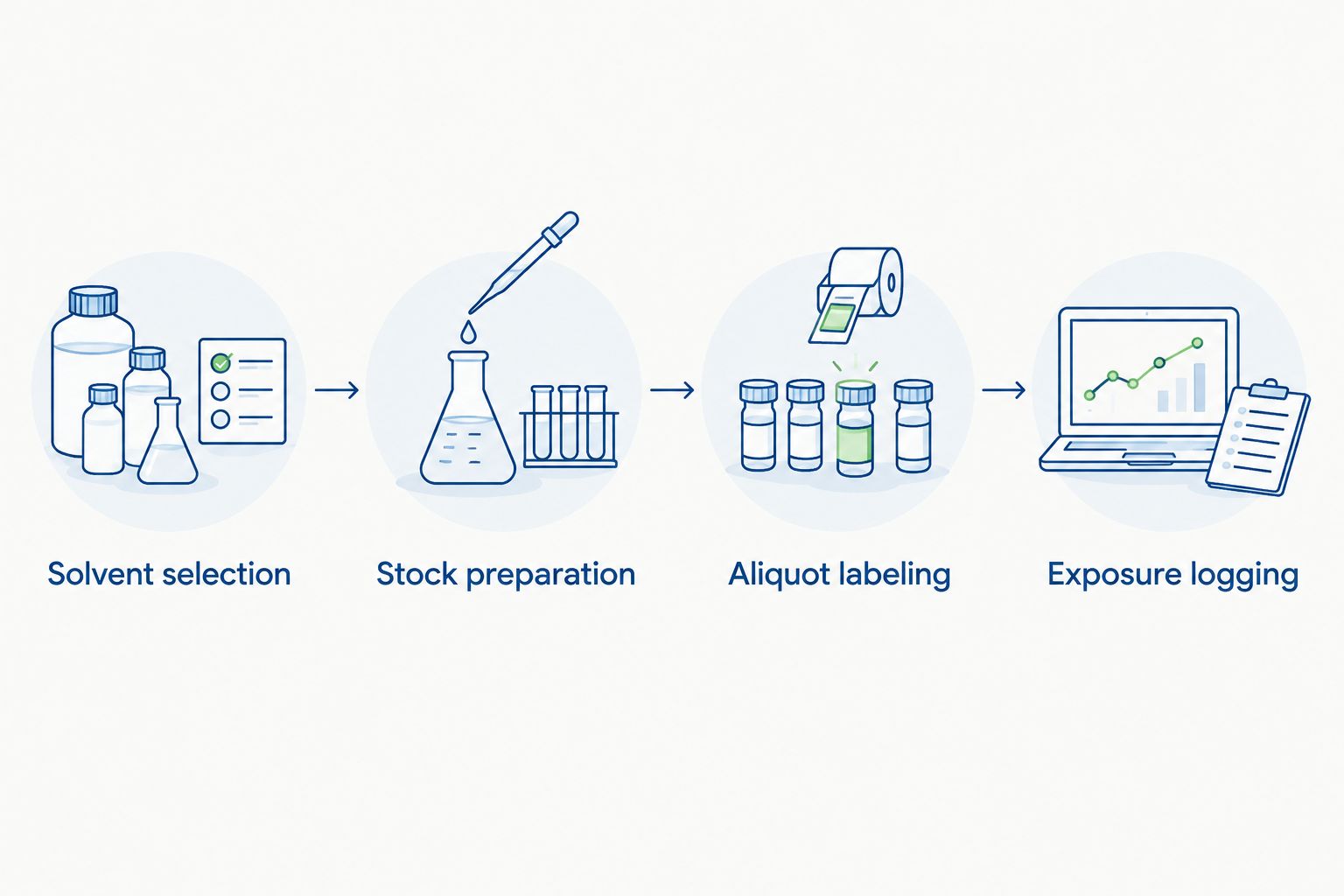
A clear-looking solution does not prove chemical integrity, sterility, or biological activity. Inspect the preparation as required by your procedure, but use analytical evidence when the question concerns degradation or identity. Avoid assigning universal storage temperatures or holding times without compound-specific support.
Draft a control matrix alongside the experimental plate map. Include a matched vehicle control so you can distinguish the preparation solvent from the peptide condition. Select positive controls from methods validated for your assay rather than assuming another research peptide fills that role.
Neuroscience readouts require careful interpretation. Changes in fluorescence, morphology, or a signaling marker need appropriate background and viability checks. A peptide-associated signal is not, by itself, evidence of a specific receptor interaction or a cognitive effect.
Define how you will handle exclusion criteria and unexpected results before collecting the main dataset. This prevents a promising-looking result from changing the rules used to judge it. Use pilot work to evaluate technical feasibility, not to retroactively select a preferred conclusion.
A shared spreadsheet and organized document folder are enough to begin. Link the supplier lot, analytical report, stock preparation, aliquot identifier, and experiment record. If your laboratory already uses an electronic notebook or inventory system, keep those identifiers consistent across systems.
For a 2026 neuroscience project, the essential outcome is a traceable result: another researcher can identify the material used and reconstruct its preparation history. Software does not replace that record structure. Avoid assuming a supplier provides an integration unless the functionality is explicitly documented.
Treat a new lot as a planned qualification event. A bridging experiment under matched conditions helps you assess whether a material change coincides with a changed assay response. Keep the lot comparison distinct from the main biological question.
The best option is the material that matches your question and documentation requirements. Semax and Selank offer different research starting points; an appropriately characterized reference material serves a different analytical purpose. None is a universal substitute for the others.
| Option | Best for | Useful characteristic | Key limitation |
|---|---|---|---|
| Semax 5mg | Literature-led investigation of neurological signaling | Cataloged as a synthetic neuropeptide for laboratory research | Catalog relevance does not establish the mechanism or conditions in your model |
| Selank 5mg | Literature-led investigation of neurochemical signaling | Cataloged as a synthetic neuropeptide for laboratory research | It is not an interchangeable substitute for Semax or a validated assay control |
| Appropriately characterized peptide reference material | Analytical identity or method checks within its documented scope | Provides a defined analytical comparison when supported by documentation | Reference-material status does not establish biological activity or experimental suitability |
Celonyx Labs lists the following neuropeptide products. Review their documentation against your acceptance criteria before selecting either; the catalog descriptions do not provide an assay protocol or establish clinical effects.


Cognitive research describes a broad area, not a measurement. Replace it in your protocol with a specific endpoint and model. Do not translate a cellular signaling result into a claim about memory, mood, or neurological treatment.
A 99% purity statement does not answer every qualification question. Identity, peptide content, contamination requirements, and biological suitability need their own evidence. Reject the shortcut of treating one analytical result as proof of all four.
A published method applies to the material and conditions it describes. Differences in chemical form, solvent, or model require review before you reuse the procedure. Record the reason for any adaptation so later researchers can distinguish replication from method development.
A changed biological response cannot be assigned to the supplier lot if solvent composition, storage history, or stock calculations also changed. Hold those variables consistent during bridging work. Otherwise, the comparison introduces several explanations at once.
What’s the best way to choose research peptides for neuroscience research?
Choose research peptides by the experimental question, biological model, and required analytical evidence. Confirm that the exact compound and preparation conditions match the evidence supporting your protocol.
Is Semax better than Selank for neuroscience experiments?
Neither Semax nor Selank is universally better for neuroscience experiments. Select the compound supported by relevant literature for your defined endpoint; their catalog descriptions do not establish comparative effectiveness.
Does 99% purity mean a peptide is ready for my assay?
No, 99% purity alone does not establish assay suitability. Review identity, concentration calculations, contamination requirements, and handling compatibility before releasing the material for use.
Can I use bacteriostatic water for every neuroscience peptide?
No, bacteriostatic water is not a universal solvent for neuroscience peptides. Use compound-specific guidance and verify that the solvent and its constituents are compatible with the downstream assay.
Are research peptides the same as certified reference materials?
No, a research peptide is not automatically a certified reference material. Reference-material status requires appropriate documentation defining its characterized properties and intended analytical use.
What records should I keep when preparing a peptide stock?
Keep the supplier lot, analytical report, chemical form, calculation basis, solvent, final concentration, preparation date, and operator identity. Link each aliquot and experiment to that stock record.
Can these research peptides be used in people?
These products are for research use only, not human use. Laboratory findings and supplier purity statements do not establish clinical safety, efficacy, or approval.
Your most useful purchasing specification is the one tied to an experimental acceptance criterion. Instead of requesting high-quality peptide, specify the identity evidence, analytical information, and handling documentation your laboratory needs to interpret its results.
Before your next 2026 study, write the release checklist before placing the order. That sequence makes unsuitable documentation a procurement decision rather than a problem discovered after the experiment. All products discussed here are for research use only, not human use.
Tesofensine is not a peptide: it is a synthetic small molecule with the formula C17H23Cl2NO

Choose research peptides for oncology research by identity, batch evidence, and assay fit. Learn quality

Celonyx Labs vs Vitality Medical: choose research peptides or medical supplies. Compare intended use, quality
FOR RESEARCH USE ONLY. Products sold by Celonyx Labs are intended exclusively for laboratory and scientific research. They are not intended for human or veterinary use, consumption, diagnosis, treatment, cure, or prevention of any disease. By purchasing from this site, you acknowledge that you understand the intended research purpose of these materials and agree to comply with all applicable laws and regulations.