

Is Humanin stable at room temperature for research use?
Is Humanin stable at room temperature? Do not assume stability. Learn how formulation, exposure records,

Follistatin-344 has no single, transferable time to show research effects: the observation window depends on the material, experimental model, and endpoint being measured. A ligand-binding result does not establish when a cellular response or tissue-level change will appear. For a 2026 research plan, use a time course supported by a matched study and a validated assay—not a general onset claim.
An observation time is part of an experimental method, not a standalone property of Follistatin-344. Without an endpoint and a defined starting event, a claim about how quickly it works is incomplete. You need to know what changed, how it was measured, and what the result was compared against.
Material documentation comes first. Keep identity, batch information, analytical results, and handling records together; the guide to connecting peptide purity data to your electronic lab notebook addresses the documentation side of that task.
This page concerns laboratory interpretation only. Research-use materials are not instructions for human administration, personal experimentation, or predicting health outcomes.
There is no defensible universal interval that applies across Follistatin-344 experiments. A useful answer must identify the preparation, biological system, measurement method, and sampling schedule. Otherwise, results from different experiments are being treated as interchangeable when they answer different questions.
Follistatin binds members of the transforming growth factor beta superfamily, including activins and myostatin. Binding, downstream signaling, gene expression, and tissue morphology are distinct endpoints. Evidence for one does not automatically establish the timing of another.
| Research endpoint | Best for | What a positive result supports | Main limitation |
|---|---|---|---|
| Ligand binding | Testing a defined molecular interaction | Interaction under the assay conditions | Does not establish a cellular or tissue response |
| Signaling readout | Testing pathway modulation | A change in the measured signaling endpoint | Depends on model responsiveness and assay specificity |
| Gene expression | Measuring selected transcriptional responses | A change in the selected transcripts | Does not establish a corresponding protein or functional change |
| Tissue morphology | Evaluating structural outcomes | A measured difference in the sampled tissue | Does not, by itself, establish the responsible mechanism |
For your 2026 protocol, state the endpoint before selecting observation times. The first scheduled positive measurement is the first detected effect—not proof of the exact moment the effect began.
The reviewed human follistatin entry in UniProt, P19883, describes a canonical precursor of 344 amino acids. Its signal peptide comprises 29 amino acids, leaving a mature chain of 315 amino acids. These sequence annotations describe protein processing, not an experimental onset schedule.
That distinction matters when you read a paper or evaluate a reagent. A precursor designation, a mature protein designation, and an expression construct description do not necessarily describe the same physical preparation. Confirm the sequence and construct details rather than relying on the name alone.
Record whether the study used purified protein or a system that produces follistatin through gene expression. For an expression-based experiment, delivery, expression, and processing sit between the starting intervention and the measured biological response. You cannot transfer that timeline directly to an experiment using an already prepared protein.
The mature 315-amino-acid form is commonly designated FST315. The shorter FST288 isoform differs in its C-terminal region and its interactions with cell-surface components. Isoform identity therefore belongs in any comparison of experimental findings.
Neither designation supplies a ready-made response time. If a paper studies FST315 while your material is described only as Follistatin-344, resolve that identity question before adopting the paper's sampling schedule.
For a 2026 literature review, separate sequence identity from biological activity. Matching a name is weaker evidence than matching the construct, preparation, and functional characterization. A nominally similar label is not enough to establish experimental equivalence.
Several experimental features determine what you can detect and when a measurement becomes interpretable. Treat them as variables to document, not reasons to promise a faster response.
A timing comparison is strongest when these features match. When they differ, describe the difference explicitly instead of combining the results into an apparent average.
Build the schedule around the question your experiment can answer. The following sequence is a planning framework, not a Follistatin-344 dosing or administration protocol.
A documented 2026 protocol should preserve these decisions before the experiment begins. Changing the endpoint after seeing the data answers a different question and needs to be identified as exploratory.
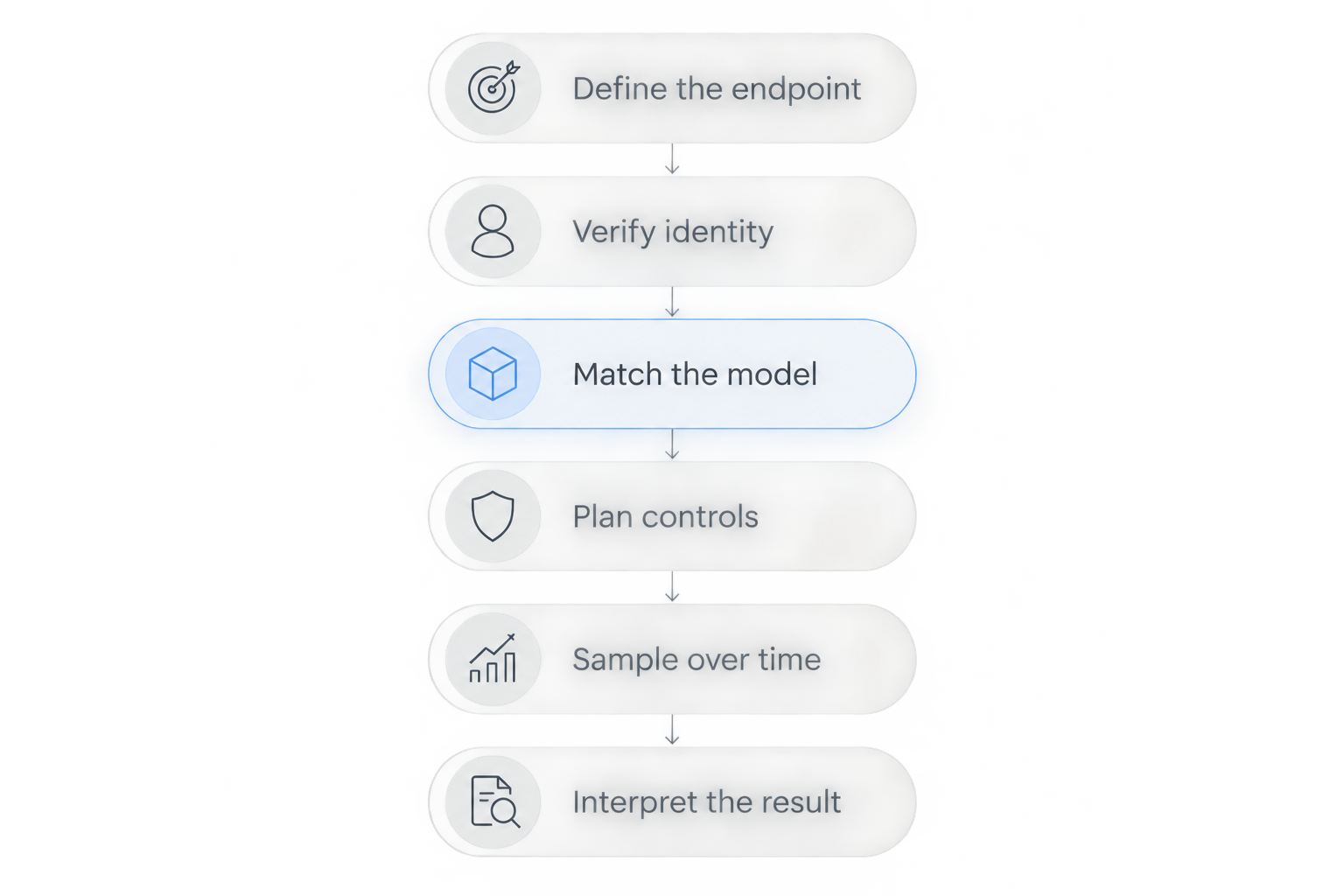
A strong timing claim points to a specific experiment. It identifies the material, model, endpoint, exposure conditions, and measurement times, then explains which comparison supports the reported change. A statement that a compound works quickly supplies none of that information.
Check whether a paper reports repeated measurements or only a final outcome. If the investigators measured an endpoint only at the end of the study, the result establishes its status at that measurement—not its onset. Do not turn a study duration into a response-time estimate.
Also separate statistical detection from biological interpretation. A measurable difference needs context: effect size, variability, controls, and the relevance of the endpoint. Statistical significance alone does not establish a useful functional outcome.
For evidence you intend to reuse in a 2026 methods document, record the publication date, experimental scope, and exact preparation. Keep the original result separate from your interpretation so another researcher can trace the reasoning.
Purity does not establish biological response timing. A chromatographic purity result describes the sample under that analytical method; it does not independently establish identity, folding, ligand-binding activity, sterility, or suitability for a particular model.
Celonyx Labs describes its research peptides as 99%-pure and third-party-tested. Those are supplier quality signals, not Follistatin-344-specific activity data or a guarantee of a response window. Evaluate the actual batch documentation against your experiment's requirements.
Celonyx Labs is for laboratory researchers sourcing research peptides, not consumers seeking treatment timelines. The practical limitation remains the same for any supplier: a catalog description cannot replace model-specific functional evidence. All materials discussed here are for research use only.
An early signaling result does not establish a later tissue effect. It supports a change in the measured pathway under the tested conditions, while structural or functional outcomes require their own measurements.
Treat the proposed connection as a hypothesis. Strengthen it with independently measured downstream endpoints rather than assuming that an upstream response guarantees the final outcome.
No observed change does not, by itself, establish inactivity. An unresponsive model, unsuitable endpoint, insufficient assay sensitivity, compromised material, or poorly matched observation window can also produce a negative result.
Check whether the controls demonstrate that the assay and model worked as intended. Extending the experiment without reviewing those checks does not resolve the underlying ambiguity.
Animal research does not establish a human response timeline for Follistatin-344. Species, experimental conditions, delivery methods, and endpoints limit what you can transfer from a preclinical finding.
Keep the conclusion within the study's scope. Do not convert a laboratory observation into advice about human dosing, muscle growth, recovery, or treatment duration.
How long does follistatin-344 take to show effects in research?
Follistatin-344 has no single response interval that applies across research models and endpoints. Use a matched study and a validated time-course assay to establish when your chosen endpoint becomes detectable.
Does the number 344 describe how long Follistatin-344 works?
No. The number 344 refers to the amino-acid length of the canonical precursor, not its onset, duration, or experimental observation window.
Is Follistatin-344 the same as mature FST315?
Follistatin-344 is the precursor designation, while FST315 describes the mature 315-amino-acid form after signal-peptide removal. Confirm what a reagent or study actually contains before comparing results.
What’s the best endpoint for detecting Follistatin-344 activity?
The best endpoint is the validated measurement that directly answers your research question. Binding, signaling, gene-expression, and tissue measurements each support different conclusions and have different limitations.
Does higher purity mean Follistatin-344 will act faster?
Higher reported purity does not establish faster biological activity. Identity, functional characterization, experimental conditions, and model responsiveness require separate evaluation.
Can I use a study’s end date as the onset time?
No. A terminal measurement shows what was detected at that measurement; it does not establish when the change began. Earlier sampling is needed to characterize the observation window.
Can research-use Follistatin-344 timelines guide personal use?
No. Laboratory timelines do not establish safe or effective human use, and research-use materials are not intended for human administration. Keep interpretation within the experimental model and endpoint studied.
Your sampling schedule sets a limit on what you can say about onset. If an endpoint is negative at an earlier measurement and positive at a later measurement, the observations bracket detection; they do not reveal the exact transition time.
Before starting your next experiment, add a sentence to the protocol defining what the first positive result will mean. Specify whether you are reporting binding, pathway modulation, or a downstream outcome. That small distinction prevents a measured research effect from becoming an unsupported general claim.
Is Humanin stable at room temperature? Do not assume stability. Learn how formulation, exposure records,

How long does follistatin-344 take to show effects? No fixed research timeline applies. Learn how

Is sermorelin legal to buy for research? Not every sale qualifies. Understand U.S. intended-use rules,
FOR RESEARCH USE ONLY. Products sold by Celonyx Labs are intended exclusively for laboratory and scientific research. They are not intended for human or veterinary use, consumption, diagnosis, treatment, cure, or prevention of any disease. By purchasing from this site, you acknowledge that you understand the intended research purpose of these materials and agree to comply with all applicable laws and regulations.