

Kisspeptin 10 for Sale Research Guide for Labs
A researcher searching “kisspeptin 10 for sale” may expect a straightforward catalog result. Instead, the
A new peptide shipment lands on your bench, still cold from transit, and everyone wants to move fast. The study timeline is already tight. The temptation is to log it, park it in the nearest freezer, and deal with the details later.
That's where expensive mistakes start.
A peptide storage container isn't just a holder for a vial. It's part of your control strategy for moisture, oxygen, light, temperature fluctuation, and handling damage. If that container fails, or if it's the wrong format for the peptide's current state, your assay may still run, but the data may no longer reflect the compound you thought you were testing. In practice, that's how small storage errors turn into failed repeats, disputed results, and wasted inventory.
Labs that handle peptides well treat storage as risk mitigation, not housekeeping. The container, seal, labeling system, aliquot plan, and storage location all work together to protect purity, consistency, and reproducibility from day one.
The first handling decision often determines whether a peptide stays reliable or becomes a hidden variable. Once a vial arrives, your job isn't only to store it. Your job is to preserve the same material identity and activity that existed when it left the supplier.
That means slowing down for a few minutes and asking the right questions before the vial is opened. Is it lyophilized or already reconstituted? Is the peptide light-sensitive? Will it be used once, used repeatedly over a short period, or archived for future work? Those answers determine the right peptide storage container, not habit or convenience.
In most labs, the threats are predictable. Moisture enters when cold containers are opened carelessly. Oxidation becomes more likely when seals are poor. Aggregation shows up after unnecessary handling and repeated freeze-thaw stress. None of those problems announce themselves clearly at the moment they happen. You usually discover them later, when a control drifts or a repeat fails.
Practical rule: If you haven't chosen the container, storage location, and aliquot plan before first use, you're improvising with high-value material.
A good storage workflow starts with four actions:
The labs that avoid preventable losses usually aren't doing anything exotic. They're just disciplined about reducing unnecessary exposure from the first hour onward. That discipline protects more than sample quality. It protects the validity of the downstream data.
Container choice is where many storage problems begin. Teams focus on the freezer setting and forget that the peptide only experiences that freezer through the vial, stopper, cap, and headspace around it.
For reconstituted peptides, chemically inert storage matters most. The verified guidance is clear that the container material should be chemically inert, such as sterile borosilicate glass with rubber stoppers, to prevent reactions that can compromise 99% purity claims, and light-sensitive materials may require foil wrapping if clear glass is used, as described in these peptide storage best practices.
For lyophilized peptides, the main issue shifts toward seal integrity, moisture exclusion, and long-term environmental isolation. Glass is still the standard in many labs because it handles cold storage well and supports dependable sealing. Plastic can have a place for secondary organization or specific validated applications, but for primary storage of valuable peptide material, glass is the preferred choice, with deviation occurring only for a clear operational reason.
Here's a simple decision view.
| Container Type | Best For | Seal Integrity | Material | Key Advantage |
|---|---|---|---|---|
| Serum vial with stopper | Routine lyophilized storage and short-term reconstituted handling | Strong when properly sealed | Borosilicate glass | Familiar format and good compatibility with cold storage |
| Cryovial | Organized cold storage and aliquot handling | Varies by cap and validation | Polymer or glass | Easy labeling and inventory management |
| Sealed glass ampoule | Long-term protection of sensitive material | Very high when intact | Glass | Minimal exposure after sealing |
| Small aliquot vial | Reconstituted working portions | Good when single-use | Borosilicate glass | Reduces repeat access to main stock |
Container sizing matters too. If the headspace is excessive, you create more opportunity for exposure during repeated handling. If the vial is too small, you make accurate transfers harder. Teams choosing among common formats often benefit from reviewing practical peptide vial sizes before they standardize purchasing.
A peptide storage container should answer three questions well.
Those trade-offs matter more than catalog appearance.
Borosilicate glass is usually the safest default because it's inert, stable in cold conditions, and compatible with sterile stopper-based closure systems. Rubber-stopper vial systems are also practical because they support repeated controlled access better than improvised caps or loosely closed tubes.
A freezer can't compensate for a poor seal. Cold slows degradation, but it doesn't stop moisture or oxygen from entering a compromised vial.
Cryovials are useful, especially for aliquot organization, but they shouldn't be chosen blindly. A cap that's convenient on the bench may not be your best option for a peptide meant for long-term archival. Ampoules offer excellent protection, but they reduce flexibility once sealed. That makes them attractive for reference material or infrequently accessed stock, not for day-to-day repeated withdrawals.
What doesn't work well is storing peptide vials loosely, mixing primary storage with transport storage, or relying on generic containers with uncertain closure performance. If the peptide is high value, the container shouldn't be an afterthought.
Most peptide loss in active lab use doesn't happen during formal storage. It happens during repeated access. Every reopening event adds risk. Every freeze-thaw cycle adds more.
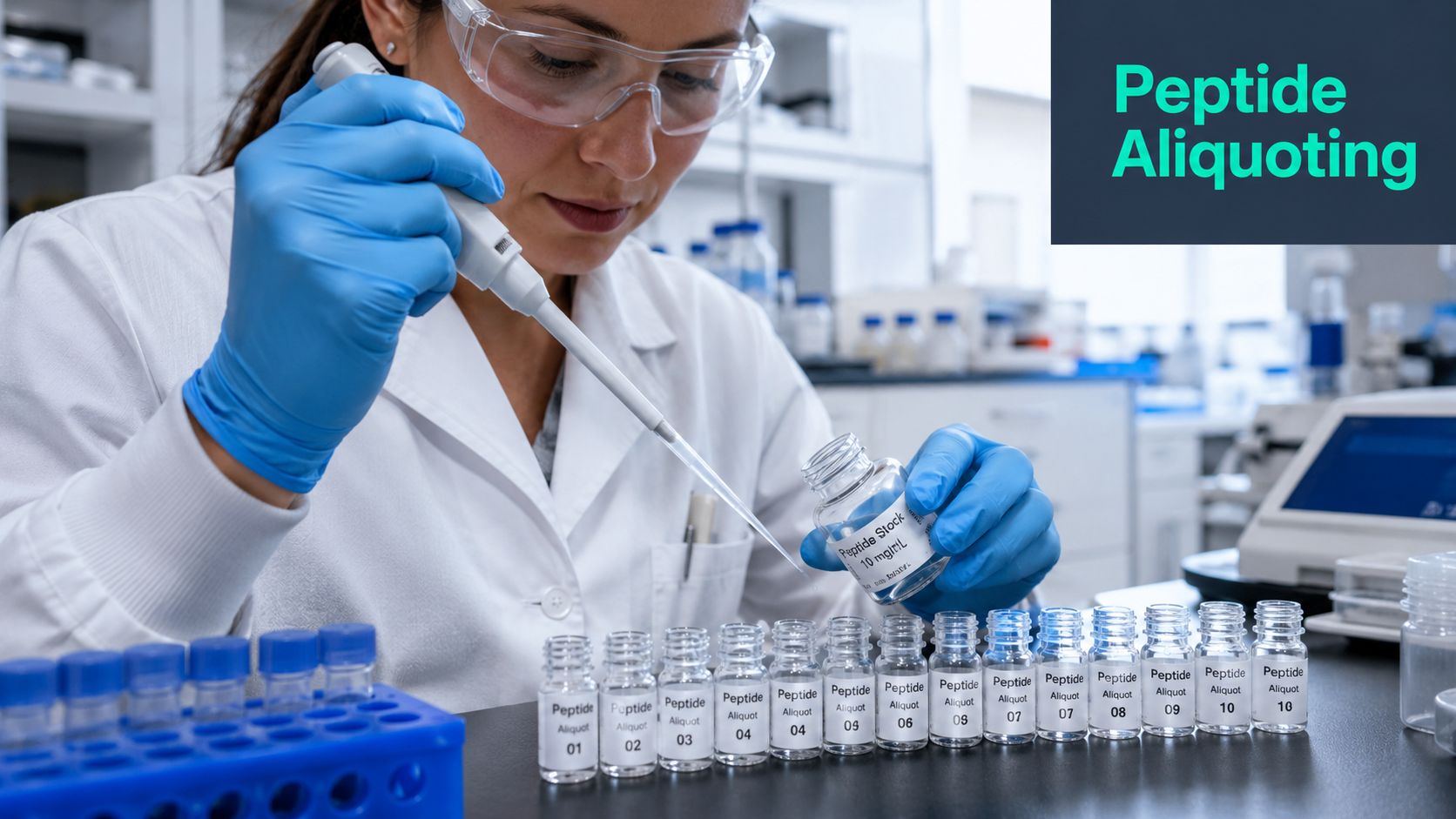
Aliquoting reconstituted peptides is one of the few storage practices that directly prevents a known potency problem. According to JPT's peptide storage guidance, freeze-thaw cycles cause aggregation and can lead to up to 15–20% potency loss per cycle. The same guidance states that aliquots stored at 2–8°C in a stable refrigerator location can retain 95%+ potency for 14–56 days, depending on sequence stability, and that failure to protect from light and temperature fluctuations accounts for 25–30% of potency loss cases.
That's why a single large working vial is usually the wrong format after reconstitution. It invites repeat warming, repeat opening, repeat pipetting, and repeated judgment calls by whoever needs the sample next. Aliquots turn one unstable workflow into many controlled single-use or limited-use portions.
A well-designed aliquot system does four things at once:
If your team needs a refresher on the upstream dissolution step before splitting into smaller portions, this guide to peptide reconstitution is a useful reference point.
Use a clean, prepared setup before you dissolve anything. Have the receiving vials labeled in advance. Know the target concentration, the aliquot volume, and which aliquots are for immediate use versus refrigerated short-term use.
A practical workflow looks like this:
Prepare sterile receiving vials first
Use sterile containers that match your planned aliquot volume. For reconstituted material, borosilicate glass is the standard choice in most labs because it minimizes interaction risk.
Reconstitute once, then move fast
Dissolve the peptide using your validated solvent and handling method. Don't leave the bulk solution sitting while the team searches for tubes, labels, or calculators.
Dispense into experiment-sized portions
Make each aliquot large enough for one run or one narrowly defined series of runs. If a vial has to be reopened many times, it's too large.
Close and protect immediately
Seal each aliquot right away. If the vial is clear and the peptide is photosensitive, shield it from light before it ever reaches storage.
Store in a stable location
Place aliquots in the designated refrigerator position, not wherever space happens to be open.
After the aliquots are prepared, a quick visual walk-through helps catch preventable mistakes before they become inventory problems.
Most aliquot failures come from ordinary bench behavior, not dramatic incidents.
If you expect to use a reconstituted peptide more than once, divide it before the first experiment, not after the second or third.
Aliquoting works because it removes repeated decision-making from the storage process. Once the aliquots are made correctly, the team doesn't need to keep improvising. That's what protects potency and keeps handling variation out of the data.
Temperature only helps when it matches the peptide's physical state and the container can hold that environment reliably. A cold room full of poorly sealed vials won't save a batch.
Lyophilized and reconstituted peptides live by different rules. For lyophilized material, long-term cold storage is the foundation of stability. Verified storage guidance states that lyophilized peptides can achieve a shelf life of 2+ years when stored at −20°C in a sealed, moisture-free container, and reducing the temperature to −80°C for ultra-long-term archival can extend stability to 5+ years, with seal integrity remaining critical over those timeframes, as detailed in this lyophilized peptide storage guide.
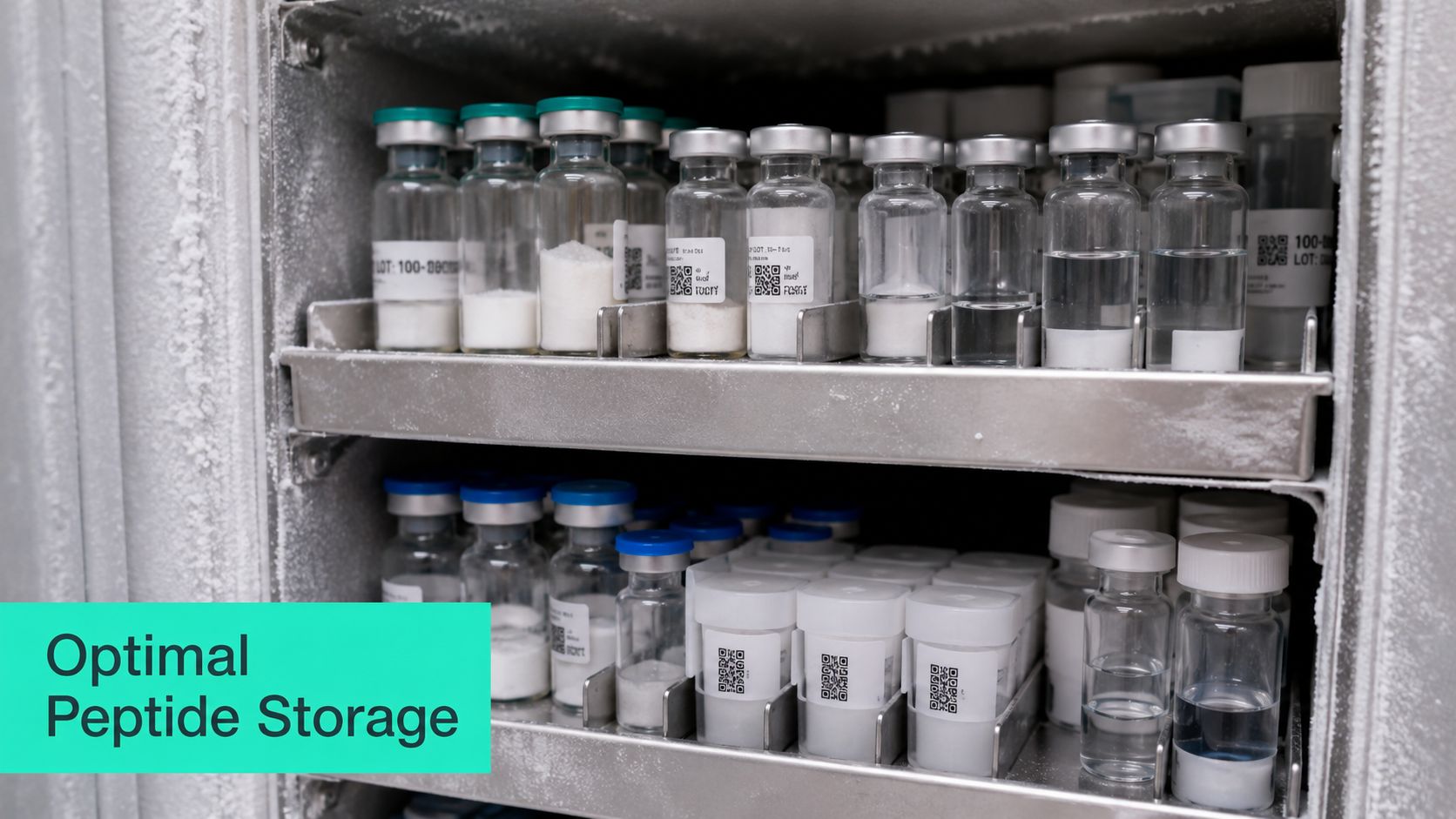
That's a container issue as much as a freezer issue. If the closure allows moisture ingress, oxidation, or loss of the protected internal environment, the freezer temperature alone won't preserve the batch.
Reconstituted peptides are different. Verified guidance states that they remain viable for only 2–4 weeks at 2–8°C in sealed, airtight containers kept in the dark, and room-temperature exposure for more than a few hours causes rapid degradation, as described in these best practices for reconstituted peptide storage.
Once the temperature is right, three environmental details still decide whether storage holds up under real lab conditions.
First is light. If a peptide is photosensitive, clear glass needs added shielding. Amber storage or foil wrapping is simple and effective. Leaving clear vials exposed on a brightly lit bench while people finish paperwork is a common avoidable error.
Second is moisture. Lyophilized powders are especially vulnerable when containers are opened carelessly or stored without enough attention to closure quality. A dry, sealed system matters more than people often assume.
Third is physical location inside the unit. Stable temperature matters more than nominal temperature. For reconstituted aliquots, the middle-shelf-back area is generally preferred over the door because it experiences fewer fluctuations during routine use. The same logic applies in freezers. Avoid high-disturbance positions when possible.
A few operating habits make a noticeable difference:
Cold storage works best when the container, the shelf location, and the access pattern all support the same goal.
Teams that get this right treat environmental control as part of sample protection, not equipment management.
Storage without documentation is just delayed confusion. If you can't identify exactly what's in a vial, when it was prepared, and how it has been handled, the sample stops being trustworthy even if the chemistry is still intact.
A peptide aliquot label should survive cold conditions, remain legible, and answer the questions a colleague would ask if you weren't there.
At minimum, every label should include:
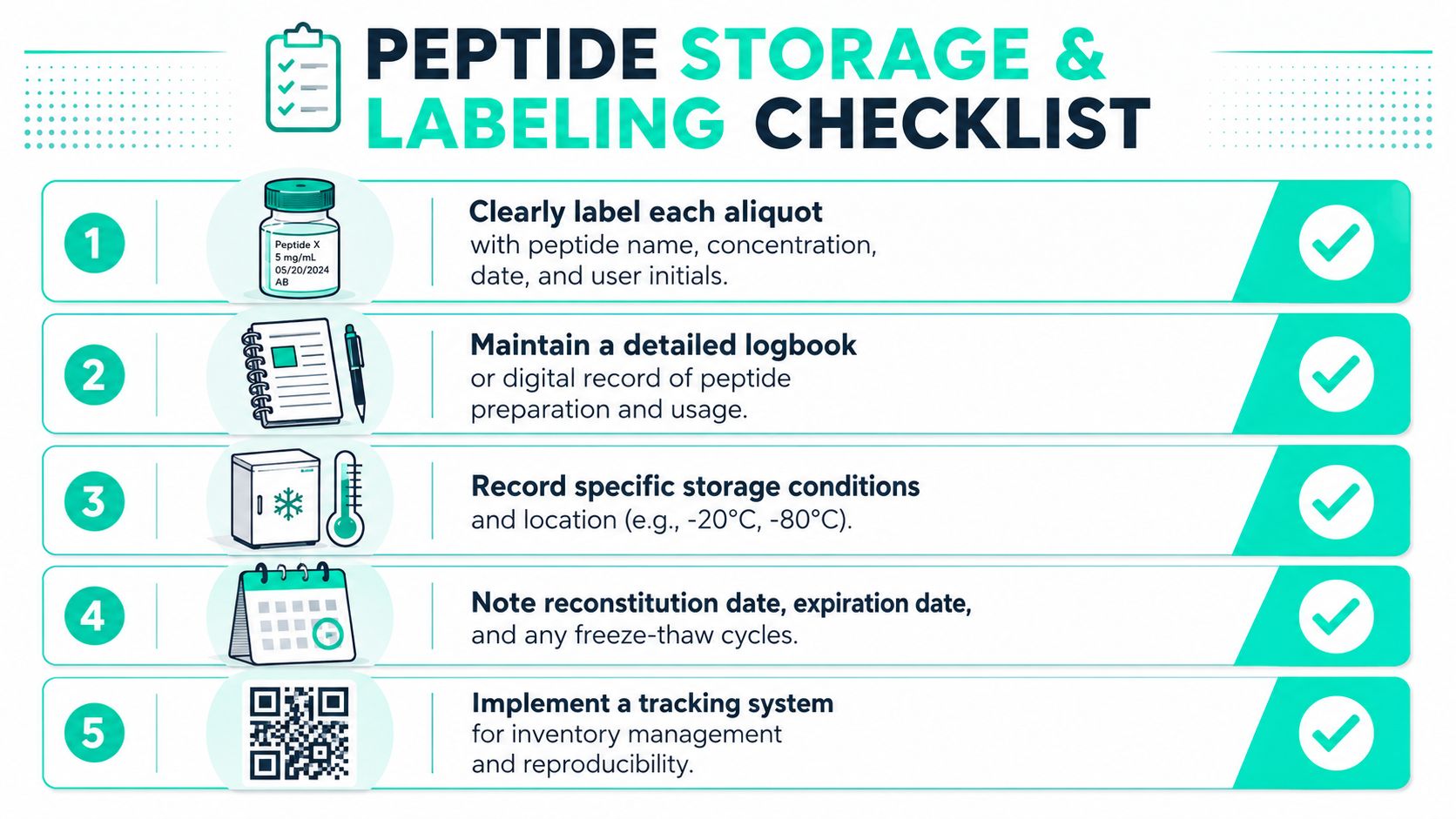
An unlabeled aliquot is not a mystery to solve later. It is material you should not trust.
A good tracking system doesn't need to be complicated. It needs to be consistent. If the form is too burdensome, staff will fill it out late or skip it altogether.
Use a simple logbook or digital record with these fields:
| Field | Why it matters |
|---|---|
| Peptide name | Prevents naming confusion across projects |
| Lot number | Supports traceability and troubleshooting |
| Date received | Establishes intake history |
| Date reconstituted | Starts the clock for dissolved material |
| Aliquot count and volume | Shows what was created and what remains |
| Storage location | Speeds retrieval and reduces unnecessary access |
| User history | Creates an audit trail for handling |
A practical documentation routine usually includes three habits:
Log on receipt, not later
Intake data should be recorded before the vial is redistributed or relabeled.
Record each aliquot event
When one vial becomes many, the inventory system should reflect that immediately.
Mark disposition clearly
Used, discarded, compromised, and archived should never blur together.
This isn't paperwork for its own sake. It's how you investigate odd assay behavior without guessing. If a result looks wrong, the log often tells you whether the issue started at the instrument, at prep, or in storage.
A peptide's risk profile starts before it reaches your freezer. Shipping, receiving, and first inspection are part of the same quality chain as long-term storage.
Don't treat incoming material as automatically ready for use. Inspect it while the shipment context is still clear and before it gets mixed into routine inventory.
Focus on the basics first:
For lyophilized vials, clumping, shrinkage, or an irregular cake can suggest moisture exposure or seal failure. That doesn't automatically prove the peptide is unusable, but it should stop routine use until the material is reviewed under your lab's quality process.
Degradation doesn't always look dramatic. Sometimes the first signal is only experimental inconsistency. Still, there are visible signs worth taking seriously.
In lyophilized material, watch for:
After reconstitution, common warning signs include:
When the vial appearance raises doubt, assume the sample may be compromised and verify before committing it to a critical experiment.
Troubleshooting should also include process review, not just visual inspection. Ask who opened it, how often it was accessed, whether it was protected from light, and whether it was kept in the correct location. In many labs, the degradation signal is real, but the root cause turns out to be handling drift rather than supplier quality.
Shipping and storage shouldn't be treated as separate topics. They're one continuity problem. The same teams that inspect carefully at receipt usually make better decisions when a questionable aliquot appears weeks later.
A peptide storage container does more than organize inventory. It protects the chemical state of the material your data depends on. The right container material, a reliable seal, careful aliquoting, stable storage conditions, and clean documentation all reduce the chance that handling becomes an uncontrolled variable.
That's the standard worth keeping. If the peptide changes before the experiment starts, the rest of the workflow can't recover the lost integrity.
If you need research peptides backed by stated 99% purity, independent third-party testing, and a supplier built for laboratory procurement workflows, explore Celonyx Labs. Their catalog, shipping support, and published policies make it easier to source material and keep your storage workflow aligned from receipt through use.
A researcher searching “kisspeptin 10 for sale” may expect a straightforward catalog result. Instead, the

Ranked guide to the best tirzepatide peptides for research in 2026: lyophilized vials, reference standards,

The best cagrilintide peptides for research in 2026, ranked by purity, COA availability, and format
FOR RESEARCH USE ONLY. Products sold by Celonyx Labs are intended exclusively for laboratory and scientific research. They are not intended for human or veterinary use, consumption, diagnosis, treatment, cure, or prevention of any disease. By purchasing from this site, you acknowledge that you understand the intended research purpose of these materials and agree to comply with all applicable laws and regulations.