

BPC 157 500mcg Explained: What the Evidence Shows
500 mcg equals 0.5 mg, a labeled research quantity, and no published human study establishes
Most method development advice treats validation as the finish line. That's the wrong operating model for peptide research labs. A method can meet its validation requirements and still become unreliable when a column ages, a reference standard changes, a mobile phase drifts, or analysts handle low-concentration samples differently.
The current regulatory direction supports a different view. ICH Q14 frames analytical procedure development as a science- and risk-based activity, while ICH Q2(R2) formalizes validation within a broader lifecycle approach. The FDA released the final Q2(R2) and Q14 guidances in 2024, replacing the earlier draft versions and moving method development beyond a one-time validation event (FDA guidance on Q2(R2) Validation of Analytical Procedures). For peptide workflows, that shift matters because the method's operating environment changes long after the validation report is approved.
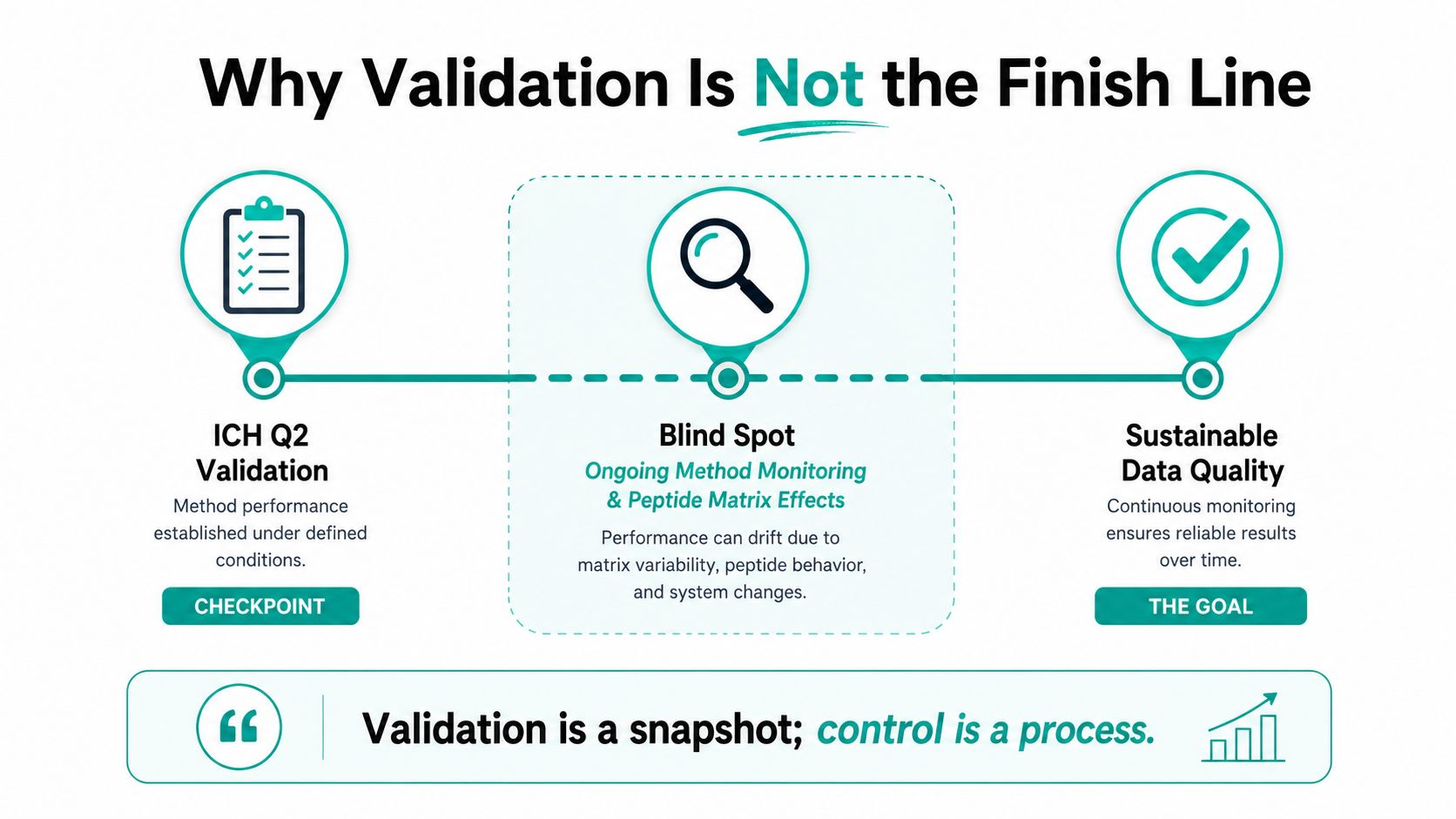
A validated method proves that a procedure met defined performance expectations under the conditions studied. It doesn't prove that the procedure will behave identically after months of routine injections, across different peptide lots, or with analysts who interpret ambiguous preparation instructions in different ways.
That distinction is easy to miss. Many laboratories complete specificity, accuracy, precision, and linearity work, approve the report, and then treat the method as fixed. The resulting blind spot appears during routine use. Selectivity can shift as a column loses performance, reference material can change in purity or stability, and small differences in sample handling can affect adsorption, recovery, or degradation.
Peptides create particular pressure on an analytical procedure. Their behavior can depend on sequence, charge state, hydrophobicity, aggregation tendency, oxidation sensitivity, and interactions with sample containers or stationary phases. A study that varies selected parameters in a controlled development setting may not capture every combination of column history, reagent age, instrument condition, and analyst technique encountered in production.
The most useful question after validation isn't “Did the method pass?” It's “What evidence will tell us that the method is still suitable?”
Practical rule: Validation is a snapshot. Control is a process.
That process needs defined signals. Retention time, peak shape, critical-pair resolution, response, blank interference, recovery, and preparation stability can all become routine monitoring variables. A control strategy should identify which changes are normal method noise and which changes indicate an assignable cause.
ICH Q14 recommends defining the method's design, operating conditions, limitations, and suitability before validation. It also emphasizes product attributes, technology and instrument selection, performance characteristics, reportable range, calibration limits, and reliability during normal use (EMA scientific guideline for ICH Q2(R2)).
That language supports a practical lifecycle model:
A lifecycle approach doesn't eliminate revalidation. It makes revalidation more targeted by showing whether a change affects a critical performance characteristic or falls within an already understood operating space. That's a better use of laboratory time than restarting a complete validation package whenever a controlled operational change occurs.
The most expensive method development errors usually happen before the first injection. Teams often choose a column, solvent system, and detector because they worked for a related peptide, then attempt to force the resulting procedure to answer questions it was never designed to answer.
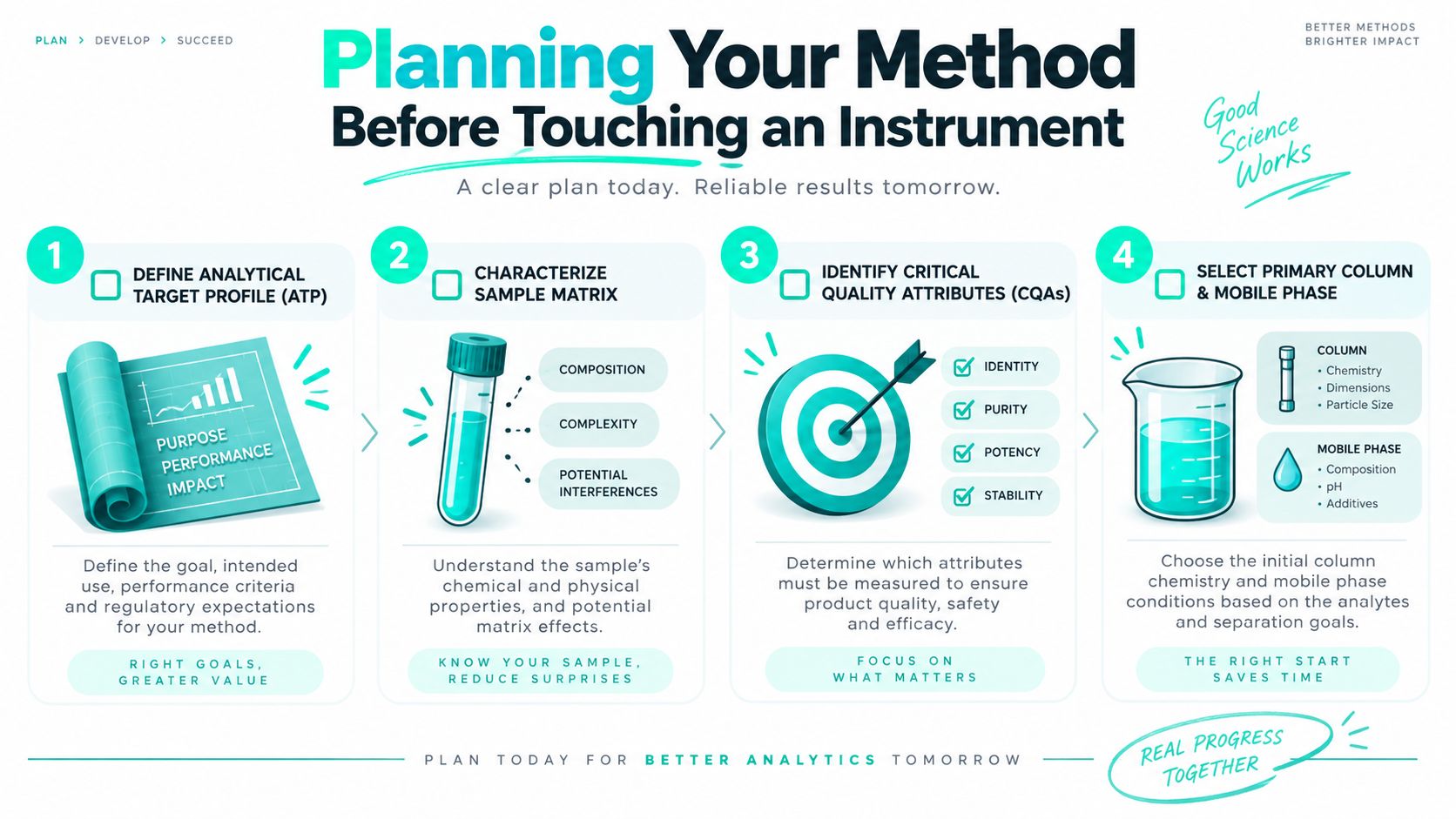
Start with an Analytical Target Profile, or ATP. The ATP should state what the method measures, in which matrix, across what reportable range, with what required specificity, accuracy, precision, and reliability. It should also identify whether the method supports release testing, stability monitoring, impurity profiling, identity confirmation, or exploratory characterization.
For peptides, define the measurand precisely. Intact peptide content, related substances, degradation products, sequence variants, aggregates, and biological activity are different analytical questions. A method that quantifies intact material may not detect every transformation relevant to stability, while a purity method may not establish biological potency.
Use an Ishikawa diagram, risk ranking exercise, or FMEA to connect peptide-specific variables to likely method failures. Include:
The risk assessment should lead to experiments, not sit in a report. A high-risk variable deserves deliberate study, while a low-risk variable may need only a documented rationale and routine control.
Before experimental work, record why the team selected the reference material, column chemistry, mobile phase, temperature, detector, and sample preparation approach. The rationale should address peptide solubility and stability, not just historical laboratory preference.
Sample preparation deserves special attention. A procedure should specify container material, mixing method, hold time, storage condition, and any recovery check needed to identify adsorption or precipitation. Teams can also document reconstitution risks using a practical reference such as how to reconstitute peptides, then convert relevant handling instructions into the controlled SOP rather than relying on informal practice.
A strong planning record answers four questions:
That discipline prevents the instrument from becoming the place where the laboratory discovers its analytical strategy.
The core validation characteristics remain useful, but peptide assays need interpretation grounded in their chemistry and intended use. ICH Q14 specifically connects development with characteristics such as specificity, accuracy, precision, and robustness across the reportable range. FDA bioanalytical guidance also emphasizes deliberate parameter variation, matrix recovery, stability, selectivity, sensitivity, and preparation stability during development (FDA bioanalytical method validation guidance).
Specificity should challenge the method with the variants it may encounter, not only with a clean standard. For a peptide assay, that can include oxidation products, deamidated forms, fragments, process-related impurities, and aggregation species. If a critical impurity co-elutes under a normal method condition, a passing chromatogram for the main peak doesn't establish adequate discrimination. The HPLC chromatogram interpretation guide shows how to review shoulders, resolution, baseline behavior, and integration before accepting a result.
Linearity can also fail at the edges of the working range. Low-level samples may lose material through adsorption or incomplete recovery, while high-level samples may approach detector saturation or overload the separation. Evaluate response and recovery across the intended range, then document why the selected range is appropriate for the decision the method supports.
Accuracy should account for the quality and assigned value of the reference material. Precision should include repeatability and intermediate precision that reflect real laboratory variation, including different analysts, days, instruments, and relevant peptide lots. Detection and quantitation limits should be meaningful for the reporting purpose, especially when low-abundance impurities influence stability or process decisions.
Method development often overlooks how thoroughly a peptide method must be challenged. Deliberately vary the parameters most likely to change routine results:
The experiment should reveal method boundaries, not merely confirm that a carefully executed procedure works.
| Validation Parameter | Peptide-Specific Challenge | Common Failure Mode | Recommended Approach |
|---|---|---|---|
| Specificity | Closely related variants may co-elute | Main peak appears acceptable while impurities remain unresolved | Challenge with relevant degradation products, fragments, and matrix blanks |
| Accuracy | Reference material purity and recovery can be uncertain | Bias is attributed to the instrument instead of the standard or matrix | Use qualified material, matrix recovery, and orthogonal comparison where justified |
| Precision | Analyst technique and peptide lot effects can be substantial | Repeatability looks strong but intermediate precision fails | Include realistic analysts, days, instruments, and lots |
| Range and response | Adsorption and detector behavior may affect extremes | Calibration performs well only near the center | Evaluate the full reportable range and inspect residuals and recovery |
| Robustness | Small changes can affect charge, retention, or recovery | Routine drift triggers repeated investigations | Use deliberate variation and define acceptable operating conditions |
For teams working on related impurities, peptide impurity profiling methods can help frame the analytical questions, but the final validation design still has to match the specific peptide, matrix, and decision context.
A method stays reliable when analysts can detect deterioration before a result becomes a batch decision. System suitability testing should therefore measure the features that matter to the separation, not just confirm that the instrument produced a signal.
For peptide purity methods, the SST may include retention-time consistency, peak shape, resolution between critical pairs, response repeatability, blank interference, and sensitivity for low-abundance components. The laboratory should define acceptance criteria from method capability and intended use. Avoid copying generic thresholds into an SOP without demonstrating that they protect the relevant result.
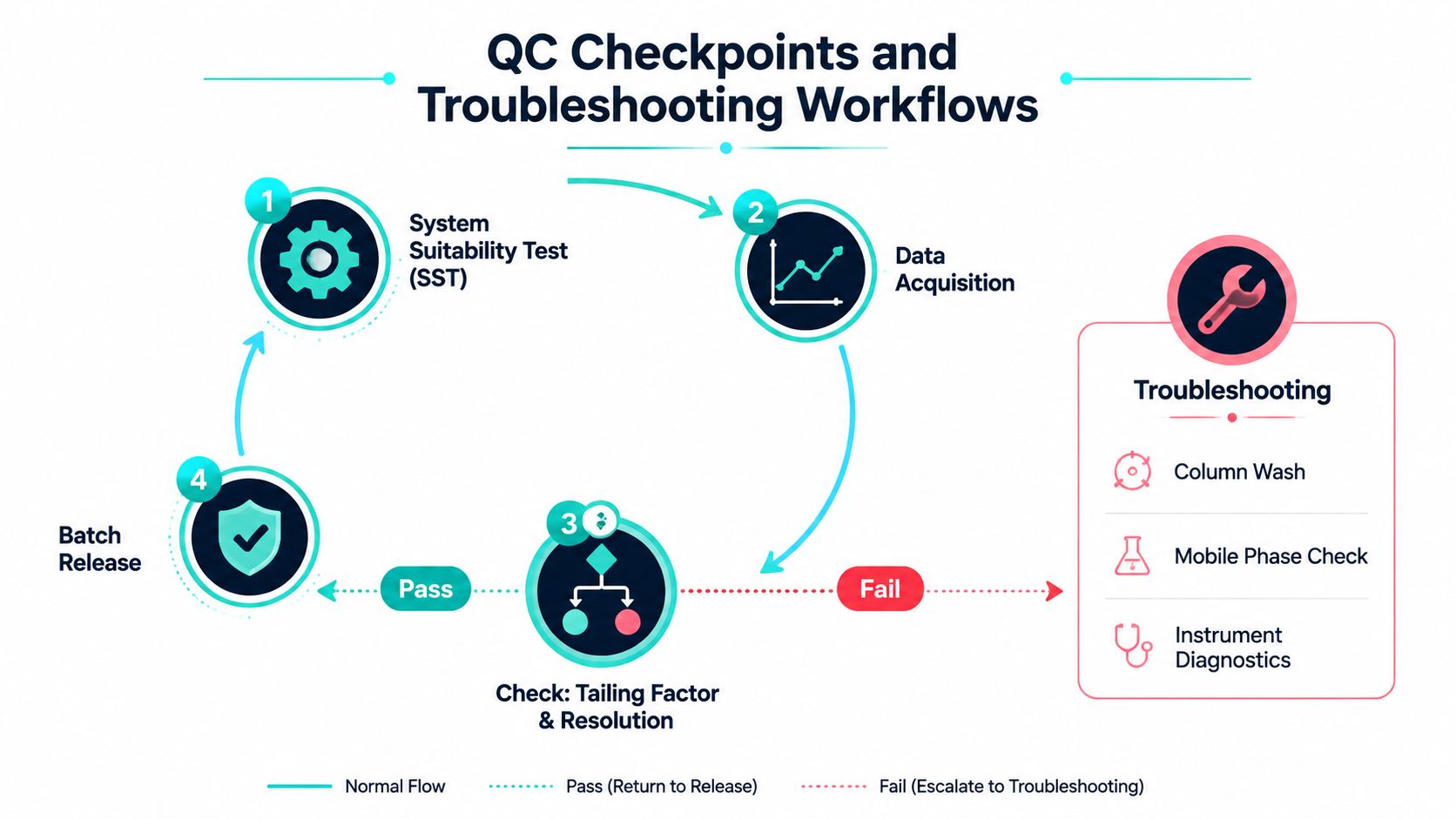
When an SST fails, analysts need a decision path that prevents both careless data release and unnecessary full revalidation.
A column wash may address hydrophobic peptide carryover, while a fresh mobile phase may resolve contamination or pH drift. Instrument diagnostics become more relevant when pressure, injection precision, detector response, or mass-spectral behavior changes without a corresponding preparation issue. Laboratories using HPLC-MS analysis for peptide research should also distinguish chromatographic problems from ionization suppression, source contamination, and acquisition-method changes.
Control charts help distinguish normal variation from an assignable cause. Trend SST data such as retention time, resolution, tailing, response, and impurity-area behavior. An out-of-trend result should trigger enhanced review when it remains within acceptance criteria but moves consistently toward a boundary. An out-of-specification or clear SST failure requires immediate investigation and a documented disposition.
The key control is escalation logic. A single failed injection with a confirmed preparation error may need correction and repeat analysis. Repeated failures across fresh preparations, columns, or instruments suggest a method-level problem and may justify a formal change assessment or revalidation.
Most method drift begins as an undocumented accommodation. An analyst changes an equilibration time, substitutes a column lot, adjusts a sample mixing step, or uses a different solvent grade because the original instruction seems impractical. Each change may look harmless. Months later, the laboratory can no longer explain why results differ between analysts or sites.
A method transfer package should make the intended procedure executable without oral history. Include reagent grades and specifications, preparation instructions, column chemistry and dimensions, column-lot qualification, instrument settings, integration rules, system suitability, sample stability, and representative chromatograms. Annotated chromatograms should show expected peak identity and acceptable variation, not just an ideal trace.
Peptide laboratories often document the instrument method carefully and the sample preparation casually. That imbalance creates avoidable uncertainty. The controlled record should capture:
Electronic audit trails in the CDS and LIMS should support this record rather than become a compliance archive that nobody reviews. If a parameter changes, the system should show who changed it, why, which version was used, and whether the change received the required approval.
| Documentation Element | Reproducibility Risk Mitigated | Implementation Effort |
|---|---|---|
| Controlled sample-preparation SOP | Analyst-to-analyst differences in recovery and degradation | Moderate |
| Column-lot qualification record | Unexplained selectivity and pressure changes | Moderate |
| Annotated reference chromatograms | Inconsistent peak identification and integration | Low to moderate |
| Electronic audit trail review | Undocumented processing or parameter changes | Moderate |
| Deviation and change proposal templates | Informal adjustments becoming permanent practice | Low |
| Reference-standard stability record | Bias caused by material deterioration | Moderate |
A practical deviation form can be short, provided it asks the right questions: what happened, which sample or run was affected, what evidence was reviewed, what immediate action was taken, and whether the result could affect reported data. A method change proposal should add the scientific rationale, risk to the ATP, impacted validation characteristics, proposed verification, and rollback plan.
Documentation fails when it becomes so burdensome that analysts work around it. The best system captures decisions at the point of use, uses version-controlled templates, and assigns review responsibilities clearly. That creates accountability without turning every routine adjustment into a bureaucratic project.
Traditional chromatographic validation works best when the measurand is stable, the reference material is well characterized, and the response behaves predictably. Complex peptide modalities and adjacent assays often violate those assumptions.
A cell-based potency assay measures a biological response shaped by cell health, passage history, incubation conditions, receptor expression, and analyst technique. A ligand-binding assay for a peptide biomarker may face serum interference, reagent-lot effects, and an imperfect calibrator. A multi-attribute method may combine chromatographic separation with mass-spectral data processing, creating model and integration considerations that a conventional purity assay doesn't fully address.
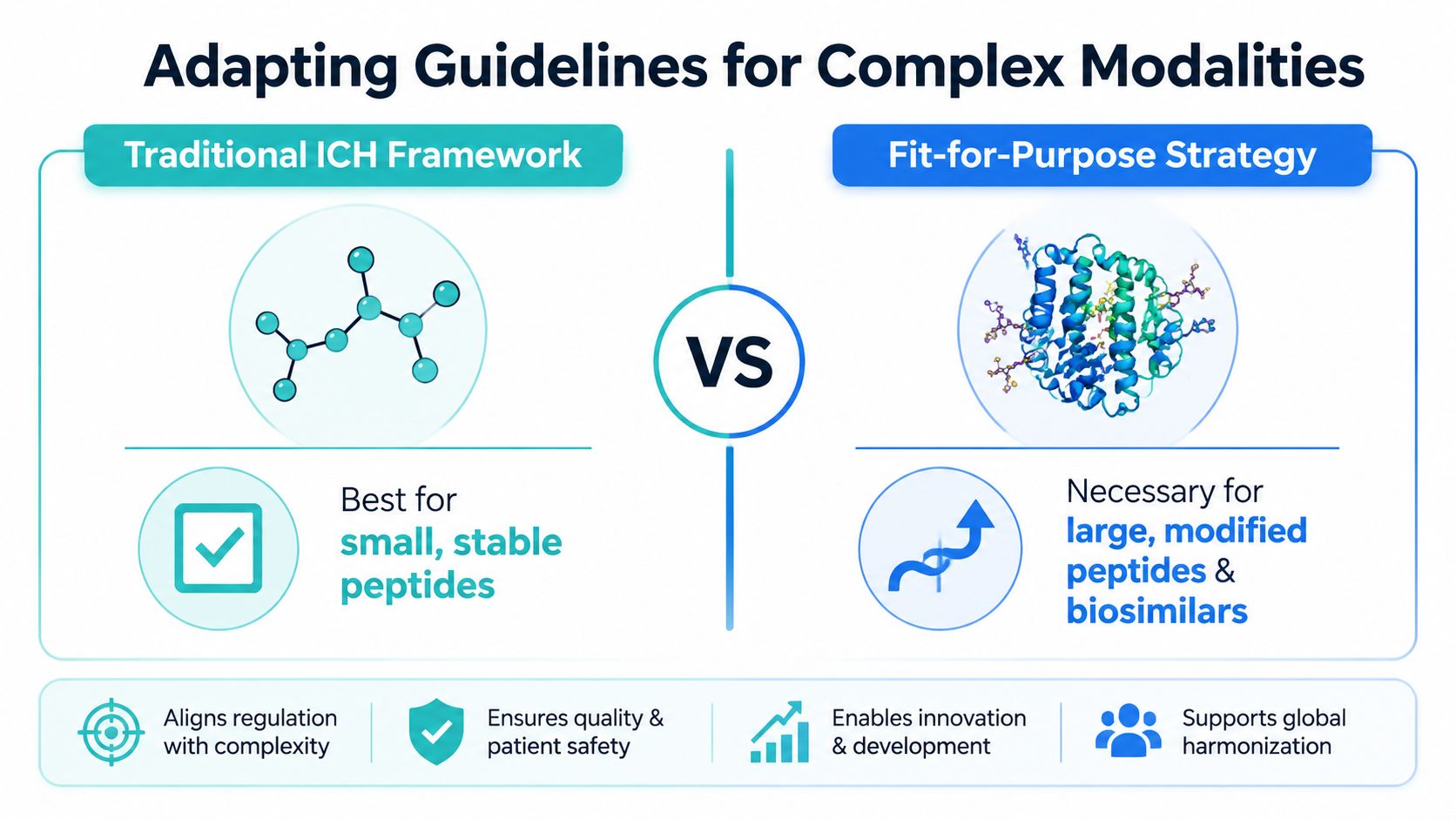
A release method needs strong control of specificity, accuracy, precision, range, and ongoing performance because its result supports a formal product decision. A stability-indicating method needs convincing evidence that it can distinguish meaningful change over time. An exploratory characterization method may require less formal validation, but it still needs enough documentation to prevent researchers from treating provisional results as definitive.
The selection should follow risk, not habit:
ICH Q14 provides flexibility for science- and risk-based development, while the revised Q2(R2) framework supports validation of modern analytical procedures. For data-rich or model-driven methods, the laboratory should also justify acceptance criteria, measurement uncertainty, tolerance behavior, and any algorithmic processing. A rigid small-molecule template can understate biological variability, while an entirely informal approach can leave critical risks uncontrolled.
The practical compromise is fit-for-purpose rigor. Validate the characteristics that protect the decision being made, then expand the evidence as the method moves from discovery into regulated or high-consequence use.
Lifecycle management gives the laboratory an early warning system. Instead of waiting for a failed result, the team watches method performance, investigates meaningful trends, and makes controlled adjustments while the method remains understood.
The framework should have three connected pillars. First, trend system suitability and selected sample results across batches, analysts, instruments, columns, and reagent lots. Second, define alert and action limits that reflect observed method behavior and the risk of crossing a performance boundary. Third, conduct periodic method reviews linked to instrument qualification, major reagent or column changes, stability findings, and recurring deviations.
Not every method needs the same review frequency or data burden. A low-risk identity screen may need limited trending, while a peptide impurity method supporting a consequential decision deserves closer attention to resolution, response, carryover, and critical-peak behavior.
A useful review asks:
The answers determine the response. A localized, understood drift may call for column replacement, reagent correction, analyst retraining, or enhanced monitoring. Repeated failure across controlled conditions, loss of specificity, or evidence that the original design space no longer covers routine use points toward formal method redevelopment or revalidation.
A lifecycle review should examine more than the validation report. Include trend plots, deviations, change controls, SST failures, reference-standard performance, column history, instrument differences, and user feedback. Q14's emphasis on knowledge management, risk assessment, control strategy, and performance monitoring makes this information part of method ownership rather than optional administrative material. The broader lifecycle perspective is also discussed in recent analytical chemistry commentary on evolving method development expectations (Analytical Chemistry discussion of lifecycle-oriented analytical procedure development).
A practical cadence can combine routine review of SST data, periodic review of deviations and trends, and a formal assessment after significant changes or recurring failures. The exact schedule should follow method risk and use, not an arbitrary calendar.
A method is under control when the laboratory can explain its variation, detect meaningful change, and show why its current operating limits remain suitable.
That standard changes how teams work. Analysts record the variables that matter, scientists investigate patterns rather than isolated symptoms, and quality groups approve changes based on evidence. The result is a method that can adapt without losing its analytical purpose.
Celonyx Labs supplies research peptides through an online catalog and references 99% purity and independent third-party testing as product quality attributes. Review the available materials and contact Celonyx Labs if your laboratory needs research peptide sourcing that fits a documented analytical workflow.
500 mcg equals 0.5 mg, a labeled research quantity, and no published human study establishes

Choose the best GHK-Cu peptide format for laboratory skin and wound-healing research. Compare documentation, assay

Choose lot-verified melanotan 1 peptide for pigmentation research. Compare material specifications, purity evidence, and documentation
FOR RESEARCH USE ONLY. Products sold by Celonyx Labs are intended exclusively for laboratory and scientific research. They are not intended for human or veterinary use, consumption, diagnosis, treatment, cure, or prevention of any disease. By purchasing from this site, you acknowledge that you understand the intended research purpose of these materials and agree to comply with all applicable laws and regulations.