

Celonyx Labs vs Eon Peptides: which is better in 2026
Celonyx Labs vs Eon Peptides: choose by lot evidence and protocol fit. Compare purity claims,
A vial of lyophilized peptide arrives, the protocol names a diluent, and the order sheet lists several products that sound almost identical. You've got sterile water, bac water for injection, and a saline diluent in the supply cabinet. Before anyone opens a package, you need to establish which formulation the peptide requires and whether the paperwork supports using it.
At the bench, the preservative is only part of that decision. Repeated vial access, an unsuitable diluent, or a missing first-puncture date can undermine an otherwise careful preparation. The product label, the peptide manufacturer's instructions, and your institution's approved procedure must agree before you mix.
Bacteriostatic Water for Injection, USP is sterile, nonpyrogenic water containing benzyl alcohol as a preservative. It serves as a diluent for preparing compatible injectable medicines, and the preservative is what separates it from plain sterile water.
The official product labeling describes a 0.9% benzyl alcohol formulation, 9 mg/mL or about 90 mg in a 10 mL multiple-dose container. That figure does real work on the label: it identifies the preservative concentration, the container format, and the benzyl alcohol load each full vial delivers.
Bac water and related diluents compared
| Product | Preservative and amount | Packaging | Typical use |
|---|---|---|---|
| Bacteriostatic Water for Injection, 0.9% | Benzyl alcohol 9 mg/mL, about 90 mg per 10 mL | Multidose vial | Diluent for repeated withdrawals when the drug label permits benzyl alcohol |
| Sterile Water for Injection, preservative-free | None | Generally single-use | Diluent for preparations that must avoid benzyl alcohol, including neonatal preparations |
| Bacteriostatic 0.9% Sodium Chloride | Benzyl alcohol, concentration stated on the product label | Multidose vial | Saline diluent when specified by the preparation's instructions, not interchangeable with water |
The percentage on a label doesn't always describe the same ingredient across products. On bacteriostatic water it identifies the benzyl alcohol concentration. On bacteriostatic sodium chloride, the named percentage describes the saline formulation, and the preservative amount sits elsewhere on the label. Two products can both read "0.9%" and mean different things.
Sterile Water for Injection isn't a less convenient form of bac water. It excludes an ingredient that may be unsuitable for the preparation at hand. Saline diluents carry a different complication: the dissolved salt changes whether the formulation meets the target product's requirements.
Other diluents demand the same kind of reading. The comparison of acetic acid and bacteriostatic water is useful when a protocol calls for an acidic diluent, since acidity and preservative content are separate properties and one never substitutes for the other.
Benzyl alcohol inhibits bacterial growth inside the container. It doesn't sterilize contaminated contents, strip endotoxins, reverse chemical degradation, or make repeated use acceptable indefinitely.
In practice, the water itself is rarely the weak link. Most problems trace back to the access pattern: a multidose vial earns its preservative only when every withdrawal follows aseptic technique and every puncture leaves a paper trail. The preservative buys a margin for repeated entry. It does not cover sloppy handling or undocumented use.
The trade-off runs both ways. A multidose presentation supports repeated withdrawals at the cost of disciplined technique each time the septum is pierced. Preservative-free water removes benzyl alcohol exposure entirely, and its single-use presentation has to be respected just as strictly.
Practical rule: Choose the diluent named in the validated protocol, not the vial that happens to be open.
A research peptide on the bench doesn't automatically need bacteriostatic water. The first decision is whether the peptide's documentation explicitly permits a benzyl-alcohol-containing diluent, including the particular formulation you've received.
A familiar-looking vial isn't sufficient evidence. Match the full product name, ingredient concentration, container designation, and intended application before moving either vial into the preparation area.
Keep both labels visible while checking the preparation.
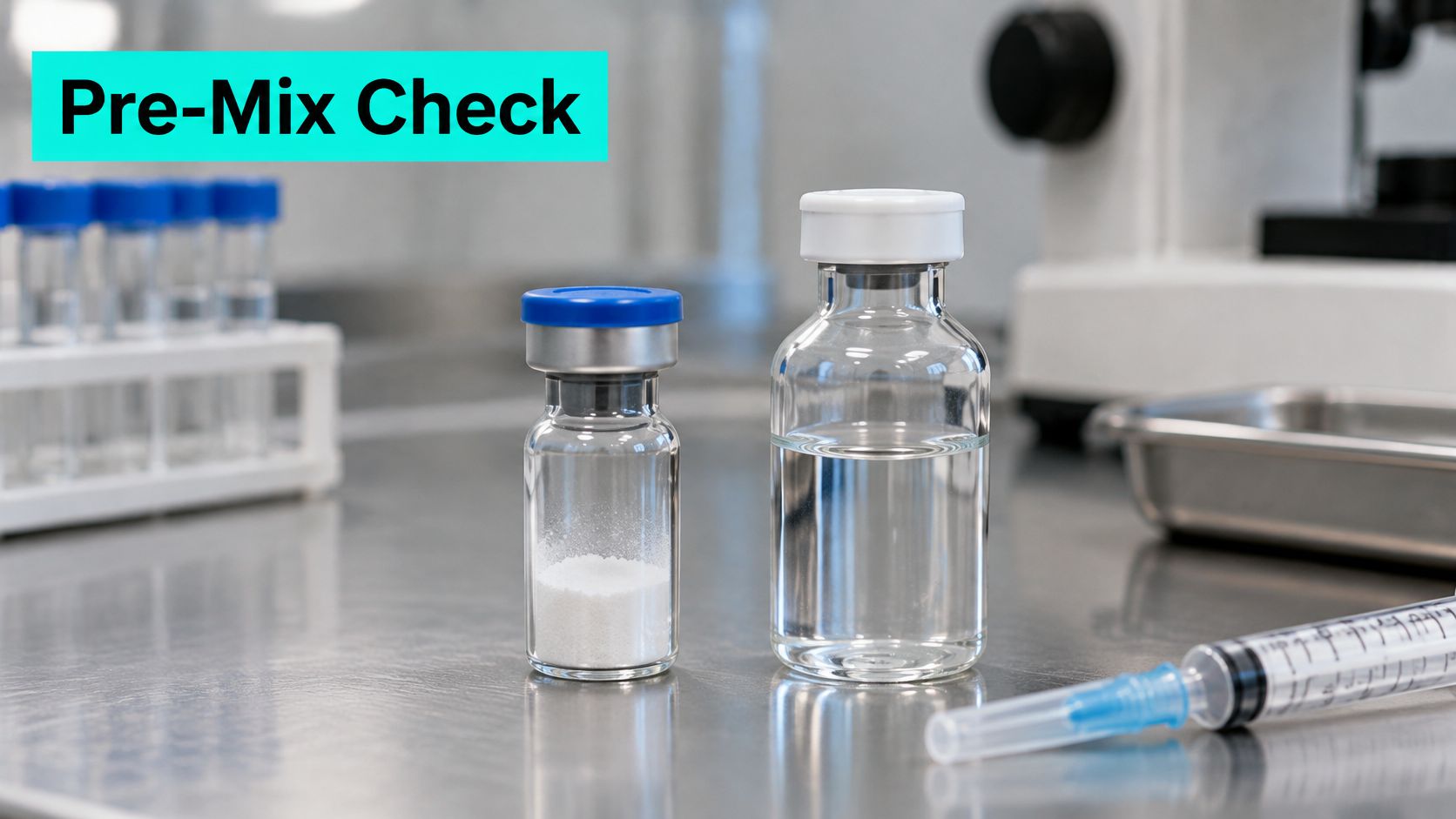
Use a pre-mix check that produces a documented answer, not an assumption:
The DailyMed prescribing information warns against neonatal use because of benzyl alcohol toxicity and states that an estimated 9 mL administration to a 6 kg infant or neonate could potentially produce blood-pressure changes. When water is needed for neonatal medication preparation, that labeling directs use of preservative-free Sterile Water for Injection.
That warning isn't an invitation to calculate a smaller acceptable exposure at the bench. Population suitability belongs to the prescribing information and qualified clinical assessment, not an improvised dilution calculation.
For research work, the question is different but equally specific: could the preservative interfere with the molecule, assay, or experimental system? If compatibility information is absent, pause and ask the manufacturer or the responsible pharmacy or laboratory lead.
Missing compatibility documentation is a reason to stop, not a reason to choose the most familiar diluent.
Don't automatically substitute preservative-free water when a check fails. It may be appropriate, but it still needs authorization for that preparation. Bac water contributes dilution and preservation under its labeled conditions; it doesn't improve peptide purity, potency, or experimental suitability.
Use this workflow only after the preparation has passed the compatibility and application checks. It's a bench-handling framework, not a replacement for product-specific reconstitution instructions or a procedure for making research materials suitable for human injection.
Keep the approved protocol beside the work area so you don't have to reconstruct the method from memory.
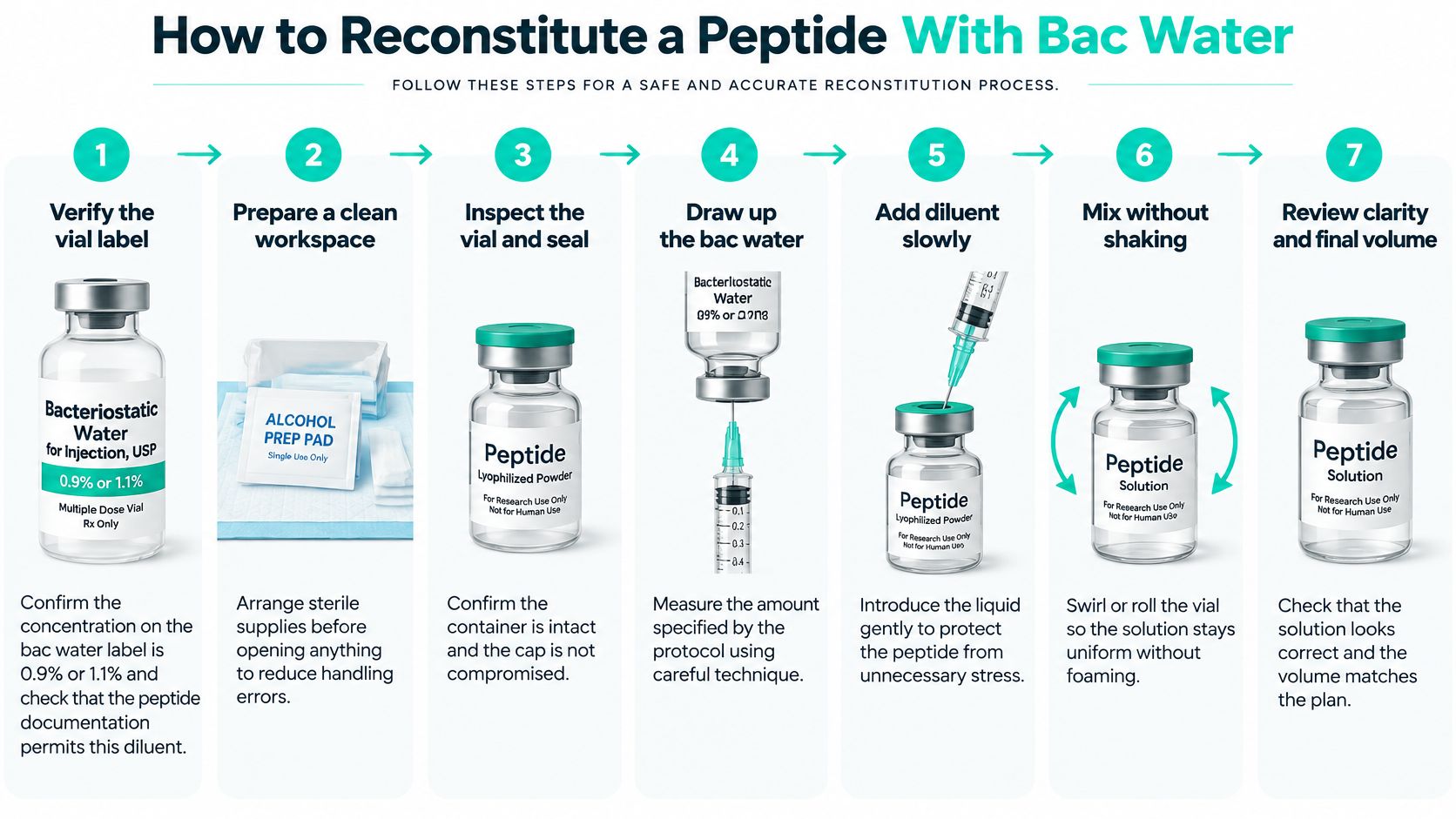
Verify the labels against the protocol. Match the water formulation and peptide identity to the approved instructions, including the permitted diluent and required final concentration. Resolve discrepancies before handling sterile components.
Prepare the workspace and inspect the containers. Arrange the necessary sterile supplies, labels, and waste container, then examine both vials for cracks, compromised seals, unexpected cloudiness, or particles. Set questionable material aside rather than trying to work around it.
Disinfect the vial stoppers. Apply sterile alcohol according to the approved procedure and allow the surfaces to dry fully before puncture. Don't touch the disinfected septum or other critical sites afterward.
Use a new sterile syringe and needle for this entry. Open the supplies without contacting the sterile connection points. A needle change alone doesn't make a previously used syringe acceptable.
Measure the prescribed diluent volume. Withdraw the amount specified by the peptide's validated preparation instructions using an appropriately sized syringe. Rounding the amount for convenience changes the intended concentration.
Introduce the liquid using the specified technique. If the peptide instructions call for gentle addition, direct the liquid slowly along the inside vial wall and swirl or roll as directed. Don't replace the manufacturer's method with vigorous shaking to speed dissolution.
Review the resulting preparation and label it immediately. Check its appearance against the product's expected appearance and record the identity, concentration, preparation date and time, and storage requirements. Clear appearance alone doesn't establish sterility or correct concentration.
Assign the product-specific in-use limit. Record the permitted storage duration from the peptide documentation or approved institutional procedure. If storage isn't supported, don't invent a refrigerated holding period.
The common mistake is shaking harder when dissolution takes longer than expected. Agitation requirements are molecule-specific, so an apparently slow preparation calls for checking the instructions, not improvising heat, extra diluent, or a different solvent.
The practical guide to reconstituting peptides can help organize the handling sequence, but the exact product documentation remains authoritative. If the expected appearance isn't achieved, quarantine the preparation and seek guidance rather than filtering or otherwise modifying it without authorization.
For a visual walkthrough, assess the demonstration against your approved procedure before adopting any technique.
Keep clinical background separate from laboratory authorization. ProMD Health Tysons Corner's overview of aesthetic and wellness uses of peptides provides context for clinical discussions, but it doesn't establish compatibility, dosing, or suitability for a particular research peptide.
The main operational risk is what happens during access, not spontaneous failure of the water. Every puncture involves personnel, equipment, and environmental conditions that need control.
The cited USP chapter on sterile compounding identifies microbial, endotoxin, chemical, and physical contamination as hazards, with personnel, objects, nonsterile components, environmental conditions, and prolonged handling among their sources. Institutions should implement their current applicable requirements through approved procedures rather than treating a general handling guide as a complete compounding standard.
Contamination risks and controls during multidose vial use
| Risk | Usual source | Control |
|---|---|---|
| Microbial entry at the stopper | Repeated needle punctures | Alcohol-wipe the septum, let it dry, and limit punctures |
| Endotoxin contamination | Nonsterile components or handling | Use a qualified controlled environment and endotoxin testing where appropriate |
| Turbidity or particles | Possible seal damage, degradation, or contamination | Quarantine the vial and don't use it |
| Operator-introduced contamination | Hand contact with critical sites | Perform hand hygiene, use appropriate garbing, and avoid touching critical sites |
Disinfecting the stopper is necessary, but it isn't the whole process. An operator can prepare the septum correctly and then compromise the entry by touching a needle connection, placing supplies on an unsuitable surface, or carrying a vial between incompatible work areas.
Set up supplies before beginning, disinfect the work surface, and keep critical sites untouched. Limit unnecessary punctures and open manipulation, but don't stretch the use of single-use equipment to reduce waste.
For training discussions about consistent disinfection behavior, BacteriaFAQ.com's resource on improving hub-disinfection compliance offers a related perspective. A vascular-access hub and a vial septum aren't interchangeable devices, so the specific procedure must still match the item being disinfected.
There's no defensible universal contamination percentage for peptide reconstitution. The likelihood depends on the environment, operator technique, access frequency, storage, and the preparation itself.
A supplier's purity claim can describe an analytical attribute without establishing the sterility of your finished preparation. Institutional assurance instead requires validated aseptic controls, appropriate environmental monitoring, product-specific stability support, and sterility or endotoxin testing where the procedure requires them.
A clear vial can still be unsuitable. Visual inspection is a rejection check, not a sterility test.
Say a CRO discovers that an operator reused a syringe during preparation of a research batch. If the affected transfers can't be reliably isolated, the laboratory may have to quarantine or discard the full preparation under its deviation procedure.
The cost isn't limited to replacing water. Staff may need to repeat sample preparation, reassess affected experimental results, and investigate whether other materials were involved. Saving a disposable syringe is a poor trade for an uncertain batch.
Bacteriostatic doesn't mean sterile indefinitely. The preservative doesn't protect against viruses or completely prevent bacterial contamination, so an opened vial needs a defined discard decision even when it looks unchanged.
The CDC guidance on multidose vials generally calls for discard within 28 days of first puncture, unless the manufacturer specifies a different period, without exceeding the original expiration date. The FDA label records for bacteriostatic water describe controlled room-temperature storage at 20–25°C (68–77°F) and direct users to the solute manufacturer for storage of reconstituted drugs.
Storage and discard limits for bac water and reconstituted solutions
| Condition | Limit | Source |
|---|---|---|
| Unopened vial | Controlled room temperature, 20–25°C (68–77°F), subject to the exact label | Bac water labeling |
| Opened multidose vial | Discard within 28 days of first puncture unless the manufacturer specifies otherwise; never past expiry | CDC guidance |
| Reconstituted peptide solution | Follow the solute manufacturer's storage and use directions; don't store if no supported directions are available | Peptide documentation and diluent labeling |
| Cloudy or particulate solution | Remove from use and discard through the approved process | FDA labeling |
| Damaged or compromised seal | Don't use | FDA labeling |
The water vial and the reconstituted peptide are different preparations. A permitted access period for the diluent doesn't establish peptide stability, potency, or an acceptable storage duration.
At first puncture, record the opening date and time and calculate the discard deadline under the applicable rule. If someone opens a vial on the first Monday of the month, they should calculate the deadline immediately rather than write a vague instruction to discard it next month.
For organizing product-specific requirements, the guide to storing reconstituted peptides is a useful reference alongside the manufacturer's instructions. Refrigeration isn't a substitute for stability evidence.
Place used needles and syringes directly into the approved sharps container. Route discarded vials through the institution's designated pharmaceutical, chemical, sharps, or biohazard waste process, and never return an opened vial to unopened stock.
Clinical aftercare is a separate subject. ProMD Health Bel Air's discussion of what to expect after B12 injections concerns patient-facing care, not permission to extend vial storage or reuse limits.
A purity claim isn't a substitute for product identification and traceability. Purchasing needs to establish what will arrive, while the bench record needs to establish what happened after receipt.
Order against the exact formulation and presentation your procedure permits. General descriptions such as sterile diluent or peptide water don't provide enough information to approve a purchase.
Keep the ordering checks visible to receiving staff as well as laboratory users.
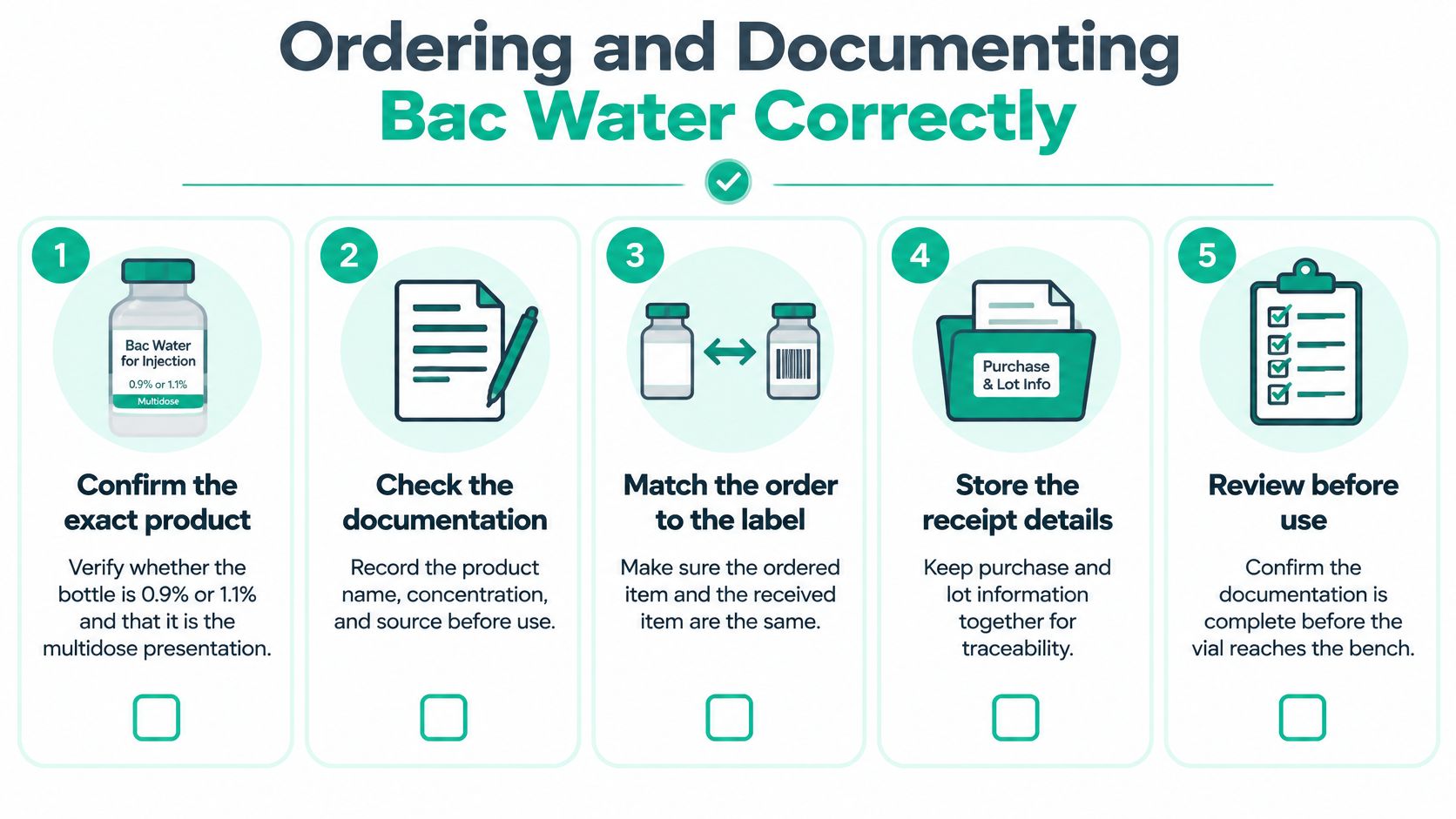
Use a controlled paper form or electronic record that connects the source vial to each destination preparation. For every entry, capture operator, date and time, lot number, volume withdrawn, storage location, and destination preparation identifier.
Keep the first-puncture date and discard deadline attached to that same record. During review, reconcile withdrawals with the vial identity and confirm that no entry occurred after its permitted use period.
If an operator discovers missing information, don't fill the gap from memory as though it were contemporaneous documentation. Follow the institution's correction or deviation procedure and assess whether affected preparations need quarantine.
Apply these checks to every supplier. Complete paperwork won't compensate for poor handling, but incomplete paperwork can prevent a laboratory from identifying which preparation was affected when handling goes wrong.
Celonyx Labs offers an online research peptide catalog and customer support for laboratory ordering and product questions. Visit Celonyx Labs to review available research materials and request the product information your laboratory needs before selecting a diluent or approving a preparation protocol.
Celonyx Labs vs Eon Peptides: choose by lot evidence and protocol fit. Compare purity claims,

Celonyx Labs vs Onyx Biolabs: choose by lot documentation, peptide identity, and laboratory fit. Compare

Celonyx Labs vs Onyx Weight Loss in 2026: Celonyx wins for lab researchers needing third-party-tested
FOR RESEARCH USE ONLY. Products sold by Celonyx Labs are intended exclusively for laboratory and scientific research. They are not intended for human or veterinary use, consumption, diagnosis, treatment, cure, or prevention of any disease. By purchasing from this site, you acknowledge that you understand the intended research purpose of these materials and agree to comply with all applicable laws and regulations.