
Kisspeptin 10 for Sale Research Guide for Labs
A researcher searching “kisspeptin 10 for sale” may expect a straightforward catalog result. Instead, the
You've got a lyophilized peptide vial on the bench, a protocol that needs repeated draws over several days, and a small but important question sitting between clean data and wasted material. What should you reconstitute it with?
That question usually shows up at the worst moment. The assay plan is ready, the vial has just come out of storage, and someone in the lab says sterile water is probably fine. Sometimes it is, if the vial will be used immediately. But many researchers aren't doing a one-time prep. They're returning to the same vial across multiple sessions, and that's where contamination risk, peptide stability, and solvent compatibility start to matter.
In peptide work, the phrase bacteriostatic water peptides usually refers to peptides reconstituted with bacteriostatic water so the same vial can be accessed more safely over time. If you need a plain-language refresher on common uses, this overview of what bacteriostatic water is used for is a helpful starting point.
A common lab situation looks like this. A researcher reconstitutes a peptide on Monday, pulls one aliquot for an experiment, then returns to the same vial later in the week. The peptide still looks clear, the stopper still seems intact, and it's easy to assume the solution is still fine. That assumption is where problems start.
Bacteriostatic water is used because it contains 0.9% benzyl alcohol (9 mg/mL), which inhibits bacterial reproduction in multi-dose peptide vials rather than killing microorganisms already present, according to Peptide Insider's analysis of bacteriostatic water for peptide research. That difference matters. It means the preservative helps maintain a microbiostatic environment, but it doesn't replace sterile technique.
Researchers also get tripped up by the phrase itself. “Bacteriostatic water peptides” doesn't mean the peptide changes into a different class of compound. It means the peptide has been reconstituted in bacteriostatic water, usually because the protocol calls for multiple sterile withdrawals from one vial instead of a single use.
Practical rule: If the same peptide vial will be punctured repeatedly, the diluent choice becomes part of your experimental control strategy, not just a prep detail.
Another point often missed is compatibility. Many peptides tolerate bacteriostatic water well, but not every downstream system does. Some cell types react poorly to the preservative, and that changes the right choice.
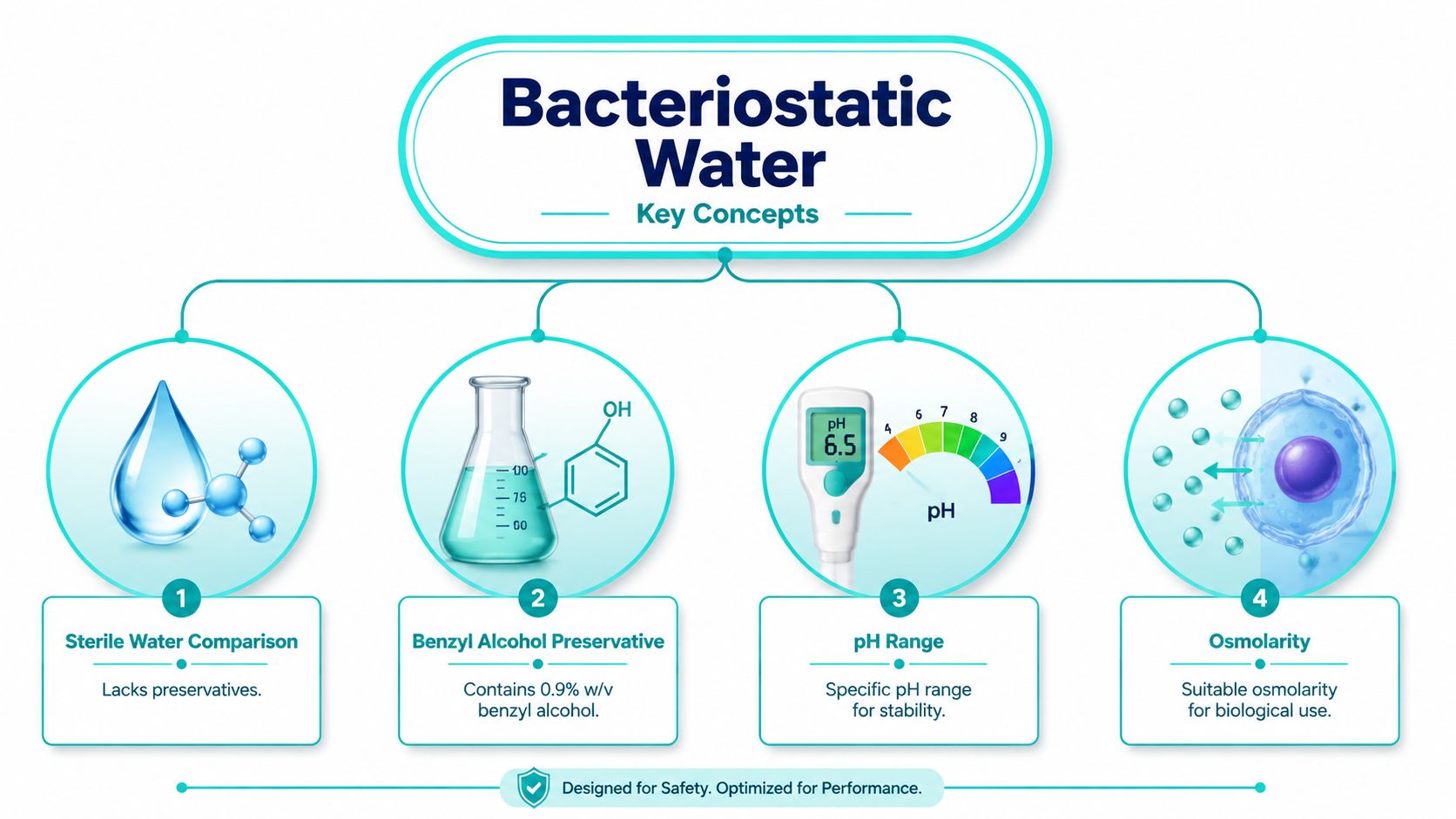
Think of bacteriostatic water as sterile water with a built-in traffic controller. The water is the vehicle. The preservative controls what unwanted microbes are allowed to do after the vial is punctured. It doesn't sterilize a contaminated solution after the fact. It helps prevent small contamination events from turning into rapid microbial growth.
HerbiLabs describes bacteriostatic water as 0.9% w/v benzyl alcohol in sterile water, with a pH of 5.7, osmolarity of approximately 286 mOsm/L, and endotoxin levels below 0.25 EU/mL for assay compatibility in sensitive work, as outlined in HerbiLabs' lab professionals guide.
Use this concept map when you're deciding whether a vial setup makes sense:
The term bacteriostatic is where many readers get confused. It means growth preventing, not microbe killing. If your technique is sloppy, the preservative won't rescue the sample.
The safest way to think about it is simple. Bacteriostatic water buys handling time, not carelessness.
That's also why researchers should separate two questions that often get blended together. First, is bacteriostatic water suitable for the peptide's chemical stability? Second, is it suitable for the biological system that will receive that peptide solution later? Those are not always the same answer.
A good reconstitution routine should feel boring. When labs have problems, they usually come from rushed handling, vague labeling, or using a concentration that looked right in the moment but wasn't calculated from the correct mass.
For a detailed walkthrough on prep logic and workflow, Celonyx Labs' peptide reconstitution guide is one example of a practical reference researchers use alongside internal SOPs.
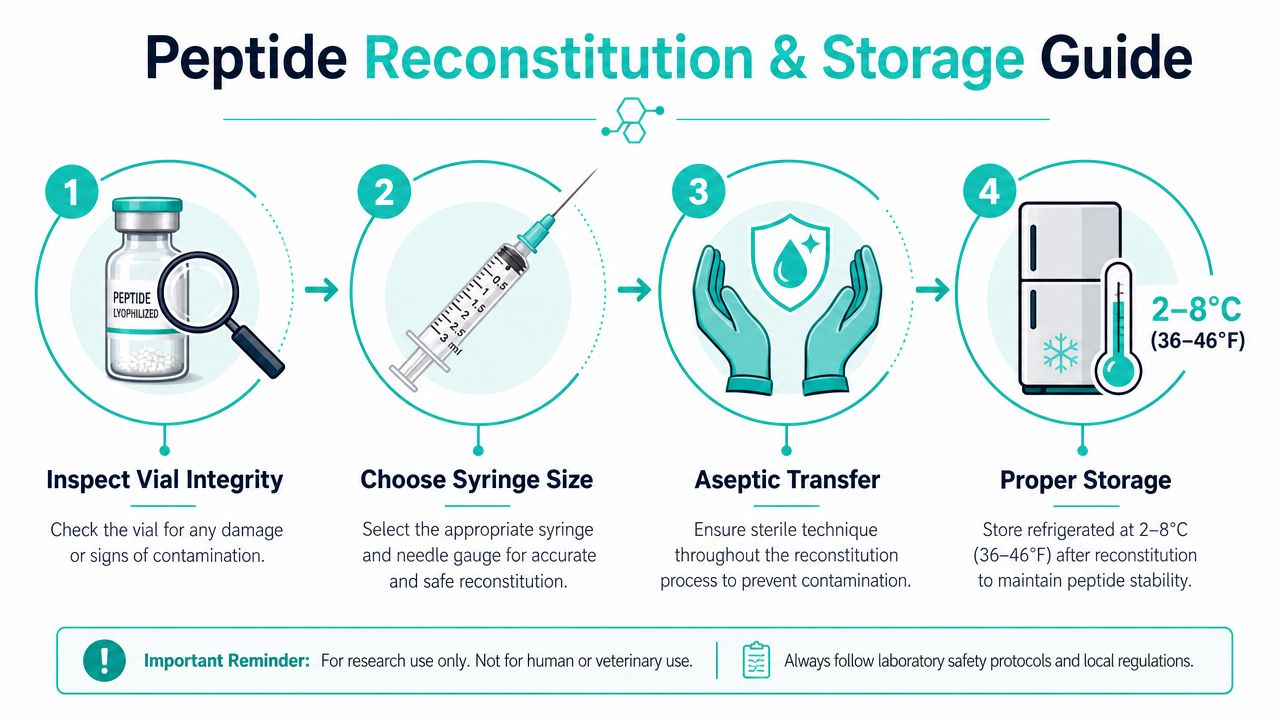
Start with inspection, not mixing.
This short video is useful if you want to visualize the flow of a careful transfer before doing it at the bench.
When you inject the diluent, don't blast it directly into the powder cake. Aim the stream down the inner wall of the vial so the liquid runs gently across the material. Think of washing a watercolor palette, not power-rinsing a dirty flask.
A few handling habits prevent a lot of avoidable damage:
HerbiLabs notes that the formulation is standardized for assay compatibility, including 0.9% w/v benzyl alcohol, pH 5.7, and osmolarity of about 286 mOsm/L in its specification guide for lab use. That helps explain why the diluent is so widely used, but the peptide still has to be handled as if it's fragile.
Label immediately after reconstitution. Don't trust memory.
Include:
Store the vial refrigerated and protected from light if your protocol calls for that condition. Keep a draw log if multiple people may access the vial. The log is often what reveals why one vial behaves differently from another.
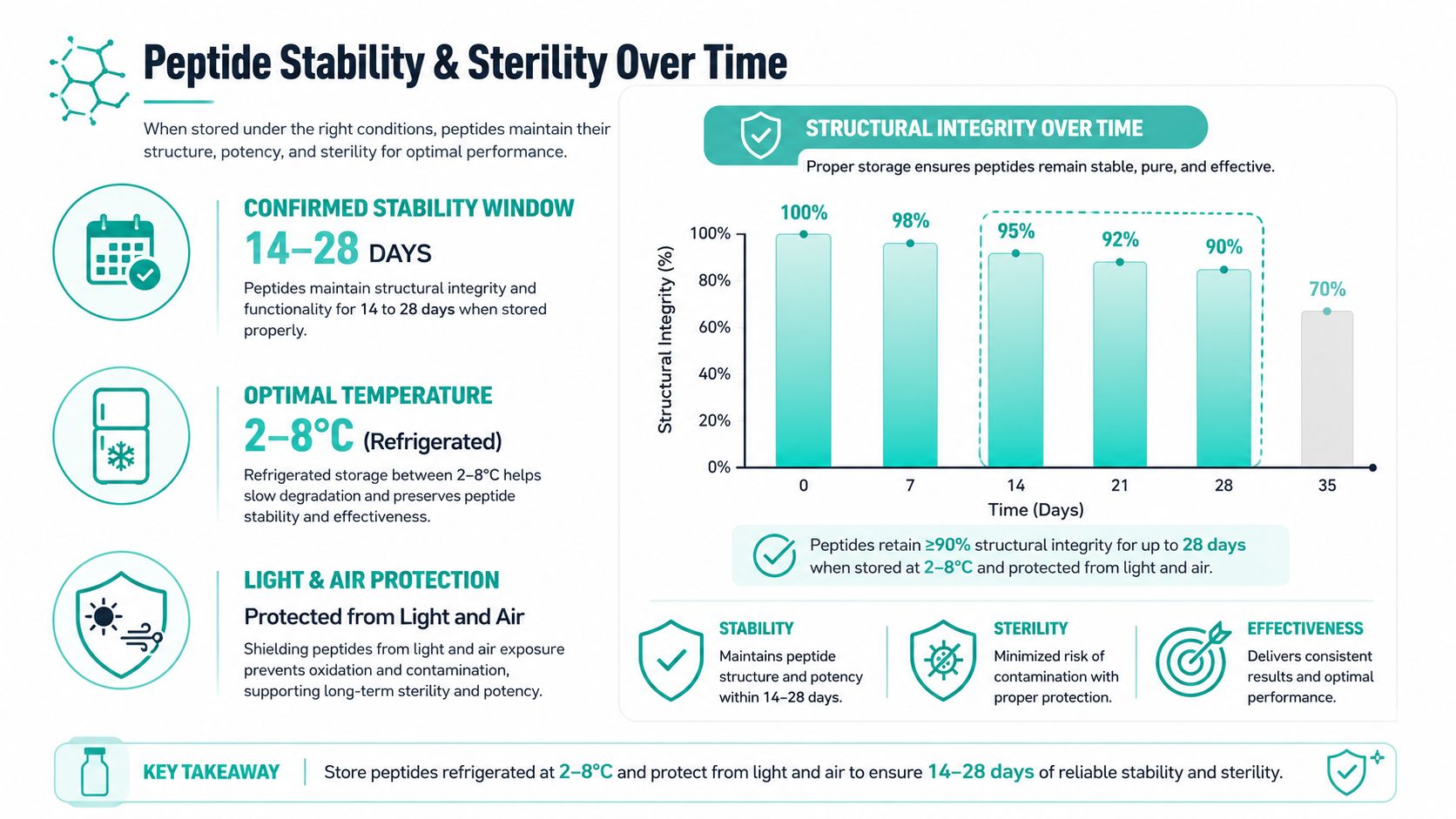
A vial that still looks clear can still be a problem. Visual clarity doesn't prove structural integrity, and it definitely doesn't prove the absence of contamination.
According to Genetra's storage guidance for reconstituted peptides, reconstituted research peptides in bacteriostatic water show a confirmed structural stability window of 14 to 28 days when refrigerated at 2–8°C and protected from light. Beyond that window, degradation becomes a realistic concern even if the solution appears unchanged.
That timing is useful, but it's not a permission slip to push every sample to the end of the range. A heavily accessed vial, inconsistent refrigerator conditions, or poor stopper hygiene can shorten how comfortable you should feel about using it.
Repeated puncture is the hidden stress test. Every needle entry is a chance to introduce contamination, shed particulates, or compromise the stopper.
Use this quick bench checklist:
Research-grade bacteriostatic water should be sterile-filtered through validated 0.22 micron membranes and have sterility verified under USP <71> standards, according to Peptide Insider's procurement analysis. That addresses the starting material. Your job in the lab is to avoid undoing that clean starting point.
If you're debating whether an older vial is “probably fine,” the data quality question is already bigger than the leftover volume.
The calculation itself is simple:
Volume of water (mL) = peptide mass (mg) ÷ target concentration (mg/mL)
What makes this tricky in practice isn't the math. It's using the wrong mass, rounding too early, or choosing a concentration that's awkward for later aliquots. If you want a second check on your calculations, Celonyx Labs' Peptide Reconstitution Calculator is one example of a tool researchers use to verify setup before mixing.
| Peptide Mass (mg) | Target Conc (mg/mL) | Volume of Water (mL) |
|---|---|---|
| 5 | 1 | 5 |
| 5 | 2.5 | 2 |
| 10 | 2 | 5 |
| 2 | 1 | 2 |
| 3 | 0.5 | 6 |
Here's how to read the table like a lab instructor would:
The most common error is using the nominal vial label instead of the exact peptide mass listed on the Certificate of Analysis. Genetra specifically notes that researchers should calculate from the exact peptide mass stated on the CoA, not the nominal label quantity, in its guidance on mixing peptides with bacteriostatic water.
A few other traps show up often:
If the concentration choice feels confusing, work backwards from the smallest volume you'll need to measure accurately.
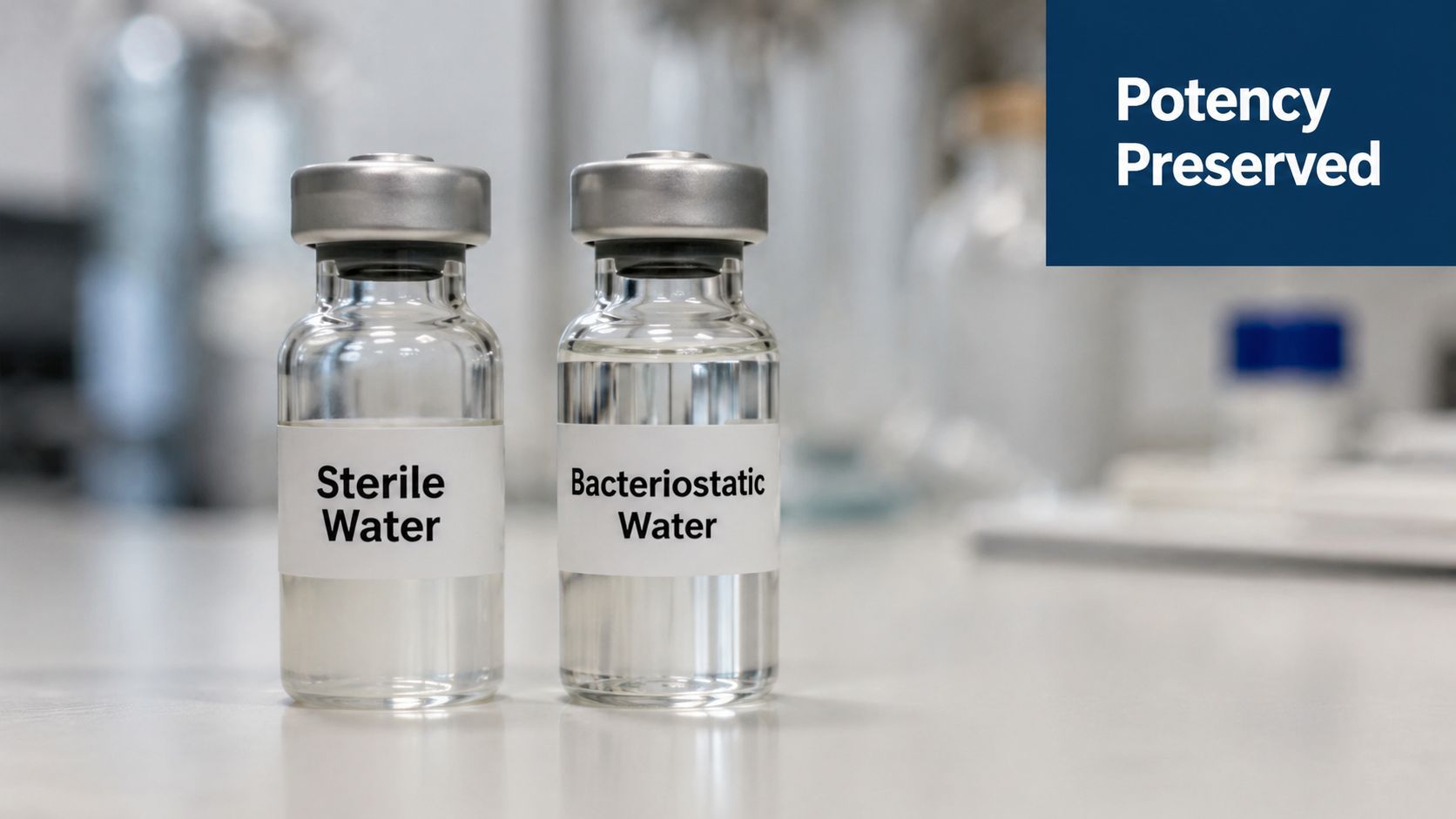
Choosing a diluent isn't just a chemical question. It's also a workflow question and, in cell work, a biology question.
The overlooked issue is cytotoxicity. Hati Peptides' guide on bac water use notes that primary neurons, certain stem cells, and epithelial cells are sensitive to 0.9% benzyl alcohol, so those systems may require sterile water or PBS for immediate use within 4–6 hours.
Use this simple decision path:
Will you access the vial more than once over time?
If yes, bacteriostatic water is usually the practical default.
Is the peptide or protein known to be sensitive to acidic or preservative-containing environments?
If yes, review compatibility before defaulting to bacteriostatic water.
Will the reconstituted material contact sensitive cell types such as primary neurons, some stem cells, or epithelial cells?
If yes, avoid treating benzyl alcohol as harmless background. Immediate-use sterile water or PBS may be the better fit.
One product example in this category is Celonyx Labs Bacteriostatic Water 10mL, which is described as a sterile aqueous solution containing purified water and 0.9% benzyl alcohol for peptide reconstitution. That's a factual product description, not a universal answer. The right diluent still depends on the peptide and the experiment.
Lab quality starts before the vial reaches the bench. Procurement teams should ask for documentation that confirms sterility, preservative concentration, endotoxin testing, lot traceability, and packaging suitable for repeated sterile access.
Useful checkpoints include:
The physical packaging matters too. Genetra notes that research-grade products are commonly packaged in sealed glass vials with aluminum crimp caps and medical-grade rubber stoppers in its procurement and handling guidance. That's not a cosmetic detail. It helps reduce contamination and leaching concerns.
If a protocol requires repeated draws across more than a day, diluent choice becomes part of experimental design. Real Peptides' explanation of bac water science states that peptides in sterile water lose 15–25% potency within 72 hours due to bacterial peptidase activity and oxidative stress, making bacteriostatic water the appropriate choice for protocols requiring multiple draws over more than 24 hours.
That doesn't mean bacteriostatic water should be used automatically in every setup. It means you should balance three things every time: multi-dose handling needs, peptide stability, and downstream cell compatibility.
A label is a starting point, not the whole answer. For research use, ask for a lot-specific Certificate of Analysis confirming the stated 0.9% benzyl alcohol concentration and related quality metrics.
Treat it conservatively and retire it from use. Even if the solution still looks normal, visual appearance doesn't guarantee stability or sterility.
No. Many are, but some sequences are sensitive to acidic or preservative-containing conditions. Review peptide-specific handling guidance before defaulting to one diluent.
Sometimes, but not always. Sensitive cell types can react poorly to benzyl alcohol. In those cases, immediate-use sterile water or PBS may be more appropriate.
Celonyx Labs supplies research peptides and related lab materials for investigators who need documented products, catalog access, and customer support. If you're sourcing peptide reconstitution materials or comparing peptide options for laboratory workflows, visit Celonyx Labs to review current product information and published policies.
A researcher searching “kisspeptin 10 for sale” may expect a straightforward catalog result. Instead, the

Ranked guide to the best tirzepatide peptides for research in 2026: lyophilized vials, reference standards,

The best cagrilintide peptides for research in 2026, ranked by purity, COA availability, and format
FOR RESEARCH USE ONLY. Products sold by Celonyx Labs are intended exclusively for laboratory and scientific research. They are not intended for human or veterinary use, consumption, diagnosis, treatment, cure, or prevention of any disease. By purchasing from this site, you acknowledge that you understand the intended research purpose of these materials and agree to comply with all applicable laws and regulations.