Best GHK-Cu peptides for skin and wound healing research 2026
Choose the best GHK-Cu peptide format for laboratory skin and wound-healing research. Compare documentation, assay
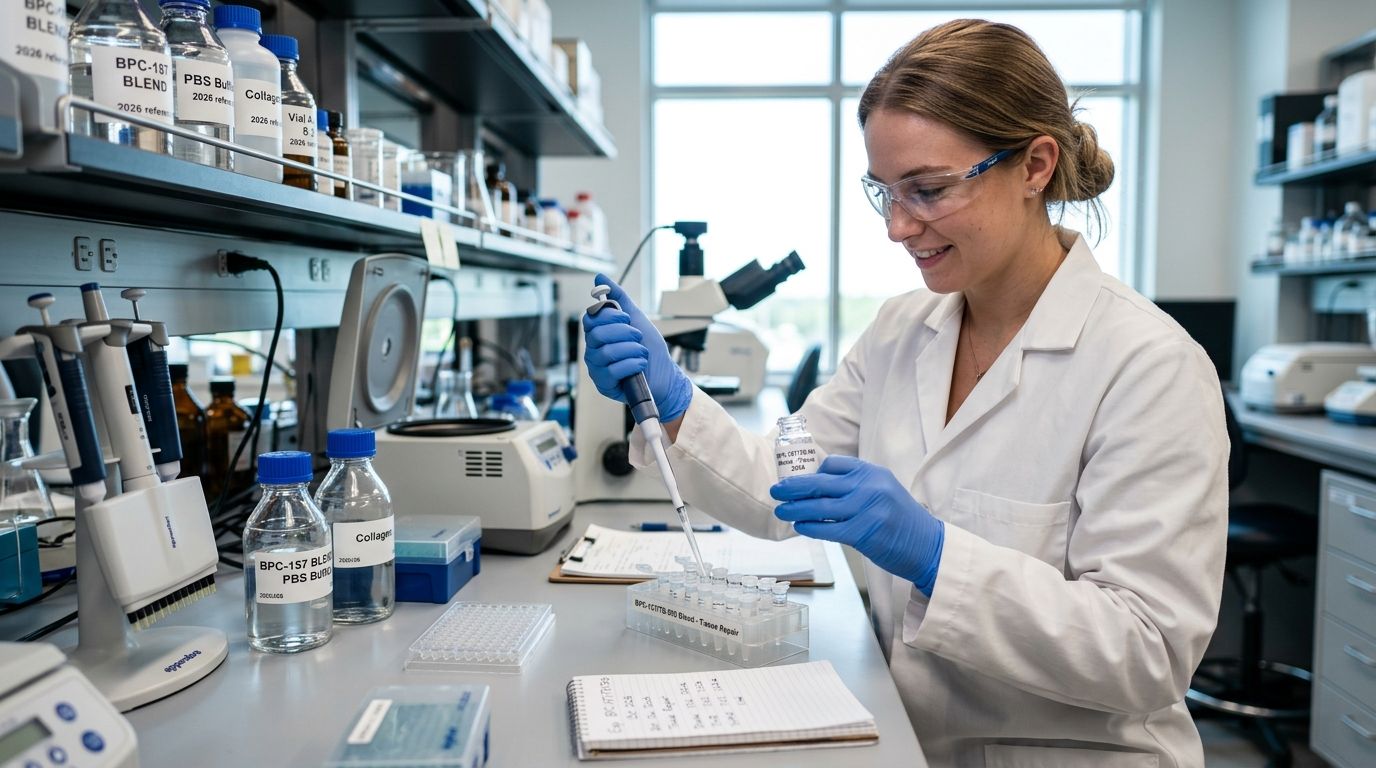
BPC-157 research blends pair the pentadecapeptide with a second compound to model combined repair pathways, and picking the wrong pairing wastes both budget and bench time. Best overall for combined tissue-repair modeling: BPC-157/TB-500 blend. Best for isolated mechanism studies: standalone BPC-157. Best for connective-tissue and dermal matrix work: BPC-157/GHK-Cu blend.
A "blend" is two research peptides packaged together, and the combination only earns bench time if both compounds hold purity and stability independently. Vendors marketing BPC-157 blends in 2026 vary wildly on documentation — some ship a COA per lot, others ship none. Researchers comparing the best BPC-157 peptide blends need to weigh the pairing's scientific rationale, not just the label.
Celonyx Labs stocks 99% purity, third-party tested peptides, and that verification standard is the baseline this list uses to judge every blend below. All compounds referenced here are strictly for research use only — none of this is intended for human or veterinary application.
| Blend | Best For | Standout Feature | Key Limitation |
|---|---|---|---|
| BPC-157/TB-500 | Combined systemic + localized repair modeling | Two well-documented repair-pathway peptides in one vial | More variables to isolate in a single study |
| BPC-157 (standalone) | Isolated mechanism-of-action studies | Single-variable clarity for baseline data | No synergistic pathway data to compare against |
| BPC-157/GHK-Cu | Connective tissue and dermal matrix research | GHK-Cu's copper-peptide profile is heavily documented in dermal literature | Copper-peptide handling needs tighter light/temperature control |
| BPC-157/KPV | Inflammatory pathway research | KPV's anti-inflammatory mechanism is distinct from BPC-157's | Less third-party literature volume than TB-500 or GHK-Cu pairings |
| BPC-157/Thymosin Alpha-1 | Immune-modulation adjacent research | Pairs a repair peptide with an immune-signaling peptide | Narrower use case; not a fit for pure tissue-repair protocols |
This pairing combines BPC-157 with TB-500 (a synthetic fragment of Thymosin Beta-4), and it's the most requested combination in tissue-repair research catalogs in 2026. The rationale is straightforward: BPC-157 is studied for localized gut and tendon pathway activity, while TB-500 is studied for actin-regulation and cell migration at a more systemic level. Together they let a protocol model both angles without running two separate compound orders.
BPC-157/TB-500 pros:
BPC-157/TB-500 cons:
Best for: labs running combined-pathway tissue-repair models. Verdict: Buy if the protocol is explicitly designed to test synergy rather than isolate mechanism.
Standalone BPC-157 stays the control point for any lab building baseline data before moving to a blend. At 99% purity with a documented COA, it gives a single-variable dataset that a blend can never produce on its own.
BPC-157 standalone pros:
BPC-157 standalone cons:
Best for: researchers establishing baseline BPC-157 activity before layering in a second compound. Verdict: Buy for any protocol still in the mechanism-mapping phase.
GHK-Cu is a copper-binding peptide with a long research history in dermal matrix and collagen-signaling literature, and pairing it with BPC-157 targets connective-tissue-focused protocols specifically. This blend shows up less often in general repair catalogs but fits a narrower, well-defined niche.
BPC-157/GHK-Cu pros:
BPC-157/GHK-Cu cons:
Best for: dermal matrix and connective-tissue-specific research designs. Verdict: Hold unless the protocol is specifically dermal or matrix-focused — otherwise BPC-157/TB-500 covers more ground.
KPV is studied for anti-inflammatory signaling distinct from BPC-157's repair pathway, making this pairing a fit for protocols examining inflammation alongside tissue response. It's a smaller catalog category in 2026 than the TB-500 or GHK-Cu pairings, so sourcing consistency takes more diligence.
BPC-157/KPV pros:
BPC-157/KPV cons:
Best for: inflammatory pathway studies that need a repair-peptide comparator. Verdict: Hold — verify supplier documentation closely before ordering.
Thymosin Alpha-1 is studied for immune signaling, and pairing it with BPC-157 targets a narrow overlap zone between immune modulation and tissue repair. It's the most specialized entry on this list and the one with the smallest applicable use case.
BPC-157/Thymosin Alpha-1 pros:
BPC-157/Thymosin Alpha-1 cons:
Best for: research crossing into immune-modulation territory alongside repair pathways. Verdict: Skip unless the protocol explicitly calls for an immune-signaling variable.
Each blend was judged against the six criteria above: purity verification, COA traceability, compound compatibility, reconstitution clarity, scientific rationale for the pairing, and clean research-use-only labeling. BPC-157/TB-500 ranks first because it covers the broadest combined-pathway use case with the most consistent 2026 documentation across suppliers; the other four blends rank by how narrow and well-supported their specific niche is.
“A blend only earns bench time if both peptides in it hold 99% purity independently — the pairing doesn’t fix a weak compound.”
Reconstitution and storage decisions matter as much as which blend gets ordered. Lyophilized BPC-157 blends store reliably at -20°C for extended periods, but once reconstituted with bacteriostatic water, most blends are stable for roughly 20-30 days when kept refrigerated at 2-8°C. Solvent choice, needle gauge, and container material all affect how much of that stability window survives in practice.
A short checklist before the first reconstitution:
Compare peptide purity and COAs
Check current BPC-157 blend listings and batch documentation.
For most 2026 tissue-repair protocols, BPC-157/TB-500 is the default pick — it covers the widest research angle with the strongest documentation trail. Run standalone BPC-157 first if the study still needs a clean baseline, reach for BPC-157/GHK-Cu when the focus narrows to dermal or connective-tissue matrix work, and treat BPC-157/KPV and BPC-157/Thymosin Alpha-1 as situational picks for inflammation- or immune-specific designs. Whichever blend gets ordered, the COA is the non-negotiable gate — no documentation, no order.
What is the best BPC-157 peptide blend for tissue repair research in 2026?
BPC-157/TB-500 is the most broadly applicable blend for combined systemic and localized tissue-repair research in 2026. It pairs two independently documented repair-pathway peptides in a single order.
Is BPC-157/TB-500 better than standalone BPC-157?
It depends on the study design. Standalone BPC-157 gives cleaner single-variable data, while the BPC-157/TB-500 blend is better suited to protocols specifically testing combined-pathway activity.
How should BPC-157 blends be reconstituted?
Reconstitute with preservative-grade bacteriostatic water at a documented concentration, then store refrigerated at 2-8°C. Most blends stay stable for roughly 20-30 days once reconstituted.
How should unreconstituted BPC-157 blends be stored?
Lyophilized BPC-157 blends store best at -20°C, away from light, until they’re ready for reconstitution. Cold-chain consistency during shipping matters as much as storage after arrival.
Is BPC-157/GHK-Cu a good choice for general tissue-repair research?
It’s a strong choice specifically for dermal and connective-tissue matrix research, but it’s narrower than BPC-157/TB-500 for general repair-pathway studies.
What purity level should a research-grade BPC-157 blend have?
Look for 99% purity confirmed by third-party HPLC or mass spec testing, backed by a batch-specific Certificate of Analysis. Anything without a traceable COA should be treated as unverified.
How much does a BPC-157 blend cost for research use?
Pricing varies by vendor, blend composition, and quantity ordered, so check current listings directly rather than relying on a fixed figure.
Can BPC-157/KPV replace BPC-157/TB-500 in an inflammation study?
BPC-157/KPV targets inflammatory signaling specifically and suits protocols studying inflammation-repair crossover, but it doesn’t cover the same systemic-repair ground as BPC-157/TB-500.
The blend that gets skipped most often on this list — BPC-157/Thymosin Alpha-1 — is also the one researchers ask about most when a protocol unexpectedly crosses into immune-signaling territory mid-study. Keep it in mind as a pivot option rather than a default pick.
Choose the best GHK-Cu peptide format for laboratory skin and wound-healing research. Compare documentation, assay

Choose lot-verified melanotan 1 peptide for pigmentation research. Compare material specifications, purity evidence, and documentation

Native oxytocin peptide is the default for behavioral research. Compare reference standards, labeled materials, and
FOR RESEARCH USE ONLY. Products sold by Celonyx Labs are intended exclusively for laboratory and scientific research. They are not intended for human or veterinary use, consumption, diagnosis, treatment, cure, or prevention of any disease. By purchasing from this site, you acknowledge that you understand the intended research purpose of these materials and agree to comply with all applicable laws and regulations.