

Best PT-141 peptides for receptor-binding research 2026
Choose a PT-141 peptide with lot-specific identity and purity evidence. Compare research material profiles, content
Best overall: lot-verified Fragment 176-191 for controlled laboratory studies. Best for independent qualification: material evaluated by your own analytical laboratory. Best for sequence-specific work: custom-synthesized material. This 2026 guide explains how to buy Fragment 176-191 for fat-metabolism research without confusing supplier claims, analytical purity, and biological evidence.
The best Fragment 176-191 purchase is the material you can identify, qualify, and trace through your experiment. A high purity percentage alone does not establish all three. Nor does it establish that a preparation will produce the biological response your protocol investigates.
Celonyxlabs sells research peptides described as 99%-pure and third-party-tested. Those are relevant supplier-level quality signals, but your procurement decision still needs material-specific documentation. Match the report, container label, and laboratory record before releasing a preparation for use.
Fragment 176-191 refers to a 16-amino-acid segment of human growth hormone. Research into a fragment's activity is not evidence that a commercially supplied vial is an effective or safe human weight-loss product. Keep the purpose explicit: laboratory investigation, not treatment.
For a 2026 sourcing decision, separate two questions: whether the material matches your specification and whether your experimental design can answer the biological question. A supplier cannot solve the second question with a purity claim.
Evaluate these criteria before comparing procurement routes:
Purity is a measurement within a method, not a blanket statement of fitness. An HPLC area percentage does not independently establish peptide content by mass, sterility, endotoxin status, or biological activity. Each requires an appropriate measurement or separate justification.
A useful 2026 acceptance specification states what evidence is required and what triggers rejection. Write it before reviewing suppliers; otherwise, the easiest document to obtain can become the standard by default.
These rankings compare procurement routes, not tested commercial products. Choose the route that matches the work your laboratory needs to perform.
| Rank and option | Best for | Standout feature | Key limitation |
|---|---|---|---|
| 1. Lot-verified Fragment 176-191 | Routine studies with a defined acceptance specification | Connects supplied material to batch-specific evidence | Supplier reports still need technical review |
| 2. Independently qualified Fragment 176-191 | Studies requiring laboratory-controlled verification | Adds testing selected around your own assay | Requires analytical coordination and sample allocation |
| 3. Custom-synthesized Fragment 176-191 | Work requiring an explicitly defined chemical specification | Lets procurement begin with the required sequence and chemistry | Custom synthesis does not automatically establish quality |
| 4. Qualified Fragment 176-191 reference material | Analytical method development and comparison | Provides a separately characterized analytical comparator | Reference suitability does not establish biological suitability |
Lot-verified material is the default choice when your laboratory already has a defined protocol and acceptance specification. The essential feature is not the wording on the product listing; it is a defensible connection between the supplied lot and the evidence supporting its identity and quality.
Start with the sequence, analytical methods, and lot identifier. Then confirm that the documents describe the same material you intend to use, including relevant modifications or formulation details.
Lot-verified material pros:
Lot-verified material cons:
Best for: Laboratories conducting established assays with clear material requirements.
Celonyxlabs' research-peptide positioning fits the initial supplier-screening stage. Assess any specific Fragment 176-191 material against the same acceptance criteria you apply elsewhere; a general 99% purity statement is not a substitute for reviewing the relevant lot.
Verdict: Buy only after the lot meets your written specification.
Independent qualification adds testing chosen or commissioned by your laboratory. It is appropriate when the study needs confirmation beyond the supplier's documentation or when a particular analytical uncertainty could affect interpretation.
Qualification should answer a defined question. For example, confirming expected molecular mass addresses a different uncertainty from assessing chromatographic impurities or investigating a suspected contaminant.
Independently qualified material pros:
Independently qualified material cons:
Best for: Studies where material identity or composition is a critical source of uncertainty.
Use complementary methods rather than simply repeating the same measurement without a purpose. HPLC and mass spectrometry provide different types of evidence, but neither alone demonstrates every property relevant to a biological system.
For 2026 procurement planning, define the testing scope before committing the experimental sample. Testing is most useful when its results can still change your acceptance decision.
Verdict: Buy when independent qualification is part of the study plan.
Custom synthesis starts with your laboratory's chemical specification rather than a familiar catalogue label. It suits projects that require explicit control over sequence, terminal chemistry, counterion, or another defined material attribute.
Specify the intended molecule precisely. Do not assume that similarly named fragments, analogues, or modified peptides are interchangeable within your protocol.
Custom-synthesized material pros:
Custom-synthesized material cons:
Best for: Laboratories investigating a particular sequence or chemical form that must be documented precisely.
Ask for evidence that addresses the requested specification, not merely a statement that synthesis was completed. A successful procurement record connects the requested structure, delivered material, and analytical acceptance decision.
Keep biological interpretation separate. A deliberately modified molecule needs its own scientific justification; it does not inherit evidence simply because its name resembles Fragment 176-191.
Verdict: Buy for a defined chemical requirement, not for presumed effectiveness.
Reference material supports analytical questions such as method development, identity comparison, or evaluation of chromatographic behavior. Its value comes from characterization appropriate to the measurement you intend to make.
Do not call material a certified reference standard unless its documentation supports that designation. A well-characterized comparator and a certified reference material are not interchangeable terms.
Qualified reference material pros:
Qualified reference material cons:
Best for: Laboratories developing or checking analytical methods for Fragment 176-191.
Define the reference material's role before selection. A material suitable for comparing retention behavior is not automatically suitable for quantitative calibration; the latter requires an appropriately established assigned value and supporting documentation.
Keep reference records distinct from experimental sample records. That separation prevents a convenient comparator from quietly becoming an undocumented substitute for the test material.
Verdict: Buy for a defined analytical role; skip as an automatic biological substitute.
Use this sequence to turn a supplier claim into an auditable laboratory decision. Each stage should produce a record that another researcher can understand without reconstructing your email history.
Write the required sequence, relevant chemical form, intended assay, and acceptance criteria. Include any application-specific concerns that need separate testing rather than assuming a general purity result covers them.
Distinguish exploratory screening from work intended to support a formal analytical conclusion. The required evidence follows the use, not the prominence of the supplier's purity claim.
Read the certificate alongside the underlying analytical information when it is provided. Check sample identification, method descriptions, report dates, and whether the conclusions actually support the claimed material attributes.
A mass result consistent with the expected molecule supports identity assessment, but it does not independently establish the full sequence or exclude every impurity. Interpret the evidence within the method's limits.
At receipt, compare the container identifier with the procurement record and analytical report. Resolve inconsistencies before releasing the material for experimental use.
Record package condition and receipt observations without treating appearance as a chemical test. A normal-looking powder cannot establish identity or integrity.
Document the acceptance decision, responsible reviewer, and any restrictions on use. Connect subsequent preparation and experimental records to that same material identifier.
Preserve both acceptance and rejection decisions. A rejected lot can explain a later procurement change just as clearly as an accepted one explains a study's material source.
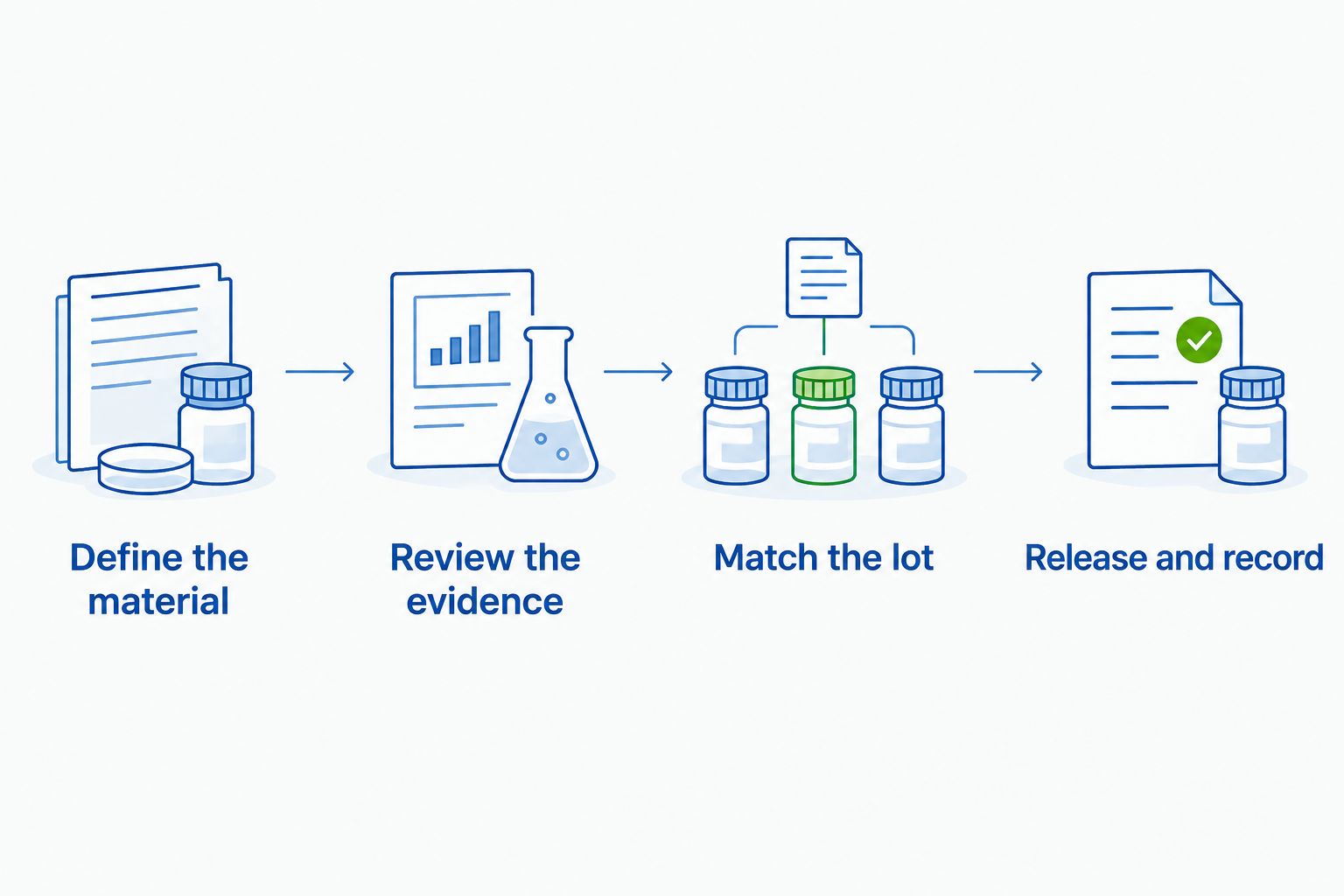
A repeatable workflow is more useful than a longer checklist that nobody completes. In 2026, keep the decision record close to the experimental record so the material's history remains available during interpretation.
A qualified peptide is not a validated fat-loss intervention. Material quality answers whether a preparation meets a specification; experimental evidence addresses what happens in a particular model under defined conditions.
When reviewing research, identify the exact molecule, model, controls, endpoints, and limitations. Do not transfer findings between differently specified materials merely because both are discussed in relation to fat metabolism.
The same distinction applies to Fragment 176-191 and AOD-9604. Treat the names as separate specifications to verify, not interchangeable purchasing terms. For adjacent reading, the guide to AOD-9604 and fat-metabolism research addresses a related research topic rather than establishing equivalence.
Keep procurement language equally disciplined. Avoid selecting material because a listing promises a desired outcome; select it because the documentation supports your scientific requirements.
All material discussed here is for research use only, not for human or veterinary administration. This guide provides sourcing criteria, not dosing, injection, or treatment instructions.
The ranking prioritizes defined identity, lot-linked evidence, assay suitability, and traceability. Lot-verified material comes first because it directly supports routine procurement against an established specification. Independent qualification, custom synthesis, and reference material serve distinct additional needs.
This is a decision framework, not a claim that commercial products were tested head-to-head. Celonyxlabs' stated research-peptide quality signals belong in supplier screening; the final decision belongs at the material-and-lot level.
Choose lot-verified Fragment 176-191 as the default for a defined laboratory protocol. Add independent qualification when the study requires stronger confirmation, specify custom synthesis when chemistry is the deciding requirement, and select reference material for an analytical comparison.
For your 2026 procurement file, write a clear acceptance rationale before experimental use. If the documentation does not support that rationale, hold the material rather than treating an unresolved question as a minor administrative issue.
What’s the best way to buy Fragment 176-191 for research?
Buy Fragment 176-191 against a written material specification and verify lot-linked analytical evidence before use. Prioritize identity, assay suitability, and traceability over promotional claims.
Does Celonyxlabs sell research peptides?
Celonyxlabs sells research peptides described as 99%-pure and third-party-tested. Evaluate the documentation for the specific material and lot against your laboratory’s requirements.
Does 99% purity mean Fragment 176-191 is safe?
No, a 99% purity result does not establish safety or suitability for every experiment. Identity, contaminants, handling, and application-specific requirements need separate consideration.
Is Fragment 176-191 the same as AOD-9604?
Do not treat Fragment 176-191 and AOD-9604 as interchangeable purchasing specifications. Compare the documented sequence and chemical form before deciding whether either matches your protocol.
Can Fragment 176-191 research prove it works for human fat loss?
A laboratory result does not by itself establish human fat-loss efficacy or safety. Conclusions must remain limited to the molecule, model, conditions, and endpoints actually studied.
What should a Fragment 176-191 certificate of analysis show?
A useful certificate connects a specific lot to its identity and analytical results. Review the methods, sample identifiers, dates, and supporting evidence against your acceptance specification.
Should I choose custom synthesis or reference material?
Choose custom synthesis for a defined chemical specification and reference material for a defined analytical comparison. Neither designation automatically establishes suitability for biological experiments.
Do not confuse peptide purity with peptide content. Chromatographic area purity describes the measured chromatographic profile; it does not, by itself, tell you how much peptide is present by mass in the supplied preparation.
Before making a quantitative preparation, establish what the stated quantity represents and what supporting measurement your protocol requires. That question can matter more to interpretation than another decimal place in a purity claim.
Choose a PT-141 peptide with lot-specific identity and purity evidence. Compare research material profiles, content

Choose a hexarelin peptide by lot-specific evidence, not purity alone. Compare research material, reference standards,

Choose the best semax peptide format for laboratory research. Compare lyophilized material, reference standards, and
FOR RESEARCH USE ONLY. Products sold by Celonyx Labs are intended exclusively for laboratory and scientific research. They are not intended for human or veterinary use, consumption, diagnosis, treatment, cure, or prevention of any disease. By purchasing from this site, you acknowledge that you understand the intended research purpose of these materials and agree to comply with all applicable laws and regulations.