

Best GHK-Cu peptides for skin and wound healing research 2026
Choose the best GHK-Cu peptide format for laboratory skin and wound-healing research. Compare documentation, assay

Best overall: lot-characterized, unmodified Kisspeptin-10 for receptor and reproductive-signaling studies. Best for analytical comparison: a reference material with assigned content. Best for structure–activity research: a fully characterized custom variant. This 2026 guide explains how to buy kisspeptin-10 by research purpose, without treating different material specifications as interchangeable.
Kisspeptin-10 is a 10-amino-acid peptide that activates the kisspeptin receptor, KISS1R. Kisspeptin signaling participates in the regulation of gonadotropin-releasing hormone, making it relevant to reproductive neuroendocrinology research. That biological relevance does not make every vial an equivalent experimental reagent.
Celonyxlabs is an online store selling 99%-pure, third-party-tested research peptides for laboratory researchers and scientists. Those are supplier-level quality signals. Your purchasing decision still needs to resolve the identity, composition, and suitability of the particular material you intend to study.
For 2026 procurement, select the specification that answers your experimental question—not the most impressive label. This ranking compares material types rather than making unsupported claims about individual supplier products. All recommendations concern laboratory research use only, not human or veterinary administration.
Use these criteria before comparing suppliers:
These criteria also define the limits of a ranking. A reference material can be the strongest analytical comparator without being the best routine biological reagent. A modified peptide can answer a structure–activity question while being unsuitable as a substitute for the native ligand.
| Rank and material specification | Best for | Standout feature to require | Key limitation |
|---|---|---|---|
| 1. Lot-characterized, unmodified Kisspeptin-10 | Native-ligand receptor and signaling studies | Confirmed sequence, termini, and lot-specific analytical identity | Purity alone does not establish peptide content or biological activity |
| 2. Assigned-content Kisspeptin-10 reference material | Quantitative analytical comparison | Documented identity, content assignment, and intended reference use | A reference designation does not automatically establish assay suitability |
| 3. Fully characterized custom Kisspeptin-10 variant | Structure–activity and mechanistic comparison | Explicitly defined modification with corresponding analytical characterization | Modification changes the test article and can change biological behavior |
The table ranks specifications, not interchangeable versions of the same experiment. Start with the research question, then use the relevant row as your purchasing brief.
Unmodified Kisspeptin-10 is the default starting specification when your protocol calls for the native short kisspeptin ligand. Human Kisspeptin-10 has the sequence YNWNSFGLRF with a C-terminal amide; confirm that the ordered material matches the species and terminal chemistry required by your protocol.
The name alone is insufficient. Ask for the complete chemical identity, including terminal modifications and the supplied salt or counterion where applicable.
Unmodified Kisspeptin-10 pros:
Unmodified Kisspeptin-10 cons:
Best for: Researchers investigating native Kisspeptin-10 receptor signaling or reproductive-axis mechanisms under an approved laboratory protocol.
For a 2026 purchasing specification, request a lot-linked certificate of analysis and the supporting identity and purity evidence. Include any content, formulation, or impurity requirements that your assay actually needs.
Verdict: Buy against this specification for native-ligand studies only after the batch documentation meets your acceptance criteria.
A Kisspeptin-10 reference material serves a different purpose from a routine experimental reagent. Its value comes from the properties assigned and documented for its intended analytical use, not simply from the word “reference” on the label.
For quantitative work, distinguish identity confirmation from content assignment. A material can have a convincing identity result yet lack the information required to establish a concentration on the basis your analytical method uses.
Assigned-content reference material pros:
Assigned-content reference material cons:
Best for: Analytical laboratories developing or checking methods that require a documented Kisspeptin-10 comparator.
Read the scope of the accompanying documentation. Determine what was assigned, how it was established, and what uncertainty or limitations apply; do not assume that all reference materials provide the same metrological information.
Verdict: Buy for analytical comparison when the documented assigned properties satisfy the method; skip the reference label as a substitute for evidence.
A custom variant changes a defined feature of Kisspeptin-10 to investigate a specific experimental question. Examples of research modifications include sequence substitutions or chemical labels, but each modification creates a distinct test article that requires its own characterization.
Custom material belongs in a study designed to examine that difference. It is not an automatic replacement for unmodified Kisspeptin-10.
Custom Kisspeptin-10 variant pros:
Custom Kisspeptin-10 variant cons:
Best for: Laboratories conducting planned structure–activity, labeling, or mechanistic investigations.
Specify the modification unambiguously before commissioning material. Require identity evidence appropriate to the resulting molecule, and define the native comparator before interpreting a difference in experimental response.
Verdict: Buy only for a protocol that explicitly requires the modification; skip as a substitute for the native ligand.
A useful procurement review follows the material from the experimental requirement to the received lot. Keep these decisions in sequence so that a persuasive purity claim does not override a mismatch elsewhere.
Write down the sequence, species context, terminal chemistry, and intended material type. Include any modification explicitly. “Kisspeptin” is not a sufficiently precise purchasing specification when the experiment requires Kisspeptin-10.
Check that the certificate of analysis identifies the batch associated with the material being supplied. Record the lot identifier in your laboratory inventory and preserve the report alongside the purchase record.
Read the identity and purity results separately. Mass spectrometry supports molecular-mass assessment, while chromatography evaluates separation under the reported method; neither result alone answers every question about the sample.
Confirm that the supplied form and preparation requirements fit your assay. Assess solvent effects, relevant impurity controls, and institutional handling requirements before using the material.
Document whether the material meets your predefined criteria and who approved its use. Keep rejected or unresolved material outside the experimental workflow until the discrepancy is addressed.
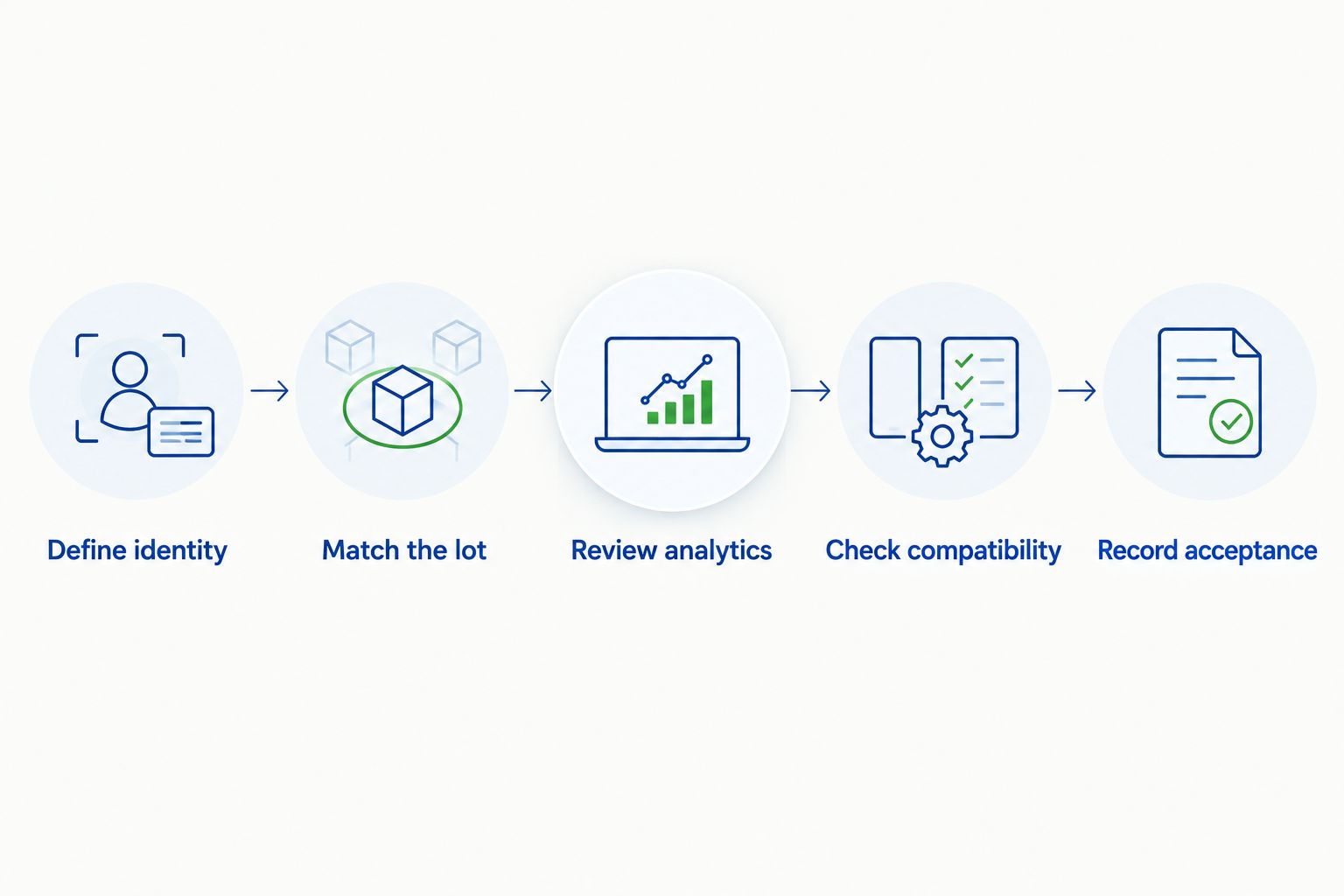
In 2026, the practical value of this workflow is traceability: a reviewer can connect the experimental result to the material that produced it. For a closer look at analytical evidence, use the guide to peptide purity testing for contract research organizations.
A reported 99% chromatographic purity result describes the sample under the stated method and calculation. It does not, by itself, establish 99% peptide content by mass, correct identity, sterility, endotoxin suitability, or biological activity.
Celonyxlabs research peptides carry a stated 99% purity and third-party-testing quality position; your assay still determines the required acceptance tests. Avoid converting a supplier-level statement into an unsupported conclusion about a particular Kisspeptin-10 batch.
Mass units also need careful interpretation. 1 mg equals 1,000 µg, but that conversion does not tell you whether a vial's stated mass represents net peptide, total powder, or a content-adjusted quantity. Resolve the basis before calculating experimental concentrations.
For biological systems sensitive to contaminants, assess the relevant controls separately. A purity chromatogram is not a sterility certificate, and “research grade” is not a universal specification shared by every laboratory.
This 2026 ranking prioritizes fit to the experimental question, then identity, interpretable analytical evidence, content definition, and traceability. It does not rank suppliers by unsupported performance claims or treat a general quality statement as a compound-specific result.
The native ligand ranks first because it matches a native-ligand study. Assigned-content reference material ranks first instead when quantitative analytical comparison is the task. A custom variant belongs first only when the modification is itself the variable under investigation.
Choose lot-characterized, unmodified Kisspeptin-10 for native reproductive-signaling research. Choose an assigned-content reference material for a method that needs those assigned properties, and choose a custom variant only when your protocol explicitly requires it.
Celonyxlabs research peptides are best suited to laboratory researchers seeking a supplier with stated 99% purity and third-party testing. That supplier-level fit is the starting point—not a substitute for confirming the exact compound specification and batch evidence.
Before you buy kisspeptin-10 in 2026, write an acceptance statement your lab can actually enforce: the required identity, supporting analytical results, content basis where needed, and handling documentation. If a critical requirement remains unresolved, hold the purchasing decision rather than relaxing the requirement silently.
What’s the best Kisspeptin-10 for reproductive research?
Lot-characterized, unmodified Kisspeptin-10 is the default specification for studies that require the native short ligand. Confirm the intended species sequence, terminal chemistry, batch identity, and assay-specific quality requirements before selecting material.
What should I check before I buy kisspeptin-10?
Check the exact chemical identity, batch-linked analytical evidence, content basis, and assay compatibility. A peptide name and purity percentage alone do not establish that a material meets your protocol.
Is Kisspeptin-10 the same as Kisspeptin-54?
No. Kisspeptin-10 contains 10 amino acids, while Kisspeptin-54 contains 54; they are distinct peptide forms and should not be substituted without a study-specific justification.
Does 99% purity mean Kisspeptin-10 is sterile?
No. A chromatographic purity result does not establish sterility, endotoxin suitability, or biological activity. Evaluate those properties separately when your experimental system requires them.
Is a reference material better than a routine research peptide?
A reference material is better suited to a task that requires its documented assigned properties. It is not automatically the better choice for a biological assay, and the reference designation alone does not establish certification or activity.
Can modified Kisspeptin-10 replace the native peptide?
A modified Kisspeptin-10 should not replace the native peptide without protocol-specific justification. The modification creates a distinct test article and can change receptor interactions or assay behavior.
Are Celonyxlabs research peptides intended for human use?
No. Celonyxlabs research peptides are intended for laboratory researchers and scientists, for research use only. This guide does not provide instructions for human or veterinary administration.
Archive the certificate you accepted, not just a link to a supplier page. Keep that file tied to the lot identifier, preparation record, and experiment: a general product description cannot reconstruct which material your laboratory actually used.
Choose the best GHK-Cu peptide format for laboratory skin and wound-healing research. Compare documentation, assay

Choose lot-verified melanotan 1 peptide for pigmentation research. Compare material specifications, purity evidence, and documentation

Native oxytocin peptide is the default for behavioral research. Compare reference standards, labeled materials, and
FOR RESEARCH USE ONLY. Products sold by Celonyx Labs are intended exclusively for laboratory and scientific research. They are not intended for human or veterinary use, consumption, diagnosis, treatment, cure, or prevention of any disease. By purchasing from this site, you acknowledge that you understand the intended research purpose of these materials and agree to comply with all applicable laws and regulations.