Integrity Research BPC 157: How to Judge Vendor Claims
The advice you'll hear most often about buying BPC-157 for the bench is short: demand
A purity percentage on a product page tells you almost nothing until you know which lot was tested, which method produced the number, and what the result leaves unmeasured. For laboratory procurement, the best research chemicals aren't the ones with the boldest headline claim. They're the ones whose identity, content, and intended use you can verify from documents tied to the exact vial you'll receive.
In 2024 alone, 688 individual NPS were reported, the highest annual total recorded, and 153 countries and territories had collectively identified 1,396 unique NPS by October 2025, according to the United Nations Office on Drugs and Crime announcement. Stimulants represented 33% of those 2024 reports.
That scale breaks the usual meaning of a ranking. Research chemical isn't a scientific quality grade. It's a label that can cover substances with very different structures, pharmacology, legal treatment, and evidence bases, including compounds introduced before their risks and legal status are fully established.

Say two suppliers sell the same named compound. One vial matches its stated molecular mass but contains an unidentified peak close to the main peak. The other has a cleaner chromatogram but its certificate belongs to a different lot. A single purity figure can't rank those products, because the first problem is analytical and the second is traceability.
Legal treatment adds a third dimension. A material that's lawful to hold for one bounded laboratory protocol may be restricted in another jurisdiction or for another use. Catalog terminology doesn't settle any of that.
Working definition: Best means the strongest independently verifiable documentation, a clearly bounded laboratory purpose, and a lawful route into your lab.
That definition changes your buying sequence. You don't start by comparing percentages. You start by defining what evidence your experiment needs, then you read the certificate line by line, vet the supplier's batch records, check whether independent testing covers your lot, confirm the legal limits, and plan storage before the package arrives.
If a vendor can't support each step with a document you can file, the product hasn't earned a place in the experiment yet, whatever the product page says.
Purity is one dimension of fitness, not the whole of it. Identity, net content, stability, endotoxin burden, aggregation, and matrix compatibility answer different questions. Collapsing them into one percentage hides the failure mode most likely to ruin your assay.
| Criterion | What to request | What it establishes |
|---|---|---|
| Identity | Mass spectrometry result for the same lot | Molecular mass matches the stated sequence |
| Purity method | Stated HPLC or UHPLC method with chromatogram | Main peak is resolved from impurities |
| Impurity reporting | Reporting threshold, with impurities at or above 0.10% identified | Which unknown peaks were characterized |
| Net peptide content | Assay basis, HPLC assay, qNMR, amino-acid analysis or mass balance | Actual peptide amount per vial |
| Counterions and water | Residual water and salt or counterion content where reported | Mass that is not peptide |
| Stability and storage | Shelf-life data and recommended storage temperature | Whether the material changes before use |
| Endotoxin and bioburden | Test results for cell-based or in vivo work | Suitability for biological systems |
The table isn't a wish list to apply evenly. It's a menu you narrow by use case, because each experiment fails in a different way.
Non-biological chemistry sits at the lower end. You mainly need confirmed identity and chromatographic purity, because there's no living system to react to trace biological contaminants. Even here, an unidentified co-eluting peak can distort a reaction yield or a calibration curve.
Analytical standards demand more. A reference material is only useful if its value traces to a qualified standard and its assay basis is stated. Without traceability, you're calibrating one unknown against another, and every downstream measurement inherits the error.
Receptor-binding assays turn on accurate net peptide content. If part of the vial mass is water, counterions, or salts, your nominal concentration is wrong and the binding curve shifts. Identity confirmation matters just as much, since a sequence variant can bind differently while looking similar on a UV trace.
Cell culture adds a biological layer. Endotoxin and bioburden results become essential, because cells respond to contaminants that a chromatogram won't show. A chemically clean peptide can still trigger a cellular response that you mistakenly attribute to the compound.
Animal studies require the deepest file. You need stability data, endotoxin results, accurate content for dosing calculations in the protocol, and a documented vehicle. Gaps here don't just add noise. They can invalidate an entire cohort.
Say a vial is labeled 99% pure. That leaves 1% unidentified material, and in a sensitive assay that fraction can be pharmacologically active, fluorescent, or cytotoxic. The headline number tells you the size of the unknown, not its nature.
The reverse failure is just as common. A highly pure material can degrade in solution, adsorb to a container wall, or aggregate, so the amount reaching your system bears little relation to the certificate value.
Before you order, answer one question in writing. How much evidence does this experiment need for its result to be interpretable?
If you can't answer that, you can't judge whether a certificate is sufficient, and you'll default to buying the largest percentage on the page. That's marketing doing your experimental design for you.
A certificate of analysis, or COA, is evidence only when you can connect each line to the vial in your hand. Work through it in order and stop at the first gap.
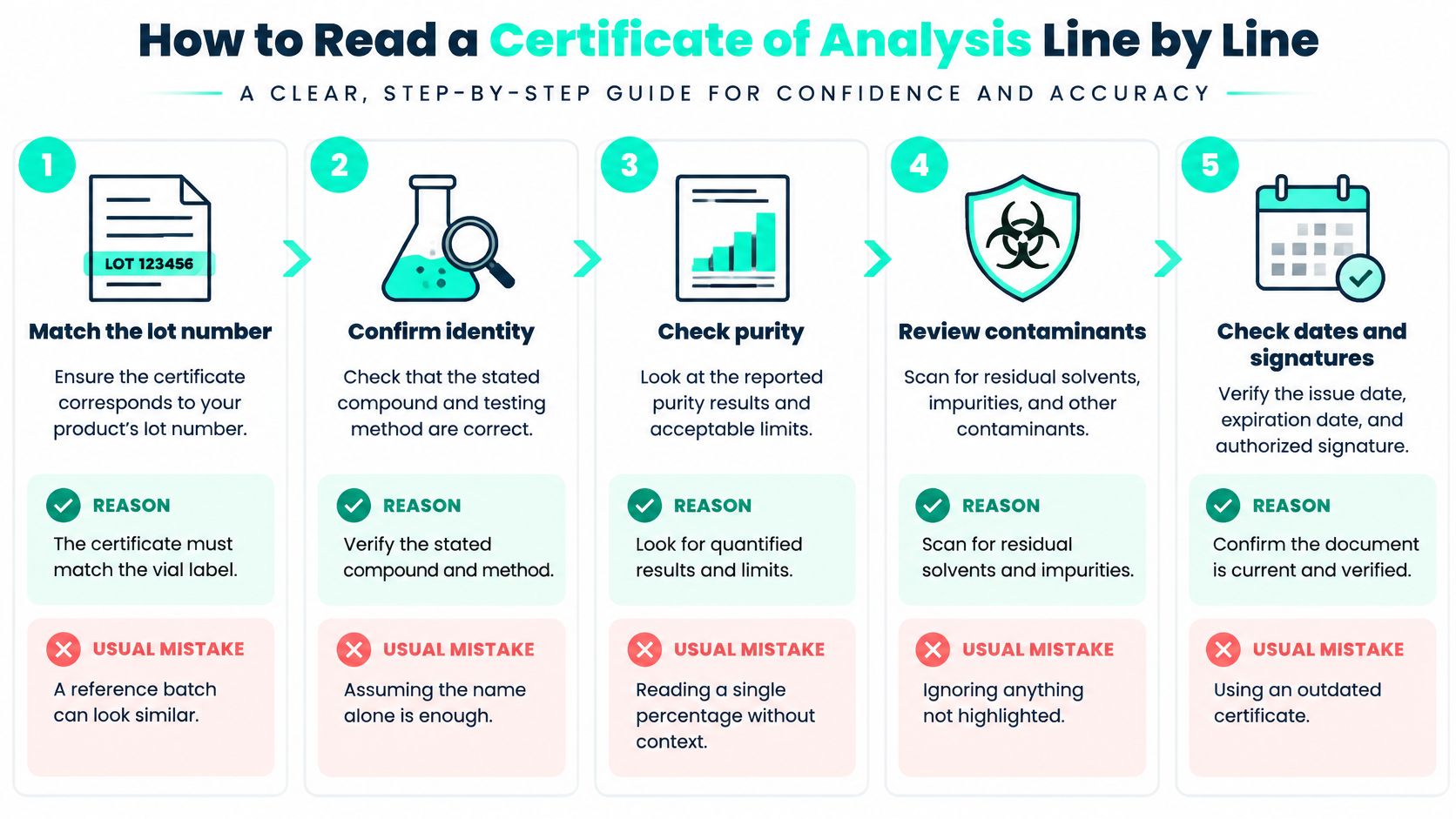
Steps 4 and 5 belong together for a methodological reason. The FDA guidance on peptide drug substance characterization recommends orthogonal characterization, pairing chromatographic separation with high-resolution or tandem mass spectrometry to establish identity, detect sequence variants, and investigate impurities. One method alone can confirm a mass and still miss a variant that co-elutes under the same peak. What the guidance leaves to the laboratory is the reporting threshold, so the number that matters is the one your supplier states on the page, not the one you assume is standard.
Read the certificate for what it proves and what it doesn't. A lot-matched COA with a named method establishes that the batch was tested and what the method resolved at the time of testing. It says nothing about how the material was stored afterward, whether the vial was relabeled, or whether the sample submitted was drawn from the same container that ships.
For a fuller walkthrough of document structure, see this guide to reading a peptide certificate of analysis before you compare suppliers.
Reading a COA is partly a numeracy skill, and the same discipline you'd use to evaluate survey figures applies here. Ask what was measured, what the denominator is, and what's excluded.
The video below shows the analytical workflow behind these documents, which helps when you're judging whether a summary table is hiding detail.
If any step can't be completed, request the missing data before ordering. A gap you can name is negotiable. A gap you fill in yourself becomes part of your experiment's error budget.
Consider a concrete claim. Every batch of our BPC-157 research peptide undergoes analytical verification using high-performance liquid chromatography (HPLC), mass spectrometry verification, and batch consistency testing, and the BPC-157 5mg product is labeled Third-Party Tested.
That's a testable statement, and your job is to test it. Request the records for the exact batch being shipped rather than accepting the general claim. A supplier's marketing is only as useful as the batch documents behind it.
| Signal | Stronger evidence | Weaker evidence |
|---|---|---|
| Certificate | Lot-specific COA with lot number matching the vial label | Generic purity figure with no lot or date |
| Method disclosure | Named method, column and chromatogram supplied | Only the words 'high purity' on the page |
| Batch testing | Per-batch HPLC and mass spectrometry records | Testing described only in marketing copy |
| Document access | Certificate available before purchase | Documents provided only after payment |
| Policies | Published terms, shipping conditions and return rules | No written policy or contact details |
| Scope of use | Explicit research-only labeling and use restrictions | Dosing, injection or human-use guidance on the page |
A catalog listing isn't an endorsement, and this approach doesn't rank suppliers. Apply the identical test to every vendor, including ones you've used before, because personnel, sourcing, and testing arrangements change without announcement.
A supplier who answers document requests slowly but completely is a better risk than one who replies instantly with a percentage and no method.
Three findings should end the process. Refusal to supply batch documents is the clearest. A 99% figure with no stated method is the second. Dosing or injection guidance on the product page is the third, because it signals an intended use outside laboratory research.
Price and shipping speed belong in the decision only after those gates. A fast, cheap shipment of unverifiable material costs more than a delayed order once you repeat the experiment.
In-house quality control and independent testing aren't the same thing. A manufacturer's own lab can run excellent methods, but it reports to the organization selling the product. Independent testing adds a separate chain of accountability for a specific lot.
Coverage should follow your use case. Paying for endotoxin data on a compound destined for non-biological chemistry adds little, while skipping it for cell work leaves the main confounder unmeasured.
Four features separate a usable report from a decorative one. The testing laboratory is named. It holds an accreditation such as ISO/IEC 17025. The report carries the lot number and test date. The method is stated in enough detail that another lab could repeat it.
Say a seller states a batch is third-party tested but supplies only a one-page summary with no lot number. Treat that claim as unverified until the full report for the shipped batch arrives. The summary may be accurate and still describe different material.
For background on how independent laboratories structure this work, review these notes on third-party testing labs and compare them against any report you're offered.
Watch for three red flags. A third-party claim with no report at all. A genuine report issued for a different lot. A testing laboratory owned by the seller without that relationship being disclosed.
Your routine is short. Request the report, compare its lot number with the vial, ask for the raw chromatogram if the summary is unclear, and file everything with the order.
Know the limits too. Independent testing can confirm identity and purity for a lot on a date. It doesn't establish safety, efficacy, or legal status, and it says nothing about how the material was stored after testing.
A research use only, or RUO, label doesn't settle legality or safety. It's a statement of intended use, and regulators read the surrounding marketing to decide whether that statement is credible.
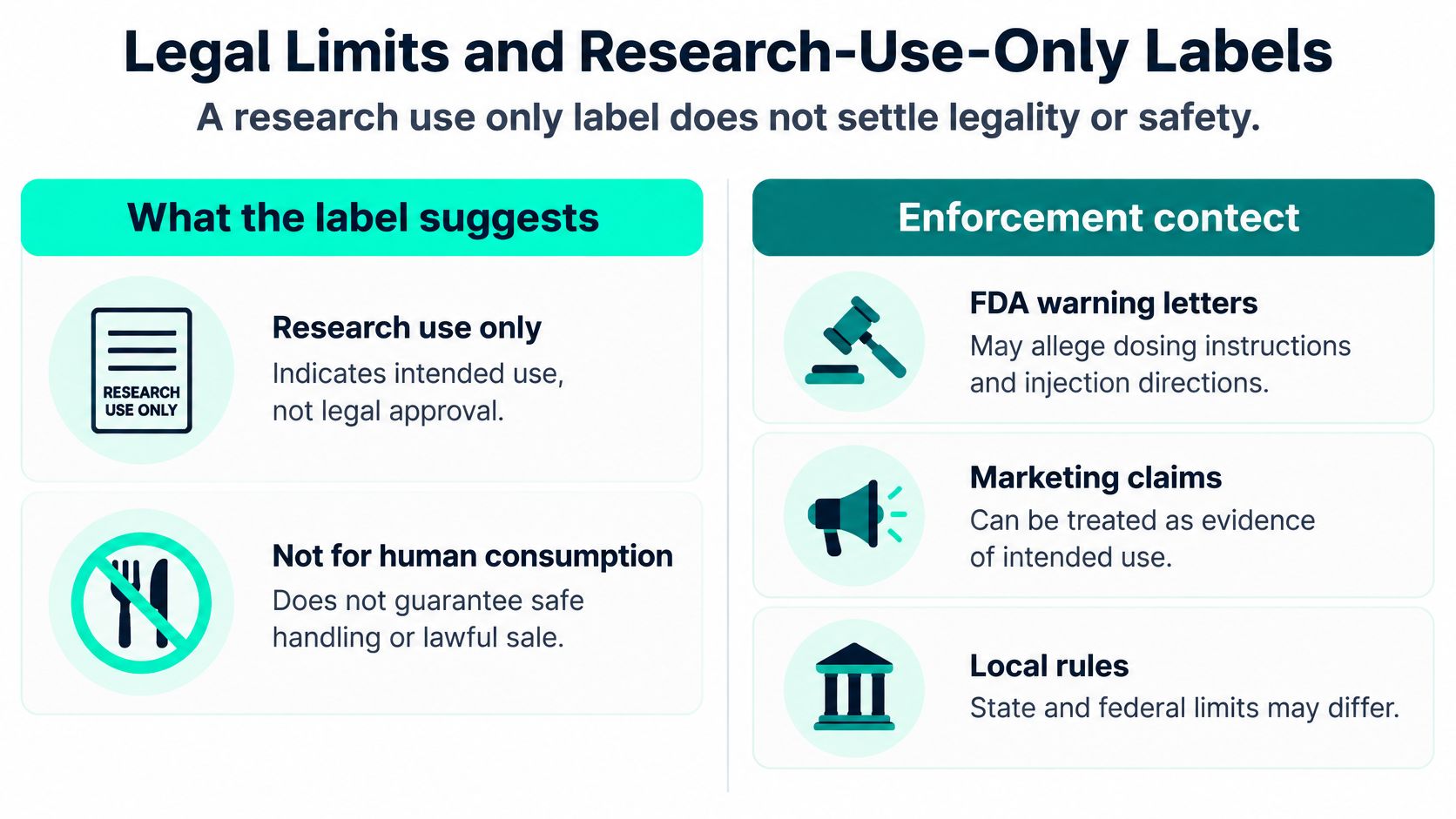
Recent enforcement shows that disclaimers don't override conduct. The FDA warning letters database for peptide products includes warning letters alleging that dosing instructions, injection directions, and dose calculators can establish intended human use despite RUO disclaimers, with peptide-related letters involving unapproved or misbranded products appearing in 2025-2026.
That gives you a practical test you can run in minutes. On one side sits explicit research-only labeling with clear use restrictions and no human-use content. On the other side sits dosing guidance, injection directions, transformation claims, or calculators. The second pattern tells you how the seller expects the product to be used, whatever the label says.
All Celonyx Labs peptides are labeled "For Research Use Only," and our products are intended exclusively for laboratory and scientific research, not for human or veterinary use. By purchasing from our website, buyers acknowledge that research-only intended purpose and agree to comply with applicable laws and regulations. You can read more about how that boundary is defined for research use only peptides.
Purity claims don't change this analysis. A well-characterized compound can still be an unapproved drug if it's marketed for human use, and a pure product isn't thereby sterile, clinically safe, or effective.
Rules vary by jurisdiction and change as new compounds are scheduled. Consult your institution's compliance office for any novel substance rather than relying on a vendor's shipping policy, since a vendor's willingness to ship isn't evidence that receipt is lawful.
The best material is the one with the strongest verifiable documentation and a clearly bounded research application, not the highest advertised purity.
The quality on a certificate is the quality on the day it was tested. Storage decides how much of it remains when you run the experiment, and handling errors are the commonest reason a verified lot starts behaving like a different compound.
| Form | Storage approach | Main risk |
|---|---|---|
| Lyophilized powder | Sealed, desiccated, at or below -20°C | Moisture uptake and oxidation |
| Reconstituted solution | Refrigerated at 2-8°C, aliquoted, used within a short window | Degradation and adsorption to containers |
| Repeated freeze-thaw use | Avoided by aliquoting before freezing | Aggregation and loss of content |
| Opened vial at room temperature | Time out of storage minimized | Hydrolysis and contamination |
Physical form drives the risk. A sealed lyophilized powder is comparatively stable because water, which drives hydrolysis, is largely absent. Once you reconstitute it, the clock runs faster and the container surface becomes part of the system, since peptides can adsorb to glass and plastic.
On arrival, check the package condition and any temperature indicator, then record both with the date and your initials. A warm shipment doesn't automatically mean ruined material, but an unrecorded one means you'll never know whether transport explains a later anomaly.
Log the lot number on every aliquot, not just the parent vial. Unlabeled aliquots are how a lab ends up running a careful experiment on material it can't trace.
Keep a storage log with dates for removal, reconstitution, and return to the freezer. Note freeze-thaw cycles explicitly, because that count is often the missing variable in a failed replication.
Don't reuse a solution beyond the window the certificate or supplier states. If no window is stated, ask, and treat the absence of an answer as a documentation gap rather than permission.
Say a lot passed every test on its certificate, then gives inconsistent results after three freeze-thaw cycles. The efficient move is to trace the problem to handling first. Aliquot a fresh vial into single-use portions, repeat one condition, and compare before you blame the material or reorder from a different supplier.
That sequence protects your budget and your conclusions. Replacing a supplier to fix a storage problem just imports the same failure with a new lot number.
A procurement file is only as strong as its weakest entry. One unchecked box is a no-go until the gap closes, and a gap that cannot be closed means a different material or no order at all.
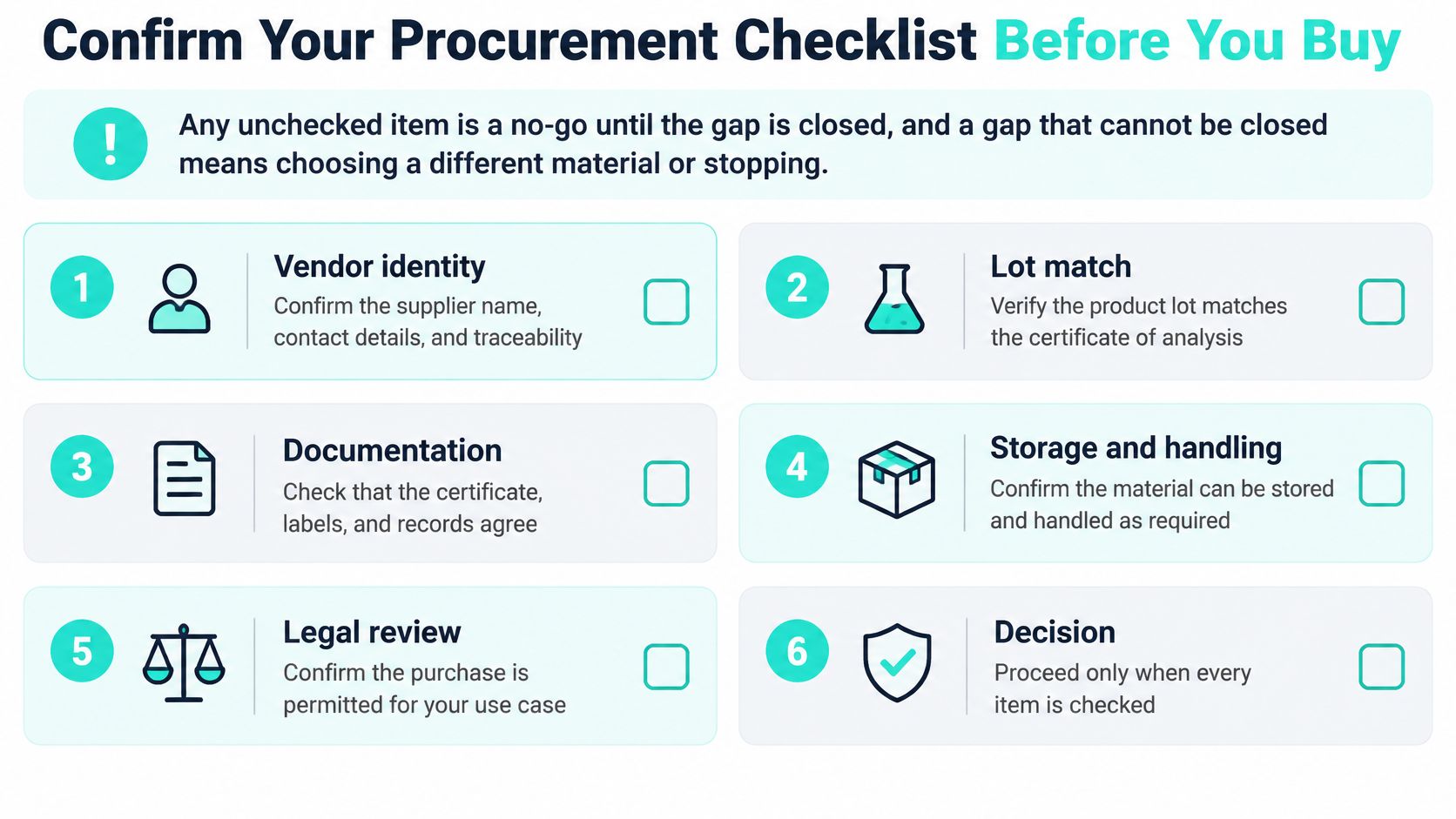
No supplier is named best here, deliberately. The right choice depends on your experiment, the documents a supplier will produce for a specific lot, and the law where you will do the work. A ranking that ignores those three variables is a sales device, not procurement advice.
Review the checklist at every new lot, not only with new suppliers. Methods change, and a vendor who documented last year's batch thoroughly may send a thinner file this year. Labs that buy repeatedly also gain from coordinating purchasing and inventory for distributors, so a reorder triggers a document check rather than a reflexive repeat order.
Treat the checklist as part of the method. If it is not in the file, it did not happen.
Celonyx Labs supplies research peptides for laboratory and scientific research, and BPC-157, GLP-1 and GHK-Cu each undergo batch verification by HPLC and mass spectrometry. Every product carries a research-use-only label. Contact the team by phone or email with order and product questions at Celonyx Labs.
The advice you'll hear most often about buying BPC-157 for the bench is short: demand

Can cagrilintide be combined with GLP-1 peptides? Yes, in controlled research. Understand mechanisms, study controls,

Can Selank be combined with nootropic peptides? Yes, in controlled laboratory studies. Learn the controls,
FOR RESEARCH USE ONLY. Products sold by Celonyx Labs are intended exclusively for laboratory and scientific research. They are not intended for human or veterinary use, consumption, diagnosis, treatment, cure, or prevention of any disease. By purchasing from this site, you acknowledge that you understand the intended research purpose of these materials and agree to comply with all applicable laws and regulations.