
Best research peptides ranked by purity test scores 2026
Compare research peptides purity test scores by batch, method, and identity testing. Choose research-use materials

Best overall: the peptide lot with verified identity, method-specific purity results, and documentation that meets your protocol—not the highest advertised percentage. For 2026, compare research peptides purity test scores at the batch level; GHK-Cu, MOTS-c, Semax, and BPC-157 belong in different research-use slots, not an unsupported purity leaderboard.
A purity percentage describes a measurement under stated analytical conditions. It does not, by itself, establish the identity, quantity, biological activity, or suitability of the material for your experiment.
Celonyx Labs is a research-peptide source for laboratory researchers and scientists, not a source of human-use treatments. Its stated 99% purity and third-party testing are supplier-level quality claims; your acceptance decision belongs at the lot level. The peptide purity grade benchmarks guide provides related context for separating grade terminology from experimental requirements.
For 2026 procurement, keep the decision sequence simple: define the compound, specify the analytical requirements, then assess the lot. Reversing that order turns a research-material decision into a comparison of labels.
All materials discussed here are for research use only, not for human or veterinary use.
Use these criteria before considering any ranked recommendation:
A report that passes one criterion does not automatically pass the others. Third-party testing identifies who performed testing; the actual report establishes what was measured.
The order below is a use-case shortlist, not a ranking of measured purity scores. A numeric purity league table requires comparable, lot-specific results; supplier-wide claims cannot establish that one of these compounds is purer than another.
| Research peptide | Best for | Standout research characteristic | Purity-review priority | Key limitation |
|---|---|---|---|---|
| GHK-Cu 100mg | Copper-binding peptide research | Copper-binding tripeptide | Verify identity and the reported material specification | A general purity figure does not establish copper-related composition |
| MOTS-c 10mg | Mitochondrial-derived peptide research | Mitochondrial-derived peptide | Match analytical identity to the intended compound | Purity does not establish biological activity |
| Semax 5mg | Neurological signaling research | Synthetic neuropeptide | Review identity and batch-specific chromatographic evidence | Research relevance does not establish suitability for every model |
| BPC-157 10mg | Cellular repair pathway research | Synthetic peptide studied in cellular repair research | Separate purity, content, and application-specific requirements | Purity does not establish sterility or experimental performance |
The vial amounts identify the listed products. A 100mg, 10mg, or 5mg label is not a purity test score, and larger nominal content does not indicate higher analytical quality.
GHK-Cu is a naturally occurring copper-binding tripeptide studied in laboratory research involving cellular signaling pathways. The listed GHK-Cu 100mg product is relevant when your research question specifically concerns that compound rather than peptides as a general category.
For purity review, distinguish confirmation of the peptide component from characterization of the copper-containing material. Ask what the reported analytical result establishes and which attributes require separate measurements.
GHK-Cu 100mg pros:
GHK-Cu 100mg cons:
Best for: Researchers whose approved protocol calls for GHK-Cu and specifies the required material characterization.
Verdict: Hold pending lot-specific acceptance. Select GHK-Cu 100mg for its fit to the research question, not because its product name or vial amount implies a higher purity score.
MOTS-c is a mitochondrial-derived peptide investigated in metabolic biology. The listed MOTS-c 10mg product belongs on a shortlist when the intended study concerns MOTS-c specifically.
Identity evidence matters before a purity comparison becomes useful. A chromatogram showing a dominant peak does not independently establish that the dominant component is the intended peptide.
MOTS-c 10mg pros:
MOTS-c 10mg cons:
Best for: Laboratories investigating MOTS-c within a defined metabolic-biology protocol.
Verdict: Hold until identity and purity documentation meet the protocol. Do not substitute MOTS-c for another peptide simply because both are discussed in metabolic research.
Semax is a synthetic neuropeptide studied in laboratory environments for interactions with neurological signaling pathways. The listed Semax 5mg product is a compound-specific option for that research area.
Review the identity result and chromatographic evidence together. If the method cannot adequately distinguish relevant impurities, the reported percentage alone is an incomplete basis for accepting the material.
Semax 5mg pros:
Semax 5mg cons:
Best for: Researchers whose study design explicitly requires Semax and includes appropriate analytical acceptance criteria.
Verdict: Hold pending a satisfactory lot review. Choose Semax 5mg because the protocol requires Semax, then assess whether the supplied material meets that protocol.
BPC-157, also called Body Protection Compound 157, is a synthetic peptide studied in laboratory research related to cellular repair. The listed BPC-157 10mg product is relevant to protocols that specifically identify this compound.
Keep chemical purity separate from microbiological requirements. A chromatographic report does not establish sterility, and it does not substitute for endotoxin testing when the experimental application requires that measurement.
BPC-157 10mg pros:
BPC-157 10mg cons:
Best for: Laboratories conducting protocol-defined BPC-157 investigations with documented material acceptance requirements.
Verdict: Hold until chemical and application-specific requirements are satisfied. Do not interpret cellular repair research terminology as a treatment claim.
An HPLC area percentage describes the relative integrated detector response assigned to a peak under the method used. It is not automatically the percentage of the vial's total mass that consists of the intended peptide.
Water, counterions, residual solvents, and differences in detector response complicate that interpretation. Read the report's definition of purity before comparing percentages across laboratories or methods.
Mass spectrometry supports identity assessment by measuring mass-to-charge information. Chromatography assesses separation under specified conditions; these techniques provide different, complementary evidence.
Neither technique should be reduced to a quality badge. Review whether the method and interpretation are appropriate for the compound and the decision you need to make.
Nominal vial content identifies the product presentation. Peptide content or assay results address a different analytical question and require their own measurement basis.
For 2026 laboratory records, capture the reported units and calculation basis exactly. Do not copy a chromatographic percentage into a concentration calculation as though the two measurements were interchangeable.
Use this sequence before releasing a research peptide into an experiment. Set acceptance criteria before reviewing the result so the purchasing decision does not determine the scientific standard.
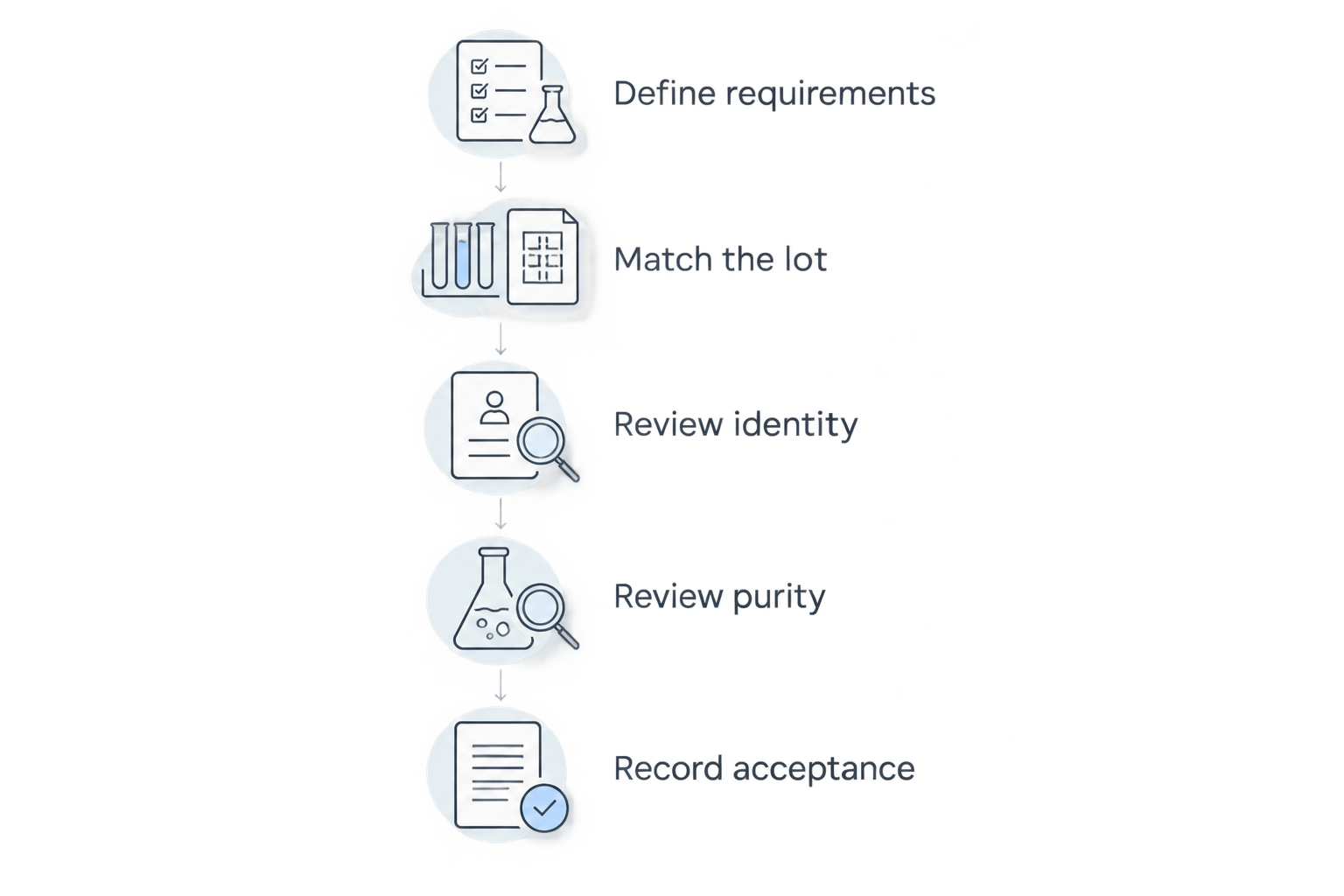
Keep the underlying report, not just a screenshot of its headline result. The peptide purity reports and QMS guide addresses the related documentation workflow.
A different lot requires its own review. An acceptable result from a previous purchase does not establish the properties of the next shipment.
This 2026 shortlist separates compounds by their stated research context: copper binding, mitochondrial biology, neurological signaling, and cellular repair pathways. The order does not represent measured superiority, verified purity differences, or experimental performance.
Celonyx Labs describes its research peptides as 99%-pure and third-party-tested. Those statements support asking for the corresponding evidence; they do not justify assigning an identical measured score to every product or inventing differences between products.
The deciding criteria remain batch traceability, identity, method transparency, content clarity, application fit, and document integrity. Rank acceptable lots within the compound your protocol requires—not unrelated compounds against one another.
Choose the compound specified by your research question, then select a lot that satisfies your written acceptance criteria. If the study does not yet identify the required compound, a purity leaderboard cannot resolve the study-design decision.
For Celonyx Labs research peptides, assess the specific lot documentation before experimental use. GHK-Cu 100mg, MOTS-c 10mg, Semax 5mg, and BPC-157 10mg are research-context options, not demonstrated purity winners.
The default recommendation for 2026 is to prioritize complete, relevant analytical evidence over the highest headline percentage. Hold any lot that cannot be evaluated against the requirements of the intended experiment.
What’s the best way to compare research peptides purity test scores?
Compare batch-matched results for the same intended compound using methods suitable for your acceptance decision. Review identity, chromatographic purity, content, and application-specific requirements separately.
Does 99% purity mean a research peptide is safe?
No. A 99% purity claim does not establish safety, sterility, identity, or suitability for human use. Research peptides are for research use only, not for human or veterinary use.
Is HPLC testing enough to confirm a peptide’s identity?
An HPLC purity percentage alone does not confirm peptide identity. Review appropriate identity evidence, such as mass spectrometry, alongside the chromatographic result.
Are research peptides with larger vial amounts purer?
No. Nominal vial amount and analytical purity describe different attributes. A larger amount does not establish a higher purity percentage or better material quality.
Can I compare purity percentages from different testing laboratories?
Compare them only after reviewing the methods and reporting basis. Differences in separation, detection, integration, and sample preparation affect what the reported percentages represent.
Does third-party-tested mean every required test was performed?
No. Third-party-tested identifies an external testing arrangement, not a universal panel of measurements. Read the lot report to establish which attributes were actually tested.
Which Celonyx Labs peptide has the highest purity score?
A highest-purity product cannot be established from a supplier-wide 99% purity claim. A defensible ranking requires comparable, lot-specific analytical results rather than product names or research categories.
A precise-looking percentage can still answer the wrong question. Before approving a lot, write one sentence stating what each analytical result proves—and what it does not prove—for your experiment.
That exercise keeps purity, identity, content, and biological suitability separate. It also gives the next researcher a clear reason for the acceptance decision instead of an unexplained number.
Compare research peptides purity test scores by batch, method, and identity testing. Choose research-use materials

Choose the fastest shipping research peptide supplier using dispatch evidence, delivery records, and quality checks—not

Compare research peptide cost per milligram across five compound families. Find the lowest unit-cost option,
FOR RESEARCH USE ONLY. Products sold by Celonyx Labs are intended exclusively for laboratory and scientific research. They are not intended for human or veterinary use, consumption, diagnosis, treatment, cure, or prevention of any disease. By purchasing from this site, you acknowledge that you understand the intended research purpose of these materials and agree to comply with all applicable laws and regulations.