
1500 Mg Glutathione: What That Strength Really Means
You're comparing two bottles on a supplement shelf. One says 500 mg glutathione. The other
You're probably staring at a peptide listing, a quote from a vendor, and a protocol that needs DSIP, while trying to figure out whether you're buying a real research tool or just paperwork with a vial attached. That's the right place to slow down. Buying DSIP peptide is less about chasing a product page and more about deciding whether the material is fit for your assay, your compliance file, and your interpretation of the data.
A CRO manager calls because a sleep-pathway project is stalled. The protocol calls for DSIP, the budget is approved, and the team has already seen three vendors whose pages all say “research use only” while offering very different levels of documentation. That's the common DSIP purchase problem, and it starts with understanding what the molecule is.
DSIP, or delta sleep-inducing peptide, is a 9-amino-acid neuropeptide that entered the literature through rabbit brain work in the 1970s, later becoming a recurring target in sleep and stress research. The historical arc matters, because one placebo-controlled trial in chronic insomnia did report higher sleep efficiency and shorter sleep latency, but the authors still concluded that short-term treatment was “not likely to be of major therapeutic benefit”. By 2024 to 2026, modern reviews still described DSIP as an experimental compound with no FDA approval and no well-established modern controlled-trial base, so its role is research interest, not established medical adoption. The relevant historical summary is captured in the DSIP literature overview on delta sleep-inducing peptide.
Buyers usually want DSIP for one of three reasons. Sometimes it's a sleep-pathway protocol where the team needs a reagent with a long paper trail. Sometimes it's exploratory work around stress or pain signaling. Sometimes the buyer has inherited a protocol that assumes DSIP is already validated, when the evidence is mixed and thin in humans.
Practical rule: buy DSIP for protocol fitness, not because a catalog says it's available. Availability tells you almost nothing about whether the peptide will support your endpoint.
That distinction changes the procurement conversation. A vendor can have the vial in stock and still be a poor match if the batch documentation is weak, the identity data are incomplete, or the supply chain can't support your audit trail. For academic labs, startups, and CROs, the question isn't just “can I order it,” it's “can I defend why this batch belongs in this experiment?”
DSIP is still treated as a research-use-only compound, and that's not just a marketing phrase. It reflects the gap between early signal and modern clinical certainty. If your team is running in vitro work, animal studies, or nonclinical method development, the product can be appropriate as an exploratory reagent. If the purchase is drifting toward self-use or therapeutic intent, the evidence base doesn't support that leap, and the procurement file should never be written as if it does.
The safest buyer mindset is simple. Treat DSIP as a peptide whose scientific interest is real, but whose translational certainty is not. That keeps the lab honest, and it keeps the purchase tied to the experiment rather than the hype.
DSIP sits in the kind of gray zone that makes procurement teams careful for good reason. It has historical human research, but it has no FDA approval, and modern reviews still describe it as experimental rather than established therapy. That matters because institutional buyers don't buy molecules in a vacuum, they buy them inside policy, protocol, and documentation rules.
The easiest mistake is to think that because DSIP has appeared in human literature, it can be purchased or used like an approved agent. That's not how compliance works. A historical placebo-controlled insomnia trial does not create a therapeutic approval pathway, and it doesn't convert a research peptide into a routine clinical product. The literature marker is useful because it shows early promise followed by limited translational success, not because it opens a clinical door.
For academic labs, CROs, and biotech groups, the purchase should be anchored to an authorized research purpose. The file should show who ordered it, what protocol it supports, and why the batch is needed. Vendors should publish transparent policies, because unclear terms make institutional review harder and can slow down approval cycles.
A procurement lead should ask three questions before anything reaches checkout.
That's the right mental model because the regulatory risk isn't just about legality in the abstract. It's about whether your institution can show that the material was sourced, reviewed, and handled in a way that matches its research status.
The DSIP story is especially important because early findings can look stronger than they are when read out of context. A placebo-controlled result in chronic insomnia is interesting, but it doesn't replace a modern controlled-trial base. The current reality is that DSIP remains in the category of compounds that researchers may explore, while clinicians and procurement teams still lack a strong, contemporary evidence framework for routine use.
A clean procurement file won't rescue a weak protocol. It only proves you bought the right material for the right reason.
That's why institutionally mature buyers separate procurement from enthusiasm. The peptide may be worth studying, but the compliance standard is about documented purpose, not optimism.
A DSIP purchase can look fine on the surface and still fail the first procurement review. The vial label is the easiest part to print. Identity, purity, and batch traceability are what determine whether the supplier can support a defensible research file.
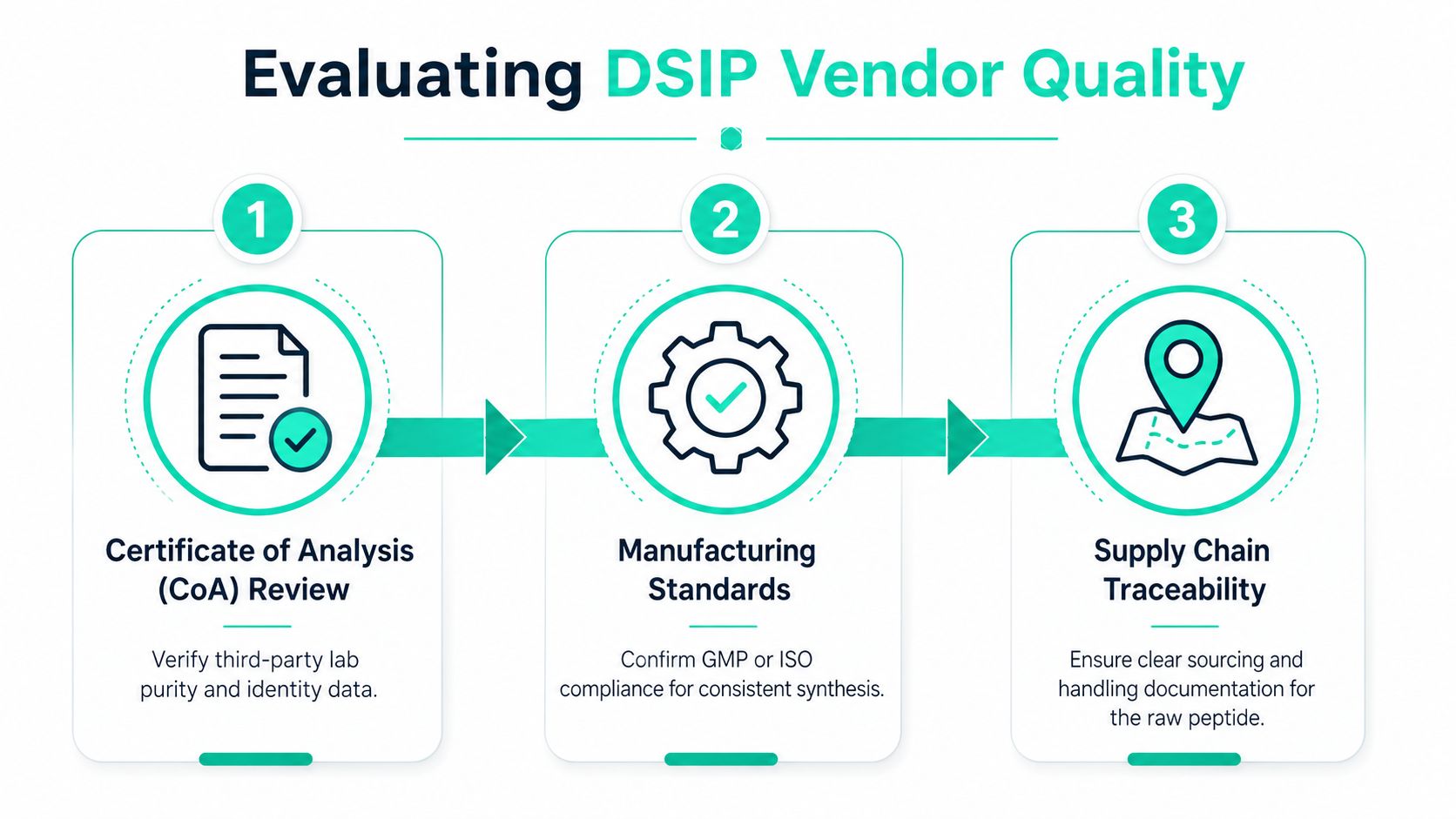
For buyers working through buy dsip peptide options, the first screen should be the certificate of analysis, then the assay method, then the consistency of the batch record. That workflow sits inside the broader peptide sourcing process covered in research peptide basics and how to buy peptides online, because protocol fit matters more than product availability. DSIP is also a compound where the evidence base splits by setting. In vitro work, animal work, and human observations do not carry the same weight, so procurement should match the intended protocol rather than assume one form of evidence covers all uses.
Request the batch-specific COA before you place the order. Do not accept a generic PDF that could apply to several listings, and do not wait until after payment to ask for it. The COA should match the vial lot number, and the issuing lab should be independently identifiable.
In-house testing can help as a screening layer, but it is a weaker signal than a verifiable external report. A COA without a matching batch number is a document, not evidence. If the file cannot be tied back to the exact vial, it will not carry much weight in a serious procurement record.
The strongest technical control is independent third-party HPLC plus mass spectrometry verification. HPLC should show a dominant purity peak at ≥98%, while MS should confirm the expected DSIP molecular mass of about 850 Da. HPLC alone can miss sequence deletions or substitutions, so a clean chromatogram does not prove the peptide was assembled correctly.
That is the main quality trap. A product can look pure and still be wrong in sequence or identity. If mass confirmation is missing, the lab can end up reading biological noise as if it were a peptide effect.
A buyer workflow should stay short and repeatable.
Practical rule: purity without identity is incomplete. A peptide can look clean on paper and still be wrong for your assay.
The best DSIP vendors make verification straightforward. That is a good sign, not a boring one. When documentation is easy to check and the batch trail is clear, procurement gets faster and the study starts with less risk.
Once a vendor clears the quality screen, the next risk is transactional sloppiness. A DSIP order can still go sideways if the cart is unclear, the pricing structure is opaque, or the purchase confirmation is too thin for your records. Good procurement doesn't just buy the vial, it preserves the paper trail at the moment of payment.
A practical comparison helps because the 2026 market was reported with distinct retail bands by vial size. Typical pricing was about $40 to $80 per 5 mg vial and $70 to $130 per 10 mg vial, with multi-vial discounts of roughly 10% to 20% in some listings, according to the vendor guidance on where to buy DSIP. That pricing context matters because it helps buyers spot listings that are priced too low to support credible synthesis and testing, or high enough to suggest unnecessary margin without added documentation.
| 2026 DSIP Research-Grade Pricing | ||
|---|---|---|
| Vial Size | Price Range (2026) | Typical Discount |
| 5 mg vial | $40 to $80 | Multi-vial discounts of 10% to 20% in some listings |
| 10 mg vial | $70 to $130 | Multi-vial discounts of 10% to 20% in some listings |
Use online cart checkout only if the page shows the exact item, lot or batch identifiers, and the shipping terms before payment. If a vendor wants a back-and-forth email chain for basic details, that may still be workable, but it should end in a written confirmation that can be archived. Phone or email support is useful when the catalog leaves a gap, especially if you need clarity on batch availability or documentation timing.
A price below the range above doesn't automatically prove a bad product, but it should trigger scrutiny. Research-grade peptide synthesis and testing cost real money, and a low number can hide shortcuts in purity, identity confirmation, or batch handling. On the other hand, a higher price isn't useful unless it comes with stronger documentation, better shipping terms, or support that helps procurement.
If your lab buys peptides in batches, multi-vial discounts can be useful, but only when the documentation is already strong. A small discount is never worth losing traceability.
A perfect purchase can still fail at the loading dock. DSIP is a peptide, which means shipping and storage are part of the quality chain, not a separate admin detail. If the vial arrives warm, poorly packed, or unlabeled, the identity work you did earlier can be undermined before the first reconstitution step.
The practical handling rule is to keep the product protected from heat and light as soon as it lands. For reconstituted material, the storage guidance on how to store reconstituted peptides is the right mental model, because the risk after mixing is much higher than while the peptide remains lyophilized.
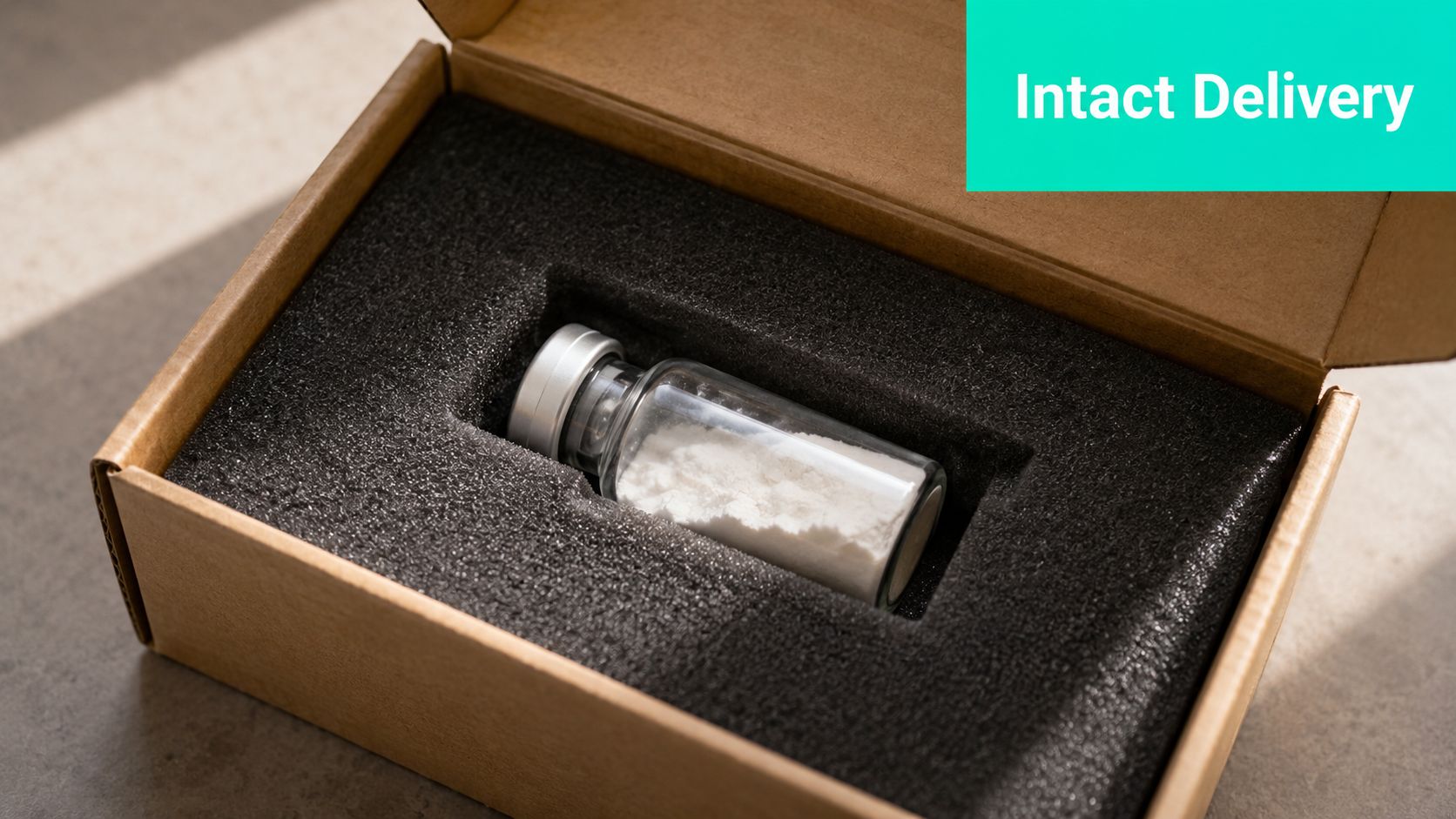
Inspect the outer box first, then the internal packaging, then the vial label. You want to see that the container is intact, the material is still properly isolated, and the label matches the order record. If anything looks off, document it immediately with photos before you move the package into storage.
DSIP stability is tied to peptide chemistry. Once reconstituted, the molecule is exposed to hydrolysis, oxidation, and handling stress, so the best practice is to minimize time at room temperature and avoid unnecessary agitation. The video below is a useful visual reminder of how simple handling decisions can preserve peptide integrity.
If you're reconstituting for near-term use, label the vial with the concentration and date, and make sure your team agrees on the storage window before the sample ever leaves receiving.
The main failure isn't exotic chemistry. It's delay, confusion, and repeated handling. A peptide that was sourced well can still become poor research material if the receiving process is sloppy.
Procurement records are what let a lab reconstruct the purchase six months later without guessing. That means the documentation set has to be more than a single invoice buried in someone's inbox. For DSIP, the record should show what was ordered, who authorized it, what batch was received, and what policies governed the transaction.
The best filing system mirrors the order process. Start with the product page or quote, add the COA, attach the order confirmation, save shipping details, and archive the vendor policy pages that were live at the time of purchase. If the vendor publishes Terms and Conditions, Privacy Policy, Refund and Return Policy, and Shipping Policy, those should sit in the same folder as the batch records so your procurement trail is complete.
If your institution uses a procurement system, map each of those items to the relevant field or attachment slot immediately. Don't wait until an auditor asks for it. Missing files are harder to reconstruct than they are to save.
A DSIP vial is not just a reagent, it's a batch with a history. If the lot number on the vial doesn't match the COA, or if the vendor can't show where the data came from, your experiment inherits that uncertainty. Documenting the chain from order to bench makes future peptide purchasing easier, because reviewers can see that the lab already knows how to source and verify materials responsibly.
Keep the file readable by someone who wasn't there when the order was placed. If only one person can explain the purchase, the record isn't finished.
That standard sounds administrative, but it protects the science. A clean record shortens approvals later, and it helps the lab prove that the material was fit for use from the start.
The cleanest way to buy DSIP is to treat it like a research decision, not a shopping decision. Start with the protocol, not the price. Then verify the vendor's batch documentation, confirm that the material is research-grade rather than loosely described, and preserve enough record detail that the order can survive review later.
The strongest buyer habit is to separate three questions that get conflated all the time. In vitro evidence can justify exploratory mechanistic work. Animal evidence can support hypothesis generation and route-of-administration questions. Human evidence is where DSIP still looks limited and mixed, with early promise but no modern controlled-trial base strong enough to call it a validated therapeutic. That split is the heart of responsible procurement, because it keeps the experiment honest about what the molecule can and can't support.
Is DSIP a therapeutic?
No. The available history shows a research compound with early human interest, but not a well-established modern clinical adoption path. The practical answer for procurement is that it remains an exploratory reagent.
Why do vendors talk about sleep, stress, and pain together?
Because those are the main research themes tied to DSIP. The problem is that vendor summaries often compress different evidence levels into one marketing message, so buyers should separate in vitro, animal, and human data before deciding whether the batch fits the protocol.
What should I trust most, the purity number or the MS result?
Trust both, but don't stop at purity. A high purity figure without mass confirmation can hide the wrong sequence or a misassembled peptide. For DSIP, identity matters as much as cleanliness.
What does a strong DSIP purchase look like in practice?
A batch-specific COA, independent testing, a lot number that matches the vial, a clean order confirmation, and storage handled promptly on receipt. If those pieces are present, the material is much easier to justify in a lab file.
Should self-use searches change how I think about the product?
Yes. If the search intent is drifting toward self-use, the evidence base doesn't support treating DSIP as a casual wellness purchase. Procurement teams should keep the file anchored to authorized research only.
The bottom line is simple. A good DSIP purchase is one you can explain to your PI, your QA reviewer, and your future self without improvising. That's the standard worth applying every time.
If you want a vendor that treats peptide buying as a documentation problem, not just a checkout flow, Celonyx Labs publishes research peptide listings, policy pages, and support channels that fit the way labs procure materials. Review the catalog, confirm the batch documentation, and use the same evidence-first standards from this guide when you're ready to place your next order.
You're comparing two bottles on a supplement shelf. One says 500 mg glutathione. The other

Is bacteriostatic water the same as sterile water? No. Compare preservatives, vial handling and peptide

How do you know if a peptide vial has gone bad? Quarantine changes, check storage
FOR RESEARCH USE ONLY. Products sold by Celonyx Labs are intended exclusively for laboratory and scientific research. They are not intended for human or veterinary use, consumption, diagnosis, treatment, cure, or prevention of any disease. By purchasing from this site, you acknowledge that you understand the intended research purpose of these materials and agree to comply with all applicable laws and regulations.