

Research Peptides for University Labs: Verify First (2026)
Research peptides for university labs require documented purity, lot traceability, and controlled handling. Use this
You've found a vendor, the product page says 99% purity, and the checkout button is ready. Your lab manager wants a purchase order, your principal investigator wants defensible evidence, and nobody wants a vial arriving with a generic certificate that can't be tied to the material in the box.
That's why buying Fragment 176-191 shouldn't start with price or shipping speed. It should start with identity, lot traceability, analytical documentation, and a clear research purpose. The unmodified peptide remains largely preclinical, while much of the human discussion comes from the related analog AOD-9604, not Fragment 176-191 itself. Treat the purchase as a controlled procurement workflow, not a casual ecommerce transaction.
Fragment 176-191 is a 16-amino-acid C-terminal segment of human growth hormone, corresponding to residues 176 through 191. Its compact structure made it useful in research designed to isolate metabolism-related activity from the broader anabolic and diabetogenic effects of full-length growth hormone. The historical research line emerged from foundational growth-hormone structure-function work in the late 1980s and early 1990s, including animal testing of synthetic fragments spanning nearby residues (PubMed Central review and source discussion).
That description matters because a lab can use the material for mechanistic work without treating it as a validated fat-loss therapy. Rodent and isolated adipocyte models have associated the fragment with lipolysis and reduced lipogenesis, and some research describes activity without detectable growth-hormone receptor engagement. Those findings support a research hypothesis. They don't establish clinical efficacy in people.
Procurement rule: Buy the material to answer a defined laboratory question, not to validate a marketing promise.
Write the intended use in the purchase request. “Mechanistic reagent for preclinical metabolism research” is materially different from “weight-loss peptide.” The first supports a defensible research-use-only workflow. The second invites unsupported clinical interpretation and may create problems with institutional review, receiving procedures, or vendor communications.
Your team should also distinguish the native fragment from AOD-9604, a modified analog that advanced into human clinical testing. Independent summaries describe Phase 1 testing in healthy overweight volunteers and report that the published human trial did not show a statistically significant difference in weight loss, body composition, or metabolic markers versus placebo (historical development summary). That result doesn't answer every mechanistic question, but it does establish a critical buying principle: the human evidence for this peptide family is limited and cannot be used to imply validated efficacy for the unmodified fragment.
Before requesting quotes, confirm:
For a concise primer on how research peptides fit into laboratory workflows, review what research peptides are. Use it to align purchasing, laboratory safety, and scientific staff before anyone places an order.
The strongest reason to slow down is interpretation. A review of the exact fragment notes that the unmodified material has no published human randomized controlled efficacy trials, while many human claims come from AOD-9604 instead (Fragment 176-191 evidence review). Your purchase decision should reflect that evidence gap from the start.
A purity number is only useful when you can trace it to the lot you're buying. A product page that says “99%” without a batch-specific chromatogram is a claim, not a completed quality review.
For Fragment 176-191, ask for a batch-specific certificate of analysis before approval. The certificate should identify the lot, show the analytical method, state the test date, and connect the result to the product label. HPLC or UPLC can describe chemical purity, while MS or LC-MS supports identity confirmation. Those tests answer different questions, so one cannot substitute for the other.
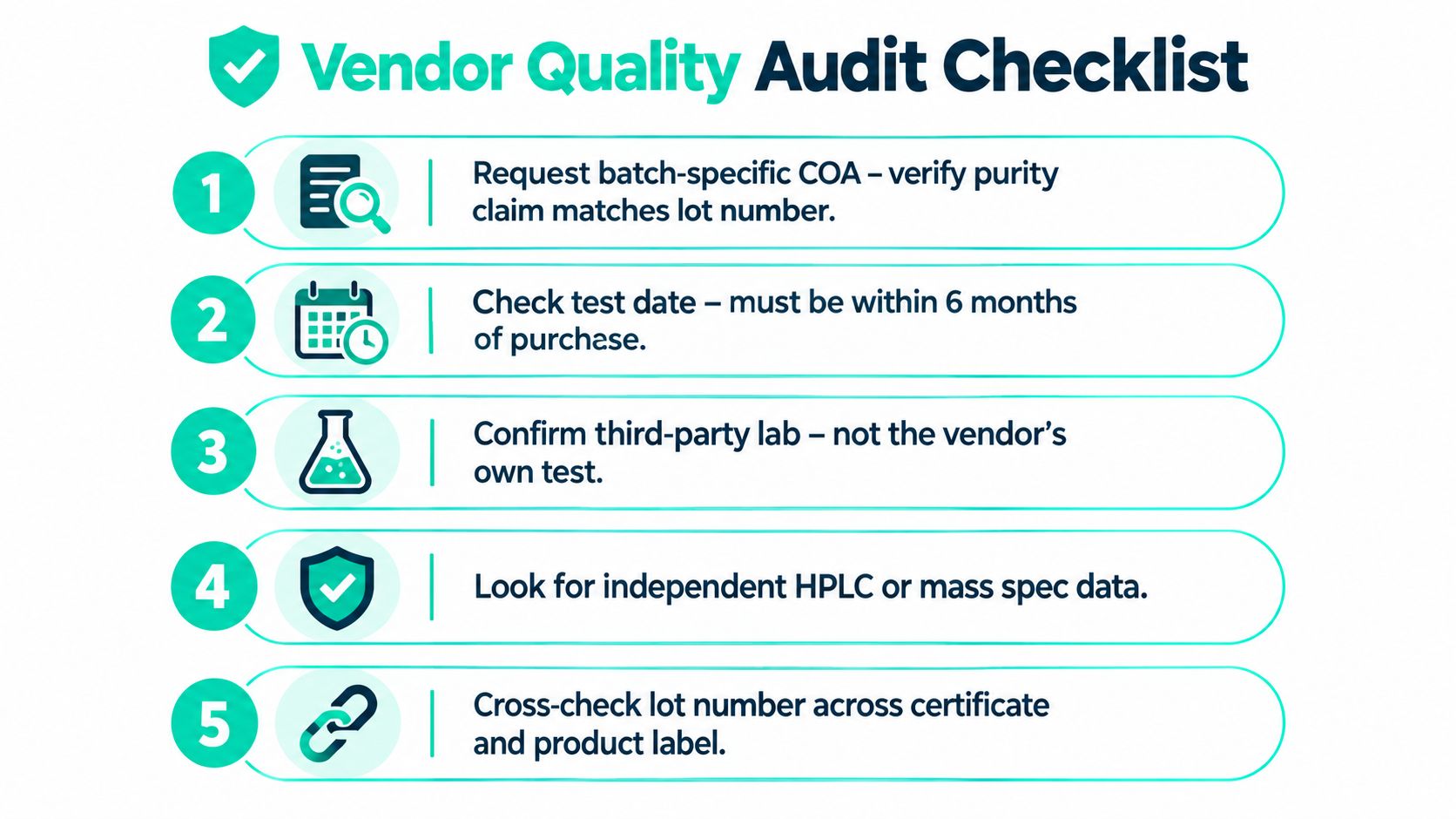
A credible vendor should explain who performed the testing and whether the laboratory was independent. Independent testing doesn't guarantee perfect material, but it gives your team an external check rather than asking you to accept the supplier's internal assertion.
Look for these signals:
Don't let price dominate the decision. A lower-cost vial can become expensive if your lab must repeat an experiment, quarantine an undocumented lot, or wait for missing paperwork. A vendor that provides clear records and answers specific questions is easier to defend during internal review.
Use a scorecard like this before approving a supplier:
| Quality Signal | What to Verify | Why It Matters |
|---|---|---|
| Batch-specific COA | Product name, lot number, test date, and analytical results | Links the evidence to the material you'll receive |
| HPLC or UPLC data | Purity result and chromatogram or detailed report | Shows how the purity claim was generated |
| MS or LC-MS | Identity confirmation consistent with the named peptide | Helps distinguish the target fragment from related material |
| Independent testing | Laboratory identity and testing scope | Adds external review to the vendor's claim |
| Shipping documentation | Packaging, dispatch records, and delivery process | Supports receipt review and material traceability |
| Supplier communication | Written answers to technical and procurement questions | Reveals whether missing records will be recoverable |
For broader supplier-screening principles, use the vendor qualification process as a reference point. The practical standard is simple. If the supplier won't provide enough information to let your lab verify the lot, don't approve the purchase.
A researcher can approve a product page and still leave procurement unable to clear the order. Institutional review needs a traceable vendor identity, usable invoice, defined policies, and evidence that the certificate belongs to the exact Fragment 176-191 lot being purchased. Treat the order as a documentation workflow, not a routine checkout.
Build the purchase packet before payment. Request each record in writing, save the response with the quote, and send your receiving team the expected product name and lot details.
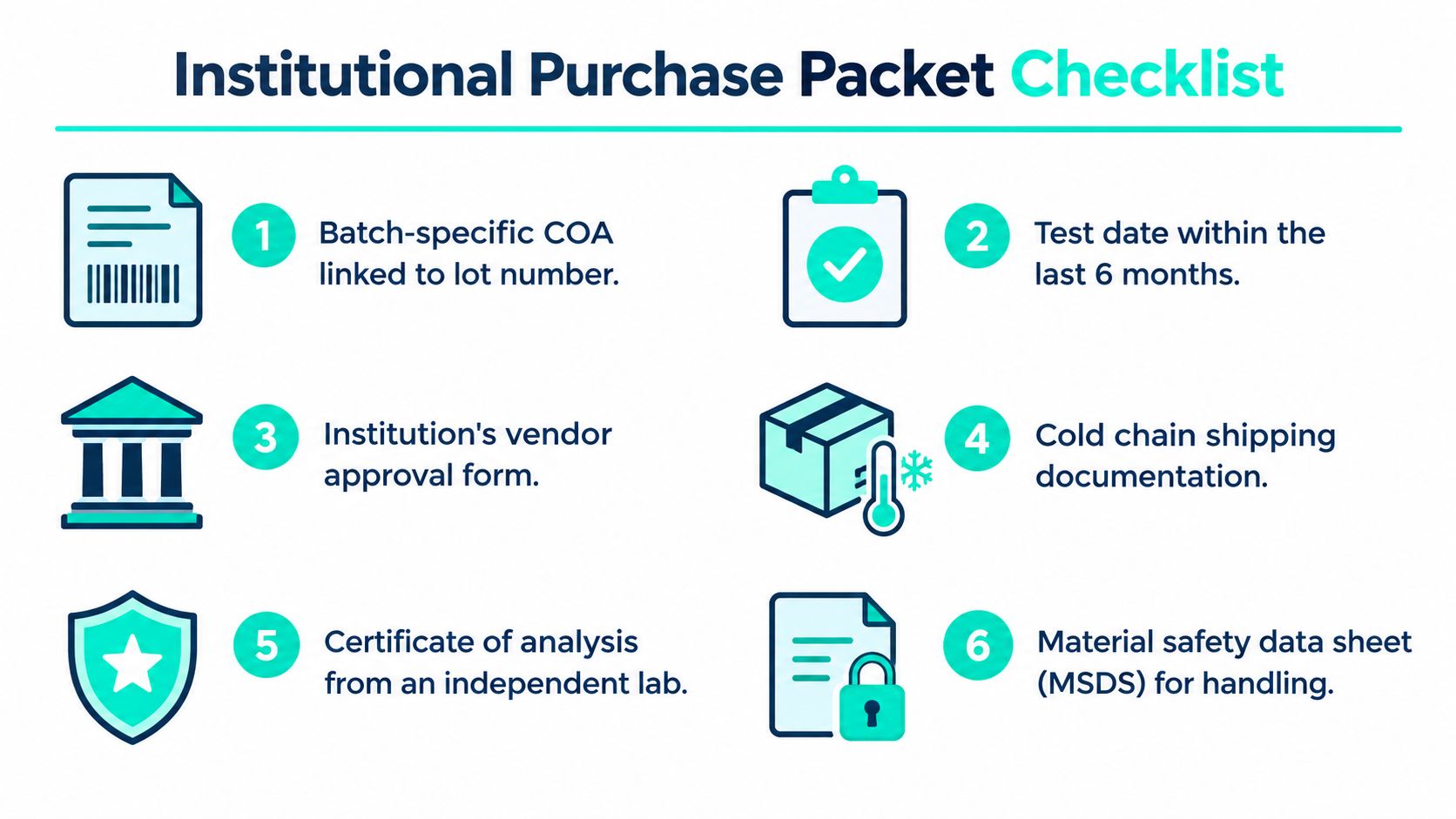
Start with the batch-specific COA. It should name Fragment 176-191, identify the lot, include the test date, and state the methods used for purity and identity testing. A certificate from an earlier production run does not establish what is in the current shipment.
Add the commercial and handling records:
For organizations that maintain supplier-data systems, Digital Product Passport supplier data provides a useful way to frame the information procurement should retain. Keep records portable and understandable if the product page changes.
The vial label, outer packaging, invoice, and COA should identify the same material. Check the product name, lot number, labeled amount, and stated form. Photograph the package before opening it, then attach the image and receiving note to the laboratory record.
A certificate without a lot number, or a mismatch between the label and certificate, requires quarantine. Do not release the material because the product name appears correct. Ask the supplier to correct the record or issue a replacement certificate tied to the shipment.
Handling documents serve separate controls. An MSDS or SDS supports internal safety review, but it does not prove identity or purity. Shipping records establish movement and receipt, not analytical quality. Keep every document in the packet so reviewers can see which requirement each record addresses.
Checkout errors usually come from selecting the wrong format, missing a lot-specific availability note, or failing to preserve the transaction record. Slow down at the product page, not after the package arrives.
Start by confirming that the listing is for native Fragment 176-191. Vendors may use similar names for related growth-hormone fragments or modified analogs. The product title, description, label, and COA request should all use the same identity.

Use a short pre-submission check:
A catalog's “New Arrivals” or “Bestsellers” section may help you locate current listings, but it doesn't replace technical review. Popularity is not evidence of identity, purity, or suitability for your assay.
For teams checking a payment flow or preparing a direct purchase, the Bulk Aussie Peptides order page is an example of the kind of checkout information buyers should inspect, including the fields needed to complete an order. Use any checkout page as an administrative document, not just a payment screen.
Download the invoice and confirmation page. Save any chat or email in which the vendor confirms the lot, testing status, or shipping conditions. If the supplier says a COA will follow, record that commitment and set an internal reminder before the material reaches the bench.
Contact support before ordering when a key detail is unclear. Ask direct questions, such as whether the certificate is tied to current stock, which laboratory performed the testing, and what happens if the received lot doesn't match the supplied paperwork. A fast response is useful, but a written, specific response is what belongs in the procurement file.
Don't subscribe to every marketing email during checkout. A restock alert can be useful for an active project. Promotional noise can bury the order and documentation messages your team needs.
The purchase isn't complete when tracking says delivered. It's complete when the lab has received the correct lot, recorded its condition, and placed it under an approved storage and handling process.
Before dispatch, confirm how the supplier packages the material and whether the shipment includes the documentation packet. Don't assume that “fast shipping” describes temperature control or receipt conditions. Your lab should know who receives the package, where it goes after delivery, and who has authority to quarantine it.
At delivery, record:
If the outer package is damaged or the vial identifier doesn't match the COA, stop the process. Notify the vendor, preserve photographs, and keep the material segregated until the discrepancy is resolved.
Follow the supplier's validated storage instructions and your institution's approved SOP. For lyophilized peptides, the storage plan should address temperature, moisture, light, container closure, and access control. Once material is reconstituted for an approved experiment, document the solvent, preparation conditions, concentration, operator, date, and storage location in the laboratory record.
The storage question is not separate from scientific interpretation. Older physiology work reported that several synthetic C-terminal fragments, including 176-191, produced a short-lived rise in blood glucose and a more sustained rise in plasma insulin in rats, while other tested fragments were inert in that system (PubMed record for the foundational physiology study). That result argues against simplistic statements that every C-terminal fragment is metabolically neutral. Species, assay conditions, fragment design, and preparation quality all affect what your experiment means.
For practical guidance on handling freeze-dried research material, consult lyophilized peptide storage. Keep the storage record with the lot file, and don't let a rushed experiment erase the receiving history.
A lot should be released only after the documentation and physical material agree. The final decision is not “the vendor looks reputable.” It's a documented acceptance judgment based on identity, analytical support, traceability, and condition on receipt.
Use this sequence:
Quarantine the lot when the certificate is missing, the lot number conflicts, the identity evidence is inadequate, the package is damaged, or the supplier can't answer a material discrepancy. Don't “test around” a documentation failure by starting the experiment and hoping the results clarify the product. That creates an avoidable confounder and weakens the study record.
The scientific decision also needs the right evidence label. Fragment 176-191 is a small, biologically active research fragment with a preclinical rationale, but the exact unmodified peptide lacks a controlled human efficacy dataset. The related analog AOD-9604 reached human clinical testing, yet the reported placebo comparison did not establish a statistically significant advantage in the published trial summaries (independent evidence discussion). That makes the fragment appropriate for carefully designed mechanistic or preclinical work, not for unsupported therapeutic conclusions.
Release standard: If you can't defend the lot's identity and paperwork in an audit, you shouldn't defend its experimental result.
For future reorders, keep a supplier file containing prior COAs, correspondence, invoices, receipt records, and any nonconformance notes. Score the next purchase against the same criteria rather than relying on familiarity. Vendors earn repeat business by making verification easy, not by offering the loudest purity claim.
Celonyx Labs supplies research peptides through an online catalog and provides product, ordering, support, and policy information for laboratory procurement workflows. Review the available Celonyx Labs materials, request the documentation your institution requires, and verify the specific Fragment 176-191 lot before releasing it for research.
Research peptides for university labs require documented purity, lot traceability, and controlled handling. Use this

Peptide reconstitution for biotech startups in 2026: diluent choice, concentration math, storage windows, and the

Research peptides for veterinary research need batch-level COAs and standardized handling. See the sourcing steps,
FOR RESEARCH USE ONLY. Products sold by Celonyx Labs are intended exclusively for laboratory and scientific research. They are not intended for human or veterinary use, consumption, diagnosis, treatment, cure, or prevention of any disease. By purchasing from this site, you acknowledge that you understand the intended research purpose of these materials and agree to comply with all applicable laws and regulations.