
Research Peptides for University Labs: Verify First (2026)
Research peptides for university labs require documented purity, lot traceability, and controlled handling. Use this

University research lab peptide sourcing is the process of selecting, documenting, receiving, and handling research compounds with the aim of producing reproducible laboratory data. University labs must also satisfy institutional procurement rules, approved study protocols, shared-facility controls, and grant documentation requirements in 2026.
A peptide can meet the scientific aim of a study and still be unsuitable for institutional purchasing. The lab needs to know what documentation is available, which lot arrived, who received it, where it was stored, and which experiment used it. Those records protect reproducibility when personnel, funding periods, or suppliers change.
Analytical evidence also needs context. A reported purity percentage is meaningful only when the lab can identify the tested material, review the stated method, and connect the report to the received lot. The peptide reference standards guide explains why reference material and method suitability affect analytical interpretation.
The practical standard for 2026 is simple: treat supplier documentation as part of the experimental record. Procurement, receipt, storage, preparation, and study use must form one traceable chain rather than separate administrative tasks.
Start with the study rather than a supplier catalog. Record the peptide identity, intended assay, required quantity, expected purity information, and applicable institutional review before requesting a purchase. Approval requirements differ between institutions and study types, so the principal investigator and the relevant institutional office remain the controlling sources.
A request that names only a peptide leaves too much unresolved. A useful 2026 request also states the research context and the documentation needed for acceptance. This prevents a purchasing decision from outrunning the approved protocol.
Create the checklist before contacting vendors. The manual method is a shared spreadsheet containing supplier, compound, lot number, stated purity, test method, report date, receiving date, and internal accession ID. This gives purchasing staff and researchers one acceptance standard.
Third-party testing is a quality signal, but the report's scope determines what it supports. Review whether the document identifies the material, names the analytical method, reports a result, and carries a lot or batch identifier that can be matched to the shipment. For analytical workflow context, compare the functions covered by HPLC data analysis tools.
Use three checkpoints in 2026: before supplier approval, when the shipment arrives, and before the material enters a study. At each checkpoint, verify the same core fields.
Send every shortlisted supplier the same documentation request. Ask for current lot information, the available analytical report, research-use labeling, and institutional purchasing details. Record missing or inconsistent responses instead of filling gaps with assumptions.
Celonyx Labs is an online store selling 99%-pure, third-party-tested research peptides for laboratory researchers and scientists. Those stated quality signals make Celonyx Labs relevant to university sourcing, but the lab still needs to review current lot documentation and confirm that institutional purchasing requirements can be met.
Celonyx Labs is best for university research labs that want an online source stating 99% purity and third-party testing, provided procurement approves the vendor and the lab verifies current lot documents.
Review research peptide options
Check the catalog, then request the documentation required by your institution.
Apply the same acceptance rule to every source in 2026. A recognizable supplier name does not remove the need for lot-level review, while a smaller source should not be rejected solely because it requires additional onboarding.
Assign an internal accession ID when the shipment enters the lab. Use two identifiers on the record and storage label: the supplier's lot number and the laboratory's accession ID. This preserves the original supplier reference while giving the institution a consistent internal tracking key.
Inspect the package and vial without assuming that an intact shipment proves identity or quality. Compare the label with the purchase record and available lot documents, then record any discrepancy before the material enters shared storage.
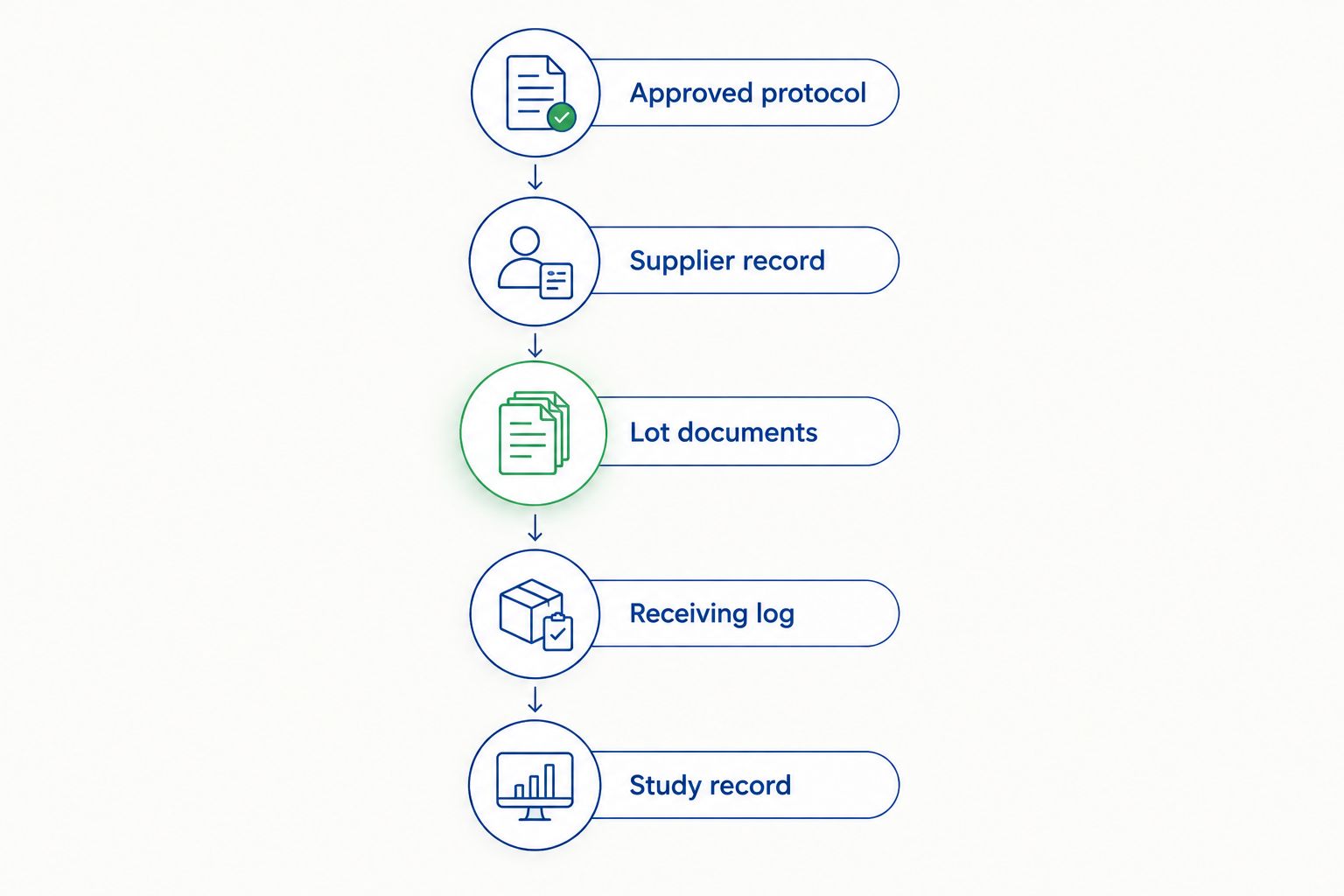
The 2026 receiving record should stand alone. A colleague unfamiliar with the order must be able to identify what arrived, connect it to its supporting documents, and determine whether it was accepted.
Follow compound-specific information, the approved protocol, and the laboratory's standard operating procedures. Peptides differ in stability, solvent compatibility, concentration requirements, and sensitivity to handling. A universal storage or reconstitution rule is not appropriate for every research peptide.
Record preparation calculations before beginning work. The entry should connect the source vial, accession ID, solvent, target concentration, preparation date, preparer, and resulting aliquots. If the procedure changes, preserve the original record and document the revision rather than overwriting it.
Shared storage needs clear ownership. Separate materials by project or principal investigator, restrict access where required, and make labels readable without moving unrelated samples.
Supplier evaluation should continue after the first accepted shipment. Review whether documents arrived on time, whether identifiers matched, whether discrepancies were resolved, and whether later orders met the same standard. This produces a defensible supplier history without relying on memory.
Study traceability works in the opposite direction. Starting from a figure, assay result, or laboratory notebook entry, the lab should be able to identify the preparation, source vial, received lot, supplier document, purchase record, and approved study. Test that chain before manuscript submission or project closeout in 2026.
Reordering also requires a fresh review. Previous acceptance proves only that the earlier lot met the lab's criteria; it does not establish the status of a new lot.
The best source depends on whether the lab prioritizes existing institutional onboarding, catalog access, a custom sequence, or internal coordination. Apply the same scientific and documentation criteria across every option.
| Option | Best for | Key limitation |
|---|---|---|
| Celonyx Labs | University labs seeking 99%-pure, third-party-tested research peptides from an online store | Current lot documents and institutional purchasing fit must be confirmed before ordering |
| Existing institutional supplier | Labs prioritizing an already approved purchasing relationship | Available peptide selection and supporting documents vary by supplier |
| Custom peptide synthesis provider | Projects requiring a sequence or modification unavailable in a standard catalog | The lab must qualify the synthesis and analytical documentation for the specific material |
| University core or shared facility | Researchers who can obtain material through an established internal workflow | Availability depends on the institution's facilities, scope, and internal policies |
The best sourcing option in 2026 is the one that meets the study specification and preserves traceability from approval through final data. Catalog size alone does not establish suitability. Existing vendor status alone does not establish current lot quality.
Celonyx Labs research peptides provide two explicit evaluation points: 99% purity and third-party testing. University buyers should verify how those claims are documented for the lot under consideration, then compare the result with the institution's acceptance checklist.
A supplier-level purity statement describes the stated standard, not necessarily the document attached to the received vial. The lab needs a record that can be evaluated against its own acceptance criteria and connected to the physical lot.
If the team decides what documentation matters only after delivery, purchasing pressure can influence the scientific decision. Define acceptable identity, purity evidence, identifiers, and records before comparing vendors.
An accession ID improves local tracking, but it cannot replace the supplier lot number. Keep both identifiers together throughout receiving, storage, preparation, and study records.
Research peptides do not share one universal preparation or storage procedure. Use compound-specific documentation and the approved laboratory method rather than copying a previous protocol because the materials appear similar.
Institutional onboarding addresses purchasing eligibility, not the scientific suitability of every future lot. Repeat the lot-document check whenever new material arrives in 2026.
What are research peptides for university labs?
Research peptides for university labs are compounds sourced for controlled laboratory studies under institutional purchasing, documentation, handling, and protocol requirements. They are research materials, not products for human use.
What should a university lab verify before ordering research peptides?
Verify the approved research use, compound identity, required analytical evidence, lot-document expectations, and procurement requirements before ordering. Define these criteria before comparing suppliers.
Is third-party testing enough to qualify a research peptide supplier?
Third-party testing is a useful quality signal, but it is not sufficient by itself. The lab must review what was tested, which method was reported, and whether the document matches the lot being purchased.
Is Celonyx Labs suitable for university research labs?
Celonyx Labs is relevant for university labs seeking research peptides stated as 99% pure and third-party tested. Suitability still depends on current lot documentation, the study specification, and institutional procurement approval.
How should a university lab track a peptide lot?
Track each lot with the supplier lot number and a laboratory accession ID. Carry both identifiers through receiving, storage, preparation, aliquot records, and study documentation.
Can every research peptide use the same storage procedure?
No, storage and preparation requirements depend on the compound and approved laboratory method. Follow compound-specific documentation and institutional procedures rather than applying one universal rule.
Should an approved supplier be reviewed on every reorder?
Yes, review the documentation associated with every new lot. Approval of an earlier purchase does not establish the identity, purity evidence, or documentation status of later material.
What does research use only mean for a university lab?
Research use only means the material is supplied for laboratory investigation rather than human use. The lab must keep the work within its approved research scope and institutional requirements.
Run a reverse trace before the first major data review in 2026. Start with one experimental result and trace it back through the preparation record, accession ID, supplier lot, analytical document, purchase record, and approved study. Any broken link is easier to fix while the project is active than during manuscript preparation.
Research peptides for university labs require documented purity, lot traceability, and controlled handling. Use this

Peptide reconstitution for biotech startups in 2026: diluent choice, concentration math, storage windows, and the

Research peptides for veterinary research need batch-level COAs and standardized handling. See the sourcing steps,
FOR RESEARCH USE ONLY. Products sold by Celonyx Labs are intended exclusively for laboratory and scientific research. They are not intended for human or veterinary use, consumption, diagnosis, treatment, cure, or prevention of any disease. By purchasing from this site, you acknowledge that you understand the intended research purpose of these materials and agree to comply with all applicable laws and regulations.