
Integrity Research BPC 157: How to Judge Vendor Claims
The advice you'll hear most often about buying BPC-157 for the bench is short: demand
CJC-1295 DAC is an investigational growth hormone-releasing hormone analog, not an approved medicine, and a single subcutaneous injection in healthy adults raised mean plasma growth hormone about 2- to 10-fold for at least 6 days while mean insulin-like growth factor 1 rose about 1.5- to 3-fold over 9 to 11 days, with an estimated terminal half-life of 5.8 to 8.1 days. The long tail is chemistry rather than a therapeutic claim: a reactive linker clips the peptide to albumin, the blood protein that already circulates for weeks on its own.
Those figures come from two small 2006 pharmacokinetic trials in healthy volunteers. They measured drug exposure and hormone levels. They did not measure muscle, fat, strength, recovery, sleep, or anything a buyer scrolling a catalog cares about.
That gap is where the confusion lives. A vial can arrive with a certificate showing a clean purity peak and a mass that matches the label, and neither document says the compound does what the marketing implies. Three things get blurred together constantly: what the molecule is, what the albumin chemistry does to its signal, and what a batch record can and cannot prove. Keep those apart and the topic gets much simpler.
Say a lab manager is handed two vials for the same week's work. One is labelled "CJC-1295." The other reads "CJC-1295 with DAC." Identical white powder, similar cap, similar invoice line. They are different molecules, and the difference decides what the study can measure at all.
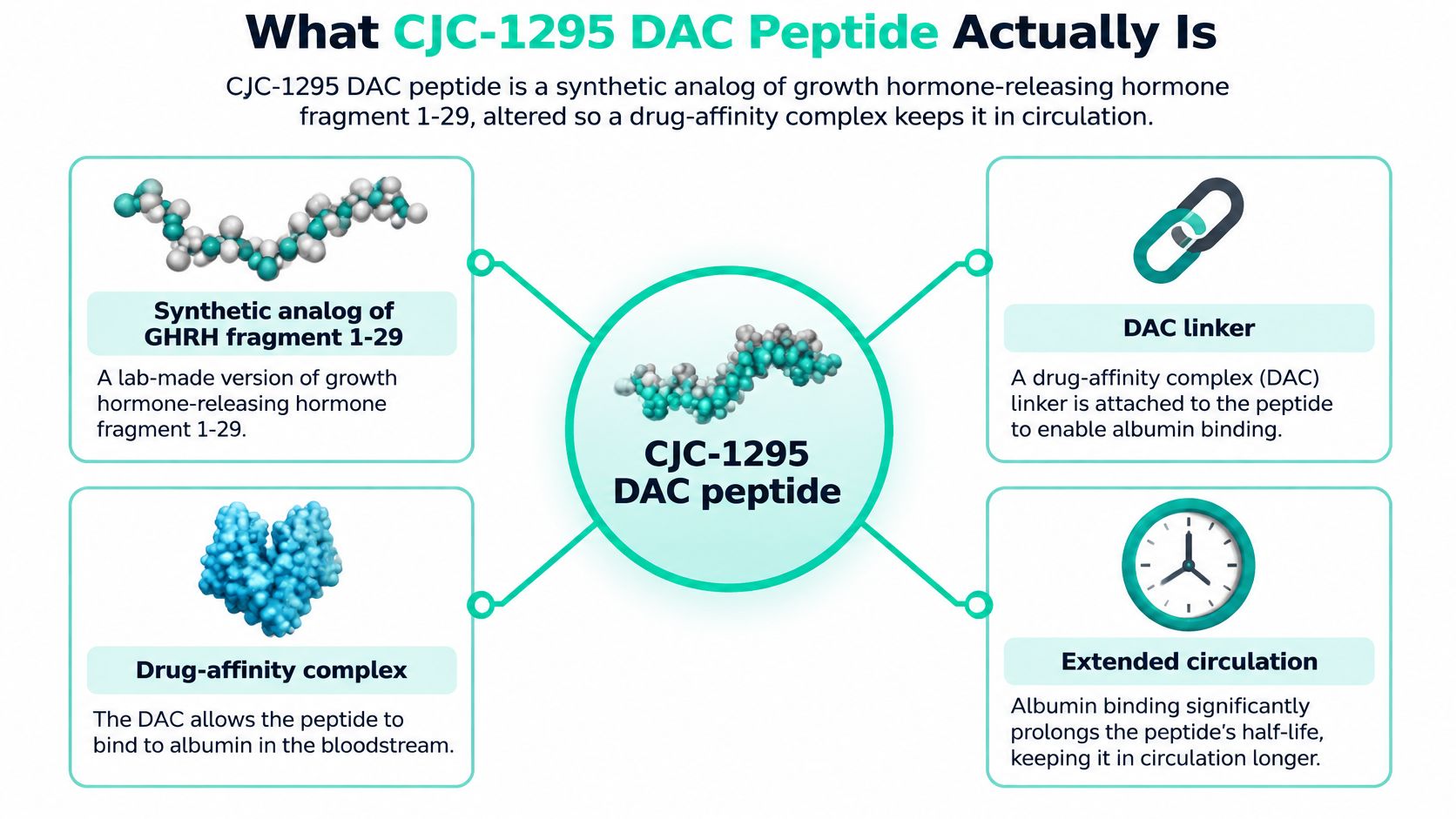
CJC-1295 DAC peptide is a synthetic analog of growth hormone-releasing hormone fragment 1-29, built so a drug-affinity complex holds it in circulation far longer than the natural hormone.
The concept map below lays out the four pieces worth memorizing before anything else.
Place it on the pathway without a lecture. The hypothalamus releases GHRH, which tells the pituitary to release growth hormone in pulses. Growth hormone then raises insulin-like growth factor 1, mostly through the liver. Natural GHRH is broken down within minutes, so the raw hormone makes a poor starting point for a long experiment.
CJC-1295 DAC is not growth hormone. It is not an IGF-1 drug. It is a signal that asks the pituitary to do its own releasing.
DAC stands for Drug Affinity Complex. Picture a short message clipped to a courier who is already making rounds. The courier is albumin, the most abundant protein in blood, a molecule that stays in circulation for weeks without help. Clip the peptide to it and clearance stops being a matter of minutes.
The clip is a maleimide-style linker attached at the peptide's tail. After injection it bonds to albumin and the peptide rides along. Nothing else about the analog needs to be exotic, because the ride does the work.
The published work is endocrine and pharmacokinetic. It asks how long the material stays detectable and how growth hormone and IGF-1 respond over days.
Its limits matter as much as its findings. The best-known human trials enrolled healthy adults aged 21 to 61, and they do not establish treatment of any disease, athletic performance, body-composition change, or consumer use. No certificate alters that.
The naming is where bench buyers slip first. Two materials sold under one number behave nothing alike, and the shared digits hide it.
| Feature | CJC-1295 with DAC | Short form without DAC |
|---|---|---|
| Chemical add-on | Maleimide drug-affinity complex that binds albumin | No albumin-binding complex |
| Reported circulation | Terminal half-life about 5.8 to 8.1 days in one trial set; 5.4 to 9.2 days across summarized studies | Cleared in minutes; exact figure not in the summarized evidence |
| Research dosing pattern | Single subcutaneous doses studied across days | Repeated pulses would be needed to mimic GHRH |
| Main research readout | Sustained growth hormone and IGF-1 elevation over days | Brief growth hormone pulse |
| Approval status | Investigational research compound, not an approved therapy | Unapproved research analog, not an approved therapy |
Read the table as two designs, not two grades.
Chemical add-on. The DAC version carries a maleimide group that bonds to albumin after injection. The short form, sold as CJC-1295 without DAC or modified GRF 1-29, is the same GHRH fragment with that group absent. One has an anchor. The other doesn't.
Circulation. This is the row people quote and the row they most often misquote. The DAC form has a reported terminal half-life of about 5.8 to 8.1 days in one trial set, widening to 5.4 to 9.2 days when the summarized studies are pooled, because dose, sampling length, and analysis all move the estimate. The short form clears in minutes. When you see a claim about "CJC-1295 half-life," check which molecule the writer means before you accept the number.
Research dosing pattern. The DAC chemistry was studied as a single subcutaneous dose observed across many days. That design only makes sense because the material persists. A short-acting analog would need repeated pulses to imitate natural GHRH signaling, which is a different experiment with a different schedule.
Main readout. Sustained growth hormone and IGF-1 elevation over days versus a brief hormone pulse. Same receptor, different shape of exposure.
Approval status. Neither form is an established approved therapy for consumer or athletic use, so a regulatory argument can't rescue a purchasing decision.
If your work involves the short-acting material, the CJC-1295 without DAC guide covers its separate evidence base and naming traps.
The practical check. Confirm DAC or no DAC on the specification before comparing any two products. If the document says only "CJC-1295," you don't yet know which molecule you've been quoted, and no amount of price comparison fixes that.
Two clocks start running after an injection, and the chemistry only makes sense if you watch both.
Growth hormone is the alarm. It can ring in pulses, and its level rises and falls within hours. IGF-1 is the hallway light. Once it's switched on, it stays lit long after the alarm pattern changes.
The flow below traces the path from injection to a signal that outlasts a single pulse.
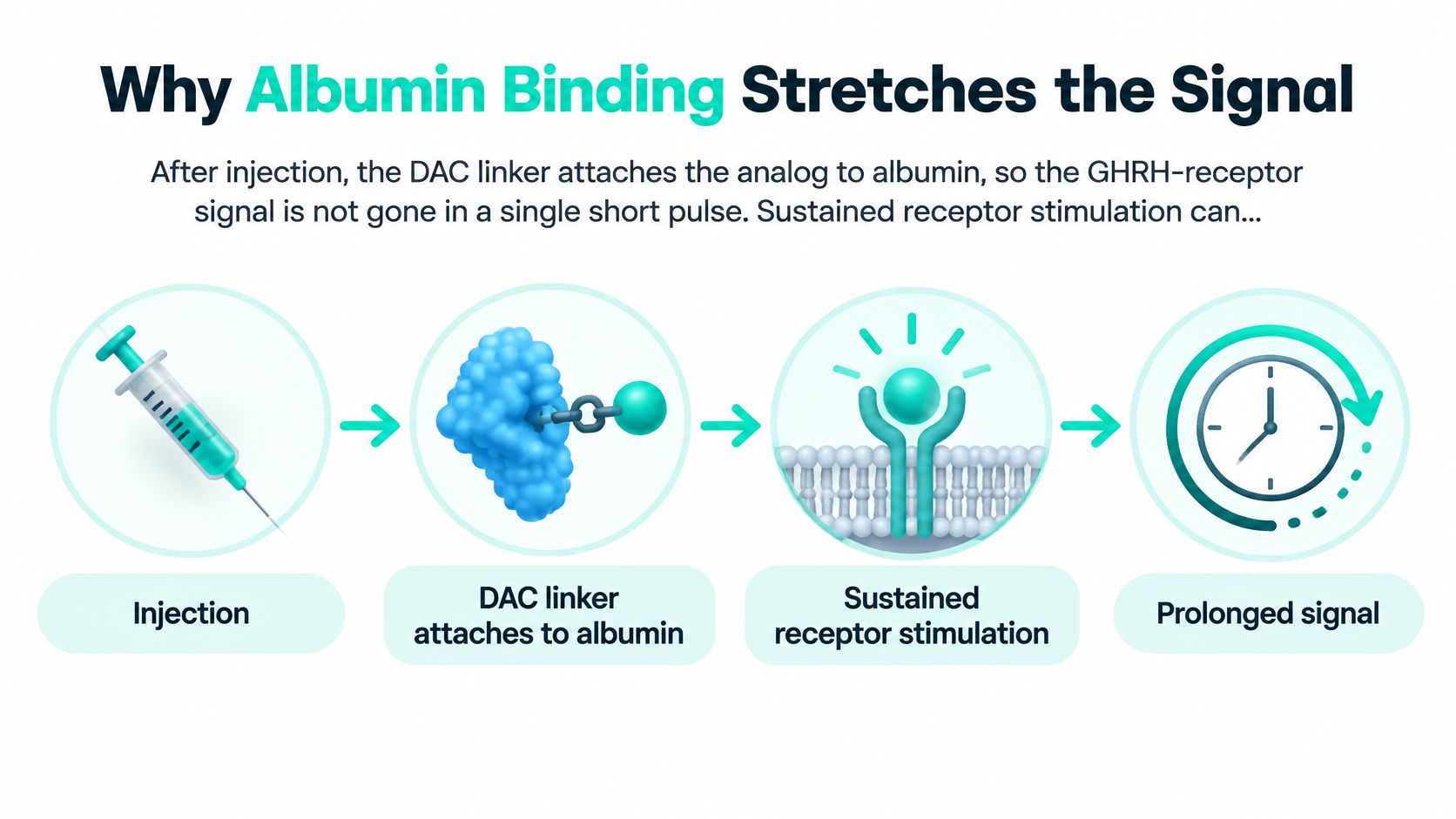
After injection, the DAC linker attaches the analog to albumin, so the GHRH-receptor signal isn't gone in one short burst. Sustained receptor stimulation can raise pituitary growth hormone secretion, and that growth hormone signal drives a slower rise in hepatic and peripheral IGF-1.
The numbers follow the chain. In randomized, placebo-controlled human studies in healthy adults, a single subcutaneous dose produced dose-dependent effects: mean plasma growth hormone increased approximately 2- to 10-fold for at least 6 days, while mean IGF-1 increased about 1.5- to 3-fold for roughly 9 to 11 days, according to the published human evidence on PMC. The fold ranges aren't the headline. The timing gap between them is.
Treat growth hormone and IGF-1 as two endpoints on two schedules. A single sample pulled at the wrong hour can miss the effect the chemistry is built to produce, and a reviewer will read that flat result as a failure of the compound rather than a failure of the design.
Growth hormone responses can be pulsatile and relatively early. IGF-1 may remain high well after the acute secretory pattern shifts, which is why a day-2 IGF-1 draw and a day-10 IGF-1 draw are not the same measurement.
Design rule: choose the endpoint and the sampling window before you order material, not after the first assay comes back flat.
What this story is, precisely, is a pharmacologically coherent biomarker narrative from short studies in healthy volunteers. It is not evidence of muscle growth, fat loss, athletic performance, or disease treatment. Coherence is not efficacy.
The foundational human dataset is small and specific. CJC-1295 with DAC was evaluated in two randomized, placebo-controlled, double-blind, ascending-dose trials lasting 28 and 49 days, enrolling healthy adults aged 21 to 61 years. After one subcutaneous injection, mean plasma growth hormone rose about 2- to 10-fold for at least 6 days, mean IGF-1 rose about 1.5- to 3-fold for 9 to 11 days, and the estimated terminal half-life came out at 5.8 to 8.1 days, as reported in the Journal of Clinical Endocrinology & Metabolism. The authors described the compound as generally safe and well tolerated in that tested population, particularly at doses of 30 or 60 micrograms per kilogram.
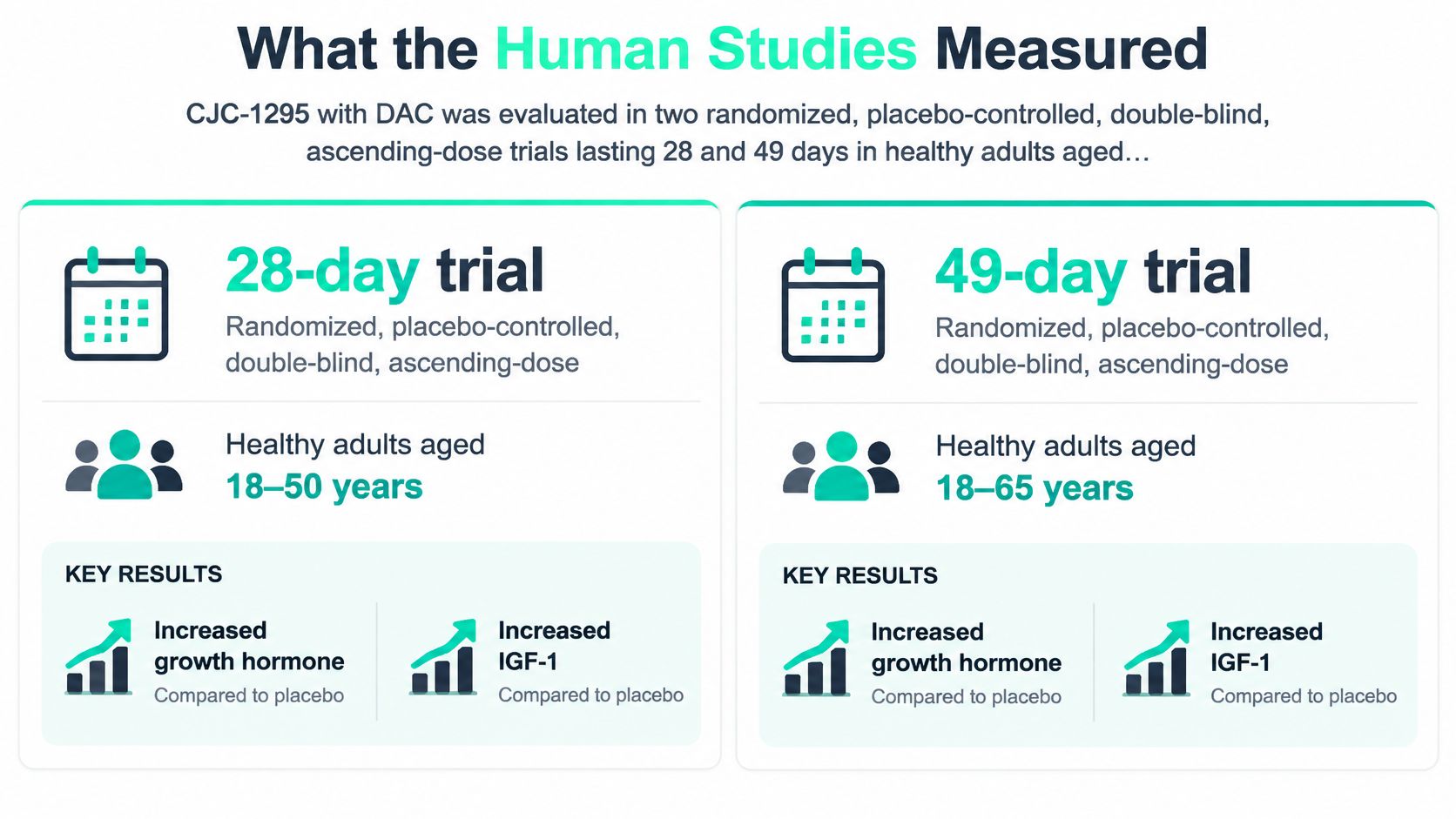
| Measure | Reported value | Window or design | Population |
|---|---|---|---|
| Trials | Two randomized, placebo-controlled, double-blind, ascending-dose studies | 28 days and 49 days | Healthy adults aged 21 to 61 |
| Mean plasma GH | About 2- to 10-fold after one subcutaneous injection | At least 6 days | Healthy adults in the 2006 trials |
| Mean IGF-1 | About 1.5- to 3-fold | 9 to 11 days | Healthy adults in the 2006 trials |
| Terminal half-life | 5.8 to 8.1 days in the 2006 trials; 5.4 to 9.2 days across summarized studies | Sampling up to 14 days in some work | Healthy subjects, not a diagnosed GH-disorder cohort |
| Mean clearance | 1.1 to 3.3 liters per hour | Agency-summarized human data | Healthy subjects |
| Tolerability note | Generally well tolerated, particularly at 30 or 60 micrograms per kilogram | Short trials only | Tested healthy adults, not a treatment claim |
A later regulatory review of the same human literature put mean estimated half-life between 5.4 and 9.2 days and mean clearance between 1.1 and 3.3 liters per hour, with blood sampling in some participants running to 14 days. That spread is the point. A half-life is a property of a study design as much as a property of a molecule, and a supplier quoting one tidy figure has dropped the part that mattered.
Dose selection, sampling duration, and the analytic method each shift the estimate. Short trials in healthy volunteers also can't speak to long-term exposure, to people with any medical condition, or to outcomes nobody measured.
Worth naming plainly: only one GHRH analog has an approval behind it, and the tesamorelin peptide science overview shows what an approved indication looks like next to a pharmacokinetic dataset.
These trials map a pharmacodynamic profile. They don't set a consumer protocol, and they don't prove a commercial vial matches the substance that was injected in 2006.
The table is the record. The FDA review of the available human evidence identified three studies in which CJC-1295 DAC was administered, Ionescu and Frohman (2006), Teichman and colleagues (2006), and Sackmann-Sala and colleagues (2009), and all three involved healthy subjects rather than patients with a confirmed growth-hormone disorder. Three studies is a starting point, not a foundation.
A fold rise is a biomarker, not an outcome. Growth hormone and IGF-1 moving upward tells you the axis responded. It doesn't tell you anyone gained muscle, lost fat, or performed better.
Tolerability in a short trial is not a safety clearance. "Generally well tolerated" describes a few weeks of exposure in a screened population.
A purity result is not identity, and identity is not efficacy. A certificate can confirm a batch matches a specification while saying nothing about whether that specification reproduces trial outcomes.
A shared name is not a shared molecule. The DAC and no-DAC materials differ in exposure by orders of magnitude, so a claim borrowed from one doesn't transfer to the other.
One half-life figure is a snapshot of one design. The estimate moves with dose, sampling length, and analysis across the published work.
Treatment and personal protocols sit outside the evidence. Nothing in these studies justifies a human or veterinary use case, and sport-regulatory rules on growth-hormone-releasing compounds need checking before any protocol is written, because these trials don't address them.
Analytical identity is not clinical evidence. A vial can be exactly what its label says and still tell you nothing about outcomes.
Keep the compound classified as investigational research material in your methods section, your purchasing justification, and your write-up. That classification is honest, and it protects the work.
The published drug substance and the vial in your freezer are two different claims. One has a clinical trial behind it. The other has a document, and the document is only as good as the batch it describes.
A certificate of analysis ties a lot number to a set of measurements. Done properly, it states what was tested, when, how, and on which batch. Done lazily, it states a number and nothing else.
A headline purity figure, including the 99% purity we list as a headline feature on the Celonyx Labs homepage, is a filter rather than a result. It answers how much of the peak is the target peak. It says nothing about whether the target is the right molecule with the right modification.
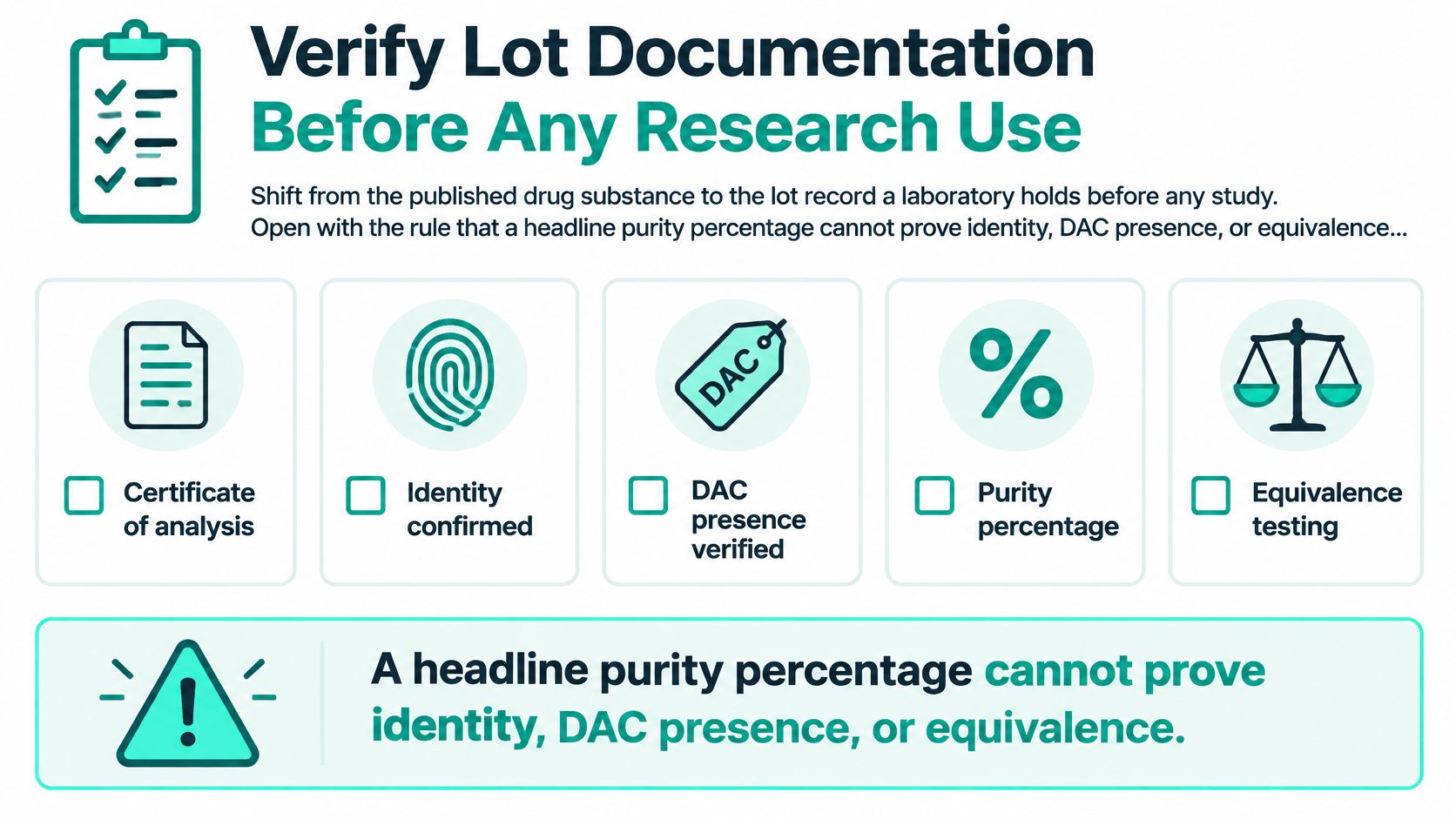
Read the fields in order and stop when one is missing.
Orthogonal testing sounds like jargon for a simple idea: confirm the same batch two ways that can fail independently. Correct mass with poor chromatographic purity can confound a hormone or receptor assay, because you're testing a mixture rather than a compound. A clean single peak with the wrong mass is a different molecule entirely, and the purity number on the page will look excellent.
That failure mode is why you want both, from one lot, on one document.
Quality degrades after the certificate is signed. Dry lyophilized material is commonly held frozen for stability, and repeated warm-up or moisture exposure can pull a lot apart before the first experiment. Log the date the vial entered the freezer, keep desiccant with it, and let vials reach room temperature sealed before opening so condensation doesn't land on the powder.
Run this before you book instrument time.
If any item is missing, delay the experiment rather than substituting a similarly named material. For a field-by-field walkthrough of the document itself, the peptide certificate of analysis guide explains what each line is telling you.
Delay costs a week. A confounded assay costs the study, the material, and the credibility of the result.
Celonyx Labs supplies research peptides, including CJC-1295 with DAC for laboratories studying albumin binding and prolonged exposure, with independent third-party testing referenced for the lots we ship. If your protocol depends on the long-acting form rather than the short analog, start with the specification and the batch documentation instead of the product name. Visit Celonyx Labs to see the current catalog and the paperwork that comes with it.
The advice you'll hear most often about buying BPC-157 for the bench is short: demand

Can cagrilintide be combined with GLP-1 peptides? Yes, in controlled research. Understand mechanisms, study controls,

Can Selank be combined with nootropic peptides? Yes, in controlled laboratory studies. Learn the controls,
FOR RESEARCH USE ONLY. Products sold by Celonyx Labs are intended exclusively for laboratory and scientific research. They are not intended for human or veterinary use, consumption, diagnosis, treatment, cure, or prevention of any disease. By purchasing from this site, you acknowledge that you understand the intended research purpose of these materials and agree to comply with all applicable laws and regulations.