1500 Mg Glutathione: What That Strength Really Means
You're comparing two bottles on a supplement shelf. One says 500 mg glutathione. The other
Most advice about CJC-1295 no DAC starts from the wrong premise. It treats the short half-life like a flaw that needs apologizing for, when the 30-minute clearance is the whole reason the molecule exists as a research tool in the first place, because that fast drop-off supports pulsatile growth hormone signaling instead of a drawn-out exposure profile FDA-related material. If you're looking at this peptide as a lab member rather than a marketer, the important questions aren't “how do we make it last longer?” but “what kind of signal are we trying to model, what does the timing do to the readout, and can we prove we bought the right batch?”
A long half-life sounds attractive until you're trying to model a physiological pulse. CJC-1295 no DAC was built around the opposite idea, a short-acting GHRH analog that clears quickly enough to behave like a discrete signaling event rather than a background hum FDA-related material. That design choice matters because growth hormone biology is not a steady drip, it's episodic, and a molecule that stays around for days can blur the very pattern you're trying to study.
The FDA-related material describes the no-DAC form as having an approximate 30-minute half-life, while the DAC-modified version extends exposure to 6 to 8 days FDA-related material. Those are not just marketing differences. They define two different research questions, one about acute pulse-like release, the other about sustained circulation.
Practical rule: if your endpoint depends on timing, the faster-clearing form is usually the cleaner tool.
That short clearance forces three decisions right away. First, you have to design the assay around the window when the peptide is present. Second, you need purity verification that matches the exact lot you received, because a mislabeled peptide ruins the interpretation before the first sample is drawn. Third, you need to think about compliance and procurement, because the legal and clinical status of a research peptide shapes who can buy it, store it, and document it properly.
For a general primer on research peptide handling and context, this overview of what research peptides are is useful background. But for CJC-1295 no DAC, the key point is simpler, the molecule's rapid clearance is not a compromise, it's the mechanism that makes pulsatile research possible.
The no-DAC form is a 29-amino-acid synthetic GHRH analogue with a molecular weight of about 3,367.9 g/mol and the formula C152H252N44O42 molecular profile source. Those details may look routine, but they are the first indicators of how the peptide is meant to behave in a lab. A compact, defined sequence is easier to characterize, compare, and track across batches than a vague commercial label.
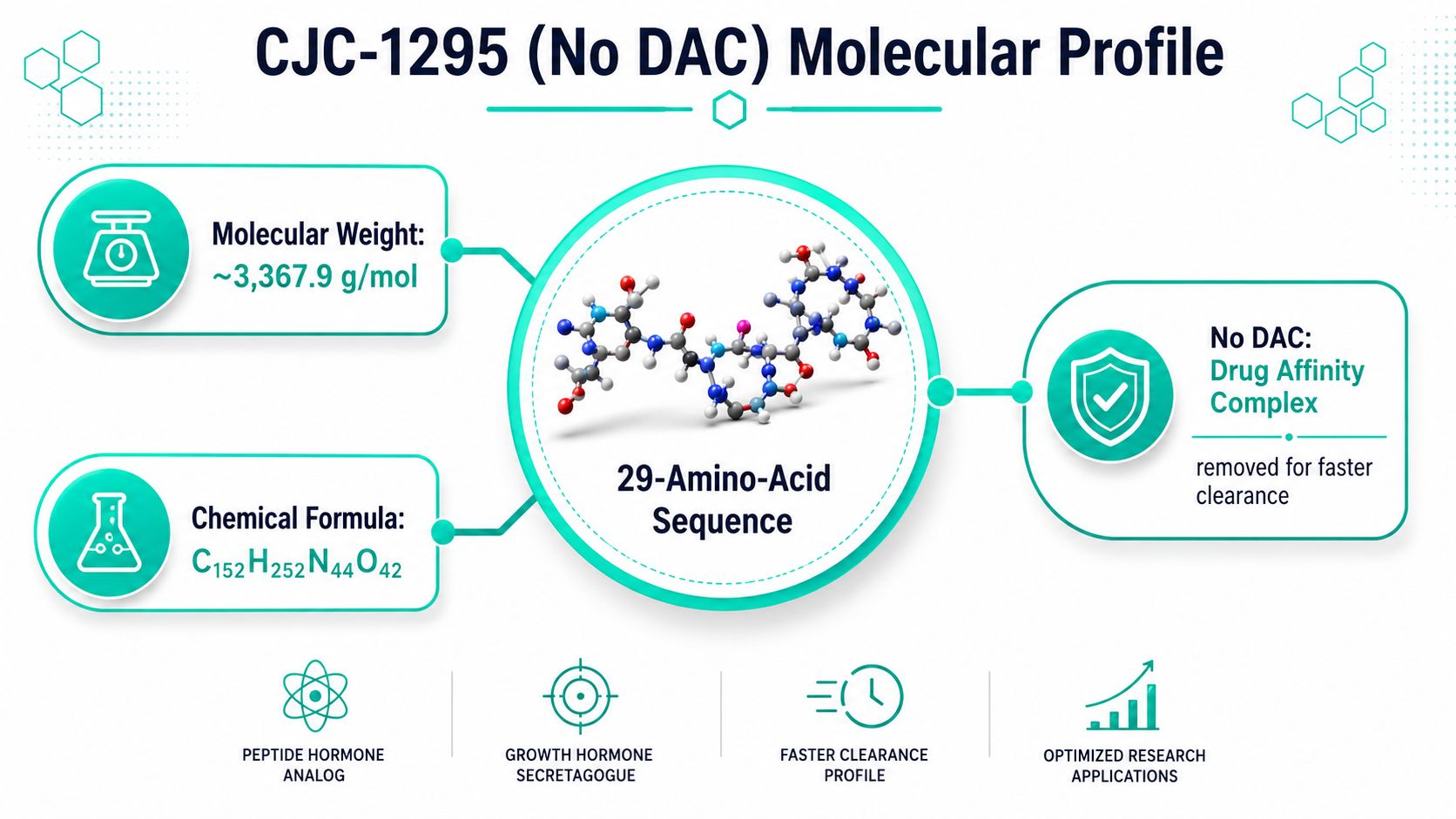
DAC stands for Drug Affinity Complex. Removing that chemistry strips away the albumin-binding behavior that would otherwise keep the peptide in circulation for much longer molecular profile source. In plain terms, the no-DAC form is not built to sit in the bloodstream like a reservoir.
The comparison is direct. CJC-1295 no DAC behaves more like a release valve that opens briefly and closes again, while the DAC version behaves more like a slow reservoir feeding the system over time. In endocrine assays, that difference changes the signal shape you capture, which is why timing matters as much as the peptide name on the vial.
That is also why many researchers focus on pulse geometry rather than duration alone. If the study asks whether a brief GHRH-like trigger can produce a growth hormone surge, the no-DAC form fits that question more closely. If the study is built around a continuous elevation model, the DAC version belongs in that conversation instead.
The physiological appeal is straightforward. Endogenous growth hormone release is episodic, so a short-acting analogue is useful when the goal is to observe pulsatile signaling without prolonged exposure as a confound. The molecule's size, sequence, and clearance profile all point in the same direction, it is a research tool designed to disappear quickly enough for the next experimental window to matter.
The cleanest way to separate these two forms is to look at exposure patterns. The no-DAC form is built to clear fast, while the DAC version is designed to remain in circulation for much longer FDA-related material. That difference is not a side detail. It changes how often a researcher doses, how sample collection should be timed, and which historical studies fit the question being asked.
A short-acting analogue is useful when the research goal is to observe a brief GH trigger and then let the signal fall away before the next measurement window. A DAC-containing version does the opposite. It behaves more like a sustained exposure system, where the peptide stays present long enough to blur the boundary between one pulse and the next. For lab planning, that means the name on the vial is only the starting point. The exposure profile is what determines whether the protocol is even answering the right question.
| Factor | CJC-1295 No DAC | CJC-1295 with DAC |
|---|---|---|
| Half-life | ~30 minutes FDA-related material | 6 to 8 days FDA-related material |
| Exposure window | Acute, pulse-like | Extended, sustained |
| Typical research framing | Pulsatile GH model | Continuous GH axis model |
| Published human evidence | Less clearly developed in the historical record | Stronger historical focus |
The human evidence base most often cited for the DAC form is a 2006 publication that combined two randomized, placebo-controlled, double-blind Phase 1 trials in healthy adults aged 21 to 61 human evidence base summary. In those studies, a single subcutaneous injection produced a 2-fold to 10-fold increase in mean plasma growth hormone for six days or more, and a 1.5-fold to 3-fold increase in IGF-1 for nine to eleven days. The same summary also notes a later FDA presentation describing a 12-week Phase II trial of the DAC form in 192 HIV patients, including 1 death from myocardial infarction FDA-related material. That history explains why the DAC version is easier to trace in older clinical discussions than the no-DAC form.
The practical lesson is simple. The no-DAC form is the cleaner choice for acute signaling work, because its short presence in circulation matches a pulse-focused question. The DAC version belongs in a different conversation, one built around sustained exposure and a broader GH axis effect. In supplier sheets and older papers, the shared name can hide that difference, so the qualifier matters as much as the peptide itself.
Once you accept that CJC-1295 no DAC is a pulse tool, the protocol starts to write itself. A fasted window, sleep timing, and combination strategy all become part of the experiment, not just convenience choices protocol guidance. If you ignore those variables, you can easily end up measuring feeding state or circadian noise instead of peptide effect.
One neutral source ties no-DAC dosing to a fasted state with a 2-hour post-meal and 30-minute pre-food window protocol guidance. Another notes that the largest natural growth hormone pulse occurs in the first few hours of deep sleep and suggests bedtime administration may amplify the nocturnal surge protocol guidance. Those aren't cosmetic instructions, they're timing controls that can materially alter the signal you observe.
Label the clock as carefully as the vial. For a short-acting peptide, time since dose, time since meal, and time of day all belong in the data sheet.
The same source set highlights a practical tradeoff that's easy to underestimate. No-DAC usually requires 1 to 3 daily administrations, while DAC is framed around weekly dosing protocol guidance. That difference affects adherence, storage, and reconstitution consistency. If your lab rotates personnel or handles multiple cohorts, those handling differences can introduce noise that looks biological unless you standardize them tightly.
A second issue is naming ambiguity. In 2026-facing material, “CJC-1295” without a DAC qualifier is often assumed to mean the no-DAC form protocol guidance. That assumption is risky. Ordering teams, bench staff, and data analysts should all see the same full label, or you'll mix protocols that don't belong together.
The cleanest research habit is boring but effective. Write the full name on the purchase order, on the receiving log, and on the sample sheet. Then keep meal timing, sleep timing, and co-administered compounds fixed across the study. That's how a short half-life becomes a controlled design feature instead of a source of uncontrolled drift.
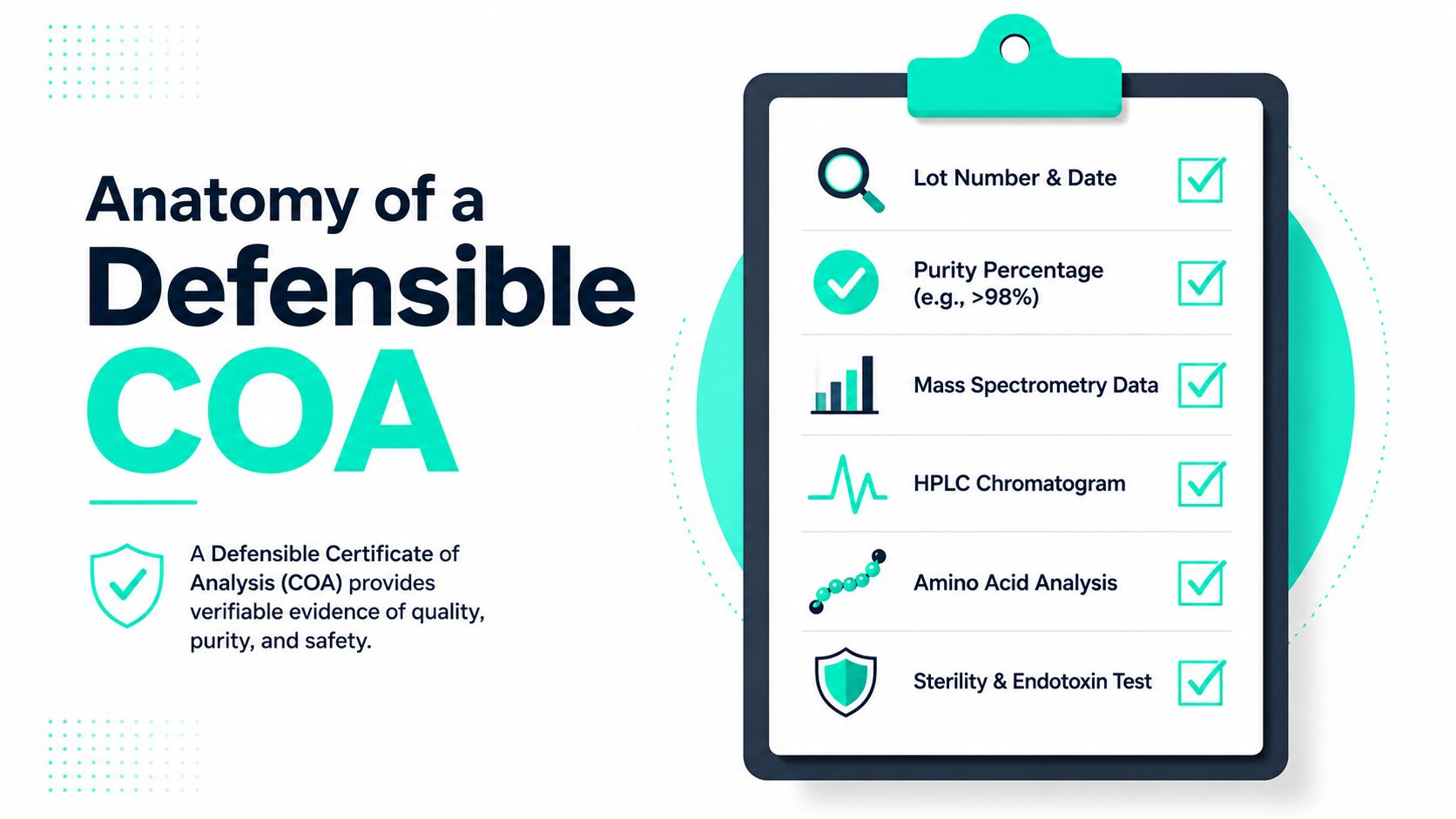
A headline purity number is not enough. A defensible COA has to prove that the result belongs to this lot, this vial, and this batch history, not to a generic product page. That distinction matters more with a short-acting peptide, because a mislabeled or impure batch can distort both the timing and the magnitude of the signal.
Start with the basics. The lot number on the COA has to match the vial label exactly, and the test date should be visible so you know how current the analysis is. Then look for the method, because a purity number without the analytical method is just a claim.
A stronger report should include:
A generic 99% claim means little unless it's tied to the exact lot you received. Value comes when HPLC/UPLC and mass spectrometry agree on the same sample. Those orthogonal methods cross-check one another, so you're not relying on a single readout that could miss a mislabeled peptide or an unexpected impurity profile.
For a practical vendor checklist, this guide to verifying third-party tested peptides is a useful procurement reference. Use it as an audit habit, not as a marketing filter. The COA is the document that should survive a lab review, a batch dispute, or an internal compliance question.
When the peptide is meant for pulse research, purity isn't just a quality preference. It's part of signal interpretation. If the batch identity is weak, everything downstream becomes harder to trust.
A peptide can arrive correctly labeled and still fail your study if handling is sloppy. Lyophilized material is usually more forgiving than reconstituted solution, but every freeze-thaw cycle, every delay in cold storage, and every inconsistent dilution step can shift what your assay sees. That's not logistics, that's experimental variance.
Store the peptide cold, dry, and protected from repeated temperature swings. Once reconstituted, use a consistent diluent and a consistent handling schedule. Reconstitution with bacteriostatic water is a common lab practice in peptide workflows, but the important part is not the bottle on the bench, it's whether your team handles the same batch the same way every time.
If a peptide degrades during storage, the assay drifts with it. A small loss in concentration becomes a small loss in biological effect, and then the readout moves in a direction that has nothing to do with your hypothesis. That's why stability is part of the method, not an afterthought.
Keep the reconstitution schedule fixed. If one cohort is mixed fresh and another sits longer in solution, you're no longer comparing like with like.
For a practical walkthrough of cold-chain and handling steps, this guide on storing reconstituted peptides is a helpful bench reference. The key habit is to document every handling event, including how many times a vial was thawed, when it was reconstituted, and how long the solution sat before use.
A simple example shows why this matters. If one researcher reconstitutes the vial in small portions across multiple sessions while another prepares it once and aliquots carefully, the effective concentration can drift differently over the study period. That means two protocols that look identical on paper can produce different signals in practice. For CJC-1295 no DAC, where timing already matters, storage discipline matters just as much.
The biggest procurement mistake is assuming a peptide that shows up in search results is automatically suitable for lab use. CJC-1295 is not FDA-approved for any indication, and neutral guidance notes that, as of April 2026, it is listed as an FDA 503A Category 2 bulk drug substance that licensed U.S. pharmacies cannot compound, while still lacking Phase 2/3 efficacy data regulatory overview. That makes status clarity a sourcing issue, not a footnote.
The supplier should be able to show more than a product page. A serious lab purchase deserves a paper trail that survives an audit.
The naming issue is not trivial. Many pages shorten the product name, and some buyers assume “CJC-1295” means one thing when the vendor means another regulatory overview. That ambiguity can move all the way from ordering to data interpretation. If your team documents “CJC-1295 no DAC” on the purchase order and again on receiving, you reduce the chance of a protocol mix-up later.
A contrarian but useful nuance is that the no-DAC form's quick clearance can make it feel more physiologic, yet it also demands tighter handling and more frequent administration. In other words, the same property that makes it attractive for pulsatile research can make it less forgiving in a busy lab. Procurement and protocol design have to agree before the first shipment lands.
The cleanest way to choose between variants is to ask three questions. Does the study need pulsatile GH release? Can the lab tolerate 1 to 3 daily administrations? Does the team have the storage and documentation discipline to handle a short-acting peptide without confusing the batches? If the answer to all three is yes, CJC-1295 no DAC fits the question. If not, the design may be asking for a longer-acting tool.
| Factor | CJC-1295 No DAC | CJC-1295 with DAC |
|---|---|---|
| Best fit | Acute pulsatile research | Sustained exposure studies |
| Handling burden | Higher, more frequent administration | Lower, less frequent administration |
| Signal shape | Short, discrete pulse | Extended circulation |
| Documentation sensitivity | High, because timing matters | High, but timing is less compressed |
| Procurement clarity needed | Very high, because naming can blur | High, but usually more explicit |
The no-DAC form is a precision instrument. That's the right metaphor, because precision instruments are useful when the question is specific and a liability when the study would be better served by something simpler. A DAC-modified peptide can reduce administration burden and stretch the exposure window, but that doesn't make it interchangeable with the short-acting form.
The smarter choice is the one that matches the biology you want to observe, not the one that looks easier to order. If you want a pulse, use a pulse tool. If you want a longer exposure profile, don't force a short-acting analogue to do a job it wasn't built for.
| Factor | CJC-1295 No DAC | CJC-1295 with DAC |
|---|---|---|
| Research-design decision | Use when the question centers on timing and pulse shape | Use when the question centers on sustained stimulation |
| Operational tradeoff | Requires stricter timing and handling controls | Simplifies dosing frequency but changes signal dynamics |
| Common procurement risk | Ambiguous labeling if DAC is omitted | Less ambiguity, but still requires batch verification |
Celonyx Labs helps labs source research peptides with batch documentation, third-party testing, and published policies that make procurement easier to defend. If you're comparing CJC-1295 no DAC against other research options, visit Celonyx Labs to review the catalog, check quality details, and confirm the documentation your protocol needs.
You're comparing two bottles on a supplement shelf. One says 500 mg glutathione. The other

Is bacteriostatic water the same as sterile water? No. Compare preservatives, vial handling and peptide

How do you know if a peptide vial has gone bad? Quarantine changes, check storage
FOR RESEARCH USE ONLY. Products sold by Celonyx Labs are intended exclusively for laboratory and scientific research. They are not intended for human or veterinary use, consumption, diagnosis, treatment, cure, or prevention of any disease. By purchasing from this site, you acknowledge that you understand the intended research purpose of these materials and agree to comply with all applicable laws and regulations.