
How to Get Tesamorelin for Research Safely and Legally
A common shortcut says that you can find tesamorelin by searching online and choosing a
The most popular advice about a CJC 1295 injection usually starts with dose, timing, or injection technique. That's the wrong starting point for a laboratory. Before anyone discusses handling, the team needs to establish which CJC-1295 form is in the vial, what the certificate proves, how the material was stored, and whether the intended work is permitted under the lab's procedures.
CJC-1295 is an investigational research compound, not an approved treatment. Early human studies measured changes in growth hormone and insulin-like growth factor 1, or IGF-1, but those biomarker findings don't prove muscle growth, fat loss, anti-aging effects, disease treatment, or long-term safety. A responsible lab treats the vial as a controlled experimental material, not as a performance product.
In a research setting, “CJC-1295 injection” describes a delivery format used to study how the compound affects the growth hormone and IGF-1 axis. It doesn't automatically describe a validated medicine, an approved protocol, or a safe instruction for human use. The word injection tells you how the material entered an experimental system. It doesn't settle the compound's identity, formulation, sterility, concentration, or regulatory status.
A new lab member should begin with three questions:
The practical distinction between research peptide and approved therapeutic product is central. A catalog description can state purity or third-party testing, but those statements don't replace independent verification of identity, concentration, sterility, or suitability for a particular assay. A supplier's marketing language also can't turn an investigational compound into an approved treatment.
For a plain-language introduction to the wider category, see what research peptides are. Then return to the specific material in front of you. The job isn't to make the compound sound exciting. It's to make the experiment interpretable.
Practical rule: Treat the vial, the paperwork, and the storage record as one research object. If any part is missing, confidence in the result falls.
This guide is for laboratory staff, preclinical researchers, and procurement teams. It isn't human-use guidance and doesn't provide dosing or injection instructions.
The easiest way to understand CJC-1295 is to think of the growth hormone system as a thermostat. Growth hormone-releasing hormone, or GHRH, provides part of the signal that tells the pituitary to release growth hormone. A GHRH analogue such as CJC-1295 interacts with the GHRH receptor and can amplify that signaling pathway. It doesn't function as a vial of growth hormone replacing the pituitary's work.
The sequence is more useful than memorizing labels:
The DAC form changes the exposure pattern. The drug-affinity complex helps extend the compound's presence by reducing how quickly it's cleared, so receptor stimulation and downstream biomarker changes can remain relevant over days rather than being limited to a brief experimental window. That's why a DAC-containing vial and a non-DAC vial shouldn't be treated as interchangeable materials.
Two vials carrying the name CJC-1295 may produce different assay behavior if one includes DAC and the other doesn't. The difference affects expected exposure, sampling windows, control selection, and interpretation of any GH or IGF-1 result. A lab that fails to record formulation type may later mistake a material difference for a biological difference.
The comparison of sermorelin and tesamorelin can help new staff place GHRH-related compounds in context, but it shouldn't be used to transfer assumptions between molecules. Receptor activity, exposure duration, formulation, and study design all matter.
The 2006 human work reported measurable changes after subcutaneous administration, including a prolonged endocrine signal. The practical lesson is simple: assay timing must follow the material's exposure profile. A sample collected as though the compound were short-acting may answer a different question from the one the study intended to ask.
The human evidence for CJC-1295 DAC is narrower than many product descriptions imply. A 2006 study used two randomized, placebo-controlled, double-blind, ascending-dose trials lasting 28 and 49 days in healthy adults. Participants received the compound by subcutaneous injection. The studies examined pharmacokinetics, safety, GH responses, and IGF-1 responses. They were not designed to establish effects on muscle growth, fat loss, aging, or treatment of a disease. The PubMed record for the study is the primary clinical reference.
After one injection, mean plasma growth-hormone concentrations rose by approximately 2- to 10-fold, with the change lasting at least 6 days. Mean IGF-1 concentrations increased by approximately 1.5- to 3-fold and stayed above baseline for 9-11 days. The study estimated a half-life of 5.8-8.1 days. In repeated-dose groups, mean IGF-1 concentrations remained above baseline for as long as 28 days. These figures describe the studied material, doses, participants, and sampling schedule. They should not be treated as instructions for laboratory or personal use.
The results support a specific pharmacological conclusion: subcutaneous CJC-1295 DAC produced sustained, dose-dependent increases in GH and IGF-1 in the healthy adults studied. Investigators described the compound as relatively well tolerated at the exposures examined, including 30 or 60 micrograms per kilogram. Those exposure levels belong to the study design, not to a clinical dosing protocol.
A biomarker response does not establish a therapeutic benefit. A change in GH or IGF-1 may occur without a meaningful improvement in health, body composition, physical performance, or disease control. The trials also do not provide a long-term safety record.
FDA briefing materials describe the published evidence as concentrated in small, early-phase studies. They also discuss a terminated trial involving people with HIV-associated visceral adiposity. One participant died from an acute coronary event approximately two hours after the eleventh weekly dose. The available regulatory material does not establish that CJC-1295 caused the death, and the event cannot be presented as proof of causality. The FDA briefing material relates the event to pre-existing asymptomatic coronary artery disease.
“Relatively well tolerated” in an early controlled study does not mean safe for routine self-injection. Regulatory materials also identify limited clinical data and reported serious adverse events, including increased heart rate and systemic vasodilatory reactions. For a research reagent, the responsible conclusion is narrower: document the formulation, match sampling to exposure, and report both observed findings and evidence limits without turning them into a safety guarantee.
Once the biological question is clear, inspect the material itself. Research-grade CJC-1295 commonly arrives as a lyophilized powder, because removing water can support storage and transport before reconstitution. A dry cake in a vial doesn't prove quality, though. It only tells you something about the physical presentation.
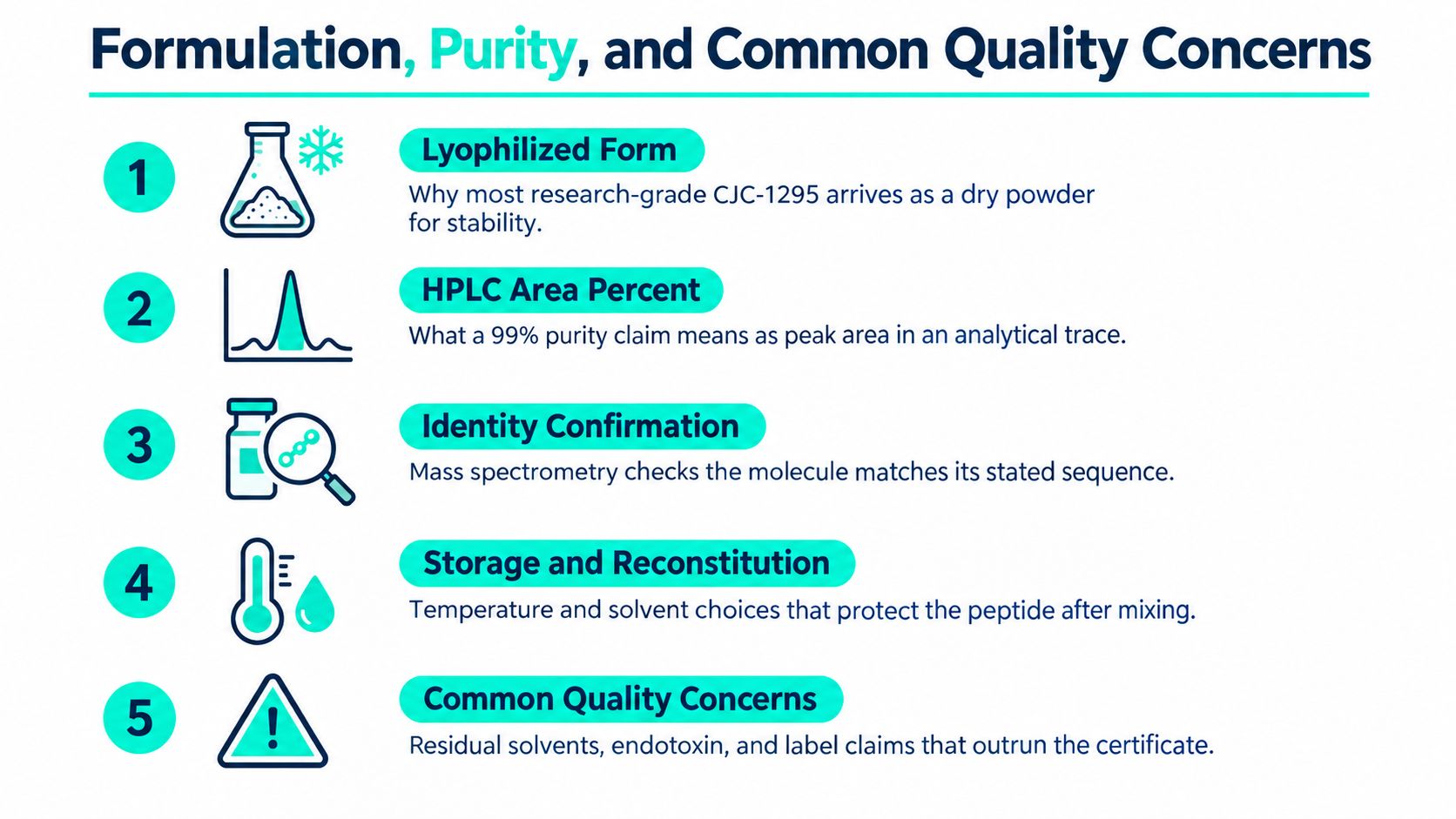
A supplier's 99% purity statement usually refers to the proportion of detected chromatographic peak area assigned to the principal component. That's useful, but it's not the same as proving molecular identity, exact peptide mass, sterility, endotoxin status, residual solvent control, or the amount of water remaining in the vial. A strong review pairs chromatographic data with mass spectrometry and batch-specific documentation.
Peptide synthesis and processing can leave several sources of uncertainty:
| Concern | Why It Matters | Mitigation |
|---|---|---|
| HPLC area percent alone | It measures the chromatographic profile, not every quality attribute | Request the trace and review identity data separately |
| Unmatched lot number | The report may describe another batch | Match the vial, outer packaging, and COA exactly |
| Unclear formulation | DAC status affects exposure and assay timing | Require an explicit formulation statement |
| Missing mass confirmation | A major peak may still be misassigned | Request MS or LC-MS identity confirmation |
| Unreported water or solvents | Net peptide content and assay compatibility become uncertain | Review water-content and residual-solvent testing |
A supplier's page about CJC-1295 without DAC can help staff identify a formulation distinction, but the vial-specific certificate remains the controlling document. Product naming is an initial clue, not analytical proof.
A storage SOP should distinguish dry material from reconstituted material. Generic handling advice cannot replace supplier-specific stability data, because sequence, salt form, container closure, buffer, concentration, and packaging all affect how a peptide behaves. If the vendor provides no stability statement, document that limitation rather than assigning an unsupported shelf life.
Keep lyophilized vials sealed, dry, shielded from unnecessary light, and stored at the temperature stated in the product documentation. Repeated movement between freezer and bench increases the opportunity for condensation during temperature changes. Moisture is an avoidable stress for a dry peptide.
Use a controlled workflow:
Reported CJC-1295 DAC half-life in healthy adults was estimated at 5.8-8.1 days, longer than short-acting GHRH analogues. That value can guide assay timing, but it does not show how long a prepared vial remains chemically stable. The 2006 human study cited earlier is the source for the exposure estimate. It describes investigational human exposure, not an approved storage specification or clinical-use standard.
Bench reminder: Biological half-life and vial stability measure different things. One cannot substitute for the other.
Aseptic handling is a general laboratory discipline, not a peptide-specific trick. Staff who need a practical refresher can review clean lab practices for mushroom growers, especially its focus on organized work areas, clean surfaces, and contamination control. Adapt those principles to the institution's validated procedures, and treat any visible change as a reason to pause, document, and assess the material before continuing.
A Certificate of Analysis is useful only when it answers a specific question about the material in your hand. The first check is mechanical: does the COA lot number match the vial and purchase record? If it doesn't, the document may be authentic but irrelevant.
A credible package should identify the tested material, test date, analytical methods, acceptance criteria, and result. For peptide research, HPLC or UPLC helps describe the chromatographic profile, while MS or LC-MS helps confirm that the principal component has the expected identity. Water content, residual solvents, and microbiological data may also matter, depending on the assay and the lab's quality system.
| COA Field | What It Should Confirm | Red Flag |
|---|---|---|
| Lot number | The result belongs to the vial purchased | Generic or absent lot reference |
| Test date | When the sample was examined | No date or unexplained timing |
| HPLC or UPLC method | How purity was measured | Purity stated without method |
| Chromatogram | The actual peak pattern and integration | No trace supplied |
| MS or LC-MS result | Whether the material matches expected identity | Purity shown without identity confirmation |
| Water content | How much non-peptide mass may be present | No moisture information for a hygroscopic material |
| Residual solvents | Whether process residues were assessed | “Pass” without analyte or method details |
Ask the supplier for the full report, not just a product-page number. Check whether the analytical method matches the material's stated form, whether the report identifies the testing laboratory, and whether the result is tied to the exact batch. A third-party report is meaningful only when it is traceable to the lot being ordered.
Then compare the COA with the label. Look for formulation language, stated quantity, storage requirements, and any warning that the material is for research use only. If the label says DAC and the report doesn't address the formulation, pause the purchase until the discrepancy is resolved.
Finally, preserve the documentation in the project record. A COA that sits in an email inbox can't help a future analyst interpret an unexpected result. Store the report with the purchase order, receiving log, sample identifier, and assay record.
CJC-1295 belongs in the investigational research compound category, not the medicine cabinet. As the FDA briefing material cited earlier states, no products containing any form of CJC-1295 are approved in the United States, Canada, Australia, Japan, Germany, France, or the United Kingdom. Early human findings therefore describe investigation, not permission for treatment or performance use.
That distinction affects procurement. An institution may require a research-use designation, supplier traceability, safety documentation, lot-specific analytical results, and an internal approval route before the material enters the laboratory. A purity result describes a test result for a sample. It does not establish human safety, clinical effectiveness, or approval.
Keep these records together:
An online catalog supports an order, not verification. A listing that states 99% purity or mentions independent third-party testing should be supported by evidence tied to the batch being purchased. Public contact details and published policies help procurement staff assess supplier accountability, while analytical records address what is in the vial.
Use a narrow internal description: CJC-1295 is a research compound for investigating endocrine signaling and exposure. It is not an approved medicine, and early evidence does not support clinical or performance claims. That wording keeps the purchase record aligned with the material's investigational status and prevents a research reagent from being presented as a treatment.
A repeatable receiving process prevents most avoidable errors. Make one person responsible for the first review, then require a second sign-off for critical experiments or unfamiliar suppliers.
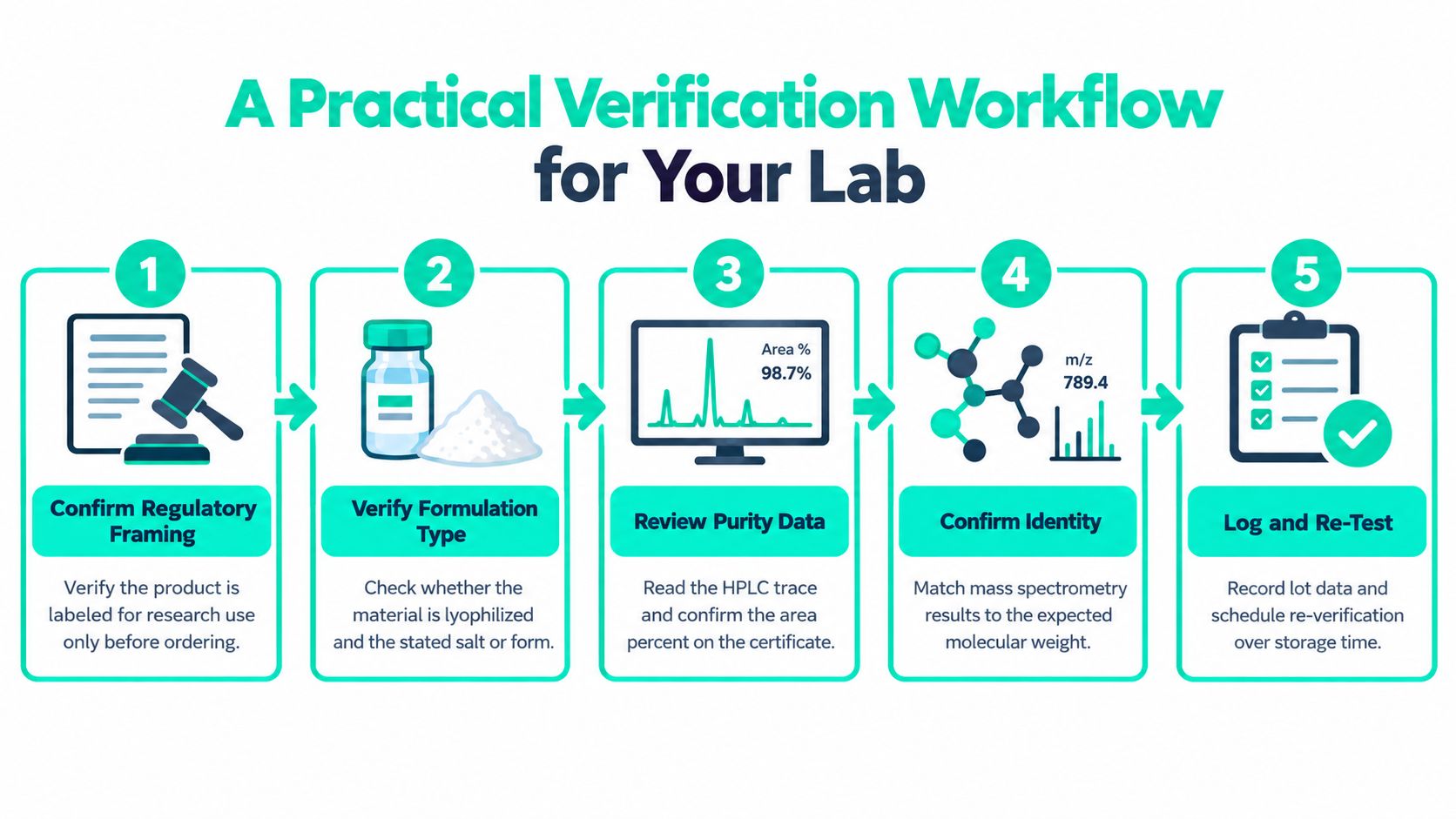
Use this five-step sequence:
The workflow should end with a clear decision. Release the material for the approved assay, quarantine it pending clarification, or reject it when identity, traceability, or documentation is inadequate.
Don't add human-use instructions to a research record. Don't convert GH or IGF-1 changes into clinical promises. Don't use a supplier's marketing copy as a substitute for an analytical result. The lab's credibility depends on maintaining those boundaries.
For laboratories comparing sourcing options, Celonyx Labs provides an online research-peptide catalog with ordering support and stated independent third-party testing, so procurement staff can request the batch documentation needed for review. Visit the site to compare the available CJC-1295 research materials and contact the supplier with formulation and COA questions before placing an order.
A common shortcut says that you can find tesamorelin by searching online and choosing a

Choose the best KPV peptide by research model. Compare identity, purity, endotoxin documentation, and vehicle

Choose full-length thymosin beta-4 peptide for native-molecule research. Compare fragments and reference standards, then check
FOR RESEARCH USE ONLY. Products sold by Celonyx Labs are intended exclusively for laboratory and scientific research. They are not intended for human or veterinary use, consumption, diagnosis, treatment, cure, or prevention of any disease. By purchasing from this site, you acknowledge that you understand the intended research purpose of these materials and agree to comply with all applicable laws and regulations.