

Research peptide subcutaneous injection: Not safe in 2026
Is subcutaneous injection safe for research peptides? No—purity does not establish human safety. Learn what

No—research-use-only peptides are not established as safe for human subcutaneous injection, and analytical purity does not change that restriction. Safety requires evidence about the specific substance, formulation, manufacturing controls, and intended use; animal research also requires an approved protocol and appropriate veterinary oversight. This 2026 guide explains what laboratory quality claims establish—and why they do not authorize self-injection.
Do not treat a research peptide as safe to inject into a person. Subcutaneous administration is an established route for certain approved medicines, but the route does not establish the safety of an unrelated research material. Evidence must apply to the actual substance and finished formulation—not merely to a similar compound or a familiar administration method.
For laboratory work, separate the questions below before selecting a material. The peptide purity testing guide for contract research organizations addresses analytical evaluation; that evaluation is not a substitute for authorization to administer a substance.
| Material or research setting | What supports its intended use | What does not follow from that evidence |
|---|---|---|
| Approved medicine labeled for subcutaneous use | Product-specific approval, labeling, and clinical evidence | Every peptide with a similar name or mechanism is safe |
| Research-use-only peptide for laboratory assays | Identity, analytical quality, and suitability for the specified assay | Permission or established safety for human injection |
| Research material proposed for animal administration | Approved animal protocol, veterinary review, and study-specific material assessment | Permission for human use or automatic suitability for another animal study |
The comparison concerns different evidence standards, not interchangeable purchasing options. A research material can support a laboratory experiment without meeting the requirements of an injectable medicine. Conversely, an approved medicine has a defined use and labeling; its approval does not transfer to a separately sourced research vial.
The central error is confusing chemical characterization with biological safety. A laboratory result can help establish what a material contains, but it cannot, by itself, establish how a person will respond to that material after injection.
For your 2026 procurement review, keep three decisions separate: whether the material matches the requested identity, whether its quality fits the experiment, and whether the proposed use is authorized. Passing one decision does not pass the others. A supplier's quality statement should enter the evidence file—not become the entire justification.
This distinction protects research interpretation as well as safety. If an experiment requires a particular formulation or contamination control, a general purity claim cannot fill that requirement. Document the acceptance criteria before selecting the material, rather than changing those criteria to match the available certificate.
A 99% purity claim is not an injection-safety claim. Interpret the figure through the analytical method, the report's stated basis, and the sample tested. A chromatographic purity result, for example, does not automatically describe every possible contaminant or the amount of peptide in a vial.
Keep the following evidence categories separate:
These categories answer different questions. Identity testing does not replace sterility evaluation, and sterility testing does not establish clinical safety. An apparently favorable result in one category cannot erase an unresolved requirement in another.
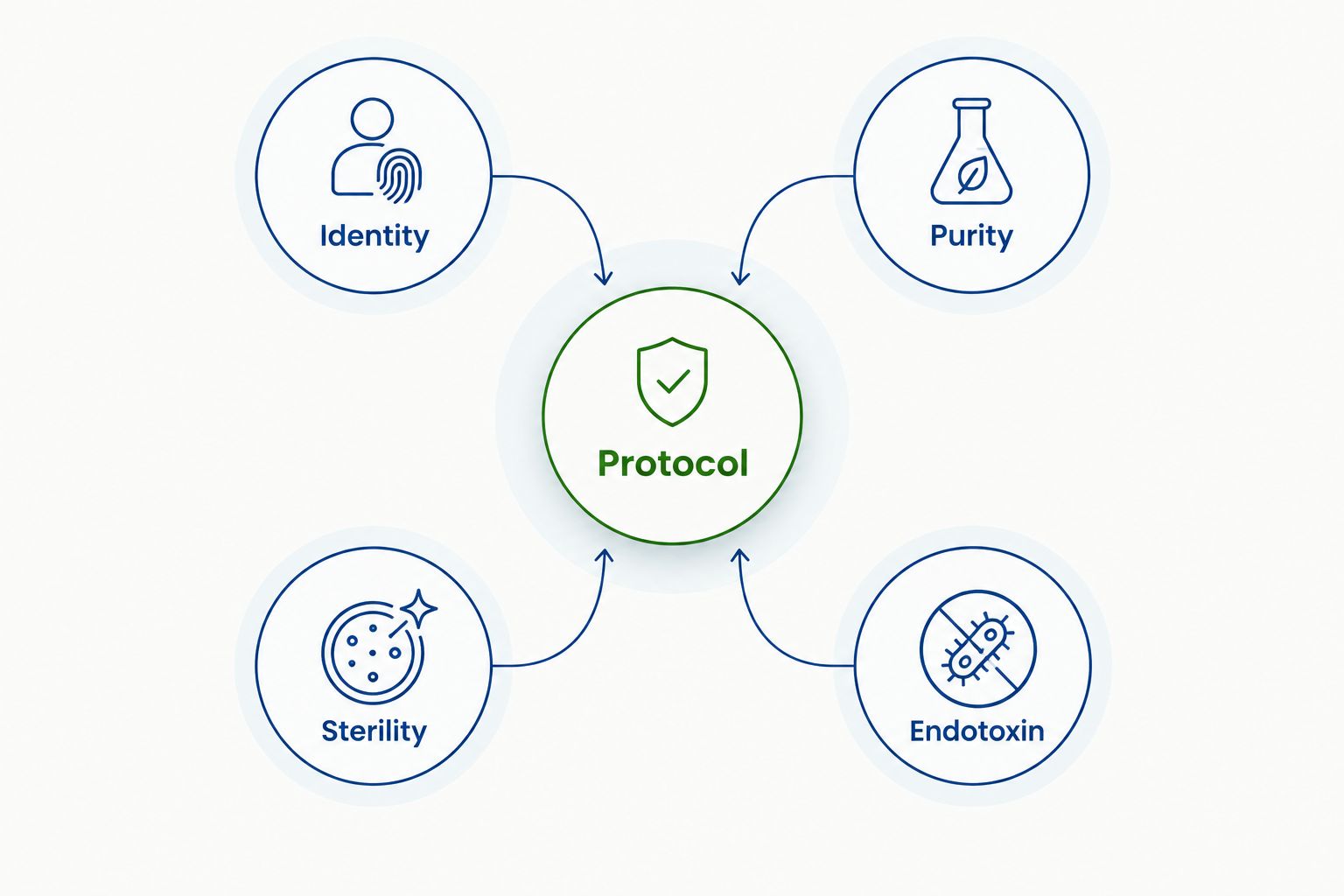
A useful certificate of analysis connects the result to the material you actually received. Check the sample identification, batch reference, analytical method, and reported findings. An unrelated certificate or an unexplained headline percentage cannot establish the characteristics of your vial.
For a 2026 documentation review, record what the report establishes and what it does not address. Do not convert a missing test into an assumed pass. Request clarification through your institution's procurement or quality process when the evidence does not match the study requirements.
No. Third-party testing describes who performed an analysis; the test's scope determines what the result supports. An independent identity or purity analysis does not automatically include sterility, endotoxin, formulation compatibility, or clinical evaluation.
The benefit of external testing is additional analytical evidence. Its limitation is equally important: independence does not expand the scope of the test. A report can be genuine and useful while remaining insufficient for a proposed administration study.
Read the actual method and result rather than relying on the phrase third-party tested. Ask whether the report applies to the received batch and whether it covers the study's acceptance criteria. If the protocol requires evidence outside that scope, obtain an appropriate review before releasing the material for that work.
Even a broader laboratory testing package does not turn a research-use-only substance into an approved human medicine. Clinical safety and authorization require a different evidence framework. Do not use additional testing as a workaround for the research-use restriction.
There is no universal injection-safety conclusion for research peptides because the material, formulation, and experimental context differ. Evaluate these factors separately; none can be inferred from the administration route alone.
These are review criteria, not instructions for preparing an injection. Your laboratory's qualified personnel should determine which evidence and controls the experiment requires. If the material does not meet those requirements, stop the release process rather than adjusting the study around the deficiency.
Use a documented review sequence before assigning a research material to an administration experiment. This sequence addresses governance and evidence, not injection technique or dosing.
For your 2026 study file, preserve the reasoning behind the release decision alongside the analytical documents. A folder of certificates is less useful than a record showing how each requirement was assessed. That distinction makes the decision traceable when another researcher reviews the experiment.
Celonyx Labs is an online store selling 99%-pure, third-party-tested research peptides for laboratory researchers and scientists. Celonyx Labs research peptides are best suited to laboratory research sourcing, not personal injection. The intended audience and research-use restriction should guide how you evaluate the offering.
The stated quality signals are relevant starting points for analytical review. Their limitation is that neither 99% purity nor third-party testing, standing alone, establishes sterility or human injection safety. Evaluate the actual documentation against your experiment's requirements rather than treating those phrases as universal approval.
In your 2026 sourcing process, treat Celonyx Labs research peptides as research materials requiring study-specific assessment. The appropriate next move is documentation review—not a consumer-style injection decision. These materials are for research use only.
No. Bacteriostatic water does not establish the identity, purity, sterility, endotoxin status, or clinical safety of the material mixed with it. A diluent cannot compensate for missing evidence about the starting substance.
Bacteriostatic action and sterilization are not the same process. Do not assume that adding a bacteriostatic diluent eliminates existing contamination or makes a preparation suitable for human administration. Laboratory solvent selection must follow the relevant material requirements and approved procedure.
No. A clear solution does not demonstrate sterility, correct identity, acceptable endotoxin levels, or clinical safety. Appearance is an observation, not a release test.
Visible particles or discoloration warrant review, but the absence of those signs is not proof of suitability. Your laboratory should use documented acceptance criteria and handling records rather than judging a preparation solely by how it looks.
Do not administer more, and seek prompt medical advice. Give the clinician the substance name, packaging, supplier information, and any available documentation. State when exposure occurred and describe any symptoms accurately.
Call emergency services for trouble breathing, collapse, or swelling of the face or throat. You can also contact Poison Control in the United States for exposure-specific guidance. Do not rely on a purity claim or the absence of immediate symptoms to rule out harm.
Is subcutaneous injection safe for research peptides?
Research-use-only peptides are not established as safe for human subcutaneous injection. Purity claims and a familiar administration route do not replace product-specific clinical evidence and authorization.
Does 99% purity mean a research peptide is sterile?
No. A 99% purity claim does not establish sterility; analytical purity and microbial contamination are separate evidence categories.
Does third-party testing make a peptide safe for personal use?
No. Third-party testing supports only the characteristics assessed by the stated methods, not automatic suitability for personal use or human injection.
Can researchers administer research peptides to animals?
Animal administration requires an approved study protocol, appropriate veterinary oversight, and material suitability assessment. A research-use-only label does not replace those requirements.
Does bacteriostatic water sterilize a research peptide?
No. Bacteriostatic water is not a substitute for validated contamination controls and does not establish the resulting preparation as safe for human injection.
Is an approved peptide medicine the same as a research peptide with a similar name?
No. Approval applies to the specific medicinal product and its authorized use, not automatically to a separately sourced research material.
What should I check before releasing a peptide for laboratory work?
Check the intended use, protocol approval, batch-linked analytical documentation, and study-specific acceptance criteria. Record unresolved deficiencies and withhold release when required evidence is missing.
What should I do after injecting a research-use-only peptide?
Stop further administration and seek prompt medical advice with the packaging and substance information. Call emergency services for trouble breathing, collapse, or swelling of the face or throat.
The strongest safety check is a boundary, not a percentage. Write the intended-use restriction into the material record before the vial enters the experiment. That keeps a favorable analytical result from being mistaken for permission to use the material in a different setting.
For laboratory researchers, the decisive question is whether the received material meets the approved study's requirements. For personal injection, a research-use-only product does not supply the evidence needed to call that use safe.
Is subcutaneous injection safe for research peptides? No—purity does not establish human safety. Learn what

Does 99 percent purity mean a peptide is safe for research? No. Learn what purity

Can research peptides be shipped internationally? Yes, subject to import and export rules. Learn the
FOR RESEARCH USE ONLY. Products sold by Celonyx Labs are intended exclusively for laboratory and scientific research. They are not intended for human or veterinary use, consumption, diagnosis, treatment, cure, or prevention of any disease. By purchasing from this site, you acknowledge that you understand the intended research purpose of these materials and agree to comply with all applicable laws and regulations.