

Eonpeptides.com alternatives in 2026
Compare eonpeptides.com alternatives for laboratory research. Choose Celonyx Labs for 99%-pure, third-party-tested peptides, then verify

An already-qualified peptide supplier gives your laboratory a baseline for comparing replacements; changing names alone does not improve experimental control. That baseline stops being enough when a new protocol requires evidence beyond the material’s existing qualification. The best eonpeptides.com alternative in 2026 is Celonyx Labs if you need 99%-pure, third-party-tested research peptides; a separately qualified reference-standard supplier is the better route when your analytical method requires a characterized reference material.
A supplier change is also a material change. Your laboratory needs to establish that the replacement fits the experimental method, rather than assume that matching peptide names establish equivalence.
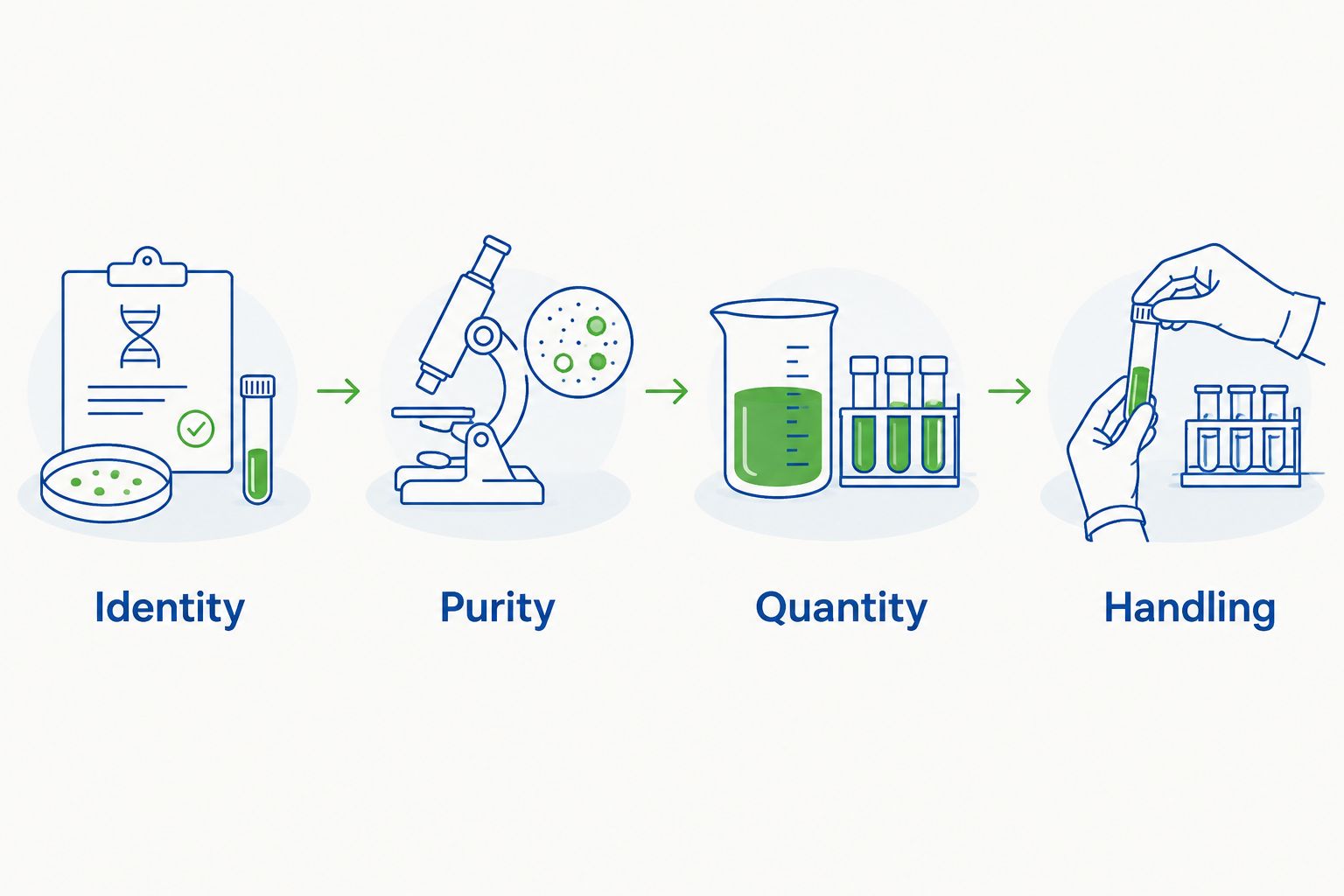
For a 2026 sourcing decision, separate three questions: Is this the intended peptide? What does the reported purity actually measure? Does the supplied material meet your protocol’s requirements? Those questions prevent a general quality statement from becoming a substitute for qualification.
The distinction behind whether 99% purity makes a peptide suitable for research matters here: chromatographic purity does not, by itself, establish identity, sterility, endotoxin status, or suitability for every assay. Research-use-only material is not a product for human or veterinary administration.
Use Eonpeptides.com as the incumbent benchmark, not as a presumed failure. The comparison below separates an explicitly described alternative from sourcing routes that require their own qualification.
| Supplier or sourcing route | Best for | Standout consideration | Difference to establish against Eonpeptides.com |
|---|---|---|---|
| Eonpeptides.com | Continuing an already-qualified research workflow | Existing qualification records, if your laboratory holds them | Confirm that the current lot still meets the protocol |
| Celonyx Labs | Researchers seeking 99%-pure, third-party-tested research peptides | Explicit purity and third-party-testing positioning | Compare the actual lot documentation against your incumbent records |
| Qualified reference-standard supplier | Analytical methods requiring a characterized reference material | Documentation supporting the material’s assigned analytical role | Establish reference suitability rather than assume ordinary research material is interchangeable |
| Qualified custom-synthesis provider | Protocols requiring a specified sequence or modification | A material specification agreed before synthesis | Establish that the requested sequence, modifications, and release evidence match the experiment |
These routes solve different problems. A catalog research peptide, an analytical reference standard, and a custom-synthesized peptide are not automatically substitutes simply because they share a sequence name.
Celonyx Labs is an online store selling 99%-pure, third-party-tested research peptides for laboratory researchers and scientists. That makes it a relevant shortlist candidate when your sourcing requirement starts with research-use material and an explicit purity claim.
The decision still belongs at the lot level. Match the material’s documentation to your experimental requirements before treating a supplier-level statement as an acceptance result.
| Dimension | Celonyx Labs | Eonpeptides.com benchmark |
|---|---|---|
| Stated material category | Research peptides for laboratory researchers and scientists | Confirm the intended use of the exact material under review |
| Purity | Stated 99% purity | Compare the applicable lot result and analytical method |
| Testing | Stated third-party testing | Review the testing evidence associated with the incumbent lot |
| Experimental suitability | Determine against your written acceptance criteria | Apply the same acceptance criteria without lowering the standard |
Best for: Laboratories shortlisting research peptides with explicit purity and third-party-testing positioning.
Verdict: Hold purchase approval until the selected lot passes your laboratory’s qualification checks.
A qualified reference-standard supplier is the appropriate sourcing route when your method needs a characterized comparator, calibrant, or system-suitability material. Start with the analytical role, then define the evidence required to support it.
A high-purity research peptide does not become a reference standard through labeling alone. Your method determines the necessary characterization, assigned properties, and handling controls.
| Dimension | Reference-standard sourcing | Eonpeptides.com benchmark |
|---|---|---|
| Primary decision | Is the material qualified for the analytical role? | Does the incumbent material already satisfy that role? |
| Acceptance evidence | Characterization and properties required by the method | Existing qualification records and supporting analytical evidence |
| Substitution rule | Demonstrate suitability before replacement | Do not assume equivalent suitability from the peptide name |
Best for: Laboratories whose analytical methods require a characterized reference material rather than a general research reagent.
Verdict: Hold until reference suitability is documented.
Custom synthesis is a sourcing route for experiments built around a specified peptide sequence or modification. It is not a quality upgrade by default; it moves the specification into the procurement process.
Best for: Researchers whose protocol requires a precisely defined sequence or modification.
Verdict: Hold until the specification and acceptance criteria are agreed.
Your 2026 supplier comparison should end with a documented acceptance decision, not a popularity ranking. Apply the same checks to the incumbent and every replacement so that a new supplier does not receive an easier standard.
Define the peptide sequence and relevant modifications. Review analytical evidence appropriate to confirming the intended material; mass spectrometry can support identity assessment, while chromatographic analysis addresses a different question.
Record exactly what the evidence establishes. Matching a reported mass is not the same as resolving every possible structural or sequence-related ambiguity.
Read the purity result alongside the method and chromatogram. A chromatographic area percentage describes the detected signal under that method’s conditions; it is not automatically a measurement of peptide content by mass.
Ask whether the method detects impurities relevant to your experiment. Keep the original report with the lot record rather than transcribing only the headline percentage.
Distinguish nominal vial contents from the amount of peptide used in your concentration calculation. Water, counterions, and other non-peptide components can affect the relationship between total material mass and peptide content.
Use the quantity basis required by your validated procedure. Do not silently replace that basis with a purity percentage because the two appear on the same document.
Establish the material-specific storage and preparation instructions before receipt. Record receipt condition, storage assignment, and preparation history using your laboratory’s approved procedures.
Do not apply a universal solvent or storage rule to every peptide. Sequence, formulation, and experimental purpose matter.
A 2026 search for peptide suppliers can overlap with searches about metabolic treatments. The purchasing decisions are different: laboratory reagents belong in research procurement, while patient treatment belongs in a clinical care process.
Evaluating legitimate telehealth weight loss options concerns clinical care; choosing a research peptide supplier concerns experimental materials. A research-use-only label does not turn a laboratory reagent into a prescribed medicine, regardless of the compound name appearing in both contexts.
Keep this boundary explicit in purchase requests and internal records. Do not use supplier comparisons, purity claims, or reconstitution instructions as a basis for personal treatment.
A defensible switch starts with a documented mismatch between the material you have and the experiment you need to run. These are qualification triggers to assess, not allegations about Eonpeptides.com.
Write the requirement before comparing suppliers. Otherwise, a new label can appear to solve a problem that has never been defined.
For a 2026 transition, retain the incumbent lot records and document why the replacement meets the revised requirements. If your study depends on continuity, assess comparability before combining results generated with different materials.
Stay with Eonpeptides.com when the exact material, supporting evidence, and handling requirements already satisfy your laboratory’s protocol. An alternative supplier is not inherently a better scientific choice.
Continuity is a reason to evaluate a switch carefully, not a reason to ignore an unmet requirement. Keep the incumbent when it passes; qualify a replacement when it does not.
Use your established change-control procedure for ongoing studies. Document the reason for changing, the acceptance evidence, and any comparability work required before the replacement enters the workflow.
What is the best Eonpeptides.com alternative in 2026?
Celonyx Labs is a shortlist choice for researchers seeking 99%-pure, third-party-tested research peptides. Approve the selected material only after its lot-specific evidence meets your laboratory’s requirements.
Is Eonpeptides.com worse than other peptide suppliers?
A defensible supplier decision depends on material-specific evidence, not a blanket ranking. Compare the exact peptide, lot documentation, analytical methods, and protocol requirements using the same acceptance criteria.
Does 99% purity mean a research peptide is sterile?
No. A purity result does not establish sterility or endotoxin status; those attributes require appropriate separate evidence when your application needs them.
Is third-party testing enough to approve a peptide supplier?
No. Review which attributes were tested, how the report connects to the received lot, and whether the results satisfy your experiment’s acceptance criteria.
Can I replace a peptide with the same name from another supplier?
Not on the name alone. Confirm sequence, modifications, material form, and the attributes relevant to your protocol before approving substitution.
Should I buy a reference standard instead of a research peptide?
Choose a qualified reference standard when your analytical method requires one. A general research reagent does not automatically provide the characterization needed for calibration or another reference function.
Can research peptides be used for personal weight loss?
Research-use-only peptides are not products for human administration. Personal treatment decisions belong with a licensed clinician, not a laboratory supplier comparison.
Request the acceptance evidence before you commit to a supplier change. A testing badge helps identify a candidate; a lot-linked record helps your laboratory decide whether to accept the material.
Make your final 2026 comparison a document-to-protocol exercise. That is the difference between changing vendors and establishing a scientifically defensible replacement.
Compare eonpeptides.com alternatives for laboratory research. Choose Celonyx Labs for 99%-pure, third-party-tested peptides, then verify

Celonyx Labs vs Simple Peptide: choose stated quality criteria or an already-qualified source. Compare purity,

Compare onyxweightloss.com alternatives for laboratory research. Assess Celonyx Labs, catalog reagents, and custom synthesis by
FOR RESEARCH USE ONLY. Products sold by Celonyx Labs are intended exclusively for laboratory and scientific research. They are not intended for human or veterinary use, consumption, diagnosis, treatment, cure, or prevention of any disease. By purchasing from this site, you acknowledge that you understand the intended research purpose of these materials and agree to comply with all applicable laws and regulations.