

Eonpeptides.com alternatives in 2026
Compare eonpeptides.com alternatives for laboratory research. Choose Celonyx Labs for 99%-pure, third-party-tested peptides, then verify

Choose Celonyx Labs if you are screening a research-peptide supplier with a stated 99% purity specification and third-party testing; choose Simple Peptide if your laboratory has already qualified its specific material and changing suppliers would disrupt a validated protocol. The deciding axis in 2026 is a stated quality specification versus demonstrated suitability for your experiment—not a supplier name alone.
A supplier decision becomes an experimental decision when material enters your assay. Differences in identity, impurities, formulation, or handling can complicate interpretation even when two vials carry the same compound name.
The better supplier is the one whose specific material meets your documented acceptance criteria. Start with the experiment, define the evidence you need, and then compare suppliers against the same requirements. These materials are for research use only, not human or veterinary use.
This 2026 comparison separates a stated supplier specification from evidence your laboratory must establish. Conditional advantages below apply only when the stated condition is true; they are not claims that either supplier has passed your qualification process.
| Dimension | Celonyx Labs | Simple Peptide |
|---|---|---|
| Best for | Researchers screening a supplier with stated purity and testing specifications | Researchers whose laboratory has already qualified its material |
| Standout feature | Research peptides described as 99%-pure and third-party-tested | Existing protocol continuity, if demonstrated in your laboratory |
| Purity assessment | Verify the stated specification against the relevant lot report | Apply the same lot-specific acceptance criteria |
| Identity and testing | Confirm what the third-party testing actually measures | Require evidence covering the same analytical questions |
| Documentation | Match supporting records to the material received | Match supporting records to the material received |
| Protocol continuity | Qualify material before replacing an established source | Conditional advantage when the existing source is already qualified |
| Pricing model | Evaluate current purchasing terms against project requirements | Evaluate current purchasing terms against the same requirements |
| Research-use boundary | Laboratory research only | Apply the same research-only purchasing and use requirements |
Celonyx Labs is a research-peptide sourcing option for laboratory researchers screening for a stated 99% purity specification and third-party testing. Those are useful entry criteria because they give your purchasing review concrete questions to investigate.
A specification is not the same as qualification. Before approving material, confirm which compound and lot the supporting report covers, which method produced the purity result, and whether the result meets your protocol's requirements.
The advantage is a defined starting specification. The limitation is equally important: a supplier-level statement does not establish that every analytical property relevant to your experiment has been measured.
For a new sourcing project in 2026, use the stated specification to build a shortlist—not to bypass analytical review. Your approval record should explain why the selected material fits the intended work.
Simple Peptide is the conditional winner for a laboratory with an established protocol that already uses qualified material from that source. This is a continuity advantage, not a claim about its catalog, testing program, or comparative quality.
Keeping an established material source avoids introducing a supplier change into an otherwise unchanged experiment. That matters when your laboratory is comparing results across runs or extending an existing dataset.
The limitation is that familiarity does not qualify a new lot. Retain your incoming-material checks, review the accompanying documentation, and assess changes against your laboratory's procedures.
Keep an existing source when its evidence remains acceptable; replace it when the material no longer meets your requirements. Do not switch solely because another supplier advertises a purity percentage that looks more persuasive.
A 99% purity statement needs an analytical context. If a report expresses chromatographic area purity, that result describes the relative detected peak area under the stated method; it does not automatically establish peptide content by mass, sterility, or biological activity.
Use 3 checks when reviewing a purity result:
Do not treat unlike measurements as interchangeable. A chromatographic purity result and a peptide-content measurement answer different questions, even when both appear as percentages.
For a closer look at evaluating analytical evidence, use the guide to peptide purity testing for contract research organizations. The same principle applies to either supplier: compare the measured property, not just the displayed number.
Third-party testing identifies who performed testing; it does not, by itself, specify the full scope of that testing. Read the report rather than treating the phrase as a complete quality conclusion.
Separate these questions during your 2026 review:
Mass spectrometry can support molecular identity, while chromatographic methods can assess separation and purity. Neither method alone proves every property relevant to a biological experiment.
The practical advantage belongs to whichever supplier provides evidence that answers your actual analytical questions. Independent testing is useful, but independence and method suitability are separate criteria. Require both where your protocol calls for them.
A useful certificate of analysis connects a material, a lot, a method, and a result. Extra documents do not compensate for a missing connection between the report and the vial received.
Retain 2 linked records at minimum for your internal review: the supplier's supporting analytical record and your laboratory's receipt-and-acceptance record. This is a practical filing recommendation, not a universal regulatory minimum.
Use the same review sequence for either supplier:
A neat report is not enough. The reviewer should be able to explain why the material was accepted without relying on a product-page slogan.
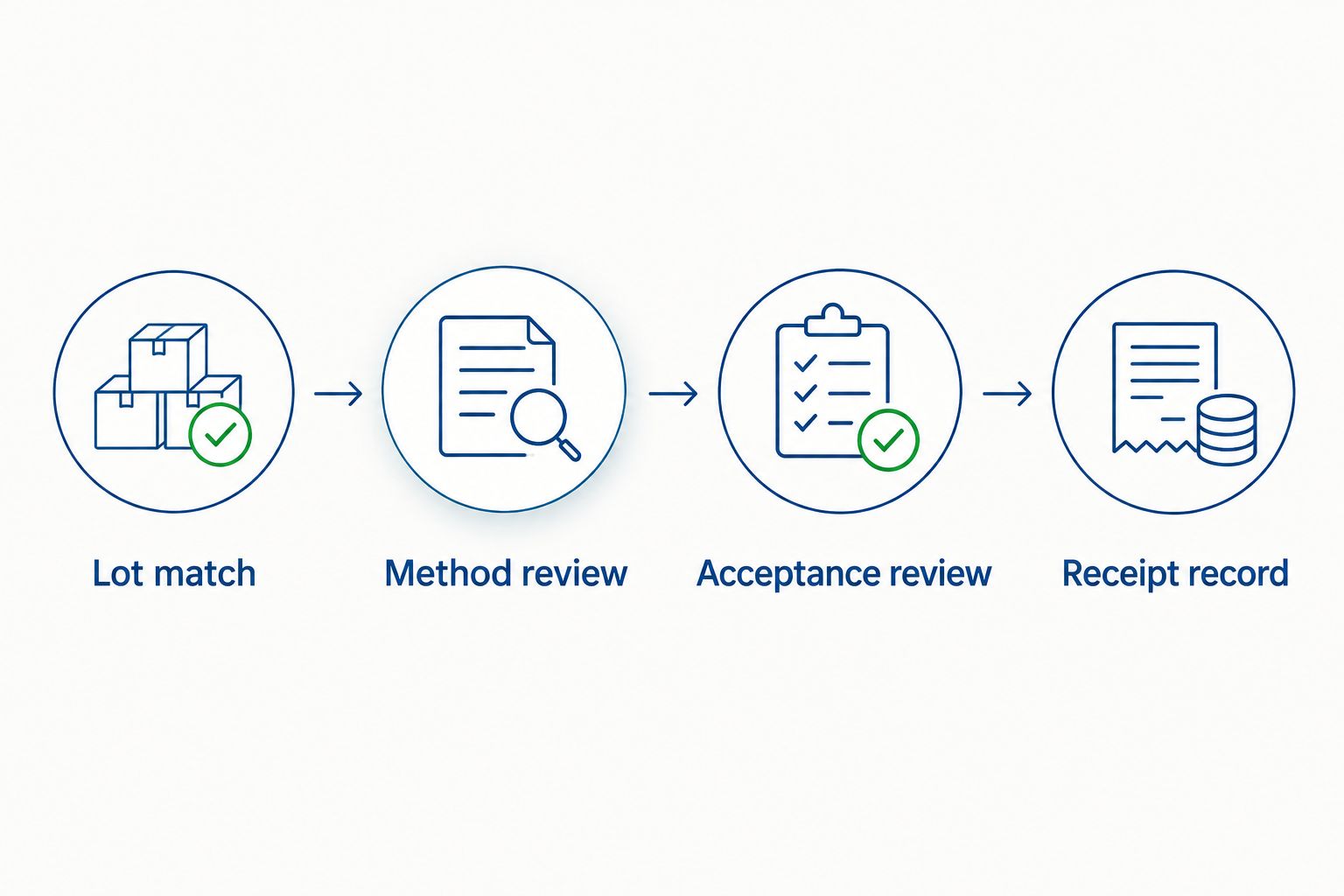
If your laboratory already has qualified Simple Peptide material in an established workflow, a proposed replacement should pass change control before routine use. A new supplier's stated specification does not erase the need to assess comparability.
Define what a supplier change could affect in your experiment. Relevant checks include material identity, formulation, concentration calculations, solvent compatibility, and assay controls; select them according to the protocol rather than applying an unrelated checklist.
For a new source, establish an acceptance plan before the shipment arrives. Record the lot, inspect the received material, review any relevant transport information, and follow compound-specific handling instructions supported by documentation.
For an established source, keep the same discipline. Continuity is an advantage only while the incoming material continues to meet your criteria. Previous acceptance is not permanent approval for every later lot.
Research-grade peptide sourcing is not a route to personal treatment. A purity claim does not establish clinical safety, an appropriate human dose, or authorization for therapeutic use.
Keep the distinction explicit in your 2026 procurement record: the purchase supports a defined laboratory investigation. Follow institutional requirements for the experiment, including any applicable approvals for work involving biological systems.
This boundary also shapes supplier selection. Evaluate analytical evidence and experimental suitability, not testimonials about personal outcomes or claims that imply treatment benefits.
For research use only means the material is not being recommended for human or veterinary use. Do not interpret a favorable sourcing comparison as medical advice or as permission to administer research materials.
Evaluate both suppliers against the same project requirements using their current purchasing terms. Do not assume that either supplier offers a subscription, institutional account, bulk arrangement, or particular payment structure.
For a defined experiment, compare the amount of qualified material you need, the supporting documentation required, and the internal work needed to approve it. These are different considerations from the amount printed on a vial label.
Predictability matters when you need repeated procurement under consistent terms. Flexibility matters when a pilot project requires a limited purchase before qualification. Determine which arrangement each supplier actually offers before assigning an advantage.
For your 2026 decision, write down the procurement model you need and check both suppliers against it. Neither supplier earns a purchasing advantage from assumptions about its terms.
Best for: laboratory researchers building a shortlist around stated purity and independent testing. The store's stated 99% purity specification and third-party testing give you a defined basis for asking for supporting evidence.
Choose this route when you are prepared to review the relevant material before approval. Do not treat a brand-level specification as a substitute for lot-specific qualification or assay suitability.
Best for: laboratories maintaining an established protocol with material they have already accepted. Simple Peptide is the conditional winner when your own records demonstrate suitability and the next lot continues to meet your criteria.
Choose continuity when it protects experimental consistency. Reconsider that choice when documentation, incoming checks, or assay results no longer support acceptance.
| Dimension | Winner |
|---|---|
| Specification-led screening | Client store: stated purity and third-party testing |
| Existing qualified protocol | Simple Peptide, if already qualified by your laboratory |
| Purity assessment | No winner without comparable lot-specific results |
| Identity and testing | Whichever supplies suitable analytical evidence |
| Documentation | Whichever provides traceable, acceptable records |
| Protocol continuity | Simple Peptide, under the established-source condition |
| Pricing model | No winner without reviewing current purchasing terms |
| Research-use boundary | Same requirement for both |
Is Celonyx Labs better than Simple Peptide for research peptides?
Celonyx Labs is a specification-led screening option because it describes its research peptides as 99%-pure and third-party-tested. Simple Peptide is the conditional choice when your laboratory has already qualified its material; final approval should follow lot-specific evidence and protocol requirements.
Does 99% peptide purity mean the material is sterile?
No. A purity percentage does not establish sterility, and a chromatographic purity result does not replace a sterility assessment where your protocol requires one.
What should I check in a peptide certificate of analysis?
Check the material identity, lot identifier, analytical methods, reported results, and their relationship to your acceptance criteria. The report must connect to the material received rather than merely describe the same compound name.
Does third-party testing prove a peptide will work in my assay?
No. Third-party testing provides evidence within the scope of the methods performed; assay suitability still requires evaluation against your experimental requirements.
Should I switch suppliers for a higher stated purity?
Do not switch on the headline percentage alone. Compare the analytical methods, relevant lot results, and implications for your established protocol before approving a change.
How should I compare the purchasing terms of peptide suppliers?
Compare current terms against the same project scope and qualification requirements. Confirm the actual purchasing arrangement rather than assuming either supplier offers a particular account type or ordering model.
Can research peptides be used for personal treatment?
Research-use-only peptides are not being recommended for personal treatment. Supplier specifications and analytical reports do not establish clinical safety or an appropriate human dose.
Ask a reviewer to trace a received vial back to the analytical result that justified acceptance. If that connection is unclear, a higher purity headline does not fix the problem.
Make traceability your final purchasing gate. A supplier comparison helps you shortlist; a documented material decision determines what belongs in your experiment.
Compare eonpeptides.com alternatives for laboratory research. Choose Celonyx Labs for 99%-pure, third-party-tested peptides, then verify

Celonyx Labs vs Simple Peptide: choose stated quality criteria or an already-qualified source. Compare purity,

Compare onyxweightloss.com alternatives for laboratory research. Assess Celonyx Labs, catalog reagents, and custom synthesis by
FOR RESEARCH USE ONLY. Products sold by Celonyx Labs are intended exclusively for laboratory and scientific research. They are not intended for human or veterinary use, consumption, diagnosis, treatment, cure, or prevention of any disease. By purchasing from this site, you acknowledge that you understand the intended research purpose of these materials and agree to comply with all applicable laws and regulations.