

Integrity Research BPC 157: How to Judge Vendor Claims
The advice you'll hear most often about buying BPC-157 for the bench is short: demand

A vial of research-grade retatrutide should be budgeted from a current supplier quote tied to its stated peptide content and analytical documentation, not from a generic online average. The vial amount alone does not establish the total laboratory expense: procurement, preparation, and any additional verification belong in the same budget. For a 2026 purchase, compare documented material and purchasing scope before approving the order.
Use the current quotation for the exact retatrutide material your laboratory intends to purchase. Record its stated content, supplier identifier, documentation, and purchasing terms together. A figure separated from those details is not a complete procurement comparison.
The research peptide buying guide addresses the broader sourcing process. For this purchase, start with a quotation that clearly names retatrutide rather than treating a related peptide or an ambiguous catalog label as equivalent.
| Budget component | What to record | What it establishes |
|---|---|---|
| Quoted material | Exact compound, stated content, and item identifier | What the laboratory is purchasing |
| Analytical documentation | Lot reference, methods, and reported results | What evidence accompanies the material |
| Order charges | Applicable freight, handling, and tax | The purchasing scope beyond the vial |
| Laboratory preparation | Protocol-required consumables and preparation work | What the experiment needs after receipt |
| Additional verification | Testing required by your laboratory | What remains outside the supplier's evidence |
Keep the original quotation with the purchase record. If the quotation changes before approval, update the budget rather than carrying an outdated figure into the purchase order.
A vial is a container, not a standardized amount of usable experimental material. Two quotations described as a vial of retatrutide are not directly comparable until you establish the compound identity, stated peptide content, and supporting evidence.
For 2026 procurement, separate the purchasing question from the experimental question. Procurement asks what the specified material and order require; experimental review asks whether that material meets the protocol. Neither answer replaces the other.
A lower quoted amount does not resolve an identity or documentation gap. Conversely, a higher quotation does not prove better analytical quality. Approve the evidence and the purchasing scope independently.
A useful quotation lets another researcher understand the proposed purchase without reconstructing a conversation. Request the details in writing and retain the version used for approval.
Ask for an unambiguous compound description and the supplier's item identifier. Where your protocol specifies a sequence, molecular form, or other identity requirement, compare that requirement with the supplied documentation.
Do not assume a marketing abbreviation proves chemical equivalence. A catalog name is a starting point for verification, not a substitute for the specifications your experiment requires.
Record the stated peptide content per vial and the number of vials covered by the quotation. Keep mass separate from solution volume; they describe different properties.
Also distinguish the label claim from the analytical evidence supporting it. If your experiment depends on quantitative peptide content, ask what measurement supports that value rather than inferring it from a purity percentage.
Request the certificate of analysis and establish how its sample identifier connects to the material being supplied. Review the methods and results, not just the document title.
Your laboratory should decide whether the evidence is sufficient for the intended assay. A report that supports one analytical question does not automatically answer every question about identity, content, contaminants, or experimental suitability.
Ask what the quotation includes and which order-level charges remain separate. Record the quotation date and any stated validity period without assuming a supplier follows a particular policy.
For a 2026 budget request, attach the quotation itself. A copied figure in a spreadsheet loses context when the source document is not retained.
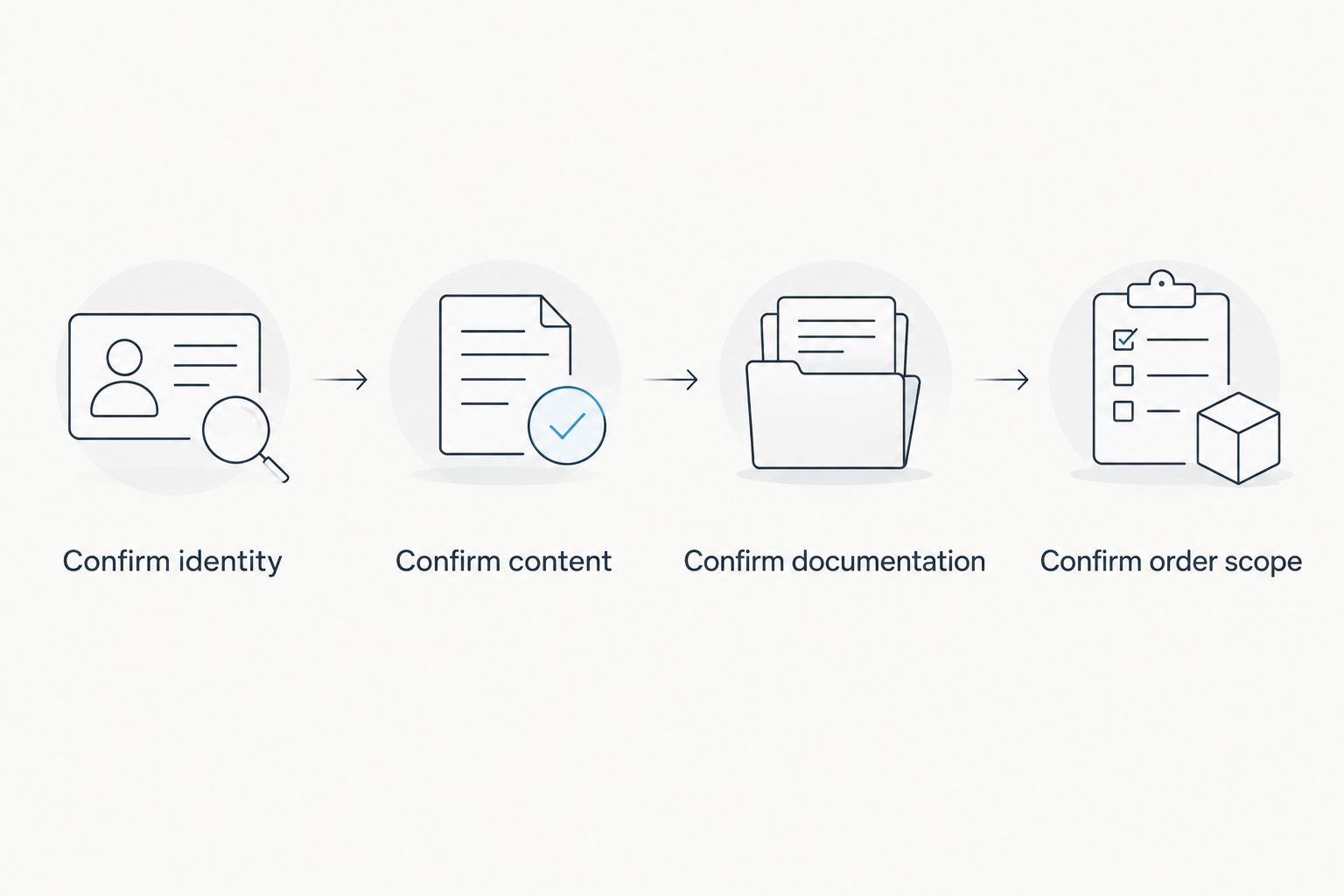
The useful comparison is the same specified material under the same purchasing scope. Check these factors before interpreting differences between quotations:
These are budget-review factors, not a formula for predicting a supplier's quotation. Ask for clarification when the scope differs instead of assigning an unsupported explanation to the difference.
Different quotation formats answer different purchasing questions. None establishes experimental suitability on its own.
| Comparison basis | Best for | Advantage | Limitation |
|---|---|---|---|
| Per vial | Checking a clearly specified item | Simple to reconcile with a purchase order | Misleading when vial content differs |
| Per stated peptide mass | Comparing documented quantities | Puts different fill amounts on a common basis | Depends on what the stated mass represents |
| Complete order | Approving the procurement budget | Includes the defined purchasing scope | Does not include every internal laboratory expense |
| Protocol budget | Planning the experiment | Includes preparation and required verification | Requires laboratory-specific inputs |
Best for purchase approval: the complete order, supported by an item-level specification. Use the protocol budget when deciding whether the experiment is funded. Keep both views rather than asking a per-vial figure to answer every financial question.
Normalizing quotations by stated mass is useful only when the identity and content basis match. If one supplier reports peptide content differently from another, resolve that difference before treating the normalized figures as equivalent.
Purity is an analytical result interpreted through a method. It is not a universal statement about everything in a vial, and it does not independently establish sterility, biological activity, or suitability for administration.
A chromatographic purity result and a quantitative content measurement answer different questions. Read the report's terminology carefully rather than treating the percentage as a direct measurement of all material in the container.
For your 2026 review, ask which method produced the reported result, what sample was tested, and how that sample relates to the supplied lot. Preserve the report alongside the purchasing record so the evidence remains connected to the material.
Celonyxlabs research peptides are best suited to laboratory researchers seeking 99%-pure, third-party-tested materials for research use only. Those stated quality signals support supplier screening; they do not replace compound-specific and lot-specific review. Confirm the documentation relevant to retatrutide rather than extending a general store description to an unverified item.
The peptide purity documentation workflow addresses how to retain that evidence. The purchasing decision should identify which documents were accepted and who reviewed them.
No. A laboratory reagent purchase and a prescribed treatment are different transactions with different purposes. A per-vial research quotation does not describe a patient's treatment expense, and a treatment figure does not establish the specification of research material.
Discussions of tirzepatide costs without insurance concern a patient-payment question, not the procurement basis for a research-grade retatrutide vial. The distinction matters even when both subjects appear in searches about metabolic research compounds.
Do not transfer a monthly treatment figure into a laboratory budget or infer a research-vial quantity from it. Keep the compound, intended use, purchasing unit, and scope explicit throughout your comparison.
Research-use-only labeling is not a treatment recommendation. This article addresses laboratory procurement, not personal use, administration, or clinical decision-making.
Ask the supplier to confirm the exact item, stated content, relevant analytical documentation, and full order scope in writing. Then apply your laboratory's acceptance criteria before authorizing experimental use.
Use this short request as a purchasing checklist:
Celonyxlabs serves laboratory researchers and scientists, but your institution remains responsible for deciding whether a proposed material meets its protocol. Supplier quality statements and institutional acceptance are related checks, not interchangeable approvals.
No. A larger stated fill provides more labeled material, but it does not establish better experimental value. Compare the documented content with the quantity your approved protocol actually requires.
Consider your laboratory's handling plan and whether the relevant stability information supports that plan. Do not assume a generic storage rule establishes how long a particular retatrutide preparation remains suitable.
A purchasing decision should account for usable material, not simply the largest container. Record the basis for that decision in the 2026 project budget so a later reviewer can understand why the selected format matched the work.
No. Third-party testing supplies evidence that your laboratory must assess against its acceptance criteria. Review the test scope, sample identification, and connection to the delivered material before deciding whether additional verification is required.
A third-party report is valuable because it documents specific testing. Its limitation is equally specific: it establishes only what the reported methods and sample support, not every property an experiment might require.
How much does a vial of retatrutide cost for laboratory research?
Use a current supplier quotation for the exact retatrutide item, stated peptide content, and purchasing scope. A generic per-vial figure does not establish a comparable laboratory budget.
What’s the best way to compare retatrutide supplier quotations?
Compare the same compound identity, content basis, analytical evidence, and complete order scope. Resolve specification differences before ranking quotations by their quoted amounts.
Does 99% purity mean a research peptide is sterile?
No, 99% purity does not establish sterility. Review the analytical method and any separate testing required by your laboratory’s intended application.
Is a larger retatrutide vial better value for my laboratory?
A larger vial is not automatically better value. Match its documented content to the approved protocol and handling plan rather than judging value by container size alone.
Can I compare a research vial with a monthly prescription treatment?
No, research-vial procurement and prescribed treatment are different purchasing questions. Keep laboratory materials, patient expenses, and intended uses separate.
Does third-party testing prove a vial meets my experimental requirements?
Third-party testing proves only what the reported sample and methods support. Your laboratory must review whether that evidence meets the protocol’s acceptance criteria.
What should I retain with a research peptide purchase order?
Retain the accepted quotation, item specification, relevant analytical documentation, and lot connection. Add the receiving and approval records required by your institution.
Approve the evidence before approving the purchasing total. A quotation can be financially clear while the material specification remains unresolved. Keep those decisions separate.
For a 2026 Celonyxlabs research peptide purchase, record what the supplied documentation establishes and what your laboratory still needs to verify. That record makes the eventual budget defensible without turning a general quality statement into an unsupported retatrutide claim.
For research use only. Not for human or veterinary use.
The advice you'll hear most often about buying BPC-157 for the bench is short: demand

Can cagrilintide be combined with GLP-1 peptides? Yes, in controlled research. Understand mechanisms, study controls,

Can Selank be combined with nootropic peptides? Yes, in controlled laboratory studies. Learn the controls,
FOR RESEARCH USE ONLY. Products sold by Celonyx Labs are intended exclusively for laboratory and scientific research. They are not intended for human or veterinary use, consumption, diagnosis, treatment, cure, or prevention of any disease. By purchasing from this site, you acknowledge that you understand the intended research purpose of these materials and agree to comply with all applicable laws and regulations.