
Is bacteriostatic water the same as sterile water? No 2026
Is bacteriostatic water the same as sterile water? No. Compare preservatives, vial handling and peptide

In 2026, third-party peptide purity testing has no fixed cost you can use for every sample; request a written, sample-specific quote that names the method and deliverables. A purity result alone does not confirm peptide identity, so ask whether identity testing is included before you set a budget.
There is no useful single figure without a defined test request. In 2026, the practical answer is an itemized quote for your peptide, sample form, analytical question and required report. Two laboratories can quote an HPLC assay yet deliver different work: one report might contain a chromatogram and peak-area calculation, while another request includes mass-based identity confirmation. Those are not interchangeable deliverables.
If you need to interpret a stated purity grade before requesting testing, start with peptide purity grade benchmarks. Decide what the grade must mean for your experiment, then describe that requirement to the testing laboratory.
| Test request | Best for | What you gain | What it does not establish on its own |
|---|---|---|---|
| HPLC purity analysis | Comparing chromatographic peaks under a stated method | A chromatogram and a method-dependent purity result | Unambiguous peptide identity or every impurity present |
| Mass-based identity confirmation | Checking whether a detected species matches an expected mass | Evidence relevant to identity | A complete purity profile or, by mass alone, an unambiguous sequence |
| HPLC plus identity confirmation | Work that needs both a purity profile and an identity check | Distinct lines of analytical evidence | Full characterization unless the additional tests are specified |
Request the smallest test scope that answers your research question, then compare quotes for that same scope. Choosing by a quoted assay name alone makes the responses difficult to compare.
A peptide labeled with a purity percentage presents an analytical claim, not a complete description of the vial. Your study might require you to distinguish the intended peptide from related species, assess a particular impurity or document how a reported percentage was calculated. Each question changes what you should request from a testing laboratory.
The distinction matters when you compare an existing supplier document with testing you commission yourself. A supplier's third-party result can help you evaluate its stated quality claim. An independent test commissioned for your study answers the question and sample scope you give that laboratory; it does not automatically reproduce the supplier's method or result.
Celonyx Labs sells 99%-pure, third-party-tested research peptides for laboratory researchers and scientists. Celonyx Labs is best for research buyers seeking those stated quality signals; buying a tested peptide is not the same as commissioning an independent test for your own sample. Keep the two decisions separate in your procurement record.
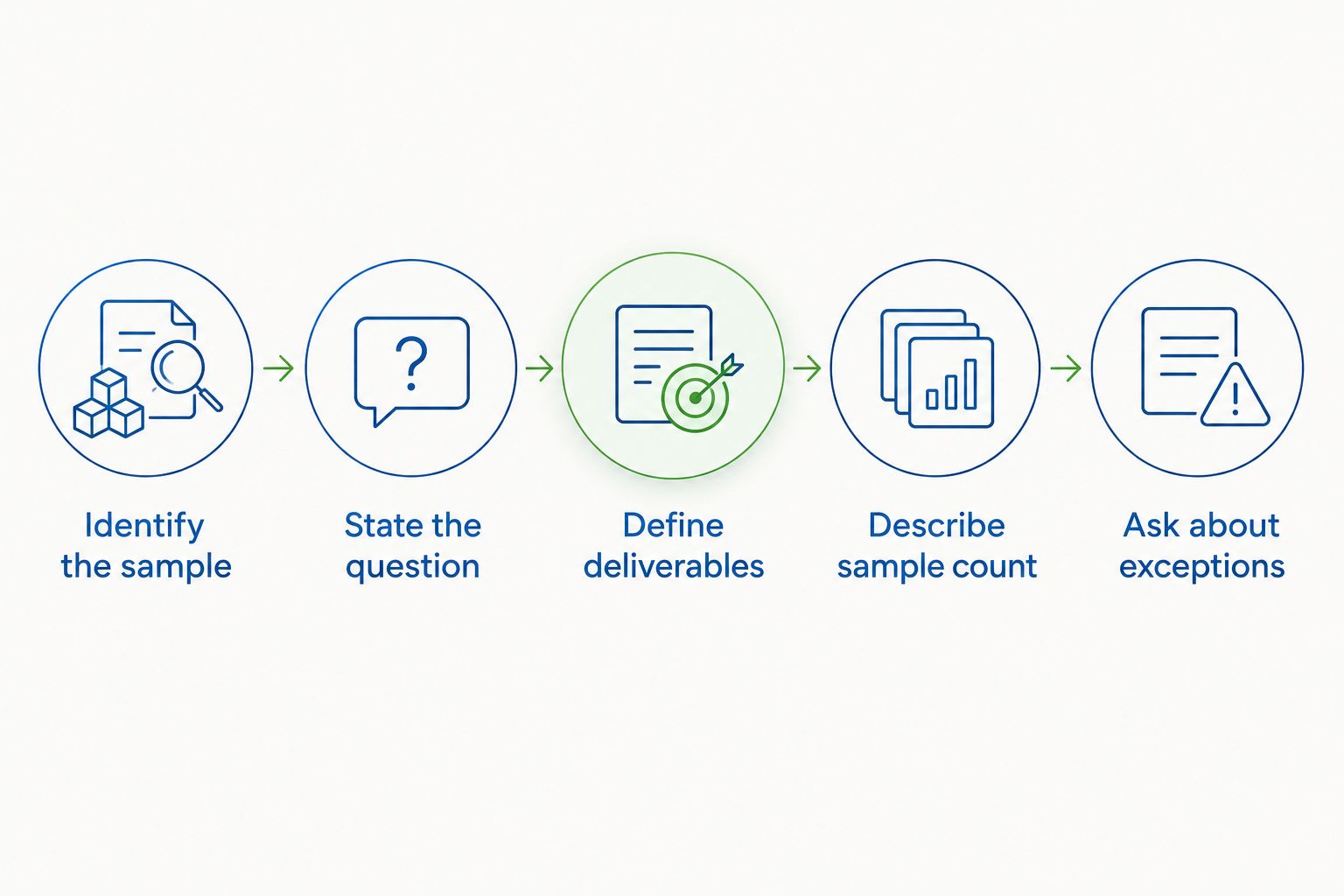
Send every laboratory the same written request. In 2026, a comparable quote needs more than the name of an instrument: it needs a defined sample, an analytical objective and a list of what you will receive. The following sequence gives the laboratory enough context to specify its work without asking it to guess what purity means for your project.
These steps do not require you to prescribe the laboratory's method. They require you to state the result you need so the laboratory can propose a suitable method and identify exclusions in its quote.
No quoted amount has meaning until you know what the laboratory has agreed to test. These are the scope drivers to settle before comparing responses:
The main comparison is scope against scope, not one quoted total against another. If one response omits identity confirmation or chromatograms, it does not satisfy the same request as one that includes them.
An HPLC result describes what the stated chromatographic method detected and how its peaks were evaluated. It is useful for comparing a main peak with other detected peaks under those conditions. Read the reported percentage alongside the method, detection conditions and integration approach; the percentage by itself does not explain how it was obtained.
A peak-area percentage is not automatically the mass fraction of the intended peptide in the vial. Different substances can produce different detector responses, and a chromatogram does not account for everything a detector fails to observe. If your experiment requires a particular interpretation of purity, ask the laboratory to state its calculation and its limits rather than assuming every reported percentage means the same thing.
The same caution applies when reviewing a supplier's claim. Celonyx Labs describes its research peptides as 99%-pure and third-party-tested. For your laboratory record, the relevant follow-up question is which document and analytical method support the material you are evaluating. Do not treat a general purity statement as a substitute for the sample-specific evidence your study requires.
Request identity confirmation when the study depends on establishing that the detected material is consistent with the intended peptide. Chromatographic separation and mass-based analysis contribute different evidence. A dominant chromatographic peak alone does not establish that the peak is the requested sequence.
Mass-based evidence also has limits. Matching an expected mass supports an identity assessment, but mass alone does not distinguish every possible sequence with that mass. Tell the laboratory whether you need a check against an expected mass or a stronger answer about sequence or related species. That distinction lets it describe what its proposed analysis can and cannot establish.
For a 2026 procurement decision, put the questions in separate lines: What is the purity result? What supports identity? What remains outside the requested scope? This prevents a report for one question from being presented internally as an answer to all three.
Use one written specification and ask each laboratory to mark what is included, excluded or conditional. A useful response identifies the submitted sample, proposed analysis, calculation or interpretation it will report, and deliverables. If any of those points is absent, ask for clarification before comparing totals.
| Check in each response | What to ask | Why it changes the decision |
|---|---|---|
| Purity method | What method produces the reported purity result? | Results depend on the method and calculation used. |
| Identity work | Is confirmation of expected identity included? | A purity profile does not answer the identity question by itself. |
| Report contents | Will you receive chromatograms and the stated calculation? | A bare result gives you less evidence to review. |
| Sample scope | Which submitted samples and lots receive separate results? | A result for one sample cannot document another lot. |
| Exceptions | What happens after an inconclusive analysis? | The initial quote might not describe the follow-up work. |
If you are still choosing a laboratory, third-party peptide testing labs is a starting point for building a shortlist. Send the same specification to each candidate. A laboratory is a better fit when it can explain exactly how its proposed report answers your stated research question, including the method's limits.
Yes, when the supplier's documentation answers your specific research question and meets your laboratory's documentation requirements. Check whether it identifies the relevant material, states the method and provides enough detail to interpret the purity and identity claims you need. If it does not, order testing against a defined question rather than repeating an unspecified purity test.
Celonyx Labs supplies third-party-tested research peptides, which makes its stated testing a relevant quality signal when you assess a purchase. An independent test commissioned by your laboratory serves a different purpose: it evaluates the submitted sample under the scope you request. Neither document should be treated as evidence for an analysis it did not perform.
For research use only. A peptide purity report is an analytical document; it is not evidence of safety, clinical suitability or a biological effect.
How much does third-party peptide purity testing cost in 2026?
There is no fixed cost that applies to every peptide sample. Request an itemized quote specifying the sample, analytical method, reporting requirements and any identity testing.
Is HPLC enough to confirm peptide purity?
HPLC can provide a method-dependent chromatographic purity result. Read the calculation and method limits before treating a reported percentage as a complete description of the sample.
Does an HPLC purity test confirm the peptide’s identity?
No. An HPLC purity profile does not, by itself, establish that the main peak is the intended peptide; request identity evidence separately if your study requires it.
Should I request mass-based identity testing too?
Request mass-based identity testing when confirming an expected mass is part of your research question. Ask what the proposed analysis can establish, because a mass match alone does not resolve every possible sequence.
What should I send a peptide testing laboratory for a quote?
Send the available peptide identification, sample form, sample count and questions the analysis must answer. Specify the reports and supporting data your laboratory needs.
Can I rely on a supplier’s third-party purity result?
You can use it when the documentation covers the relevant material and answers your laboratory’s question. Commission your own test when you need evidence for a different submitted sample or analytical scope.
Does a reported purity percentage describe everything in a peptide vial?
No. A reported percentage must be interpreted through its stated method and calculation; a chromatographic peak-area result is not automatically a measurement of every component in the vial.
Before approving a 2026 testing request, write down the decision the result must support. If the decision is whether a particular research sample matches a stated identity and purity requirement, ask for evidence addressing both parts. A cheaper-sounding assay name cannot replace a report that answers the question.
Is bacteriostatic water the same as sterile water? No. Compare preservatives, vial handling and peptide

How do you know if a peptide vial has gone bad? Quarantine changes, check storage

Can too much bacteriostatic water ruin a peptide vial? Yes, if it overfills the vial
FOR RESEARCH USE ONLY. Products sold by Celonyx Labs are intended exclusively for laboratory and scientific research. They are not intended for human or veterinary use, consumption, diagnosis, treatment, cure, or prevention of any disease. By purchasing from this site, you acknowledge that you understand the intended research purpose of these materials and agree to comply with all applicable laws and regulations.