

Integrity Research BPC 157: How to Judge Vendor Claims
The advice you'll hear most often about buying BPC-157 for the bench is short: demand
N-acetyl Semax amidate is the doubly terminal-modified heptapeptide Ac–Met–Glu–His–Phe–Pro–Gly–Pro–NH₂, with an average molecular mass near 855.0 Da, and the human and animal efficacy results that get attached to its name were generated with unmodified Semax, not with this analog. The two caps add about 41.03 Da to the parent chain, and that mass shift is one of the few facts about the molecule a laboratory can verify on the bench.
The advice you'll meet most often goes like this: the acetyl group and the amide group are a delivery upgrade, so N-acetyl Semax amidate is Semax with a longer window and a stronger effect. Use the same protocol, expect more.
That framing fails on both chemistry and evidence. Capping the ends of a peptide does slow the enzymes that chew peptides from their termini, but the same caps also change how the molecule ionizes, how it dissolves, how it distributes and how it presents itself to a receptor. Stability is a property of the molecule in a buffer. Efficacy is a property of a biological system responding to it, and nothing about the first guarantees the second.
What follows is a laboratory-facing guide to keeping those two ideas apart, from the sequence and mass on a certificate through the parent-molecule literature to the documents a batch should carry before it enters your freezer.
The name isn't a marketing suffix bolted onto Semax. It describes two specific chemical changes at the two ends of an otherwise identical seven-residue chain, and those changes are what a specification sheet has to prove before anyone treats the material as a known quantity. Technical documentation for the capped peptide describes a doubly terminal-modified heptapeptide with the sequence Ac–Met–Glu–His–Phe–Pro–Gly–Pro–NH₂, molecular formula C₃₉H₅₄N₁₀O₁₀S, and an average molecular mass near 855.0 Da, roughly 41.03 Da heavier than Semax.
Note where that extra mass sits. N-terminal acetylation replaces the free alpha-amino group, and C-terminal amidation replaces the free carboxyl group. Both changes are at the termini, not in the core, which is why the two molecules get studied as close relatives, and also why people assume they behave identically.
Free peptide termini are common substrates or recognition elements for aminopeptidases and carboxypeptidases, so capping both ends can reduce exopeptidase-driven degradation. That's a claim about one family of enzymes under one set of conditions. It says nothing about endoproteases, oxidation, adsorption to plastic, or hydrolysis in your buffer.
Eight checks carry the identity of this molecule. Print them beside any certificate you receive and compare cell by cell.
Identity specifications for N-acetyl Semax amidate
| Specification | Expected value | What a mismatch means |
|---|---|---|
| Sequence | Ac–Met–Glu–His–Phe–Pro–Gly–Pro–NH₂ | A different sequence is a different peptide |
| Length | Heptapeptide, 7 residues | Truncation or an extra residue fails identity |
| N-terminus | Acetyl in place of the free alpha-amino group | Free N-terminus is unmodified or only partly capped Semax |
| C-terminus | Amide in place of the free carboxyl | Free acid is not the amidate |
| Molecular formula | C₃₉H₅₄N₁₀O₁₀S | Formula drift signals a different modification set |
| Average mass | Near 855.0 Da | Use this mass, not the parent Semax mass, for dose calculations |
| Mass versus Semax | About +41.03 Da | Missing this shift means one or both caps are absent |
| Oxidation marker | About +16 Da methionine sulfoxide | A +16 species is a related impurity, not the parent ion |
One residue deserves its own line on your worksheet. The methionine in the chain oxidizes to methionine sulfoxide, a characteristic +16-Da product that appears in the same mass window you're using to confirm the parent ion. Reported technical descriptions name both the 855.0-Da parent ion and methionine-sulfoxide monitoring as quality-control targets for this material.
That's why a single purity percentage is a weak instrument. Reversed-phase HPLC estimates chromatographic purity and separates related impurities, while ESI-MS verifies the expected molecular mass and can reveal oxidation or truncation products. Run them as a pair, because they answer different questions.
A nominal claim of 99% purity isn't sufficient without the chromatogram, the integration method, the mass spectrum, the test date and the batch identifier. Those five items turn a number into evidence.
The practical check is blunt. A vial labeled only Semax, or labeled only acetylated, or labeled only amidated, is a different test article. Don't log it under this name.
A result belongs first to the molecule tested. A literature-oriented review of the acetylated and amidated form reports that published research on this derivative is limited to in-vitro chemistry and stability work. It does not establish that findings from unmodified Semax apply to the capped analog.
Treat parent-Semax results as indirect context, not validation of this molecule's pharmacology, efficacy, pharmacokinetics, or safety.
The matrix separates evidence about the exact analog from evidence about unmodified Semax and from claims that remain hypotheses.
Evidence matrix for the capped analog versus Semax
| Claim | Exact analog | Unmodified Semax | How to label it |
|---|---|---|---|
| Published or registered human studies | No such studies identified in the cited review | Human stroke studies exist for the parent | Do not transfer |
| Animal efficacy or pharmacology papers on the exact molecule | None identified in the cited review | Parent literature is separate | Do not transfer |
| In-vitro chemistry and stability | Limited published chemistry and stability work | Not a substitute for analog data | Exact-analog, narrow scope |
| Human pharmacokinetics, toxicology, reproductive safety, long-term safety | No such studies identified in the cited review | Not evidence for this analog | Evidence gap |
| BDNF increase and functional recovery after stroke | Not shown for this molecule | Reported in parent Semax studies | Parent evidence only |
| Longer duration, higher potency, or predictable half-life | Unvalidated | Not established by the caps alone | Hypothesis |
| Neuroprotection, cognition, or stroke-recovery dosing | Not clinically established | Parent studies used their own doses | Do not extrapolate |
Consider the claim that the peptide “upregulates BDNF and supports recovery after ischemic stroke.” First check which molecule the cited study tested. If it used unmodified Semax, label the finding as parent-compound evidence. That distinction determines what a new experiment can reasonably test.
Terminal modifications may change biological behavior. Adding an N-terminal acetyl group and a C-terminal amide could affect enzymatic stability, tissue distribution, receptor binding, immunogenicity, or nasal absorption. A stability effect is a chemical rationale, not proof of a change in any of those outcomes.
The claim that needs the most caution: greater proteolytic stability does not establish greater efficacy or a predictable half-life. A peptide may persist longer in a buffer yet fail to reach or affect the tissue under study.
For preclinical work, record the test article's exact identity and modification sites, along with its analytical characterization, purity, and batch information. Keep claims about neuroprotection, cognition, BDNF signaling, stroke recovery, and dosing separate from evidence on unmodified Semax. Otherwise, a negative or irreproducible result can leave two explanations tangled: the hypothesis may be wrong, or the molecule may not behave like the parent.
The clinical findings most often cited for Semax concern the unmodified parent peptide, not N-acetyl Semax amidate. Their value is in showing which outcomes researchers examined, not in establishing effects for a differently capped molecule.
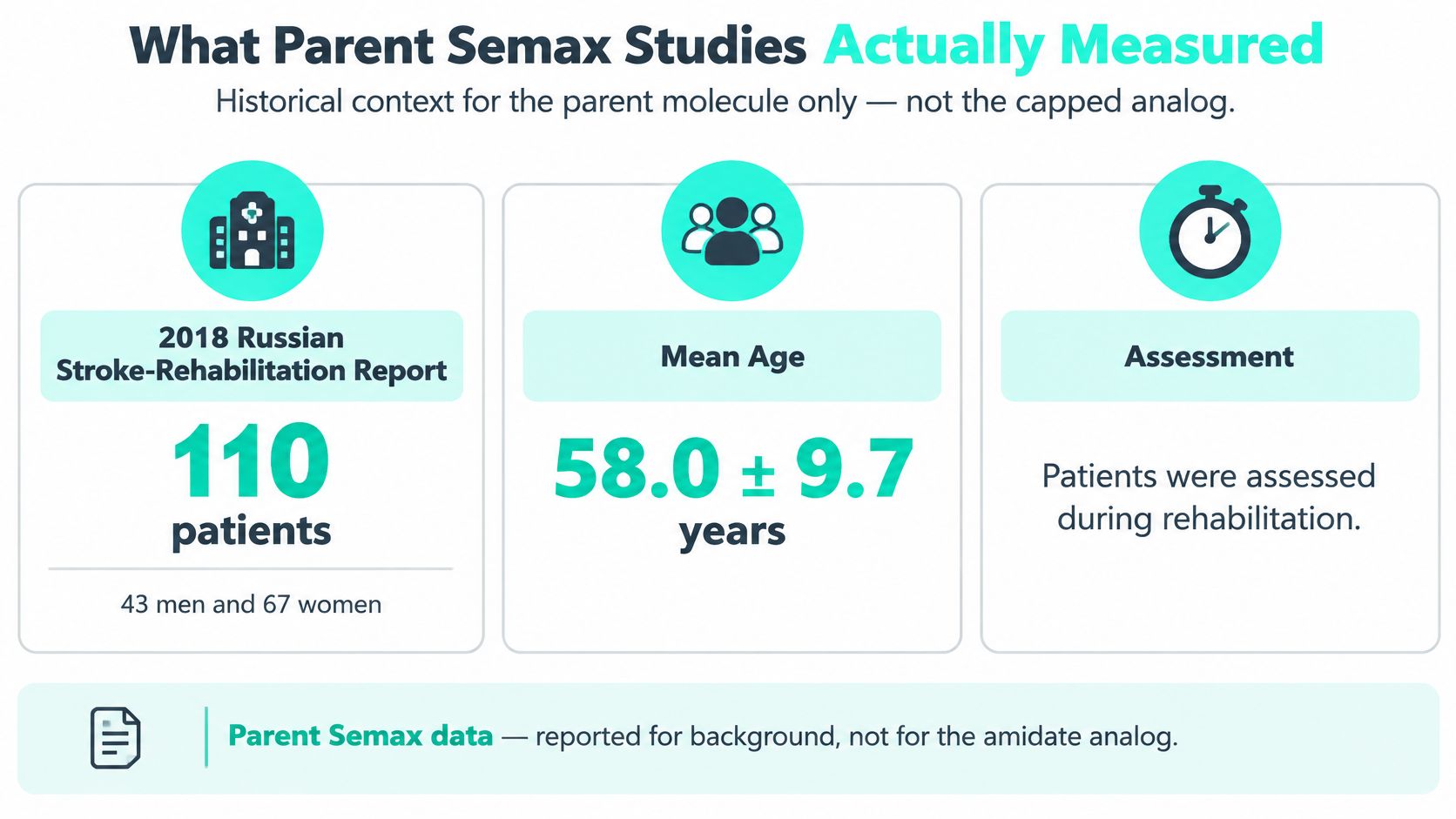
A reported 2018 Russian stroke-rehabilitation study included 110 patients, 43 men and 67 women, with a mean age of 58.0 ± 9.7 years. Participants were assessed in early or late rehabilitation after ischemic stroke, and received Semax in two 10-day courses at 6,000 micrograms per day (reference summary of the parent-compound data).
The report described increased plasma brain-derived neurotrophic factor (BDNF) and associations between treatment and functional recovery. These findings came from a rehabilitation cohort, not a large international randomized, blinded, placebo-controlled trial. They identify outcomes for further study; they do not settle whether Semax caused the observed recovery.
An early clinical and electrophysiological study examined parent Semax in acute ischemic stroke, with a comparison group receiving conventional treatment. It provides historical context for research on Semax and stroke, but does not establish an effect for the acetylated amidated analog.
These reports show that parent-Semax research examined neurotrophin readouts and functional scores. They offer hypotheses for study, while leaving pharmacokinetic evidence comparatively thin.
They do not provide dose, exposure, or safety values for N-acetyl Semax amidate. Transferring a parent-Semax dose to the modified molecule, whose stated mass is about 855 Da, would treat two distinct test articles as interchangeable.
A preclinical design can include vehicle and parent-Semax comparators, with measurements tied to the specific molecule under study. Stability alone does not establish biological activity.
Think of the two ends of a peptide as handles. Aminopeptidases grab the free N-terminus, carboxypeptidases grab the free C-terminus, and both work inward one residue at a time. Acetylation covers the first handle and amidation seals the second, so the two most common entry points for exopeptidase attack are gone.
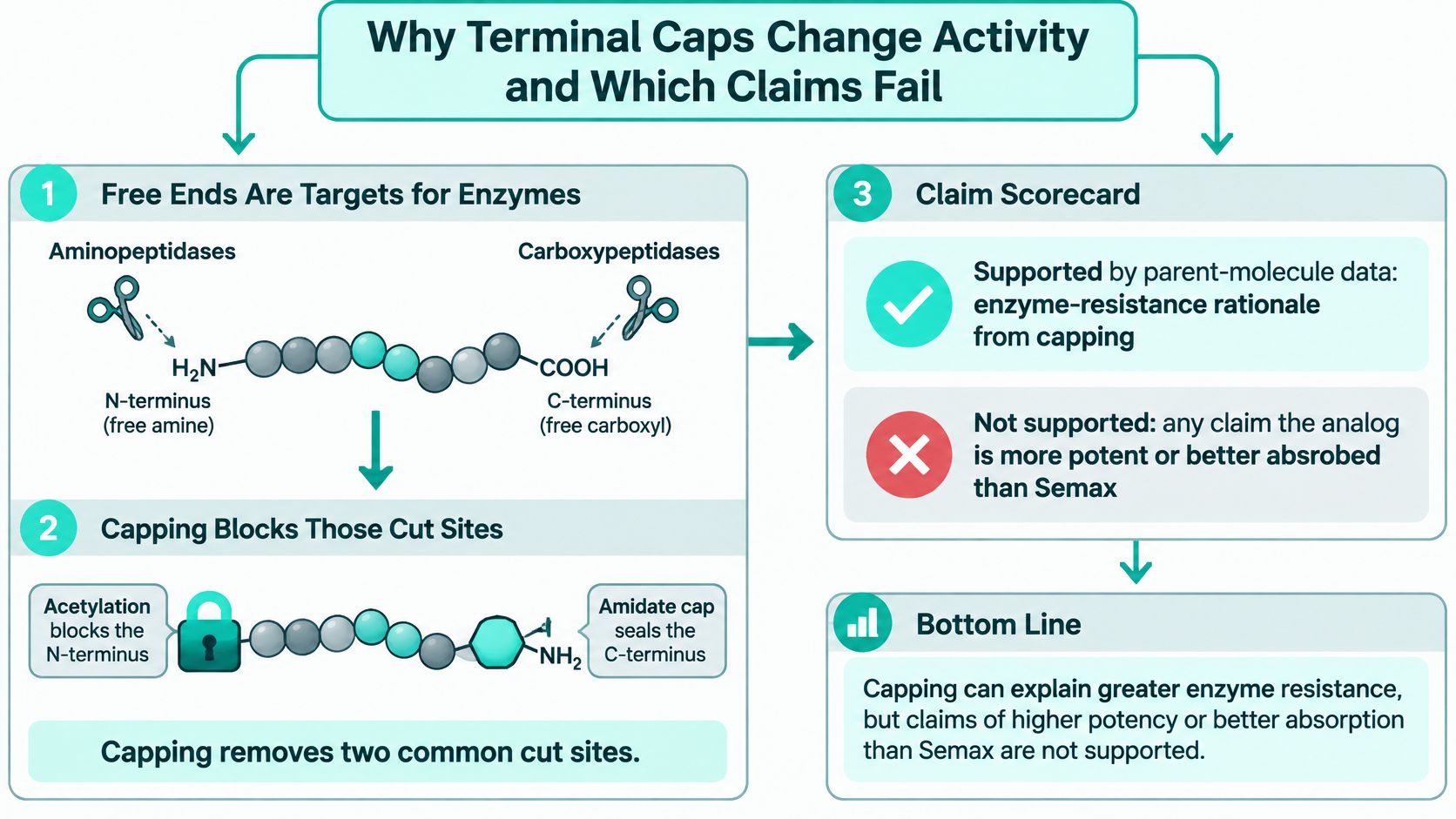
That's the whole stability rationale, and it's a sound one. It's also narrower than most product pages imply. Capping doesn't prove resistance to endoproteases that cut mid-chain, to oxidation, to adsorption on plastic, or to hydrolysis at a particular buffer, pH and temperature.
Terminal capping shifts ionization, so solubility and chromatographic retention can move even though the seven-residue core looks familiar under the HPLC method you used for the parent. The same acid-base questions that govern acetic acid handling in peptide work apply to whatever vehicle you choose here.
The biological consequences run wider than duration. Tissue distribution, receptor binding, immunogenicity and nasal absorption can all shift when the termini change. That leaves three possible outcomes, not one. Activity could rise, fall, or change shape.
The evidence on this point is thin but pointed. A review of the analog's research status cites a reported laboratory finding in which N-terminal acetylation was associated with loss of a protective effect in nerve-like cells. That finding doesn't define the behavior of the fully amidated molecule. It does show that a cap can change what a peptide does, not merely how long it lasts.
For a spoken overview of how these modified analogs get discussed in research settings, this walkthrough covers the terminology and the structural claims:
Notebook rule: write "parent Semax" beside every parent-derived claim and "hypothesis" beside every transfer. Six months from now, that's the difference between a finding and a guess.
Treat this material as its own test article rather than a variant of a familiar one. Technical summaries of the analog describe the structure and the intended stability rationale, and they report no peer-reviewed clinical trials, with limited or no direct model testing, specific to it. Claims about improved potency, brain exposure, neurotrophin regulation, cognitive effects or human safety therefore remain unvalidated for this exact molecule.
Any biological result should sit beside three controls, not one. Vehicle rules out the buffer. Parent Semax tells you whether the caps changed anything at all. An oxidation or degradation control, where the mechanism makes it relevant, separates a real structural effect from an impurity difference.
Without that trio, an apparent effect can reflect a concentration error or a related impurity rather than the acetylated amidated structure. That's the failure mode worth designing against.
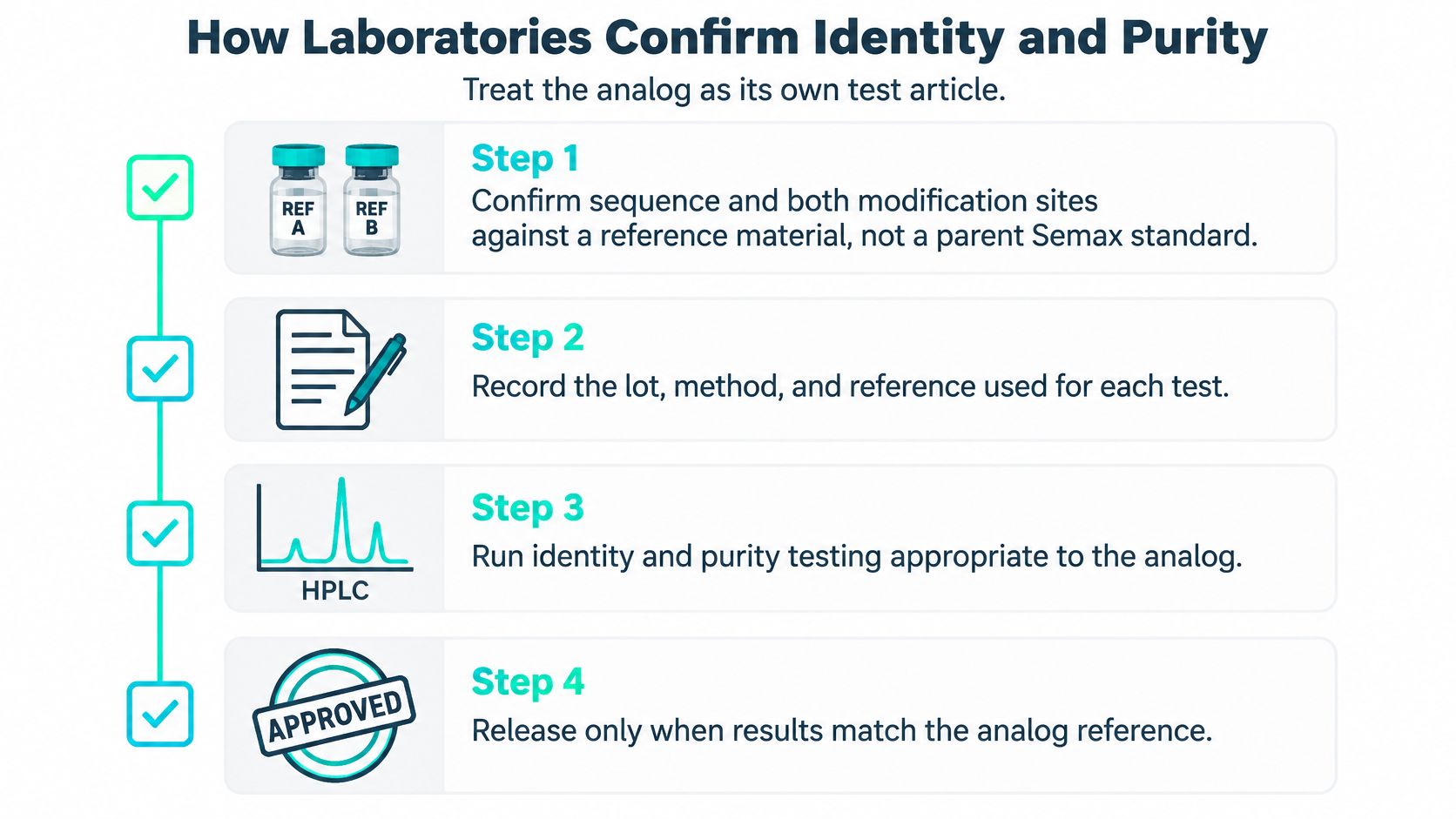
The field list is short and fixed: a lot number matching the vial, a test date, the HPLC or UPLC method used, and mass-spectrometry identity run on that same batch. Nothing aggregated, nothing from a sister lot. If you need a reference for what those documents should include, this guide to research peptide certificate of analysis documentation walks through the analytical fields.
Before the vial is opened, record the storage temperature, solvent and pH stated on the certificate or handling sheet. If none is stated, treat storage conditions as unknown and run the time-zero and endpoint checks before any biological use.
A vial belongs in the study only when its identity and batch records agree. Check that the product name, sequence (Ac–Met–Glu–His–Phe–Pro–Gly–Pro–NH₂), both terminal modifications, and approximate mass of 855.0 Da match the documentation for that lot. If any detail is missing or inconsistent, quarantine the vial.
Ask the supplier for the exact sequence in stock, batch-specific HPLC and mass-spectrometry records for the lot, its test date, and its batch identifier. A product listing identifies what is offered, but it does not establish the identity of a particular vial. A peptide certificate of analysis checklist can help you specify the information your lab needs.
Celonyx Labs sells Semax 5mg for $35.95, and its research peptides are labeled For Research Use Only. Record the Semax listing separately from the acetylated amidate: the parent molecule and the capped analog are distinct test articles.
Record the material as an experimental research product, not as a clinically established therapy. It is not for human consumption, medical use, veterinary use, or therapeutic applications. Keep the purchase within a laboratory research protocol, and enter the vial under the capped-analog name only when the sequence, modifications, and mass are consistent with its batch records.
Accept rule, in one line: accept only when the name, sequence, both caps, and approximate 855.0-Da mass match records for the same lot. Otherwise, quarantine the vial.
Celonyx Labs supplies research peptides for laboratory study, and its products are labeled For Research Use Only. For Semax or a terminally modified analog, confirm the specific product listing and request the batch records your protocol requires before ordering.
The advice you'll hear most often about buying BPC-157 for the bench is short: demand

Can cagrilintide be combined with GLP-1 peptides? Yes, in controlled research. Understand mechanisms, study controls,

Can Selank be combined with nootropic peptides? Yes, in controlled laboratory studies. Learn the controls,
FOR RESEARCH USE ONLY. Products sold by Celonyx Labs are intended exclusively for laboratory and scientific research. They are not intended for human or veterinary use, consumption, diagnosis, treatment, cure, or prevention of any disease. By purchasing from this site, you acknowledge that you understand the intended research purpose of these materials and agree to comply with all applicable laws and regulations.