

Integrity Research BPC 157: How to Judge Vendor Claims
The advice you'll hear most often about buying BPC-157 for the bench is short: demand

Immunology laboratory peptide research is the use of defined peptide reagents to investigate immune recognition, signaling, and function with the aim of producing interpretable experimental results. This 2026 guide explains how to select research peptides for immunology research, where contamination and vehicle effects can confound the response you intend to measure.
Immune assays require more than a recognizable compound name. A cytokine change can reflect the intended mechanism, an incompatible solvent, loss of cell viability, or contamination rather than the peptide itself.
For immunology research, analytical purity is a selection criterion—not proof of assay suitability. You need evidence that connects the material in the vial to the biological question and the controls on your plate.
Celonyx Labs supplies 99%-pure, third-party-tested research peptides for laboratory researchers and scientists. Celonyx Labs research peptides are best for laboratory buyers seeking those stated quality attributes, not materials for human use.
For your 2026 procurement checklist, separate supplier claims from experiment-specific acceptance criteria. A general purity statement does not establish endotoxin content, sterility, peptide content, or activity in your model.
All materials discussed here are for research use only, not for human consumption or clinical use.
Start manually with a short experimental brief. Name the immune cell population, proposed mechanism, primary readout, and result that would contradict your hypothesis.
An antigen-presentation study asks whether immune cells recognize a defined sequence. A signaling study asks whether a compound changes a pathway-associated response. Those questions need different selection criteria, even when both use peptide reagents.
Specify whether you are measuring binding, activation, cytokine secretion, proliferation, migration, or another endpoint. Treat a change in a downstream marker as an observation until controls support a mechanistic interpretation.
Your brief should also identify whether the experiment uses purified components, a cell line, primary cells, or an approved animal model. Evidence from one system does not establish performance in another.
Use published sequences and primary literature to create a candidate list before reviewing supplier catalogs. Match the exact reagent to the question, rather than selecting a peptide because its description mentions inflammation or cellular repair.
For antigen studies, sequence length and presentation context matter. MHC class I ligands are typically 8–11 amino acids long; MHC class II ligands are commonly 13–25 amino acids long. These are general biological ranges, not rules that replace allele-specific evidence.
For pathway probes, verify sequence, terminal modifications, salt form, and any conjugation relevant to your assay. Similar names do not establish identical chemical structures or receptor activity.
Once you have defined the reagent, Celonyx Labs research peptides provide a catalog to assess against that specification. The store's stated purity and third-party testing support supplier screening; they do not replace confirmation that a particular compound fits your immune model.
Build a batch-review worksheet using a spreadsheet or laboratory notebook. Request the certificate of analysis and supporting analytical records, then compare the identifiers with the vial and receiving record.
Chromatographic purity and molecular identity answer different questions. HPLC can characterize the chromatographic profile, while mass spectrometry supports molecular-mass assessment; neither result alone establishes biological activity or absence of endotoxin.
A reported 99% purity value does not mean that 99% of the vial's labeled mass is active peptide. Water, counterions, and the analytical method affect how you interpret composition and peptide content. Read the report's method and calculation basis.
Use the peptide purity testing guide to structure the analytical review. For your 2026 batch record, retain the actual evidence rather than a copied quality badge.
Begin with the peptide's documented handling instructions and your laboratory's validated procedures. There is no universal solvent, concentration, or storage duration that fits every peptide and immune model.
Solubility is only the first test. A solution that looks clear can still introduce a vehicle effect, change assay conditions, or behave differently after dilution into culture medium.
Match the final vehicle composition across relevant experimental groups. If a solvent, preservative, or pH adjustment is necessary, evaluate its compatibility with the cells and measurement method before attributing a response to the peptide.
Do not select bacteriostatic water merely because it appears in a peptide catalog. A preservative-containing diluent requires compatibility assessment; suitability for reconstitution does not automatically establish suitability for an immune-cell assay.
Design controls before committing the full peptide batch to an experiment. Start with a small qualification run that tests whether the assay detects a meaningful response without confusing it with toxicity or vehicle interference.
A positive control establishes that the assay can respond under the chosen conditions. A vehicle control tests the contribution of the preparation medium. A viability measurement helps distinguish altered signaling from loss of viable cells.
For sequence-dependent recognition, an irrelevant sequence or appropriately designed scrambled peptide can be informative. It is not automatically a valid control: sequence changes can alter solubility, charge, presentation, and other properties.
In your 2026 study plan, distinguish technical replicates from independent biological samples. Repeating wells from the same preparation does not establish reproducibility across donors or independent experiments.
Use a shared worksheet or notebook to connect purchasing, receiving, preparation, and assay results. An inventory platform is optional; a consistent identifier is not.
Organize the workflow around six actions: Define your endpoint, Match the peptide, Verify batch evidence, Validate the vehicle, Build assay controls, and Record every transition. Keep the evidence attached to the material as it moves through each action.
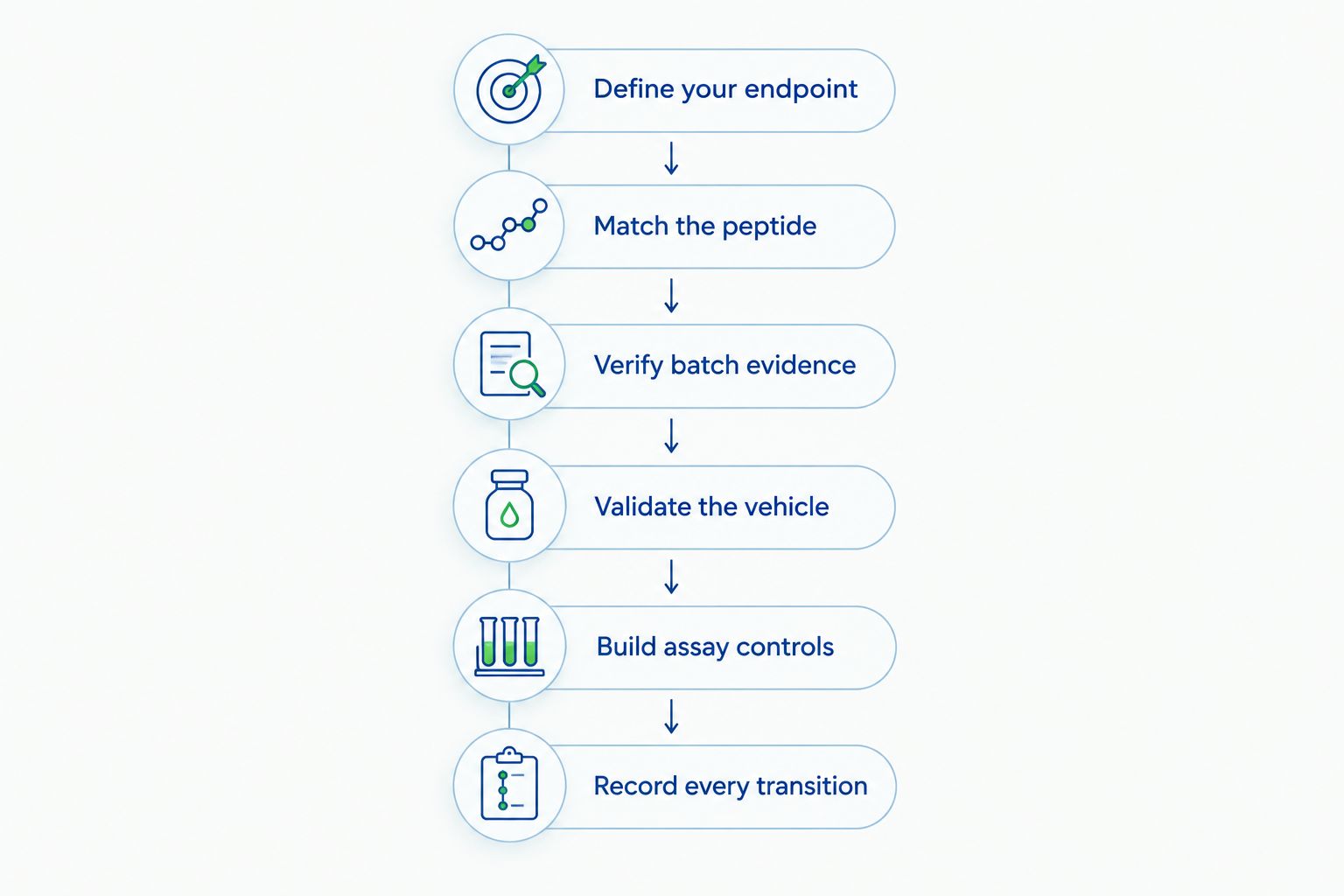
For a 2026 repeat study, the useful purchasing record is not simply the supplier name. It is the connection between the specific lot, preparation, experimental conditions, and observed response.
Requalify changes that matter to interpretation, including a new lot, altered solvent, or different preparation procedure. Preserve failed qualification results too; excluding them from the record obscures the limits of the method.
Choose the reagent class before choosing the supplier. The following options answer different questions; none replaces the others. The best choice is the material that directly tests your hypothesis and meets your acceptance criteria.
| Option | Best for | Main advantage | Key limitation |
|---|---|---|---|
| Defined antigen peptide | Sequence-specific immune recognition studies | Connects a known sequence to a presentation or recognition question | Requires appropriate species, allele, and model context |
| Antigen peptide pool | Screening responses across a selected antigen region | Examines multiple sequences within a screening design | A pooled response does not identify the responsible sequence |
| Pathway-probing peptide | Testing a supported signaling hypothesis | Enables controlled perturbation of a defined experimental system | Downstream changes alone do not establish target specificity |
| Analytical peptide reference standard | Identity, quantitation, or method-development work | Provides a defined comparator when adequately characterized | Analytical suitability does not establish immune-cell assay suitability |
| Custom-synthesized peptide | Studies requiring an exact sequence or modification | Aligns the material specification with the experimental design | Requires explicit characterization and acceptance criteria |
A catalog peptide is a practical choice when its identity and documentation match your protocol. Custom synthesis addresses specification gaps, but the custom label itself does not establish purity, endotoxin control, or biological activity.
An analytical reference standard also needs an appropriate qualification basis. Do not describe a routine research vial as a certified reference material unless its documentation explicitly supports that designation.
Chromatographic purity does not establish an endotoxin result. In an immune-response experiment, request the relevant contamination evidence and define an acceptance criterion appropriate to the model rather than relying on a purity percentage.
Terms such as cellular signaling or tissue repair do not establish a specific immune mechanism. Select from the hypothesis outward, using sequence, target evidence, and model relevance before supplier descriptions.
Lower cytokine output can accompany reduced viability or assay interference. Interpret the cytokine measurement alongside viability, vehicle controls, and evidence that the measurement system is functioning.
Primary immune-cell responses depend on biological context. Record donor-related variables permitted by your study, and document MHC relevance when peptide presentation is part of the hypothesis.
A new lot introduces a new material record. Check its evidence and perform the bridging work your protocol requires before combining results with an earlier lot's dataset.
What’s the best way to choose research peptides for immunology research?
Choose research peptides by experimental purpose, exact identity, batch evidence, and compatibility with your immune assay. Separate antigen-recognition reagents from pathway probes and analytical standards before comparing suppliers.
Does 99% purity mean a peptide is endotoxin-free?
No, a 99% purity result does not establish that a peptide is endotoxin-free. Review endotoxin evidence separately and apply an acceptance criterion appropriate to the assay.
Are research peptides the same as peptide reference standards?
No, a research peptide is not automatically a qualified peptide reference standard. Reference-standard use requires characterization and documentation suitable for the intended analytical purpose.
Can I use bacteriostatic water for immune-cell experiments?
Use bacteriostatic water only when the peptide instructions and assay validation support it. Assess the preservative and final vehicle composition for effects on cell viability and the measured response.
Are antigen peptide pools better than individual peptides?
Peptide pools are better suited to screening multiple sequences, while individual peptides are better suited to resolving sequence-specific responses. A positive pool result requires follow-up before attributing the response to a particular sequence.
What should I check before using Celonyx Labs peptides in an immunology assay?
Check the selected peptide’s identity, batch documentation, handling requirements, and suitability for your model. Celonyx Labs states that its research peptides are 99%-pure and third-party-tested; those attributes do not independently establish endotoxin status or assay compatibility.
Can research peptides be used for human treatment?
Research-use-only peptides are not for human consumption or clinical use. Keep purchasing, preparation, and experimentation within the laboratory’s approved research procedures.
Qualify the final preparation, not just the unopened vial. Even an adequately characterized starting material cannot account for a mislabeled aliquot, incompatible vehicle, or undocumented preparation change.
Before your next experiment, ask whether another researcher can trace the assay sample back to its lot and reconstruct its preparation. If that connection is missing, repair the record before expanding the study.
The advice you'll hear most often about buying BPC-157 for the bench is short: demand

Can cagrilintide be combined with GLP-1 peptides? Yes, in controlled research. Understand mechanisms, study controls,

Can Selank be combined with nootropic peptides? Yes, in controlled laboratory studies. Learn the controls,
FOR RESEARCH USE ONLY. Products sold by Celonyx Labs are intended exclusively for laboratory and scientific research. They are not intended for human or veterinary use, consumption, diagnosis, treatment, cure, or prevention of any disease. By purchasing from this site, you acknowledge that you understand the intended research purpose of these materials and agree to comply with all applicable laws and regulations.