
What Is Solid Phase Peptide Synthesis? a Clear Guide
Solid phase peptide synthesis is a method that builds a peptide one amino acid at

Pharmaceutical R&D research peptides are experimental reagents used to investigate biological mechanisms and analytical methods with the aim of producing interpretable drug-discovery data. This 2026 guide explains how to select, qualify, handle, and document research peptides for pharmaceutical R&D, where assay suitability and traceable materials matter more than a purity headline alone.
Research peptides give pharmaceutical R&D teams defined materials for experiments involving peptide biology, analytical characterization, and assay development. The challenge is matching the material to the question: a reagent suitable for an exploratory screen is not automatically suitable for quantitative calibration or a regulated study.
Celonyx Labs is an online store selling 99%-pure, third-party-tested research peptides for laboratory researchers and scientists. Those are sourcing signals, not substitutes for your laboratory's acceptance criteria. Celonyx Labs research peptides are best suited to laboratory researchers sourcing research-use materials, not materials for human administration.
For pharmaceutical R&D in 2026, the practical distinction is between a supplier claim and evidence supporting a particular experiment. Procurement needs an identifiable material; analytical scientists need interpretable test results; assay owners need a reagent that behaves appropriately in their method. Your qualification record must connect those requirements.
A chromatographic purity result describes the sample under the reported method. It does not, by itself, establish peptide identity, net peptide content, sterility, endotoxin status, or biological activity. Build your sourcing decision around the properties your experiment actually depends on.
Start with a written specification in a shared document or spreadsheet. Describe the experiment before choosing the supplier. A receptor assay, an analytical calibration experiment, and a formulation investigation place different demands on the same nominal peptide.
Specify the intended sequence, relevant modifications, material form, and any counterion requirements. Then identify which attributes are acceptance criteria and which are information to collect. Do not turn an unexplained preference into a release requirement.
Separate exploratory work from experiments intended to support formal development decisions. Your institution's quality procedures determine the approval pathway; a research-use label does not decide that pathway for you. Involve the assay owner and quality function before procurement when the study requires their review.
Close the specification with an explicit decision rule: what evidence allows the material into the experiment, and what evidence requires investigation?
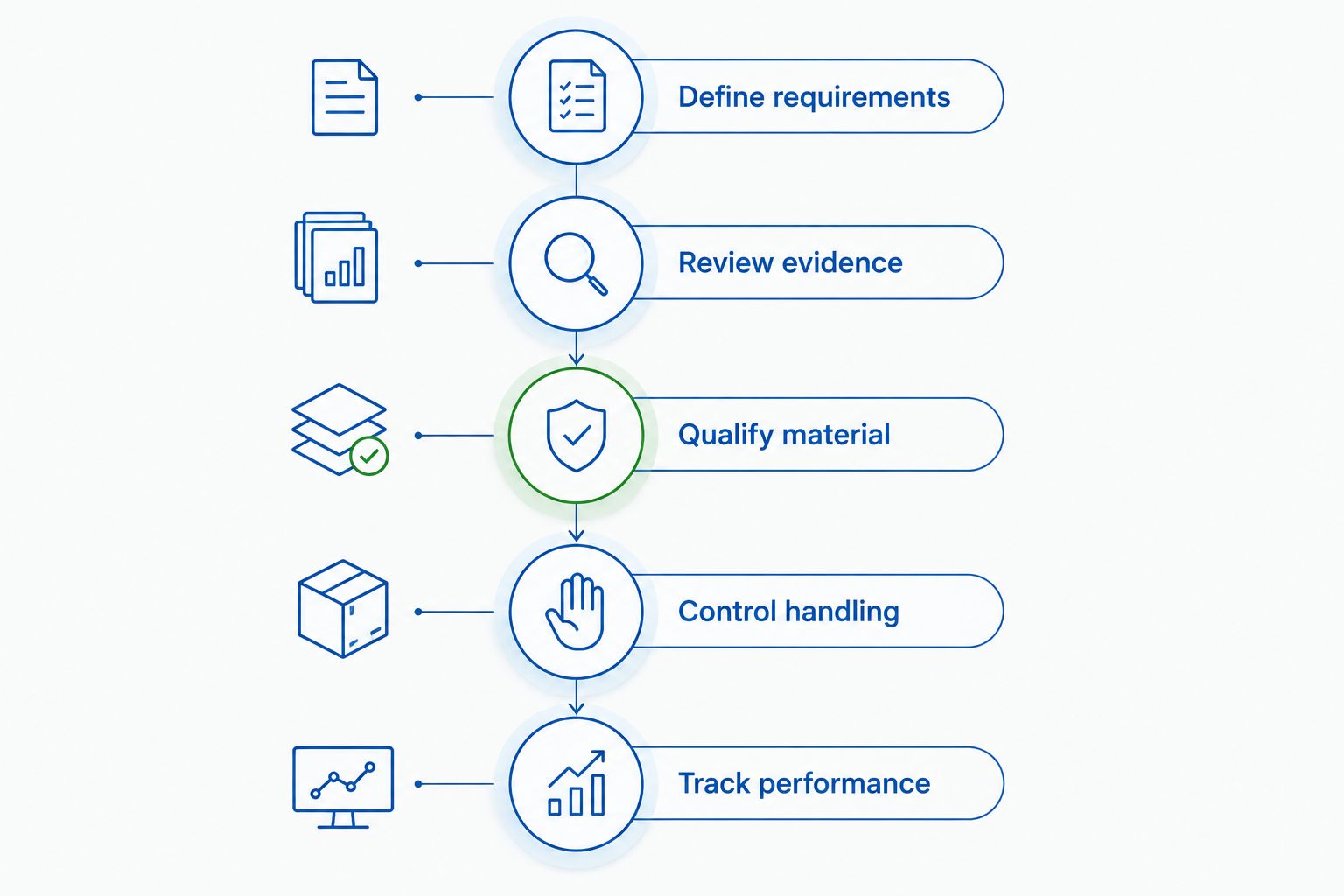
Manually review the certificate of analysis and available supporting reports against the specification. Begin with the material identifier and lot number. A report that cannot be connected to the vial cannot support that vial's qualification.
Read the analytical method, not just its reported percentage. Chromatography separates components under a particular method; mass spectrometry supplies molecular-mass evidence. Neither should be treated as a universal substitute for the other, and molecular mass alone does not establish every structural feature.
For a 99% purity claim, determine what the percentage represents. Chromatographic area purity is not automatically the mass fraction of peptide in the vial. Water, counterions, and other constituents matter when you need an accurate concentration basis.
Use the peptide purity testing guide for contract research organizations to organize the analytical review. Keep responsibility for acceptance with your laboratory, even when testing is independent.
Begin with your institution's existing vendor records and an evidence checklist. Compare sourcing routes by experimental fit rather than by supplier category alone. A catalog reagent, custom synthesis service, and characterized reference standard solve different problems.
Celonyx Labs research peptides provide a catalog sourcing option with stated 99% purity and third-party testing. The practical advantage is access to research-use materials without defining a custom synthesis project. The limitation is that those stated attributes do not establish every assay-specific requirement; review the selected material before approval.
Use custom synthesis when your experiment requires a sequence or modification that your catalog search does not satisfy. Use a characterized reference standard when the measurement requires an assigned property and appropriate supporting documentation. Neither route removes the need for qualification.
For your 2026 procurement specification, separate required evidence from supplier marketing terminology. Do not equate phrases such as GMP adjacent with demonstrated GMP manufacture or authorization for clinical use.
Start with a small, protocol-defined qualification experiment using your laboratory's existing controls. Chemical characterization supports the material's identity and composition; assay qualification tests whether it serves the intended experimental purpose.
Use an appropriate comparator when the protocol calls for one, and include vehicle controls that match the preparation conditions. A solvent effect can otherwise be mistaken for a peptide effect. Keep the preparation record attached to the qualification results.
Define the endpoint and acceptance criteria before inspecting the data. Do not release a material because one run looks plausible. Conversely, do not label a peptide defective until you have checked preparation, assay performance, and instrument controls.
Treat a new lot as a documented change rather than a silent replacement. The extent of bridging should reflect the assay's sensitivity and your laboratory's procedures, not an assumed universal testing schedule.
Prepare your calculation manually before entering it into a calculator or electronic notebook. Distinguish nominal vial mass, measured peptide content, and concentration derived from that content. These quantities are related, but they are not interchangeable.
For an illustrative calculation, 1 mg of peptide content dissolved to a final volume of 1 mL gives 1 mg/mL. A 100 µL aliquot of that solution contains 0.1 mg. This is arithmetic, not a preparation recommendation: applying it to a real vial requires a justified peptide-content value and an appropriate solvent.
Molar concentration also requires the molecular weight of the specified material and a consistent calculation basis. Account for the form described in the documentation rather than silently switching between peptide mass and total supplied-material mass.
Select solvents and mixing conditions from material-specific evidence and your approved method. Do not default to bacteriostatic water; preservatives and solvent composition can interfere with experimental systems.
Start with a receipt log and a clear inventory location. Record the material's condition, lot identifier, receipt date, and any transport information supplied. Separate material awaiting review from material approved for use.
Storage conditions depend on peptide sequence, formulation, physical state, and solvent after reconstitution. Do not copy a universal freezer temperature or solution shelf life into every record. Use the supplier's material-specific instructions and the evidence supporting your laboratory's method.
Make aliquot decisions around the experiment rather than habit. Repeated handling can introduce additional variability, but aliquot size and allowable handling cycles need a justified procedure. Record actual events instead of assuming that a storage location proves an uninterrupted storage history.
For a 2026 inventory review, connect each stock entry to its preparation history. An unopened lyophilized vial and a reconstituted solution are different material states and need separate records.
Begin with a shared folder structure and consistent identifiers; specialized software is not a prerequisite. A scientist should be able to move from an experimental result to the exact peptide lot and its preparation record without reconstructing an email chain.
Connect the purchase record, analytical reports, receiving record, qualification decision, and experimental use. Preserve the original documents alongside your review notes. A copied purity percentage loses the context needed to interpret the analytical result.
When your laboratory uses an electronic lab notebook, attach or reference controlled records through the established workflow. Do not assume a vendor provides procurement integrations or automated data transfer. Your internal process must remain usable without those features.
During the 2026 documentation review, check whether another scientist can reproduce the preparation from the recorded information. Traceability is useful only when the linked records are sufficiently complete to explain what happened.
Choose the sourcing route that supplies the evidence your experiment requires. These options describe procurement approaches, not interchangeable quality grades. A route's advantage is useful only when its limitations are acceptable for the study.
| Option | Best for | Practical advantage | Key limitation |
|---|---|---|---|
| Celonyx Labs research peptides | Laboratory researchers sourcing research-use catalog materials | Stated 99% purity and third-party testing | Those attributes alone do not establish assay suitability, sterility, or clinical suitability |
| Custom peptide synthesis | Experiments requiring a specified sequence or modification | Lets you define material requirements with the synthesis provider | Synthesis specifications still require analytical and assay qualification |
| Characterized peptide reference standards | Analytical work requiring an assigned property and supporting documentation | Provides a defined measurement reference within its documented scope | Suitability depends on the assigned property and intended method |
| Internally prepared peptide material | Teams with suitable synthesis, purification, and characterization capabilities | Places preparation and process records under internal control | Your team carries the preparation, characterization, and qualification workload |
Do not promote an exploratory reagent into a reference standard simply because its purity result is high. Likewise, do not assume a reference standard is the best biological-assay reagent. Select against the intended use and document the reasoning.
What’s the best way to choose research peptides for pharmaceutical R&D?
Choose research peptides against a written experimental specification covering identity, purity, preparation, and assay-specific requirements. Qualify the selected lot before using it to support study conclusions.
Does 99% purity mean a peptide is suitable for every assay?
No, 99% purity does not establish suitability for every assay. Review the analytical method, identity evidence, peptide-content basis, and any attributes relevant to your experimental system.
Are Celonyx Labs peptides intended for human use?
Celonyx Labs sells research peptides for laboratory researchers and scientists. The materials discussed here are for research use only, not human administration.
Is a research peptide the same as a peptide reference standard?
No, a research peptide is not automatically a peptide reference standard. Reference-standard use requires appropriate characterization and documentation supporting the property being measured.
Can pharmaceutical R&D teams use bacteriostatic water for every peptide?
No, bacteriostatic water is not a universal solvent for peptide research. Choose the solvent according to material-specific guidance and assay compatibility, including the effects of preservatives.
What should happen when a new peptide lot arrives?
Record the lot, review its documentation, and complete the qualification required by your laboratory’s procedure. Link any bridging results and preparation records to the experiments using that lot.
Does third-party testing replace internal quality review?
No, third-party testing does not replace internal quality review. Your laboratory must determine whether the reported tests and results satisfy the requirements of the intended experiment.
The most useful question is not whether a peptide is pure, but whether its measured properties support your experiment. A clean chromatogram cannot resolve a concentration calculation based on an unjustified mass value.
Before your next 2026 study, ask a colleague to trace one result back to its lot, analytical evidence, preparation, and acceptance decision. Fix any break before expanding the experiment. All materials discussed in this guide are for research use only.
Solid phase peptide synthesis is a method that builds a peptide one amino acid at
500 mcg equals 0.5 mg, a labeled research quantity, and no published human study establishes

Choose the best GHK-Cu peptide format for laboratory skin and wound-healing research. Compare documentation, assay
FOR RESEARCH USE ONLY. Products sold by Celonyx Labs are intended exclusively for laboratory and scientific research. They are not intended for human or veterinary use, consumption, diagnosis, treatment, cure, or prevention of any disease. By purchasing from this site, you acknowledge that you understand the intended research purpose of these materials and agree to comply with all applicable laws and regulations.