6 Acetic Acid: What It Means and Where It Fits in Research
What does “6 acetic acid” tell you about the bottle on your bench? Not much,
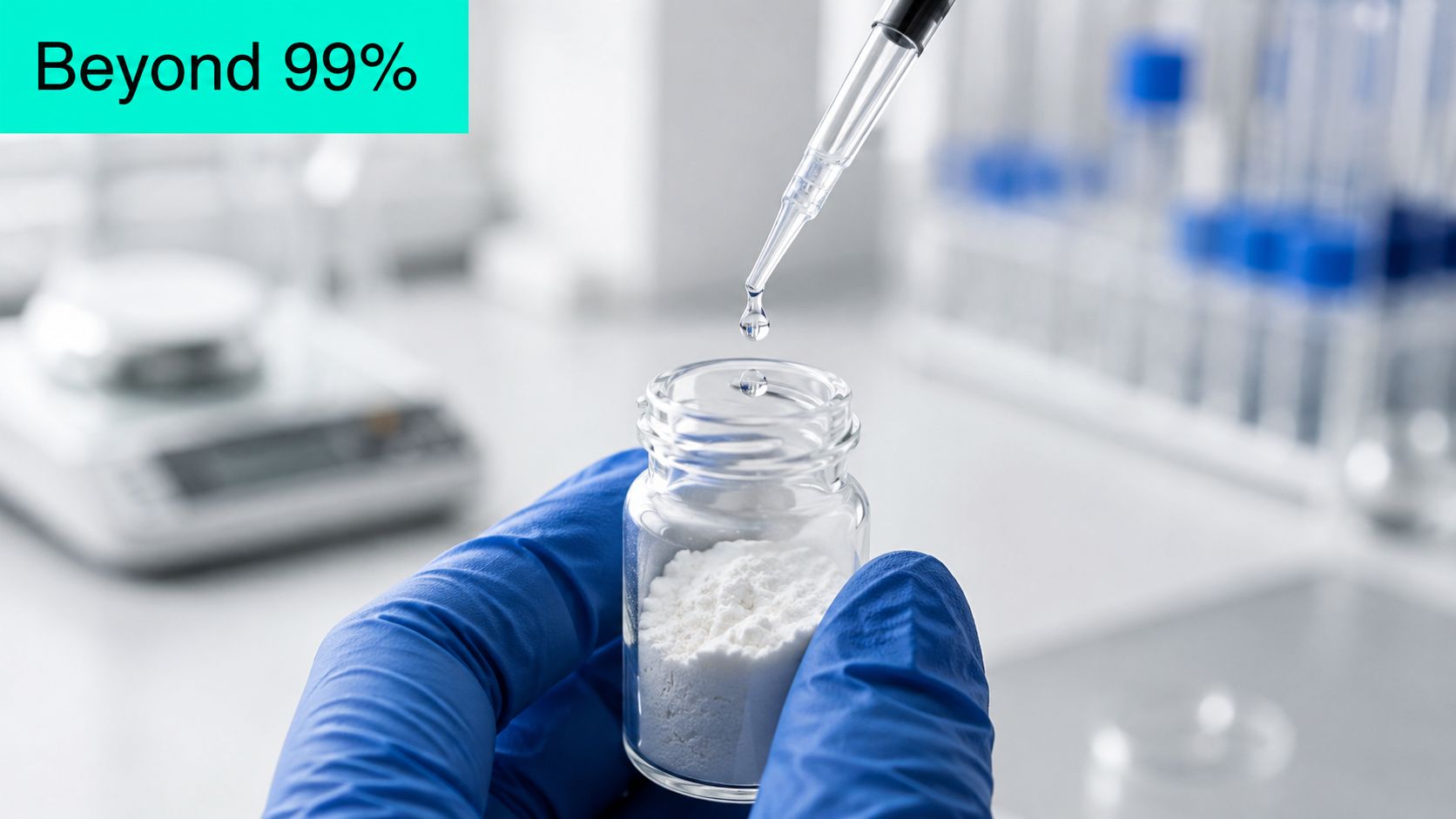
The most popular advice for buying research peptides is also the least reliable: look for a 99% purity label and place the order. That number can be useful, but it doesn't prove that the material has the intended sequence, reveal every related impurity, or address contamination risks that can affect an experiment. A defensible purchase starts with the vendor's evidence, not the product-page headline.
For laboratories, peptide procurement is a quality decision, a logistics decision, and a compliance decision at the same time. Academic groups, CROs, biotech startups, and preclinical teams need material that can be traced to a specific lot, evaluated with appropriate analytical methods, received in usable condition, and documented for institutional records.
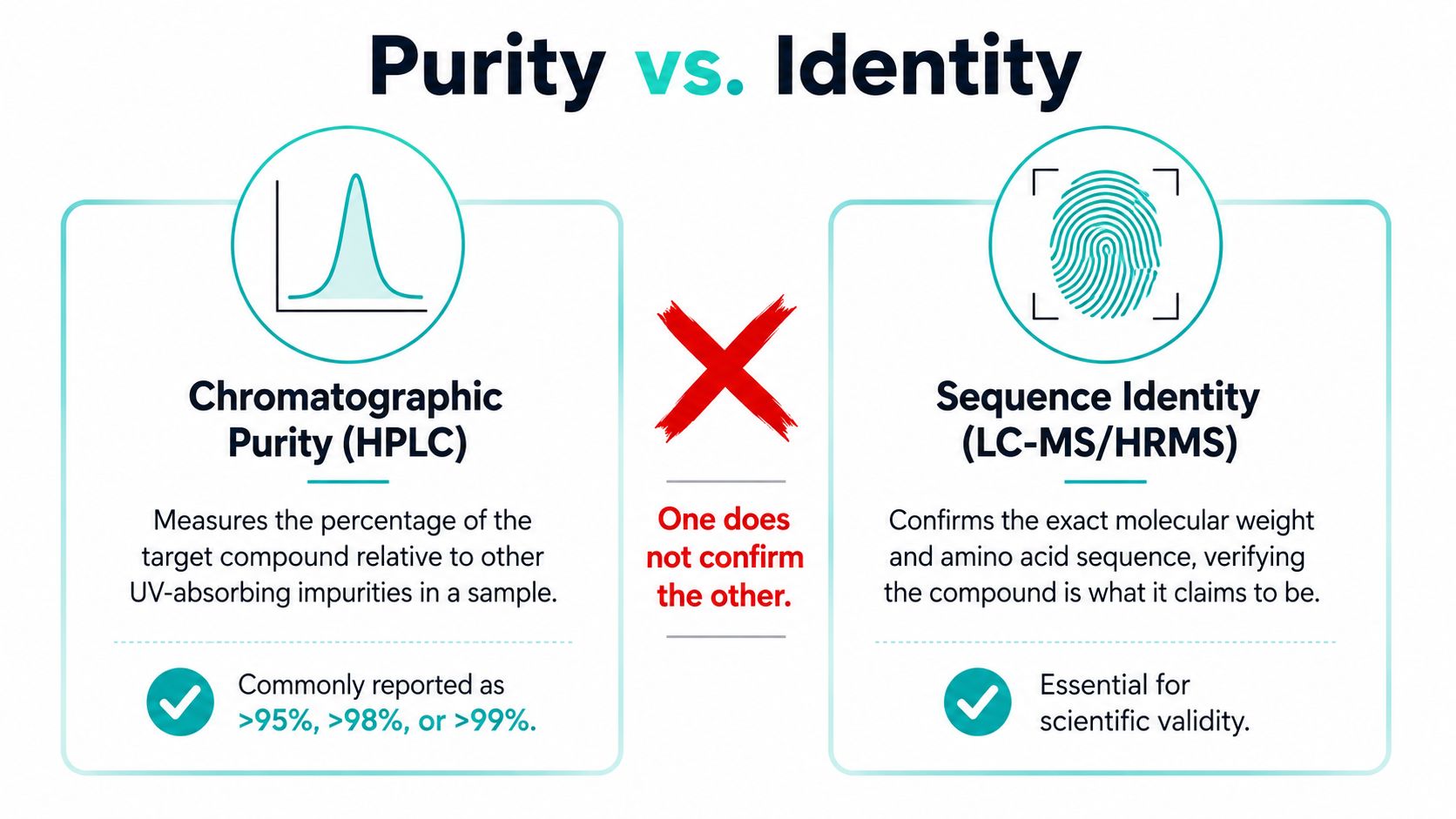
A 99% HPLC result isn't a complete description of a research peptide. HPLC primarily estimates how much of the UV-absorbing material appears in the main peptide peak. It doesn't automatically confirm that the peak belongs to the intended sequence, and it may not separate every structurally related compound from the target.
Synthetic peptide production can generate deletion sequences, truncated products, oxidation variants, and other byproducts. Some may co-elute with the principal peak or absorb in ways that make a purity percentage look reassuring without answering the more important question, namely whether the vial contains the correct material for the assay.
The analytical distinction matters in practice. In one LC-hrMS study, researchers identified and quantified more than 65 impurities in a synthetic peptide reference material. The combined impurity burden reached 83.3 mg/g, with a 3.0 mg/g expanded uncertainty, and another analysis found that failing to correct for related impurities would have produced a 1% concentration error. These findings are reported in the LC-hrMS analysis of synthetic peptide impurities.
A product page may tell you the stated purity, vial size, and nominal sequence. It may not tell you:
A stronger procurement record pairs the purity result with LC-MS or HRMS identity confirmation, a readable chromatogram, the test date, the lot number, and a description of the method. Buyers who need deeper characterization can also review peptide impurity profiling methods before selecting a testing package.
Practical rule: Treat “99% purity” as one data point. Don't treat it as a release decision.
The supplier should also explain what the percentage means, which detection method was used, and whether any additional contaminant testing is available. If customer support can't answer those questions or won't provide batch-specific documentation, the low price isn't the only risk. Your team may lose time interpreting an unexplained result, repeating an assay, or defending an unsupported material qualification.
Research peptides are synthetic chains of amino acids supplied as tools for scientific investigation. A legitimate research-use product is generally intended for controlled laboratory work, such as in vitro assays or animal research conducted under the applicable institutional framework. It isn't automatically a pharmaceutical drug substance, a finished medicine, or a consumer wellness product.
The label Research Use Only, or RUO, sets an important boundary. A GLP-1 analog might be purchased for receptor-binding work, metabolic pathway assays, or other preclinical experiments. An antimicrobial peptide could be used in a microbiology workflow to study activity against a defined organism or to examine structure-function relationships. In both examples, the material serves a research protocol. The label doesn't establish approval for administration to people.
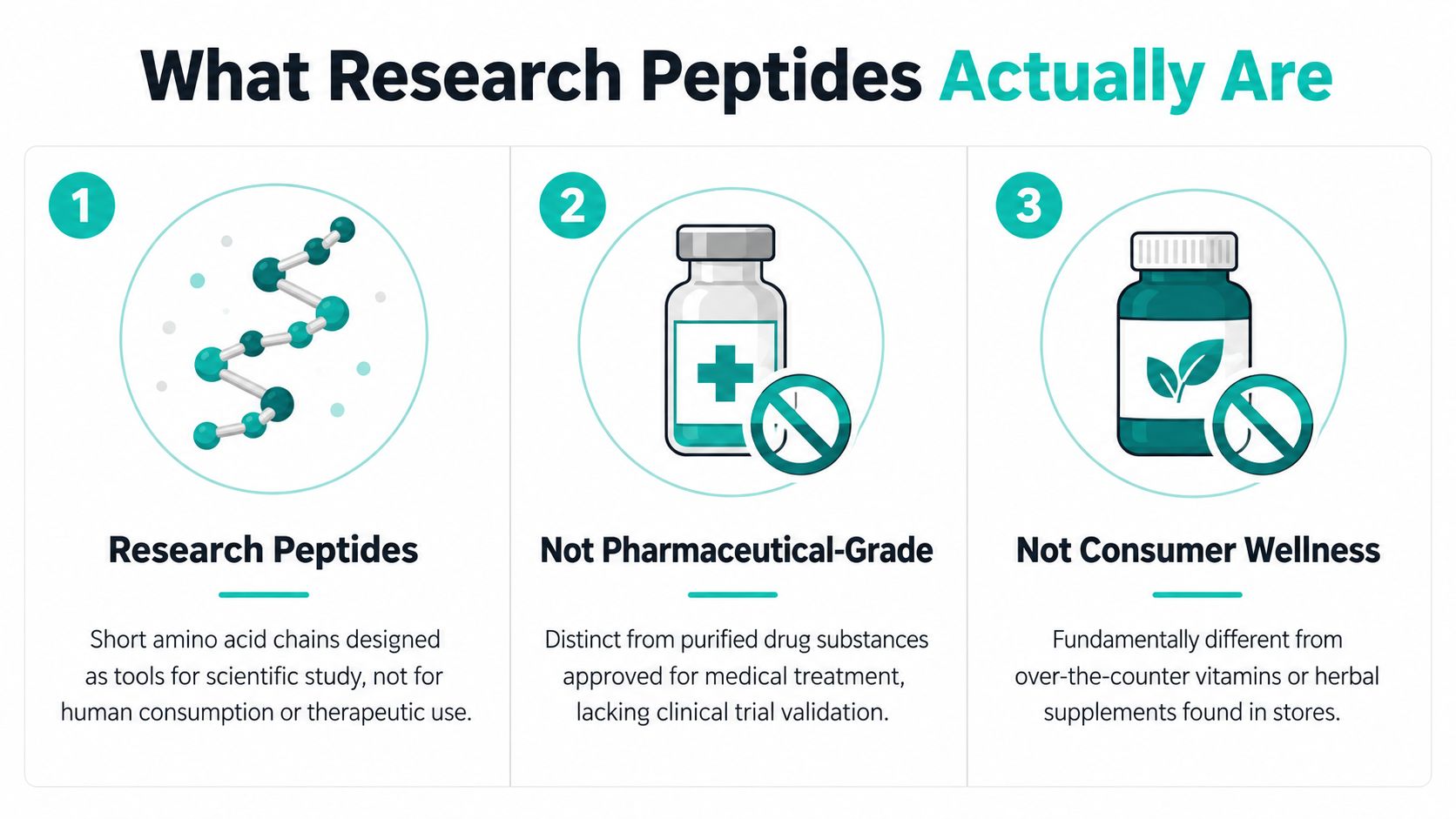
Research material is purchased for laboratory investigation. It should come with product information that supports identification, handling, and traceability, while its marketing and labeling should avoid therapeutic or wellness claims.
Pharmaceutical-grade material belongs to a different development and regulatory pathway. A research peptide shouldn't be described as an approved drug substance or presented as validated for clinical treatment because its sequence resembles a compound used in drug development.
Consumer wellness products are a separate category again. Vitamins, herbal supplements, and over-the-counter products are marketed for consumer use under their own regulatory expectations. A vial labeled RUO isn't a supplement, and changing the wording on a product page doesn't turn an unapproved research material into one.
The typical legitimate buyer is an academic laboratory, contract research organization, biotechnology startup, pharmaceutical preclinical team, or independent investigator with a defined scientific purpose. Procurement should connect the product to a protocol, project, or assay need. That connection helps the purchasing team assess the required identity evidence, purity threshold, quantity, storage conditions, and institutional approvals before money changes hands.
A buyer who treats research peptides like ordinary catalog reagents may overlook the documentation needed for a defensible audit trail. The purchasing file should preserve the product description, RUO language, lot information, COA, shipping record, and any internal approval required by the institution.
That discipline also protects the research itself. A material bought for an assay must be evaluated according to assay risk, not according to consumer marketing language. If the experiment is sensitive to concentration, sequence, oxidation, or endotoxin exposure, the procurement specification should say so before the vendor is selected.
HPLC purity and molecular identity are complementary measurements, not interchangeable labels. HPLC estimates the proportion of UV-absorbing material associated with the principal chromatographic peak. The result can help identify the dominant component, but it doesn't by itself establish that the component has the intended molecular weight and sequence.
LC-MS and HRMS provide the orthogonal check. Mass spectrometry can support confirmation of the expected molecular mass and help reveal related species that a purity-only result may not distinguish. For synthetic peptides, that includes truncated sequences, deletion products, oxidation variants, and co-eluting compounds.
A usable Certificate of Analysis should let another qualified person understand what was tested and which lot produced the result. Look for these fields:
A COA with a strong HPLC number but no identity evidence leaves a fundamental gap. The reverse is also true. A mass match doesn't tell you that the sample is free from meaningful chromatographic impurities. Procurement teams should request both forms of evidence when the experiment depends on sequence fidelity and consistent concentration.
The right testing depth depends on the project. Early exploratory work may use a practical identity and purity package, while a milestone-driven preclinical program may need a broader impurity assessment, residual solvent review, endotoxin evaluation, and stability information. The key is to define the risk before comparing prices.
The useful question isn't “Is it 99%?” It's “What was measured, on which lot, with which method, and what remains unmeasured?”
Mass spectrometry also doesn't eliminate the need for laboratory controls. Your team still needs appropriate reconstitution procedures, concentration calculations, storage records, and assay controls. Analytical evidence qualifies the incoming material. It doesn't replace good experimental practice.
A vendor comparison should begin with the records you'll need after delivery, not with the order-page design. I evaluate suppliers across documentation, testing, fulfillment, and support, then ask whether each area is strong enough for the intended study.
| Evaluation Dimension | Top-Tier Vendor | Bare-Minimum Supplier |
|---|---|---|
| Documentation | Provides lot-specific COAs, clear RUO labeling, analytical methods, product information, and published terms | Provides a generic COA or a product-page claim without matching lot details |
| Testing | Offers purity plus orthogonal identity confirmation and explains available contaminant testing | Relies on a single purity figure with no clear identity or contaminant evidence |
| Fulfillment | States shipping procedures, packaging expectations, handling requirements, and a process for damaged or delayed orders | Gives limited shipping information and leaves the buyer to resolve delivery problems |
| Support | Provides direct email and phone access, with staff able to answer documentation and order questions | Offers only a chat box or vague contact form |
| Policies | Publishes refund, return, shipping, privacy, and terms documents | Makes policies difficult to find or provides no clear remedy for discrepancies |
Send specific questions before committing to a program. Ask whether the COA is generated for the shipped lot, whether LC-MS or HRMS identity data is available, and which tests address contamination beyond nominal purity. Ask how the vendor handles a vial whose lot number doesn't match the paperwork.
The response itself is informative. A technically useful answer should address the question directly and point you to the relevant document. Evasive language, pressure to buy immediately, or unsupported claims about human effects are warning signs.
Independent testing deserves particular attention. One 2026 buyer-risk guide reports that independent testing found vials ranging from 0% to over 100% of labeled dose and says endotoxin contamination can be more consequential for experimental reliability than nominal purity. Review the peptide vendor qualification process when you need a repeatable internal method for documenting this review.
A cheaper vial can become expensive if the team has to repeat an assay, quarantine a shipment, or wait for an unclear replacement decision. A higher quoted price may reflect lot testing, better packaging, accessible support, or more complete documentation. Those features don't guarantee suitability, but they make the purchase easier to evaluate and defend.
For recurring programs, score vendors consistently. Keep the initial qualification record, preserve the correspondence, and reassess the supplier when the product, manufacturing site, analytical method, or shipping arrangement changes.
A sound order doesn't end at checkout. The receiving process determines whether the material that arrives is the material your team approved, and storage determines whether it remains fit for the planned work.
Start with the catalog record. Confirm the exact peptide name, sequence or product identifier, stated quantity, formulation, RUO designation, available documentation, and shipping terms. Save a copy of the product information and order confirmation because online catalog content can change after purchase.
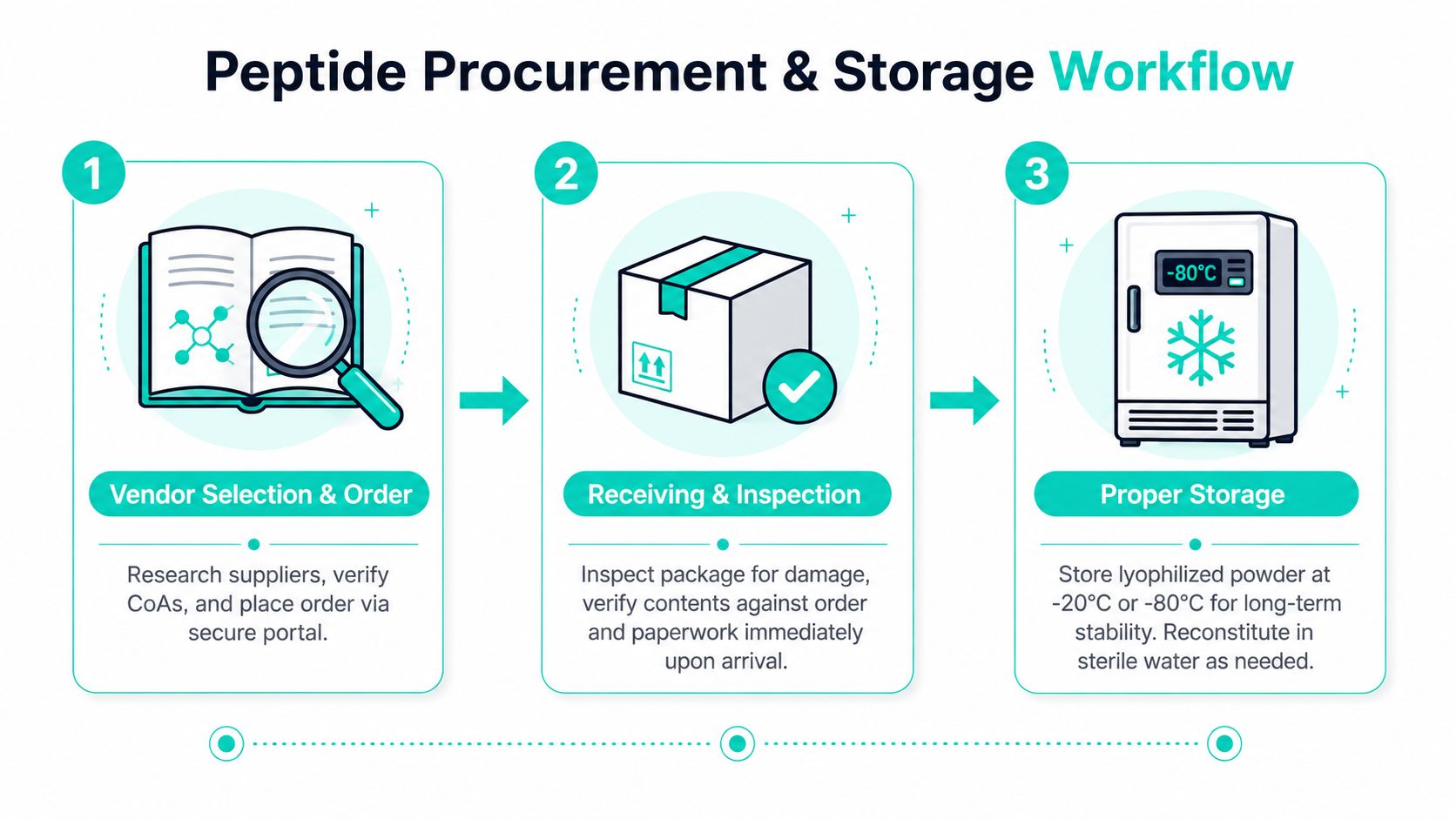
When the shipment arrives, don't put the box directly into general stock. Assign a trained person to inspect and record the delivery.
Lyophilized peptides are commonly stored under frozen conditions selected by the supplier and the laboratory's stability requirements. The appropriate condition may be -20°C or -80°C for longer-term storage, as shown in the supplied procurement workflow, but the product documentation should control when it specifies a different requirement. Minimize unnecessary temperature cycling and protect the vial from moisture during handling.
Reconstitution deserves its own controlled procedure. Use the solvent, concentration, mixing method, and container described by the protocol or supplier documentation. Record the date, operator, calculated concentration, and storage location. For additional handling considerations, review how to store reconstituted peptides.
Universities and companies often need a complete vendor file, not just an invoice. Keep the terms and conditions, refund and return policy, shipping policy, privacy documentation, COA, and correspondence with the order record. A supplier with clear published policies makes it easier for procurement, quality, and laboratory personnel to agree on what happens when delivery or documentation doesn't meet expectations.
The practical boundary is straightforward: RUO peptides must remain tied to legitimate laboratory research, with labeling and marketing that match that purpose. Recent coverage describes a sharper 2026 distinction between sales for in vitro or animal research and marketing for human use. Marketing a research peptide for human consumption can trigger FDA enforcement, so laboratories and suppliers need compliant language rather than wellness claims. See the 2026 regulatory coverage of research peptide status for that distinction.
A product page that discusses weight loss, bodybuilding, anti-aging, injury recovery, or treatment while retaining an RUO disclaimer creates an obvious compliance concern. The disclaimer doesn't erase the surrounding message. Procurement teams should avoid suppliers whose copy encourages self-administration or implies that a laboratory vial is a substitute for an approved medicine.
Use language that accurately describes the purpose and intended use:
The broader supply environment is also becoming more formal. The European Medicines Agency's Guideline on the Development and Manufacture of Synthetic Peptides became effective on June 1, 2026, with clearer expectations around manufacturing, characterization, specifications, analytical controls, impurity reporting, and qualification thresholds, as described in the peptide synthesis market and regulatory overview. That doesn't make every RUO product a pharmaceutical material, but it shows why buyers increasingly ask for traceability and impurity information.
Ethical sourcing means refusing to treat uncertainty as a bargain. A vendor that supplies incomplete records, makes human-use claims, or obscures the manufacturing and testing trail may expose researchers, institutions, and study participants to avoidable risk. A compliant supplier should make the intended use clear and provide enough evidence for the buyer to make a reasoned qualification decision.
Celonyx Labs provides an example of the supplier features a laboratory can review during qualification. Its online catalog lists research peptides, includes New Arrivals and Bestsellers sections for navigation, and presents a stated 99% purity attribute alongside references to independent third-party testing. Those claims still need to be assessed against the lot-specific documentation required by the buyer's protocol.
The operational details matter as much as the product page. The site describes fast shipping options, provides a published Refund and Return Policy, Shipping Policy, and Terms and Conditions, and offers direct customer support through phone and email. The listed phone number is 570-761-6154, and the business address is in Dallas, Pennsylvania.
A procurement review can examine whether the available information supports the following requirements:
Celonyx Labs also publishes a blog and newsletter, which may help teams monitor supplier communications without relying solely on product pages. Those channels aren't substitutes for analytical evidence, but they can make it easier to identify policy changes, availability updates, and documentation questions before ordering.
The useful takeaway isn't that one stated purity figure settles qualification. A structured supplier such as Celonyx Labs should be evaluated using the same standards applied to any research-peptide source: verify identity, review batch-specific COAs, clarify impurity and contaminant testing, confirm shipping and storage requirements, and retain the complete purchasing record.
If your laboratory needs research peptides with an online catalog, stated purity information, independent third-party testing references, shipping options, and published procurement policies, visit Celonyx Labs to review the available products and documentation before placing an order. Contact the team directly with lot, testing, storage, or fulfillment questions so your next purchase supports both the experiment and the procurement record.
What does “6 acetic acid” tell you about the bottle on your bench? Not much,

Best sterility testing kits for 2026 peptide labs: Endosafe nexgen-PTS wins on speed, Steritest for

Compare the best peptide reference standards for analytical research in 2026, ranked by purity, COA
FOR RESEARCH USE ONLY. Products sold by Celonyx Labs are intended exclusively for laboratory and scientific research. They are not intended for human or veterinary use, consumption, diagnosis, treatment, cure, or prevention of any disease. By purchasing from this site, you acknowledge that you understand the intended research purpose of these materials and agree to comply with all applicable laws and regulations.