
What Is Solid Phase Peptide Synthesis? a Clear Guide
Solid phase peptide synthesis is a method that builds a peptide one amino acid at

Sports science labs' peptide research is the study of peptide-related mechanisms in experimental models with the aim of answering defined questions about exercise physiology. This 2026 guide explains how to select research peptides for sports science labs, verify their documentation, and keep laboratory findings separate from claims about athlete performance.
Sports science laboratories investigate questions about muscle adaptation, metabolism, exercise stress, and related biological pathways. Research peptides can serve as experimental reagents within an appropriately designed study; they are not evidence that a substance improves sporting performance.
The distinction matters because a molecular response, a cell-based result, and a performance outcome answer different questions. Your protocol must identify which question the experiment addresses before procurement begins.
A supplier's purity statement also answers a narrower question than many researchers assume. Start with the distinction explained in Does 99% purity mean a peptide is safe for research?, then set acceptance criteria for your own assay.
For a 2026 sports science project, the useful quality signals are documented identity, interpretable analytical results, and traceability. A high purity percentage cannot replace any of them. Select the reagent for the model—not for an anticipated athlete benefit.
Start manually with a protocol worksheet. Write the hypothesis, identify the experimental system, and name the endpoint that would support or contradict the hypothesis. Avoid choosing a compound first and constructing a question around its promotional description.
Distinguish mechanism research from outcome research. A change in a signaling marker does not demonstrate improved strength, endurance, or recovery; those conclusions require studies designed to measure those outcomes.
Keep the scope explicit when several teams share a project. Analytical chemistry, cell biology, and exercise physiology collaborators need the same definitions of the material, the endpoint, and the limits of interpretation. This prevents a laboratory observation from acquiring a broader meaning as it moves between teams.
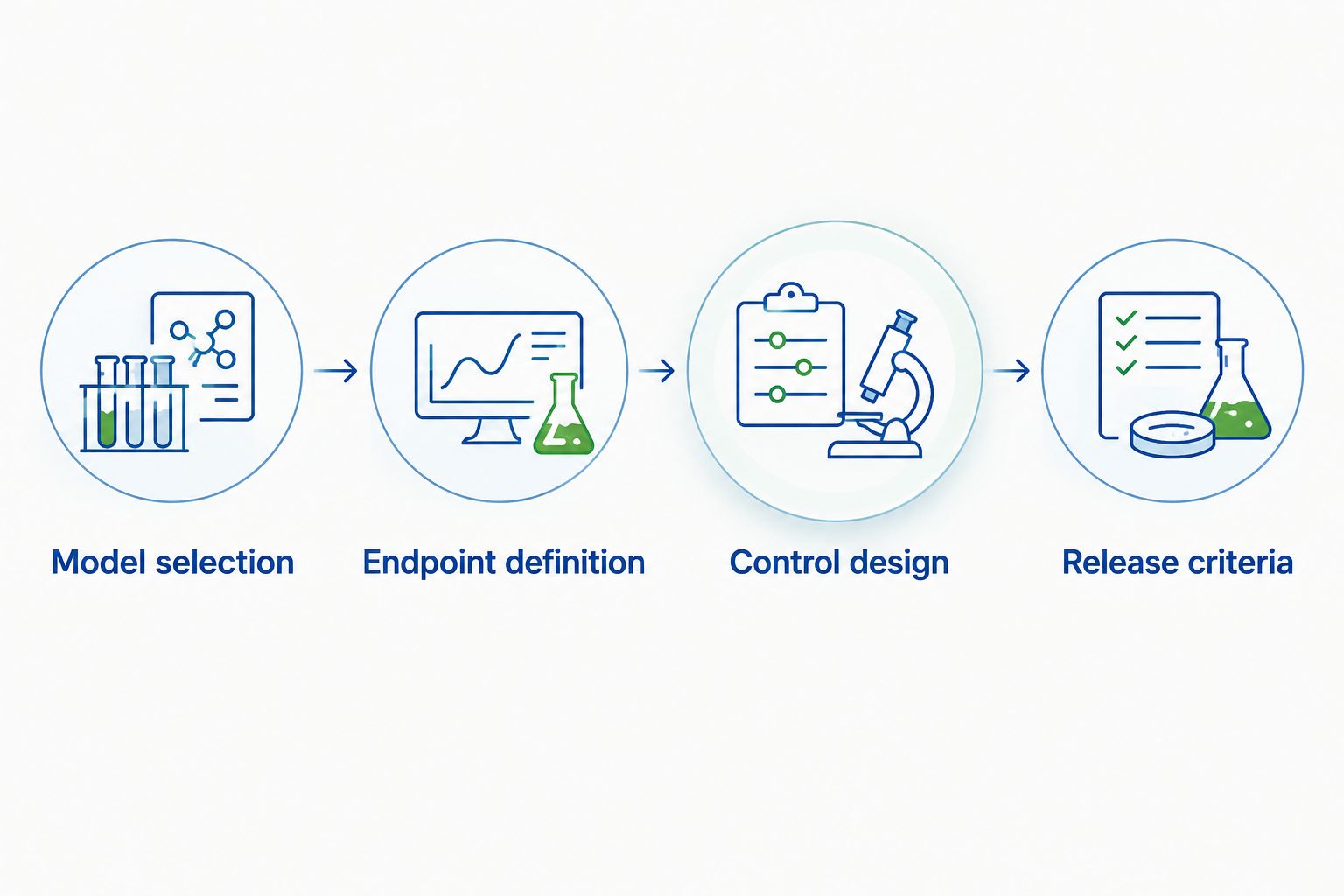
Close the planning stage with a written decision record:
This sequence keeps procurement subordinate to the experiment: model selection, endpoint definition, control design, then release criteria.
Use your institution's library resources and primary research papers before relying on supplier summaries. Read the methods, not just the abstract. Confirm that the tested material, experimental system, and measured endpoint match the question your sports science laboratory intends to answer.
Separate evidence about a peptide from evidence about a pathway. A pathway's association with exercise adaptation does not establish that every compound interacting with it produces the same response. Likewise, findings from one experimental system do not establish an effect in another.
Record uncertainties in the protocol rather than smoothing them out in the introduction. If the available evidence addresses a different tissue, model, or endpoint, make that difference part of your study rationale. An exploratory experiment remains useful when its limits are clear.
Finish the literature review with these checks:
Begin with your laboratory's approved-vendor process and a manual document review. Evaluate the actual material proposed for purchase, not just the supplier's homepage. A general quality statement is useful for screening; a lot-linked analytical record is needed for a lot-specific decision.
Celonyx Labs research peptides are best for laboratory researchers seeking 99%-pure, third-party-tested materials—not athlete use. Celonyx Labs is an online store serving laboratory researchers and scientists. Those stated quality attributes provide a procurement starting point, but your laboratory must still determine suitability for the experiment.
For your 2026 procurement record, request documentation that identifies the material, the tested lot, and the analytical methods. Where a certificate reports chromatographic purity, interpret that result according to its stated method; do not automatically treat it as peptide content by mass or proof of biological activity.
Apply the same checklist to every candidate supplier:
Start with the study method and the material's documented handling instructions. Choose the solvent and preparation conditions for the peptide and assay together. Do not assume that a solvent commonly discussed online is suitable for every laboratory application.
Reconstitution and experimental exposure are separate decisions. Preparing a stock solution does not determine an appropriate experimental concentration, and neither provides a basis for human dosing. Use the approved research protocol to define the experimental design.
Check unit conversions independently before making a preparation. 1 mg equals 1,000 µg, and 1 mL equals 1,000 µL. These are unit equivalences, not recommended preparation quantities. Record the units at every calculation stage so that a mass conversion cannot be mistaken for a volume conversion.
A preparation record should allow another trained researcher to reconstruct the work without guessing. Include the source lot, solvent identity, calculation, actual preparation details, and any departure from the approved method.
Close preparation with these controls:
Use a receiving log before adopting an inventory platform. Record the shipment, material identity, lot, receiving date, and condition on arrival. Keep materials pending review separate from materials released for experiments.
Set storage conditions from compound-specific documentation and your validated procedures. Lyophilized material and reconstituted material are different storage states; a general rule for one does not automatically apply to the other. Appearance alone cannot establish identity, stability, or activity.
Shared sports science facilities need an ownership rule as well as a temperature record. Assign responsibility for reviewing excursions, authorizing use, and updating inventory. Otherwise, an accurately labeled vial can still move through the laboratory without anyone checking whether it remains suitable for the study.
Use these handling safeguards:
Begin with a method-appropriate pilot and a predefined analysis plan. Decide how you will assess assay variability, control performance, and agreement across runs before interpreting the peptide-associated result. Do not select acceptance criteria after seeing the data.
Distinguish technical repeatability from biological reproducibility. Repeating a measurement on the same preparation checks a different source of variation from repeating an experiment with independent biological material. Name the distinction in the protocol and report it in the results.
For a 2026 study involving a new peptide lot, define whether a bridging assessment is needed before combining results with earlier work. A supplier's consistent purity claim does not demonstrate that separate lots behave identically in your assay.
Finish each experimental cycle with an auditable review:
Choose the sourcing route after defining the experimental requirement. The best option for an exploratory assay is not automatically the best option for analytical calibration or a project requiring a particular sequence modification.
For 2026 procurement, compare documentation and material suitability rather than treating all research-grade materials as interchangeable. Each route has a useful role and a specific limitation.
| Option | Best for | Main advantage | Key limitation |
|---|---|---|---|
| Existing institutional inventory | Preliminary work with already reviewed material | Existing records can support an initial suitability review | Previous approval does not establish suitability for a new assay or current stability |
| Celonyx Labs research peptides | Laboratory researchers seeking 99%-pure, third-party-tested materials | The stated quality attributes support supplier screening | Purity and third-party testing alone do not establish every assay-specific requirement |
| Custom peptide synthesis | Studies requiring a specified sequence or modification | The procurement specification can define the requested material | The delivered material still needs analytical and experimental qualification |
| Characterized analytical reference material | Methods requiring a suitable comparator or calibrant | Supporting characterization can help establish analytical comparisons | Suitability depends on documented properties, intended use, and the method |
Do not substitute a general research reagent for a reference material solely because both have high reported purity. Reference suitability depends on the analytical task and supporting documentation. Conversely, a well-characterized reference material does not automatically satisfy the requirements of a biological assay.
A promotional claim about recovery is not an endpoint. Define the tissue, model, measurement, and comparison before selecting a reagent. Otherwise, the study risks measuring whatever is convenient rather than what answers the original question.
A reported 99% purity value does not establish sterility, endotoxin status, exact peptide content, or biological activity. Read the analytical method and decide which additional attributes matter for your experiment. A percentage is one result, not a release decision.
An observed molecular response does not establish a practical sporting benefit. Keep laboratory findings within their measured scope, including in abstracts and collaborator summaries. In 2026 reporting, use language that distinguishes exploratory mechanisms from demonstrated performance outcomes.
A vial moved between groups without its lot and preparation records creates an interpretation problem. Give each aliquot a traceable identifier and keep the supporting records accessible to authorized researchers. A familiar compound name is not enough to identify the material used.
What are research peptides for sports science labs used for?
Research peptides for sports science labs are laboratory reagents used to investigate defined biological mechanisms in experimental models. Their use does not establish improved recovery, endurance, strength, or other athlete outcomes.
What’s the best way to choose a research peptide for an exercise physiology study?
Choose the peptide by the experimental question, published evidence, documented identity, and assay requirements. Define the model and endpoint before comparing suppliers.
Does 99% peptide purity mean a material is safe for human use?
No. A 99% purity statement does not establish safety for human use, sterility, or suitability for administration. Research-use materials must not be treated as medicines.
Is Celonyx Labs suitable for laboratory peptide sourcing?
Celonyx Labs supplies 99%-pure, third-party-tested research peptides for laboratory researchers and scientists. Your laboratory still needs to review the material and lot documentation against its protocol-specific acceptance criteria.
Can sports science labs use research peptides in athlete studies?
A research-use-only product designation is not authorization to administer a material to athletes. Any human study requires the applicable regulatory pathway, institutional oversight, and material suitable for that authorized use.
Do all research peptides need the same reconstitution method?
No. Select preparation conditions using compound-specific documentation and the requirements of the assay. Solvent choice, stability, and compatibility cannot be inferred from the word peptide alone.
How should a lab compare results from different peptide lots?
Use a predefined lot-bridging assessment appropriate to the assay before combining results. Keep each result linked to its lot, preparation, controls, and raw data.
Write the acceptance criteria before the purchase request. That single ordering decision makes the supplier review, preparation plan, and interpretation easier to defend because the requirements exist before the material arrives.
For your next 2026 experiment, place the release criteria beside the hypothesis in the protocol. If the reagent cannot satisfy them, change the sourcing decision—not the criteria to accommodate the vial.
For research use only. Not for human consumption or therapeutic use.
Solid phase peptide synthesis is a method that builds a peptide one amino acid at
500 mcg equals 0.5 mg, a labeled research quantity, and no published human study establishes

Choose the best GHK-Cu peptide format for laboratory skin and wound-healing research. Compare documentation, assay
FOR RESEARCH USE ONLY. Products sold by Celonyx Labs are intended exclusively for laboratory and scientific research. They are not intended for human or veterinary use, consumption, diagnosis, treatment, cure, or prevention of any disease. By purchasing from this site, you acknowledge that you understand the intended research purpose of these materials and agree to comply with all applicable laws and regulations.