
Celonyx Labs vs Honest Peptide: 2026 Verdict
Celonyx Labs vs Honest Peptide in 2026: compare purity evidence, batch documentation, pricing checks, and
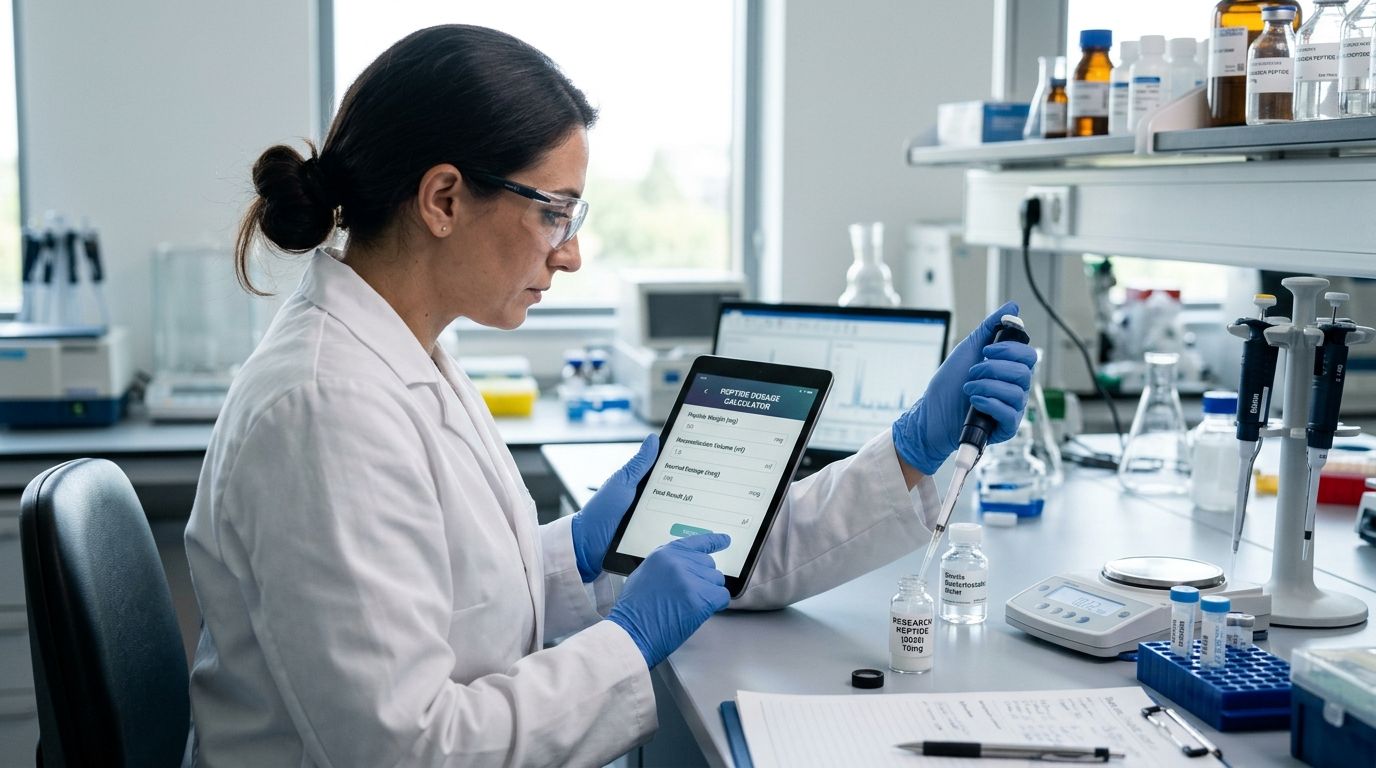
Peptide dosing calculators exist to solve one problem: turning a vial's raw peptide content into a precise, repeatable dose in milligrams, micrograms, or syringe units for research use. This guide ranks the five calculation methods researchers actually use in 2026, from manual formulas to app-based converters, so you can pick the one that fits your lab's documentation standard.
A dosing calculation error in research settings usually comes from one of two places: wrong reconstitution volume, or wrong unit conversion between milligrams and syringe units. Neither mistake shows up until data is inconsistent across replicates. The right calculator method doesn't just spit out a number — it forces you to record the concentration, the diluent volume, and the target dose in a way that can be audited later.
Before comparing tools, get the reconstitution math right at the source. Celonyx Labs' guide to reconstitution math walks through solvent selection and concentration targets — the inputs every calculator below depends on. Get that wrong and no calculator, however good, will correct it downstream.
| Method | Best for | Standout feature | Key limitation |
|---|---|---|---|
| Manual reconstitution formula | Full calculation transparency | Every variable visible and auditable | Slower for high-volume workflows |
| Spreadsheet dosing template | Lab documentation and reproducibility | Reusable across batches with saved history | Requires setup time upfront |
| Vendor-embedded web calculator | Quick single-dose conversions | No setup, instant output | No saved record for later audit |
| Mobile calculator app | At-bench reference across many vials | Works offline, fast repeat entries | Formula logic often hidden from the user |
| Insulin-syringe unit converter | Reading syringe markings against target volume | Direct mg-to-unit mapping for U-100 barrels | Only solves one step of the calculation |
The manual formula — concentration (mg/mL) = total peptide (mg) divided by bacteriostatic water volume (mL) — is the baseline every other tool is built on. Researchers who work through it by hand catch unit errors before they become dosing errors, because every step is visible on paper or in a notebook.
Manual formula pros:
Manual formula cons:
Best for: researchers who need an auditable, tool-independent calculation trail.
Verdict: Buy — this is the method every lab should default to, calculator or not.
An Excel or Google Sheets template with locked formula cells lets a researcher enter vial content, water volume, and target dose, then pulls the concentration and draw volume automatically. Because it's saved, it doubles as a dosing log across an entire study.
Spreadsheet template pros:
Spreadsheet template cons:
Best for: teams running multiple studies who need a shared, versioned record.
Verdict: Buy — pair it with the manual formula as a cross-check, not a replacement.
Many peptide vendor sites host a free web-based calculator where you punch in mg content, water volume, and target dose to get an instant draw volume. These are built for speed, not documentation.
Vendor web calculator pros:
Vendor web calculator cons:
Best for: a fast check when you're not running a structured study.
Verdict: Hold — fine as a sanity check, not as your primary calculation method.
A phone-based calculator app saves time when you're moving between vials at the bench, especially in a workflow tracking several peptides at once. Most work offline once installed.
Mobile app pros:
Mobile app cons:
Best for: researchers juggling several vials in one session who need speed over documentation.
Verdict: Hold — useful as a convenience layer over a documented method, not a substitute for one.
Once you know the draw volume in mL, a U-100 syringe converter maps that volume onto the unit markings on the barrel — since 1 unit on a U-100 insulin syringe equals 0.01 mL. This step matters because syringe markings, not milliliters, are what most researchers actually read at the point of measurement.
Syringe converter pros:
Syringe converter cons:
Best for: the final step before drawing a dose, after concentration is already known.
Verdict: Buy — a five-second check that catches a real category of measurement error.
Getting the syringe step right depends on using the correct barrel size in the first place. Celonyx Labs' comparison of syringe and needle selection covers which gauge and barrel size match which research use case.
Source verified research peptides
Every batch ships with third-party purity testing behind it.
Each method was scored against the six criteria above: formula transparency, unit flexibility, reconstitution support, documentation output, error-checking, and cost. The manual formula and spreadsheet template scored highest because both produce a record a second researcher can independently verify. Web and app calculators scored lower on documentation but higher on speed — which is exactly why they belong in the workflow as a secondary check, not a primary one.
For most research labs in 2026, the answer is the manual reconstitution formula backed by a spreadsheet template, with an insulin-syringe converter as the final measurement step. That combination gives you transparency, a documented record, and a fast final check — three things no single web or app calculator delivers together. Reach for a vendor web calculator only when you need a quick, undocumented sanity check between studies.
None of this replaces verified concentration data. A dosing calculator is only as accurate as the peptide content it's built on, which is why Celonyx Labs pairs every listing with third-party testing labs results rather than asking researchers to trust an unverified label.
What’s the best peptide dosing calculator for research use?
The manual reconstitution formula (concentration = total mg divided by water volume in mL) is the best baseline for 2026 because it’s fully transparent and doesn’t depend on third-party software. Pair it with a spreadsheet template for a documented record.
Is a spreadsheet better than a manual calculation?
A spreadsheet template is better for reproducibility across multiple vials and studies, but it should be validated against the manual formula at setup. Once validated, it saves time without sacrificing accuracy.
How do syringe unit converters work for peptide dosing?
A U-100 insulin syringe converter maps a draw volume in mL onto the unit markings on the barrel, where 1 unit equals 0.01 mL. This is the final step after concentration and draw volume are already calculated.
Are free vendor calculators accurate?
Free vendor-embedded calculators are accurate for basic conversions but rarely show their formula logic and don’t save a documented history. Use them as a quick check, not the primary calculation method.
What information does a peptide dosing calculation require?
You need the total peptide content in the vial (mg), the bacteriostatic water volume added (mL), and the target dose. Missing or estimating any of these three inputs produces an inaccurate result regardless of which calculator you use.
Does reconstitution volume affect the dosing calculation?
Yes — the water volume added directly sets the concentration (mg/mL), which determines the draw volume for any target dose. A different water volume changes every downstream calculation.
Can mobile apps replace a documented dosing record?
Mobile apps are convenient for at-bench speed but most don’t export a record suitable for lab documentation. Use a spreadsheet or manual log alongside the app for studies that require an audit trail.
How often should a dosing calculation be re-verified?
Re-verify any time the vial, water volume, or target dose changes, and periodically cross-check spreadsheet or app outputs against the manual formula to catch formula drift.
The single most common source of dosing error isn't the calculator — it's an unverified starting concentration. A calculator that's mathematically perfect still produces a wrong dose if the vial's actual peptide content differs from the label, which is why pairing any calculation method with third-party purity data matters more than which tool you use to do the math.
Celonyx Labs vs Honest Peptide in 2026: compare purity evidence, batch documentation, pricing checks, and

Celonyx Labs vs Sigma-Aldrich: compare peptide focus, reference standards, documentation, ordering, and vendor fit to

Celonyx Labs vs Peptides.org compared for 2026: purity documentation, GLP-1 specialization, and catalog breadth —
FOR RESEARCH USE ONLY. Products sold by Celonyx Labs are intended exclusively for laboratory and scientific research. They are not intended for human or veterinary use, consumption, diagnosis, treatment, cure, or prevention of any disease. By purchasing from this site, you acknowledge that you understand the intended research purpose of these materials and agree to comply with all applicable laws and regulations.