

Sermorelin Research Peptide: Uses, Purity and Handling
A 99% purity claim isn't a complete quality check for a sermorelin research peptide. It

A 99% purity claim isn't a complete quality check for a sermorelin research peptide. It describes one result from one analytical method. It doesn't, by itself, confirm the peptide's identity, reveal every impurity, show how the material was handled, or prove that it remains stable in your experiment.
That distinction matters because research results depend on the material in the vial and the way the study measures it. Treat sermorelin as a defined GHRH-axis reagent: first establish what it is, then understand its short-lived signal, and finally verify the batch and handling records before comparing results.
Sermorelin is a synthetic 29-amino-acid analogue of human growth-hormone-releasing hormone (GHRH), the hypothalamic signal that tells the pituitary to release its own growth hormone. A useful analogy is a doorbell: sermorelin rings the pituitary's bell, prompting it to release growth hormone, rather than delivering growth hormone itself. That difference shapes both the mechanism and the kinds of conclusions a study can support.
| Attribute | Value | Why it matters for research |
|---|---|---|
| Class | GHRH analogue and growth-hormone secretagogue | It acts on the pituitary, not as growth hormone itself |
| Length | 29 amino acids, the amidated 1–29 fragment of GHRH | Defines the exact species to confirm by mass spectrometry |
| First FDA approval | 1990, as a diagnostic test of pituitary GH secretory capacity | Explains the diagnostic origin of much of the early evidence |
| Pediatric approval | 1997, for idiopathic GH deficiency in children with growth failure | Anchors the pediatric evidence base |
| Commercial status | The former product was withdrawn after failing to compete with recombinant human GH | A historical product, not a current clinical approval |
The historical milestones point to two related uses. A diagnostic dose could stimulate growth-hormone release from the anterior pituitary, helping assess whether the gland retained secretory capacity. Pediatric treatment research then examined growth-hormone release and height velocity, with observations over several months and preliminary longer-term data. The clinical review describing these developments places sermorelin's foundational evidence in pediatric endocrinology and diagnostic physiology, not in contemporary wellness or athletic-performance research (peer-reviewed clinical review of sermorelin).
That history is useful context, but it isn't a shortcut to new conclusions. A past product approval for a defined diagnostic or pediatric indication doesn't validate every adult, body-composition, or longevity claim made later. Readers looking for a general introduction to age-related wellness discussions can consult a wellness guide for aging adults, while keeping its broader context separate from evidence specific to sermorelin.
For laboratories, the practical takeaway is simple: define the compound as a GHRH-axis research peptide and state the experimental question precisely. Don't treat historic regulatory milestones as evidence that a current research material has clinical status or that an untested application is established.
Think of the endocrine response as a relay race. Sermorelin binds the GHRH receptor on pituitary cells, handing off a signal that prompts the pituitary to release a pulse of growth hormone. Growth hormone then signals the liver to produce IGF-1, a downstream marker often measured later. Sermorelin starts the relay, then rapidly leaves circulation.
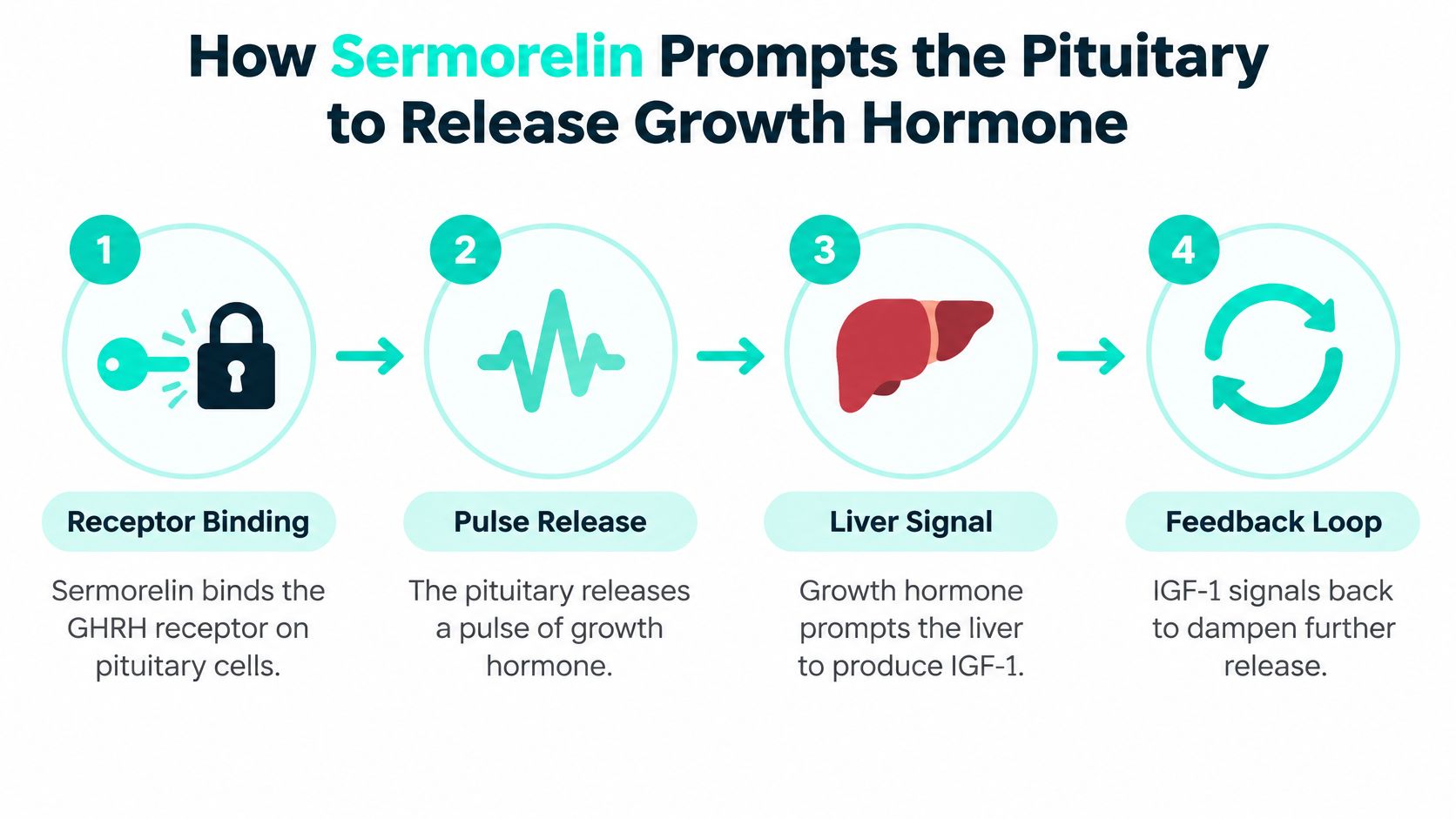
The short exposure window affects what a laboratory can observe. In pharmacokinetic data summarized in an endocrinology review, a 2 mg subcutaneous dose reached peak plasma concentration in about 5–20 minutes, had a reported half-life of about 11–12 minutes, and had adult clearance of roughly 2.4–2.8 L/min (FDA substance record summarizing sermorelin information). These are reference values for experimental interpretation, not a dosing recommendation.
| Parameter | Reported value | Design implication |
|---|---|---|
| Reference dose | 2 mg subcutaneous | Standardize dose and route across comparison groups |
| Time to peak plasma concentration | About 5–20 minutes | Place early sampling points within the first 20 minutes |
| Half-life | About 11–12 minutes | The stimulus is brief, so a single late GH draw can miss it |
| Adult clearance | About 2.4–2.8 L/min | Rapid removal limits the window of exposure |
| Acute hormone changes | GH mainly; no significant change in prolactin, gonadotropins, insulin, cortisol, glucose, glucagon, or thyroid hormones | Use as a specificity reference, while accounting for baseline pituitary status |
A single late growth-hormone measurement can miss a brief pulse. For an acute response study, plan time-resolved sampling across the early post-stimulus period; for a question about integrated downstream exposure, measure IGF-1 as a distinct endpoint rather than treating it as an immediate readout of the peptide itself. These measurements answer different questions.
Record the formulation, route, sampling intervals, fasting status, age, sex, body composition, and concurrent medications. Each can influence the observed pulse or downstream response, so leaving them out of the study record makes comparisons harder to interpret. For background on the distinction between a releasing peptide and administered growth hormone, see human growth hormone therapy explained.
Start with the research question, then choose the design and endpoint that can answer it. A test of pituitary reserve, for example, isn't the same as a repeated-dose study tracking a downstream biomarker.
Question: Does the pituitary respond to a GHRH signal? A diagnostic design gives a single intravenous or subcutaneous sermorelin dose and collects timed growth-hormone samples. The endpoint should be stated in advance, such as peak response or diagnostic classification. If the main aim is to distinguish a weak hypothalamic signal from reduced pituitary secretory capacity, comparing sermorelin alone with sermorelin plus arginine can add physiological context. Arginine can suppress hypothalamic somatostatin, reducing inhibitory tone.
Question: What changes during repeated treatment in adults with GH secretion deficiency? A randomized, double-blind adult study involving 134 participants reported that twice-daily dosing at 3 micrograms per kilogram produced the largest IGF-1 response, with a mean increase of about 187% and minimal tachyphylaxis over six months (review of sermorelin diagnostic and therapeutic research). The result concerns IGF-1 in the population and study context described, not a general claim about functional improvement in healthy adults.
| Research question | Typical design | Primary endpoint |
|---|---|---|
| GH reserve diagnosis | Single IV or SC dose with timed serial GH sampling | Peak GH response and diagnostic classification |
| Hypothalamic versus pituitary limitation | Sermorelin alone compared with sermorelin plus arginine | Difference in GH response between the two arms |
| Repeated dosing in GH-deficient adults | Twice-daily dosing over six months, randomized and double-blind | IGF-1 change over time and tachyphylaxis |
| Pediatric growth research | Multi-month observation, with preliminary data to 36 months | Growth velocity and GH release |
| Older healthy adults | Six-month randomized design | Biomarkers plus prespecified functional endpoints |
Question: Does treatment affect growth in children with deficiency? Pediatric research has assessed growth-hormone release and height velocity over several months, with preliminary observations extending longer. Those endpoints belong to pediatric growth research; they can't be substituted for adult performance, sleep, or body-composition outcomes.
A weak response to sermorelin alone doesn't prove pituitary failure. The result may reflect the broader hypothalamic-pituitary context, which is why an arginine comparison can help answer a more specific diagnostic question. Define the primary endpoint before the experiment begins: GH pulse amplitude, area under the concentration-time curve, IGF-1 change, and diagnostic classification aren't interchangeable measures.
A rise in IGF-1 is a biomarker result, and a biomarker result answers only the question it measures.
The growth-hormone axis works like a chain of measurements rather than a single switch. One study checks whether the pituitary can release GH on demand. Another tracks whether IGF-1 climbs under repeated dosing. A third follows height velocity in children. Each result describes one link in the chain, and none of them, on their own, measures sleep quality, fat loss, recovery, or lifespan.
The strongest part of that evidence is pediatric growth research and diagnostic physiology. A U.S. evidence review of sermorelin counted 435 total participants across two included studies, 279 of whom received sermorelin acetate as an experimental diagnostic intervention at an intravenous dose of 1 microgram per kilogram, given once or twice. The review describes older studies with differing purposes and protocols rather than one large, uniform modern trial, and it notes that large randomized trials in healthy adults measuring performance, body composition, or longevity have not been established.
| Study type | Population | Design and dose | Primary endpoint |
|---|---|---|---|
| Pediatric growth research | Children with idiopathic GH deficiency and growth failure | Multi-month observation, with preliminary data extending to 36 months | GH release and height velocity |
| Diagnostic GH reserve review | Adults and pediatric patients undergoing GH testing | 1 microgram per kg IV, once or twice; sermorelin alone compared with sermorelin plus arginine | Peak GH response and diagnostic classification |
| Adult GHD randomized trial | 134 adults with GH secretion deficiency | 3 micrograms per kg twice daily for six months, randomized and double-blind | IGF-1 change, mean rise about 187% |
| Healthy older adult trial | Healthy adults aged 60–85, 89 completers | Six-month randomized design | Sleep and lifting performance, no improvement established |
Read the table as four separate answers to four separate questions. A pediatric height-velocity finding applies to children with deficiency. A diagnostic response speaks to pituitary reserve. An IGF-1 rise confirms the axis responded, roughly the way a gauge confirms an engine ran; it does not report where the vehicle traveled. The row that comes closest to functional outcomes is the six-month randomized trial in healthy adults aged 60–85 with 89 completers, which did not establish improvements in sleep or lifting performance (discussion of sermorelin evidence in older adults).
Adult anti-aging use of sermorelin is off-label, and biomarker findings do not close the evidence gap for functional outcomes. When a claim about sermorelin appears, the useful question is which row of the table it actually belongs to.
For clear reporting, label each conclusion as clinical evidence, mechanistic rationale, or hypothesis. Pediatric growth velocity, biochemical GH response, body composition, sleep quality, and longevity are separate endpoints, and a careful comparison of related peptides preserves those distinctions, as in this overview of sermorelin versus tesamorelin.
A 99% HPLC result can still be insufficient for reproducible work. The headline percentage doesn't establish that the vial contains the intended molecule, explain which impurities contribute to the remaining signal, or confirm that the material hasn't degraded before use.
Start by separating identity from purity. Mass spectrometry or LC-MS can support identity confirmation by checking whether the measured molecular species matches the intended peptide. HPLC or UPLC reports the relative signal associated with the main peak under a particular method. Neither measurement answers every quality question on its own.
| Test | Question it answers | What to request |
|---|---|---|
| Identity by MS or LC-MS | Is the molecule the correct 29-residue species? | Mass spectra tied to the same lot number |
| Purity by HPLC or UPLC | What share of the signal is the main peak? | Chromatogram, wavelength, and method name |
| Impurity profile | Which related or degradation species are present? | Listed impurity peaks with their relative amounts |
| Residual solvents | Are synthesis solvents left in the material? | Test report or stated limits |
| Endotoxin | Is bacterial endotoxin present at a level that matters for the study? | LAL result where relevant to the workflow |
| Water or moisture content | How much of the weighed mass is water? | Stated value and test method |
| Lot match and test date | Does the CoA describe the vial in hand? | Lot number on CoA and label, plus test date |
Read the chromatogram and method details, not just the percentage. A main peak can look reassuring while related species or degradation products remain uncharacterized. The right level of testing depends on the experiment: endotoxin data may matter for one workflow and not another, while moisture content can affect how accurately a weighed mass represents peptide material.
Stability is another distinct question. A peer-reviewed study examined sermorelin fragments and found that some forms behave differently in blood and during enzymatic treatment. That means the exact peptide species and sample matrix matter for quantitative work (peer-reviewed study of sermorelin fragments and stability).
Practical rule: A certificate is only useful when its lot number, test date, and methods match the vial and the study's sample type.
If you're comparing batches or evaluating analytical documentation, use a research peptide test-results overview as a reference point for the kinds of records to inspect. Then confirm that the actual certificate provides evidence for the specific lot you plan to use.
Good handling records don't replace analytical testing, but they make results traceable. Use a consistent workflow for each lot so that storage, reconstitution, and time outside controlled conditions don't become hidden differences between samples.
Match the paperwork on arrival. Compare the vial label with the lot number and certificate of analysis before opening the container. Log any available shipping-temperature information so a mismatch or unusual excursion can be investigated before experimental use.
Follow the documented storage conditions. Keep the material protected from light and moisture, and follow the supplier's written instructions. Handling can change the peptide species being measured, so don't assume that two vials remain equivalent just because their labels match.
Record the reconstitution details. Use the specified diluent and write down the diluent, pH, volume, and time of preparation. Those details help another researcher reproduce the working solution and interpret unexpected assay results.
Aliquot to limit repeated handling. Divide the solution into single-use portions where the study permits, rather than repeatedly thawing and refreezing one stock. Repeated cycles can introduce avoidable differences between experimental runs.
Track time outside controlled storage. Keep working solutions cold and record how long they remain at room temperature before use. Transport time, temperature, and pH should be treated as experimental variables, not background details.
An assay-development study found that sermorelin and a metabolite degraded rapidly when urine was stored above 4 °C or at pH below 7 (assay-development study of sermorelin and its metabolite). Those findings concern urine, so don't apply them as a stability specification for another matrix. Instead, use them as a reason to validate temperature, pH, and transport time in the sample type your lab measures.
Recheck material before extended work. For a long experiment or an unusual delay, consider whether identity and concentration should be reassayed before the next run. Record the reason for the check and keep the result with the lot documentation.
Maintain one handling record per lot. Include the storage-temperature log, reconstitution history, aliquot dates, and time spent at room temperature before use. If a value can't be traced to a lot, a date, and a handling record, don't compare it with another batch as if the conditions were equivalent.
Order only when the lot number, identity data, and purity method on the certificate of analysis match the product being offered and your study's requirements. A stated purity percentage or a general claim of third-party testing isn't enough without a lot-specific document you can review.
Use a short pre-order sequence:
As one example of the questions to ask, Celonyx Labs states a 99% purity claim, references independent third-party testing, publishes shipping, return, and privacy policies, and lists business contact information. Those details can help you identify what to verify, but they aren't a substitute for reviewing the CoA for the specific lot you plan to buy. A documented vendor qualification process can also help laboratories organize their procurement checks.
Celonyx Labs offers research peptides for laboratory procurement and publishes product and ordering information that researchers can review alongside lot-specific documentation. If you're evaluating a sermorelin research peptide for a defined experiment, visit Celonyx Labs and request the batch records you need before ordering.
A 99% purity claim isn't a complete quality check for a sermorelin research peptide. It

Solid phase peptide synthesis is a method that builds a peptide one amino acid at

500 mcg equals 0.5 mg, a labeled research quantity, and no published human study establishes
FOR RESEARCH USE ONLY. Products sold by Celonyx Labs are intended exclusively for laboratory and scientific research. They are not intended for human or veterinary use, consumption, diagnosis, treatment, cure, or prevention of any disease. By purchasing from this site, you acknowledge that you understand the intended research purpose of these materials and agree to comply with all applicable laws and regulations.