

Is bacteriostatic water the same as sterile water? No 2026
Is bacteriostatic water the same as sterile water? No. Compare preservatives, vial handling and peptide

A GHK-Cu 100 mg vial looks simple on the bench. Blue lyophilized powder, intact stopper, clean label. Then the essential work begins.
Most failures with this peptide don't begin in the assay. They begin earlier, when someone treats reconstitution as clerical work, stores the vial casually, skips document review, or assumes a stock solution is stable just because it dissolved. That's how a promising wound-healing panel, fibroblast study, or exploratory neurobiology run turns into noisy data that can't be trusted.
A 100 mg format raises the stakes. It gives you enough material for repeat work, dilution series, pilot-to-follow-up continuity, and cross-assay use. It also gives you more opportunity to introduce drift. One misread concentration, one poorly planned aliquot scheme, or one week too long in the refrigerator can erase the advantage of buying the larger vial in the first place.
The practical gap isn't between theory and application. It's between a lyophilized peptide and verifiable data. Bridging that gap takes method discipline, not enthusiasm.
A new 100 mg GHK-Cu vial arrives on Monday. By Friday, one researcher has prepared a stock at the wrong concentration, another has left the vial at room temperature during setup, and the plate reader output now reflects handling variance as much as peptide activity. That sequence is common in peptide work, especially when a larger vial creates the impression that there is margin for error.
A GHK-Cu 100 mg vial supports continuity across pilot work, method adjustment, and repeat experiments under the same lot. That is useful. It also raises the cost of sloppy technique, because a single handling error can affect a long stretch of planned runs rather than one small test.
Published interest in GHK-Cu is not the limiting factor here. The practical gap is between a lyophilized powder in a sealed container and data you can defend in lab meeting, in peer review, or six months later when someone tries to reproduce the work. In practice, chain integrity from receipt to readout is paramount.
Practical rule: Treat reconstitution as part of the experiment, not prep work.
For a 100 mg format, variability usually enters through ordinary bench decisions:
Experienced labs control these points early. Reliable data begins before the seal is broken.
A labeled vial gives you a name. Experimental control requires a more exact picture of the material in that vial.
GHK-Cu is the copper-complexed form of the tripeptide glycyl-L-histidyl-L-lysine. It was first identified in human plasma and is relevant to researchers because its biological behavior depends on the peptide-copper complex, not just the amino acid sequence alone. For bench work, that distinction matters more than the familiar shorthand term “copper peptide.”
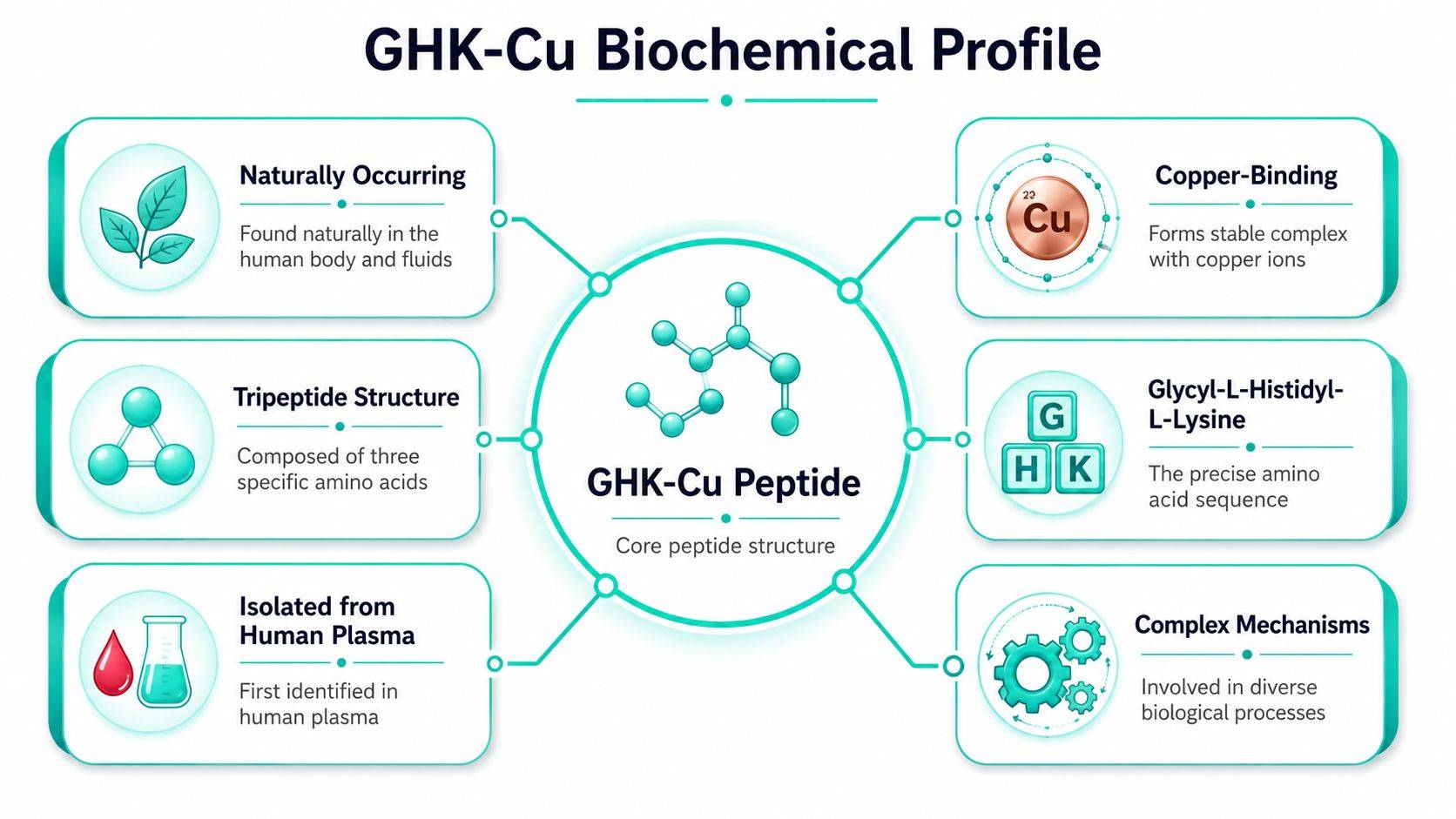
GHK-Cu is a small coordination complex with signaling relevance across several biological contexts. Researchers often encounter it in discussions of skin biology, wound repair, extracellular matrix turnover, and oxidative stress. That broad range is useful, but it also creates a common interpretation error. Teams start treating every readout as if it comes from one dominant pathway.
That is rarely a sound starting assumption.
In practice, GHK-Cu is better handled as a pleiotropic research molecule. If an assay shows a shift in collagen markers, inflammatory tone, or oxidative stress endpoints, the result may reflect overlapping mechanisms rather than a single clean upstream trigger. That affects protocol design. It also affects control selection, endpoint timing, and how aggressively you generalize from one model to another.
Unbound GHK and GHK-Cu should not be treated as interchangeable analytes. The peptide sequence can show biological activity on its own, but copper coordination changes the chemical species you are testing and can change the response profile observed in cell systems.
For a new post-doc, this is one of the first points I would lock down in the notebook. If the study question concerns redox biology, matrix remodeling, or inflammation-related signaling, copper status is part of the experimental variable set. It is not background chemistry.
A surprising amount of noise enters the literature, and internal lab datasets, when researchers write “GHK” in one place, “GHK-Cu” in another, and then compare the outputs as if the materials were equivalent. They are not. If the lot is sold as GHK-Cu, verify that the supporting documents match that identity and keep the naming consistent from stock preparation through final analysis.
The fastest way to misread a GHK-Cu experiment is to blur the line between the free peptide and the copper-complexed form.
GHK-Cu continues to attract preclinical interest because it can produce measurable effects at more than one level of analysis. Researchers have reported shifts in cell behavior, matrix-associated markers, and repair-related signaling. That makes it attractive for exploratory work. It also raises the burden on method discipline.
A phenotype-level change is not enough by itself. If fibroblast output changes after treatment, you still need to ask whether the effect tracks with peptide identity, copper complex integrity, solution age, vehicle composition, and the exposure window used in that specific model.
This is the practical chasm between a lyophilized peptide and defensible data. The biochemical profile is not background information for the introduction. It is the reason handling decisions matter. A 100 mg vial gives enough material to run repeats, optimize conditions, and compare systems under one lot, but only if the lab treats the compound as a defined chemical entity with method-sensitive behavior rather than a generic “repair peptide.”
A 100 mg vial can rescue a study or subtly destabilize it. The difference usually comes from handling discipline, not from the label on the carton. If one operator reconstitutes carefully, aliquots with a plan, and records every step, while another treats the vial as a generic peptide stock, the downstream data will not be comparable.
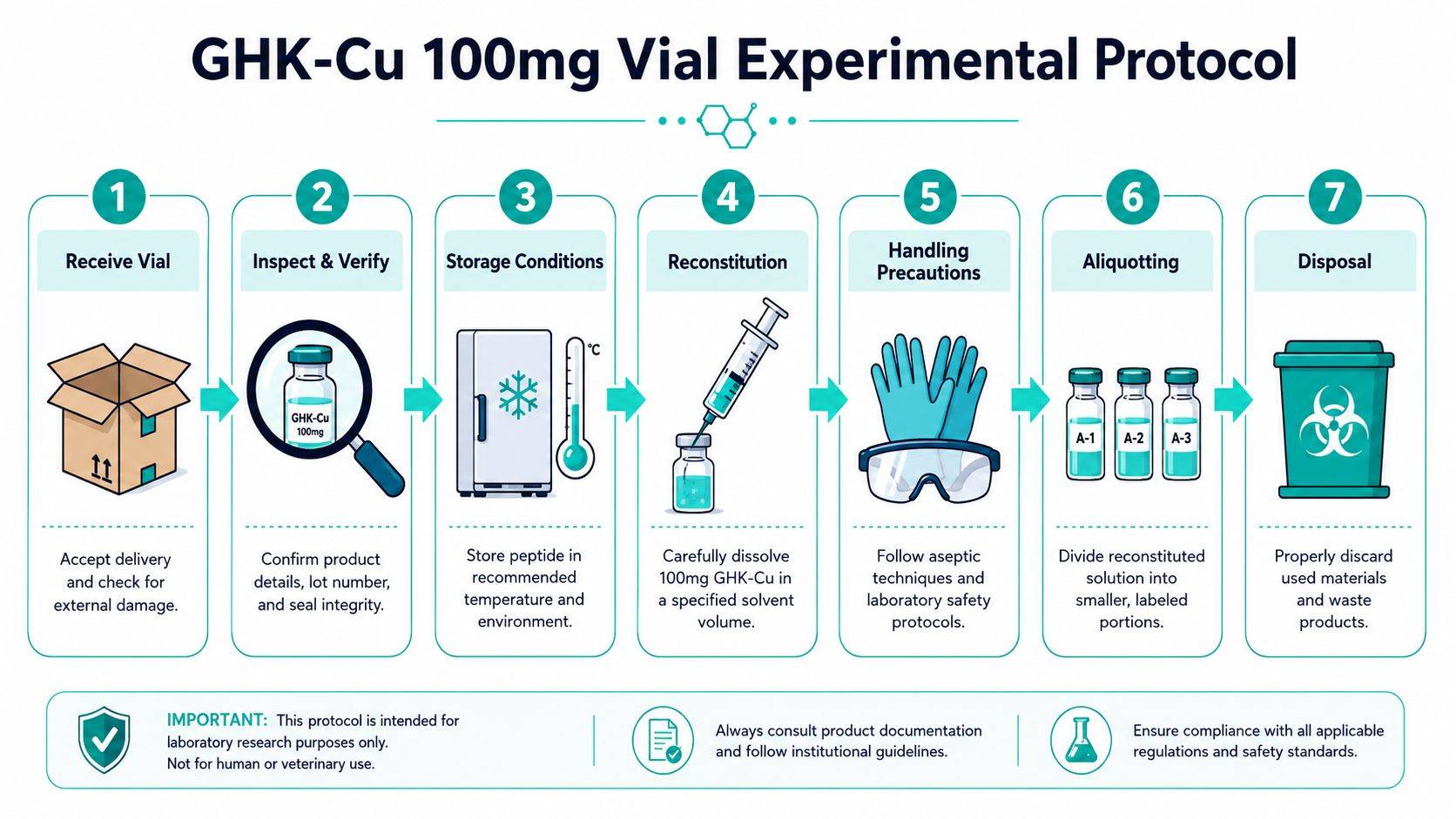
Begin with intake control. Before the stopper is pierced, inspect the shipping package, vial body, crimp seal, stopper, and printed lot information. Moisture intrusion, residue around the closure, cracked glass, or a partial label are enough to stop the material from entering active use until the discrepancy is resolved.
A short intake record prevents preventable confusion later:
| Checkpoint | What to confirm | Why it matters |
|---|---|---|
| Label match | Compound name and lot identifier | Prevents lot mix-ups |
| Container integrity | Stopper, crimp, glass, residue | Flags transport or storage problems |
| Receipt condition | Cold-chain or storage consistency if applicable | Helps interpret later anomalies |
| Planned use | Assay type and stock needs | Avoids unnecessary full-vial handling |
Timing matters here. Reconstitute the vial only when assay scheduling, staff availability, and storage capacity are aligned. A freshly prepared stock should support scheduled runs, repeat runs, and controls under known conditions, not sit in a refrigerator while the protocol is still being finalized.
For the 100 mg format, one commonly used protocol is reconstitution with 3.0 mL of bacteriostatic water, which yields a stock concentration of about 33.3 mg/mL, as outlined in this GHK-Cu 100 mg reconstitution protocol.
That concentration is practical in the lab. It keeps stock volumes compact, reduces repeated high-volume transfers, and makes dilution calculations straightforward if the team labels consistently. For groups standardizing calculations, dilution notation, and vial labeling across projects, this guide to peptide reconstitution workflows is a useful reference.
Use a controlled sequence:
Small handling differences matter more than many new researchers expect. Incomplete dissolution changes the effective concentration. Poor labeling breaks traceability. Repeated guesswork at the stock-prep stage is one of the fastest ways to turn a 100 mg vial into inconsistent data.
Later in the workflow, some teams like a visual reminder before bench use:
Treat the master stock as a controlled source material, not as the daily-use tube for routine pipetting. Lyophilized material is commonly kept frozen, and reconstituted solution is typically held under refrigerated conditions for a limited use window. The practical implication is simple. Repeated puncture cycles, temperature fluctuation, and casual relabeling create more variance than most assay notes capture.
For a 100 mg vial, aliquot strategy should match study design. If the project involves staggered cell assays over several weeks, prepare smaller working portions soon after reconstitution and leave the master stock undisturbed as much as possible. If the study is a short, concentrated run with all replicates performed in a narrow time window, fewer aliquots may reduce transfer error.
A practical bench approach looks like this:
Good peptide work often looks uneventful. That is the goal. A stable protocol preserves sample integrity, but more significantly, it preserves interpretation.
Many peptide problems look like protocol problems until you inspect the paperwork. If the starting material is mislabeled, degraded, or poorly characterized, clean execution won't rescue the study.

A Certificate of Analysis should answer basic identity and batch questions directly. Don't skim it for one purity line and move on. Read it as if you may need to defend the material choice in a lab meeting or audit trail.
At minimum, check:
If any of those items are missing, your confidence should drop immediately. Not because the material is necessarily bad, but because your ability to prove what you used has weakened.
A quality file becomes more credible when it combines internal release data with external confirmation. That second layer matters because peptide lots can look acceptable on paper while still raising unresolved questions about identity, contaminant peaks, or consistency between batches.
For that reason, researchers often rely on broader frameworks for documentation review, especially when evaluating research standards and vendor quality practices. A useful overview is this guide to the peptide reference standard and what researchers should verify.
Use this decision filter when reviewing material:
| Scenario | Interpretation | Action |
|---|---|---|
| Matching lot, clear identity, batch-specific analytics | Reasonable basis to proceed | File and document receipt |
| COA present but generic or incomplete | Weak traceability | Request clarification before use |
| Label and COA mismatch | Material chain broken | Quarantine |
| Good paperwork but odd physical appearance | Possible storage or transit issue | Hold and investigate |
Paperwork doesn't guarantee performance. It does determine whether poor performance can be interpreted rationally.
The practical lesson is blunt. If you wouldn't trust the batch record for a control reagent, don't trust it for GHK-Cu.
A 100 mg vial can support several preclinical programs on paper. In practice, the useful applications are the ones where the peptide's handling constraints, delivery method, and endpoint selection are aligned from the start.
GHK-Cu remains most credible in models tied to tissue repair, redox balance, inflammatory signaling, and extracellular matrix turnover. Those domains fit the peptide's known behavior. They also generate the kind of readouts that can be cross-checked across morphology, biochemistry, and functional outcomes, which matters if the goal is data you can reproduce in the next cohort rather than a single positive signal.
Skin and wound-repair work still offers the clearest preclinical fit. The literature repeatedly places GHK-Cu in contexts involving collagen production, fibroblast activity, and remodeling of damaged tissue. That makes it more useful in designs that measure process, not just endpoint appearance.
A common mistake is to treat the peptide as if one marker can stand in for tissue repair. It cannot. If the study reads out only one transcript, one oxidative marker, or one histology score, interpretation gets thin very quickly. Better designs pair upstream biology with downstream structure. For example, investigators may track matrix-related gene expression alongside collagen deposition, re-epithelialization, wound closure pattern, or other visible tissue features.
That approach does two things. It gives the peptide a fair test, and it reduces the risk of overcalling a weak or isolated effect.
Neuroprotection research is more exploratory, but there is a coherent reason to study GHK-Cu there. The peptide sits at the intersection of antioxidant activity, inflammatory regulation, and repair-associated signaling, so CNS models are not biologically arbitrary. As noted earlier, preclinical work has reported signal in amyloid-related and neuroinflammatory settings after intranasal delivery.
The route matters here. A positive result from an intranasal protocol should not be treated as proof that another formulation or exposure profile will behave the same way. This is a recurring problem in peptide studies. Researchers often discuss the compound as the variable of interest when the actual variable is compound plus formulation plus route plus handling history.
The strongest preclinical signal appears when mechanism, route, and endpoint structure fit the same hypothesis.
For that reason, neuro studies need tighter protocol discipline than broad summary articles usually admit. Define the behavioral endpoints before dosing starts. Pair them with inflammatory and histopathology measures. Keep the dosing rationale explicit enough that another lab could repeat it without guessing what happened between reconstitution and administration.
The weak point is not interest. It is comparative evidence.
Claims around hair growth, anti-aging, and systemic administration often run ahead of the data. The key limitation is straightforward. Evidence is not evenly developed across topical, local, and systemic use, and a mechanistic story alone is not enough to justify treating those routes as interchangeable. The available review of GHK-Cu hair growth evidence and data gaps makes that problem clear and also notes that GHK-Cu does not address DHT signaling directly.
That has direct implications for study design. A hair model built around androgen-driven miniaturization needs endpoints and comparators that match that biology. GHK-Cu may still be relevant in a mixed model involving inflammation, perifollicular tissue quality, or recovery from local damage, but it should not be positioned as if it covers an anti-androgen mechanism.
Many otherwise careful studies drift off course. The peptide gets assigned a role that fits market narratives better than experimental biology. Good preclinical design starts by narrowing the question, matching the route to that question, and choosing readouts that can distinguish matrix repair, anti-inflammatory activity, and route-specific artifact.
A surprising amount of experimental variability starts in procurement. Two labs can order “GHK-Cu 100 mg,” run nominally similar protocols, and still generate results that do not agree because the differences were introduced upstream, at vendor qualification, lot continuity, shipping control, or documentation.
For a 100 mg format, those details matter more than many new investigators expect. This vial size often supports multiple runs, multiple aliquots, or method development work across several weeks. If the material arrives with weak batch records or inconsistent fulfillment history, the problem is not administrative. It becomes part of the dataset.
Set vendor criteria before placing the order. At minimum, the supplier should provide batch-specific identity and purity records, clear research-use labeling, and enough operational transparency that your staff can reconstruct what was received, when it shipped, and how deviations are handled. GHK-Cu should be positioned for laboratory research use only. That distinction affects purchasing approvals, internal inventory language, and downstream recordkeeping.
Labs that want a repeatable screening process should use a documented vendor rubric rather than informal preference. A practical starting point is this guide to sourcing GMP-adjacent research peptides, not because every project requires GMP-grade material, but because the framework forces useful questions about lot traceability, change control, and supply continuity.
The review criteria should cover four areas:
Lot switching deserves special attention. With a 100 mg vial, many groups assume they can buy one unit now and solve resupply later. That works for pilot work, but not for a study that may expand after early signal detection. If follow-on material comes from a different lot with different supporting records, your comparison set is weaker before the assay even starts.
Treat GHK-Cu with the same discipline you would apply to any research peptide with incomplete route-specific characterization. Institutional handling rules, labeling, storage logs, access control, and waste segregation should be defined in the SOP and followed consistently. Overstating hazard is unhelpful. Casual handling is worse.
Earlier in the article, the toxicology discussion established that available preclinical data do not justify complacency. They support standard controlled handling, not improvised practices or loose documentation. For procurement teams and bench staff, the practical takeaway is simple. Buy material that can be traced, receive it into a documented system, and make sure every aliquot used in an experiment can be tied back to a specific lot and handling history.
That is how a purchased vial becomes defensible research material.
Troubleshooting works best when you resist the urge to blame the peptide first. Most bench problems come from concentration errors, handling history, storage drift, or model mismatch.

If the reconstituted solution appears cloudy, contains visible particulate matter, or develops precipitate after initially looking uniform, stop and investigate before using it in a critical assay.
Work through the likely causes in order:
A color shift can also be informative. GHK-Cu is known for its blue appearance, so any obvious change in intensity or uniformity should prompt a review of concentration records, storage history, and exposure conditions. Don't treat visual changes as proof of failure, but don't ignore them either.
Low or inconsistent bioactivity usually comes from one of four places: wrong stock math, wrong working dilution, compromised material, or an endpoint that doesn't fit the peptide's actual biology.
Run the elimination sequence:
If the stock history is uncertain, the result is uncertain.
Sometimes salvage efforts waste more time than a reset. Restart if the batch traceability is broken, the reconstitution record is incomplete, or the material appearance is inconsistent with prior verified runs and you can't explain why.
For routine exploratory work, you can sometimes learn from a compromised run. For comparative work, validation work, or anything heading toward publication-quality data, don't push ahead on doubtful material. Replace the stock, document the deviation, and rerun clean.
If your lab needs research peptides backed by documented quality controls, batch transparency, and a purchasing workflow built for investigators, review the catalog and support resources at Celonyx Labs.
Is bacteriostatic water the same as sterile water? No. Compare preservatives, vial handling and peptide

How do you know if a peptide vial has gone bad? Quarantine changes, check storage

Can too much bacteriostatic water ruin a peptide vial? Yes, if it overfills the vial
FOR RESEARCH USE ONLY. Products sold by Celonyx Labs are intended exclusively for laboratory and scientific research. They are not intended for human or veterinary use, consumption, diagnosis, treatment, cure, or prevention of any disease. By purchasing from this site, you acknowledge that you understand the intended research purpose of these materials and agree to comply with all applicable laws and regulations.