

Best low dead-space syringes for peptide research 2026
Choose a low dead space syringe for peptides by transfer volume, needle design, and material
The most common advice about the tesamorelin peptide price is to hunt for the cheapest vial and divide the sticker price by the milligrams on the label. That advice fails, and it fails in a way that's easy to measure. A vial is a container, not a dose, and a purity percentage is a claim, not a result. Once you count single-dose wastage, cold-chain freight, import brokerage and the repeat runs caused by an undocumented lot, the lowest listing on the page often produces the highest cost per finished experiment.
There's a second problem underneath the first. Almost every number circulating online describes a regulated prescription product sold through pharmacies and payers, not lyophilized material sold to a laboratory. Those are separate markets with separate packaging, separate dosing conventions and separate documentation. Comparing them directly is like comparing a hospital's billed charge to a reagent catalog line.
Everything below is procurement information for laboratory purchasing. The material discussed is for research use only, not human use, and nothing here is medical advice.
There's no single tesamorelin price for research-grade material. What exists is a set of published pharmaceutical benchmarks, each tied to a country, a year, a vial strength and a payer. Line them up and the spread stops looking like contradiction and starts looking like category error.
The 2016 CADTH pharmacoeconomic review recorded a manufacturer-submitted price of CAD$3,085 for a box of 60 single-use 1 mg vials, a 30-day supply at a modeled dose of 2 mg subcutaneously once daily, with annual drug costs translating to CAD$37,534 per patient per year. That review also projected a 30-year treatment cost of CAD$611,657 in its reference case and found tesamorelin more expensive and no more effective than standard care in that modeled scenario.
| Reference | Unit quoted | Price | Annual or monthly view | Context |
|---|---|---|---|---|
| Canada, CADTH 2016 review | Box of 60 x 1 mg vials | CAD$3,085 per box | CAD$37,534 per patient per year | Regulated prescription product, historical |
| United States, 2020 cost-effectiveness model | Box of 60 x 1 mg vials | US$5,300 per box | US$63,600 per year | Modeled list price for HIV-associated lipohypertrophy |
| Medicare Part D, 2024 average | 2 mg vial | About $240 per vial | Aggregated per claim rather than per month, so claim totals scale with the number of vials dispensed | Payer-paid amount, not retail |
| Recent wholesale acquisition cost estimates | Annual treatment course | Published as a list-price estimate, not a transaction price | Quoted before rebates, insurance and patient assistance reduce what anyone actually pays | Manufacturer pricing, US market |
| Research-use catalog quote | Per vial or per mg | Set by the supplier's fill, declared purity and lot documentation | Quoted price multiplied by vials consumed per 30 days | No published benchmark, request a batch-specific quote |
Read the rows as five separate instruments, not five competing quotes. The Canadian row is a historical, regulated pharmaceutical benchmark. It isn't a research price, and it never was one. The US row is a modeled list price from a cost-effectiveness analysis, not a pharmacy receipt. The Medicare row is what a payer paid, which is a third thing entirely: Peptifact's compilation of CMS Medicare Part D spending data puts the 2024 average at $240.07 per Egrifta SV vial.
Working figure: use CAD$51.42 per vial (CAD$3,085 divided by 60) for arithmetic, and cite the box total when precision matters, since the review reports a submitted price of CAD$51.46 per vial.
The procurement consequence is direct. Payer benchmarks include distribution margins, pharmacy fees and negotiated rebates that never appear in a laboratory quote, while research quotes carry fill volume, purity documentation and lot traceability that payer data never records. A per-vial research number and an annual payer number aren't two prices for one thing. They're prices for two things that share a molecule name.
The endpoint list is the budget. Write it before you request a single quote, because the number of milligrams you need is a downstream consequence of what you intend to measure and how long you intend to measure it.
The regulatory context is narrower than most pricing pages imply. As LegalClarity's review of tesamorelin coverage criteria explains, the FDA-approved indication is reduction of excess abdominal fat in adults with HIV-associated lipodystrophy, not general weight loss, which is why coverage is often restricted and placed on specialty tiers with substantial coinsurance. A study designed outside that population needs a clearly defined model and a stated rationale, not an extrapolation from someone else's trial.
Fat mass, hepatic fat, metabolic markers and body composition are four distinct measurement problems, not one. Each endpoint you carry into your protocol adds its own recurring charge:
Notice what that list implies. The peptide itself is only one line in a budget dominated by measurement. A cheap vial does nothing to reduce imaging slots, assay kits or reader hours, which is why the lowest per-vial listing frequently produces the most expensive finished experiment once documentation gaps force repeat work.
Duration multiplies everything. Subjects times doses per subject times study length gives total milligrams, and a year-long design consumes vastly more material than a one-week pilot. Longitudinal endpoint sets, the kind that pair repeated imaging with repeated metabolic panels, drive material volume and monitoring spend together, and the monitoring side often grows faster because it scales with visits rather than with dose.
There is also a genuine tension in the value literature worth knowing before you build a business case. Long-term safety questions and cost-effectiveness arguments remain open in the published discussion, while payer-side models have published explicit ratios for the approved indication. Treat those models as benchmarks for the approved pharmaceutical product, not as a budget template for your study. They price a finished, regulated therapy inside an insurance system. Your budget prices a research question.
Write the endpoint list, the duration and the monitoring schedule first. Then price the milligrams, and let the experiment's total cost, not the catalog's cheapest vial, decide which quote you accept.
A headline vial price tells you almost nothing until it's converted into cost per milligram of fill and cost per 30 days of your actual dosing plan. Two quotes with identical per-vial prices can differ by a factor of two once fill and dose are normalized.
The current EGRIFTA SV labeling on FDA/DailyMed identifies a 2 mg single-dose vial and a recommended dose of 1.4 mg subcutaneously once daily, administered as 1.4 mg in 0.35 mL. The labeled daily dose therefore consumes 70% of the nominal vial content, and each vial is single-dose, not a multi-use container. The older pharmacoeconomic benchmark modeled 1 mg vials at 2 mg daily, so its per-vial figure and a 2 mg-vial quotation aren't comparable until you convert both.
| Benchmark | Vial fill | Daily dose | Vials per 30 days | Cost per mg of fill |
|---|---|---|---|---|
| CADTH 2016 Canadian benchmark | 1 mg | 2 mg | 60 | CAD$51.42 |
| EGRIFTA SV labeling | 2 mg | 1.4 mg | 30 | Quoted vial price divided by 2 |
| Your research quote | Fill stated on the vial label, in mg | Your protocol's dose per administration, in mg | Doses per 30 days, one vial per single-dose use | Quoted vial price divided by mg of fill |
Say a supplier quotes $100 for a 2 mg vial. Run it in three steps.
The formula generalizes cleanly. Cost per mg of fill equals quoted price divided by mg of fill. Cost per 30 days equals quoted price multiplied by vials consumed in 30 days. If your protocol splits a vial across administrations, that's a different wastage assumption, and you should state it explicitly rather than inherit the label's single-dose convention by accident. Our guide to peptide vial sizes walks through how fill choices change that arithmetic.
Record the salt form on the quote, not just the peptide name. The labeling specifies tesamorelin as an acetate salt, and a quotation that doesn't state its salt form isn't describing the same material.
Two quotes with the same cost per mg can still differ on usable doses. Fill the third row with your own numbers before you rank suppliers, and log reconstitution volume alongside them so wastage stays visible instead of disappearing into a rounding error.
A purity percentage is one line in a documentation package, and it's the line most easily printed without support. What you're buying is the package.
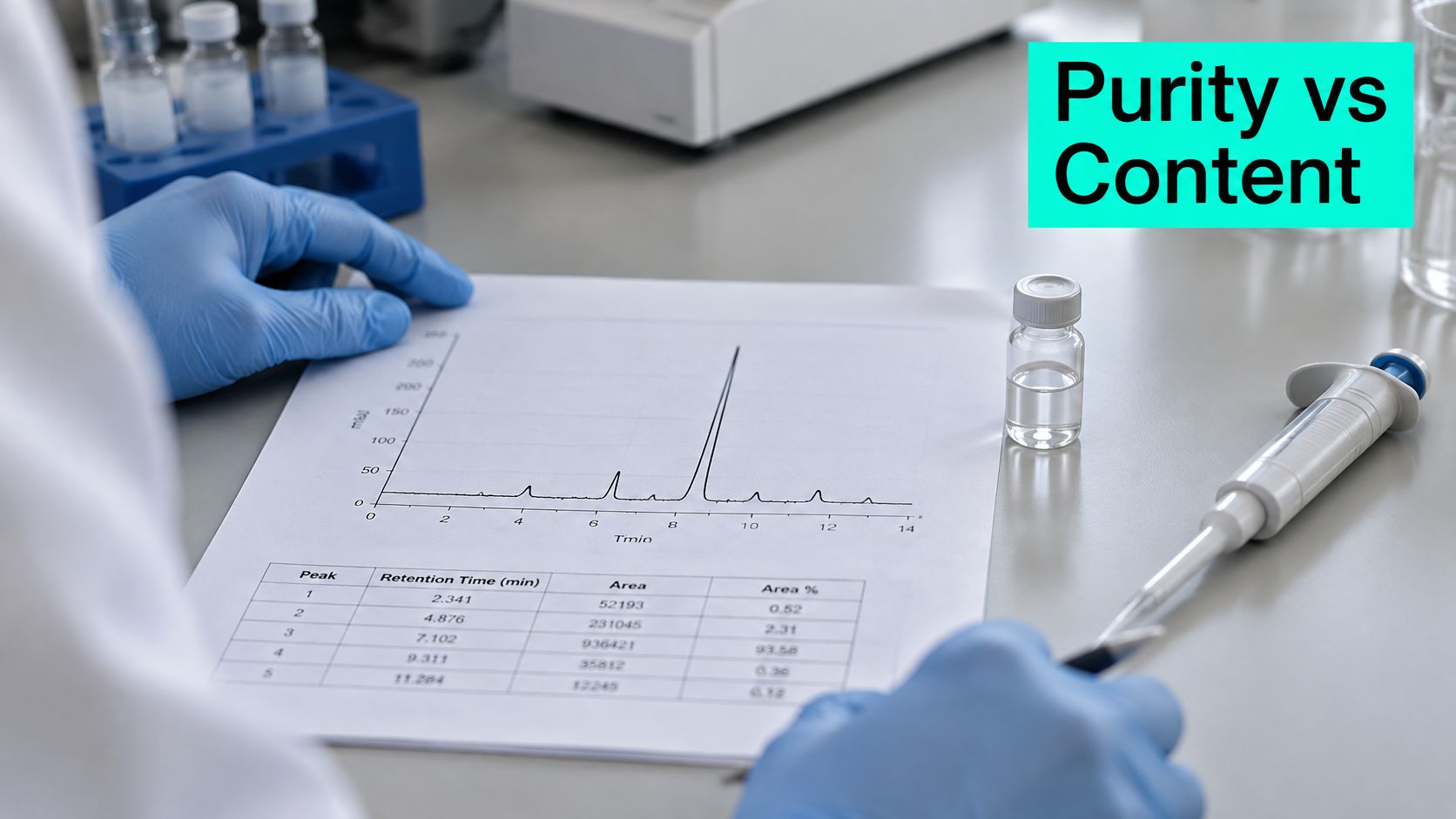
HPLC or UPLC purity measures relative peak area in a chromatographic run. It tells you how dominant one species is in the detected profile, not how much peptide sits in the vial. Net peptide content answers the second question: how much of the vial's weight is peptide after counterions, salts and residual water are accounted for. A high purity figure and a low net content can coexist in the same batch, which is why a lab paying per milligram should ask for both.
Identity confirmation by mass spectrometry establishes that the molecule matches the claimed sequence. It's only meaningful when the report's lot number matches the lot number on the vial you receive. A batch-specific certificate of analysis carries a lot identifier, a test date and a named method. A generic certificate carries a purity number and nothing that ties it to your material.
Consider two listings. One advertises 99% with a downloadable report showing no lot, no date and no method. The other advertises 97% with a lot-matched package naming an independent laboratory and a test date. For a laboratory, the second listing is worth more, because it lets you confirm identity and estimate repeat-work risk before you commit a study to that batch. The first leaves you funding your own verification, or worse, discovering the problem after a run.
Documentation costs the supplier money, so a fully documented quote will sit higher than a bare one. That premium is usually the cheapest line in your budget. Our notes on third-party tested peptides cover what an independent report should contain and how to read one against a vial label.
The video below walks through how a chromatographic report is structured and where buyers misread it.
Before paying, check five things:
A quote becomes useful when it collapses into one number: what it costs to finish the experiment. The layers below are what stand between a catalog price and that figure.
The neutral 2026 pricing analysis at Biocosm reports an approximate wholesale acquisition cost of $72,000 annually, or about $6,000 monthly, while noting that rebates, insurance and assistance programs can materially reduce what an eligible patient pays. The same coverage summarizes Medicare data showing a 2024 average payment of approximately $240 per 2-mg Egrifta SV vial and about $7,823 per claim. Manufacturer list price, insurer-paid amount, patient out-of-pocket cost and research-use material aren't interchangeable, and a vial-level figure sitting next to a monthly total is how buyers end up confused about which market they're pricing.
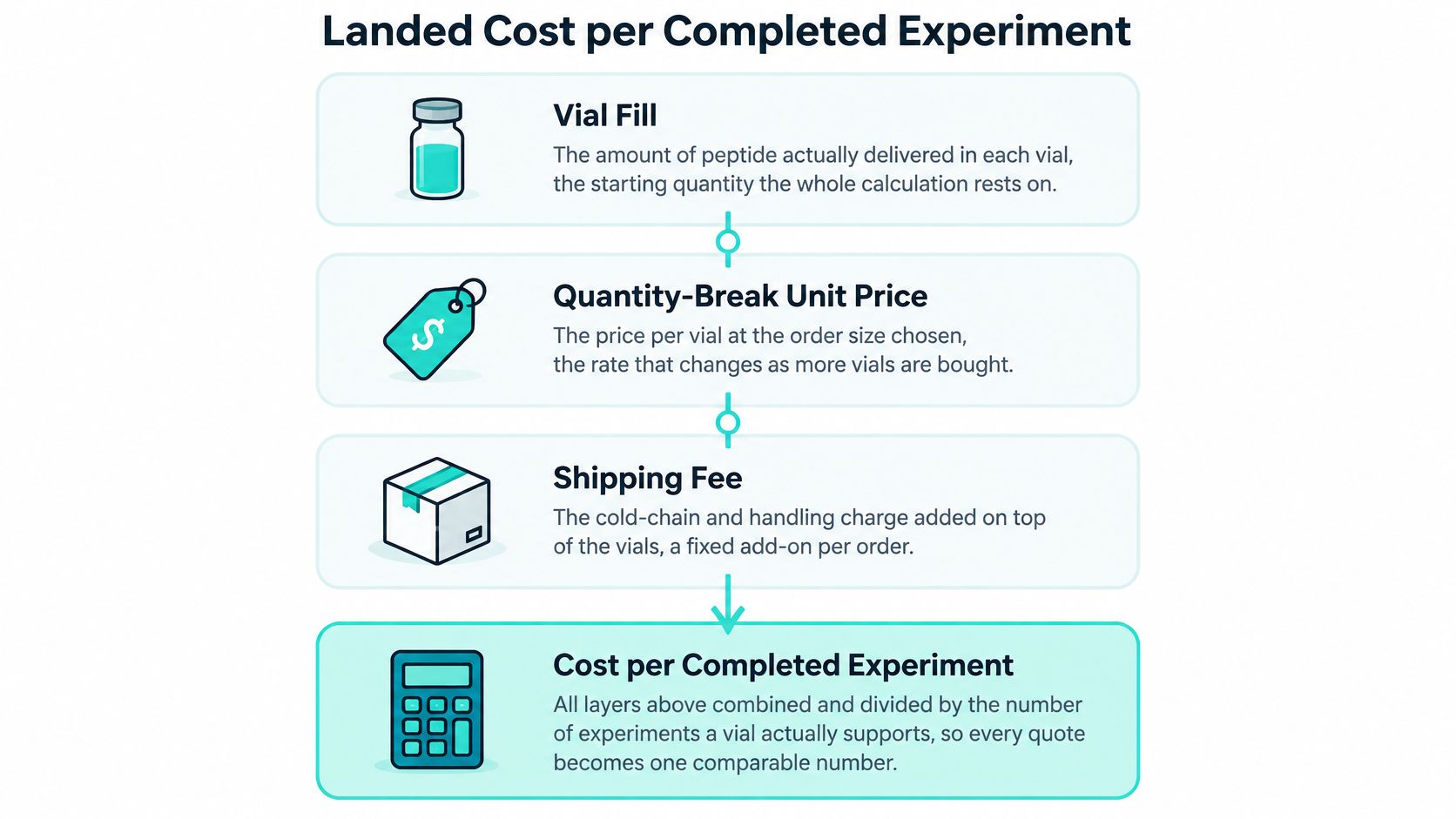
The cheapest listing isn't the lowest-cost experiment when identity, purity, stability or documentation problems force you to run it twice.
Three slips account for most bad comparisons: mismatched salt forms, ignored cold-chain and brokerage fees, and treating an undocumented listing as the low bid. Finish with one cost-per-experiment figure per supplier, written on the same line as that supplier's lot documentation status. If a supplier's figure only looks competitive while its documentation column is empty, it isn't competitive.
Send a written request before you pay anyone. A supplier who answers it fully has given you every input the cost-per-experiment calculation needs. A supplier who answers it partially has told you something more valuable than a discount.
Ask for the lot number and the matching certificate of analysis; the purity method and value; identity confirmation tied to that lot; the salt form; vial fill and labeled dose; reconstitution volume; the name of the independent testing laboratory and the test date; the shipping method and temperature controls; an import fee estimate for your destination country; quantity-break unit prices; and the total landed price for the milligrams your protocol requires. Ask the supplier to confirm that tesamorelin itself is available in a documented batch, since no verified research-catalog price appears in the published benchmarks. Our vendor qualification process sets out the same questions in the order we ask them.
All material should be labeled for research use only and must not be used for human consumption. Every peptide we supply is labeled "For Research Use Only." This is procurement information, not medical advice.
Replies that include a lot-matched report go into your comparison table. A catalog figure or a verbal quote without one stays in a separate column marked unverified.
If a provider can't name the lot, the method and the testing lab, treat the quoted price as unverified and use it only as a rough estimate.
Send the identical request to three suppliers and compare landed cost per completed experiment, not per vial.
Celonyx Labs supplies research peptides labeled "For Research Use Only," with stated 99% purity, independent third-party testing, free shipping on all orders, and a Peptide Reconstitution Calculator to help you fix reconstitution volume before you work out usable milligrams. Put those inputs into the cost-per-experiment calculation above and request a batch-specific quote for the fill and quantity your protocol needs. Visit Celonyx Labs to review the catalog and send your documentation request.
Choose a low dead space syringe for peptides by transfer volume, needle design, and material

Peptide supplier small order quantity guide: choose by vial size, batch evidence, and research fit.

Compare ghk-cu bpc-157 combination peptide research options. Choose separate vials by study needs, documentation, and
FOR RESEARCH USE ONLY. Products sold by Celonyx Labs are intended exclusively for laboratory and scientific research. They are not intended for human or veterinary use, consumption, diagnosis, treatment, cure, or prevention of any disease. By purchasing from this site, you acknowledge that you understand the intended research purpose of these materials and agree to comply with all applicable laws and regulations.