

Bacterial Water Treatment: Mechanisms, Technologies
In the United States, typhoid fever fell from about 100 cases per 100,000 people in

You've found a listing for SLU-PP-332, the page calls it a peptide, and the vendor promises exceptional purity. Before you compare prices or enter a purchase order, stop. The first question isn't “Where can I buy SLU-PP-332?” It's what exactly is being sold under that name?
That distinction controls the identity tests, catalog classification, storage instructions, customs description, and interpretation of every result generated in your lab. SLU-PP-332 is discussed online as an “exercise mimetic,” but neutral references describe it as a synthetic small molecule, not a peptide. Treat the purchase as a chemical research procurement, not as a routine peptide order.
The naming problem is the first procurement risk. Some commercial pages place SLU-PP-332 in peptide catalogs or describe it as an exercise-mimetic peptide, while neutral references identify it as a synthetic small molecule with no amino acids or peptide bonds. The SLU-PP-332 reference entry specifically highlights this mismatch and the way inconsistent labeling can create ordering and documentation errors.
For a laboratory buyer, the practical definition is simple. SLU-PP-332 should be handled as a research-grade chemical compound intended for laboratory investigation, not as a product for human or veterinary administration. A legitimate listing should make its research-only status unmistakable and should identify the material with a structure, accepted synonym, catalog or product code, and a batch number. Don't accept “exercise peptide” as a substitute for chemical identity.
Expect the material to arrive as a lyophilized powder in a sealed, batch-coded vial, subject to the supplier's documented handling instructions. The package label, packing slip, and Certificate of Analysis should all identify the same material and lot. Ask the vendor to provide the CAS-style identifier convention it uses, molecular formula, molecular weight, and structure before checkout so your purchasing and inventory records can be reconciled.
Those identifiers are sanity checks, not proof of quality. A listing can display a plausible molecular description and still contain the wrong compound, a salt variant, an analog, or a blend. The identity problem becomes especially serious when a vendor borrows peptide terminology without showing analytical evidence appropriate to the compound being sold.
Procurement rule: If the vendor can't clearly state whether the product is SLU-PP-332 itself, a salt, an analog, or a mixture, don't order it.
Before payment, demand three things: explicit Research Use Only labeling, batch traceability from vial to documentation, and a matching COA with identity and purity methods. The rest of the purchase should follow those checks, not replace them.
A credible supplier should survive a short, repeatable screening process. Start with the basics, then test whether the company behaves like a research supplier rather than a consumer storefront.
Check the following before requesting a quote:
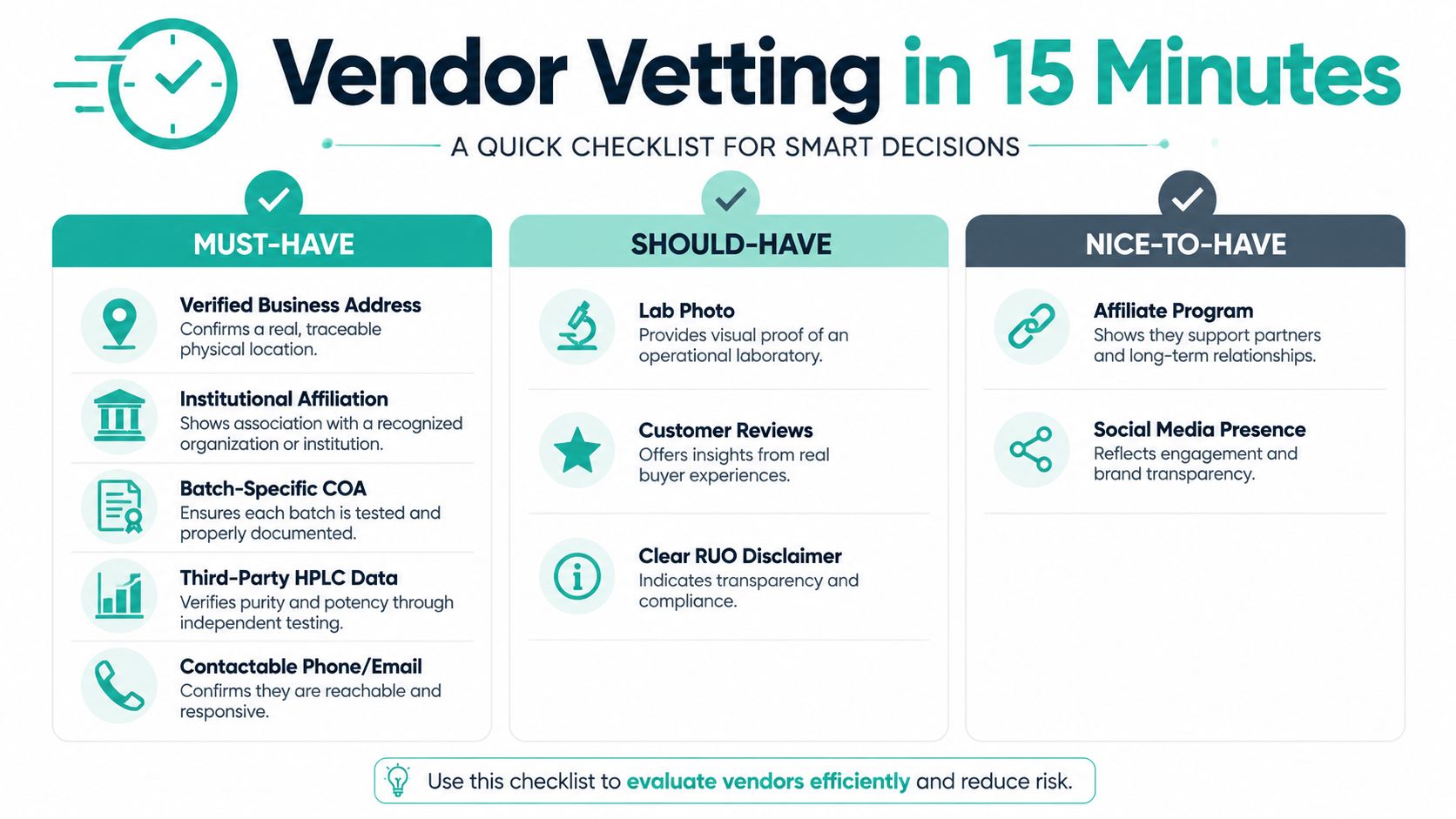
Don't let a polished website outweigh missing controls. If more than two of the signals above fail, walk away. That rule keeps a low price or attractive product photo from pulling your team into an undocumented purchase.
The broader market gives this discipline context. One peptide market summary places the global peptides market at USD 43.12 billion in 2024, with a projection of USD 91.79 billion by 2035. The same report attributes over 44.63% of the market to North America, representing about USD 19.26 billion in revenue. Those figures describe the broader peptides category, not proof that any individual SLU-PP-332 listing is legitimate, but they show why professional documentation and cross-border accountability matter.
For general supplier-screening context, review the research peptide purchasing guidance only after applying the compound-identity test. SLU-PP-332 shouldn't receive a pass merely because it appears beside conventional peptides.
A COA is useful only when it lets you connect the material in your hand to a defined analytical result. Read it as a chain of evidence, not as a certificate-shaped marketing claim.
The first line should identify the compound and any declared synonym. Next, confirm the lot or batch number, manufacturing date, expiry or retest date, physical description, and test date. The purity result must name the method. HPLC without a chromatogram is incomplete, and a purity percentage without a method column tells you almost nothing about how the figure was generated.
Identity needs separate support. Mass spectrometry can help confirm molecular mass, while NMR may provide additional structural evidence where available. Also look for residual solvent testing, the testing laboratory's legal name, accreditation or quality status, analyst signature, and a report identifier that can be independently checked.
| Required COA Field | What to Verify | Red Flag |
|---|---|---|
| Compound name and synonym | Name matches the purchase order and vial label | Generic “research material” description |
| Lot or batch number | Number matches the vial, packing slip, and invoice | No lot number or a different lot |
| Purity and method | HPLC result includes the method and chromatogram | Purity claim with no analytical method |
| Identity confirmation | Mass spectrometry or NMR data supports the stated compound | Purity shown without identity evidence |
| Dates | Manufacturing, testing, and expiry or retest dates are coherent | Missing dates or reused dates |
| Testing laboratory | Lab can be independently located and contacted | Unverifiable lab name or logo only |
| Signature and report code | Document has accountable approval and traceability | Unsigned PDF with no report identifier |
The third-party testing resource explains why external testing matters, but the procurement standard remains the same for this small molecule. In-house QC can be technically competent, yet it's still the seller's own assertion. Independent testing creates a stronger record for purchasing review, deviation investigations, and audit files.
A striking purity claim deserves more scrutiny, not less. Research on synthetic peptides found that one purchased product was a different peptide, while two-thirds of the other tested products were unsuitable for in vitro or in vivo work because purity was below 95% and/or individual impurities exceeded 1%, as summarized in this analytical quality-control reference. Although that study concerned peptides rather than SLU-PP-332, the procurement lesson transfers directly: vendor claims require independent confirmation.
Reject documentation with missing dates, no method, identical COAs reused across products, or a testing lab nobody can confirm.
A defensible order begins before the cart. Create an institutional or research account using your organization's details, attach a business email, and identify the procurement contact or principal investigator responsible for the work. If the supplier asks for end-use information, answer it accurately. Don't create a consumer account to bypass a research-use review.
Use this sequence:
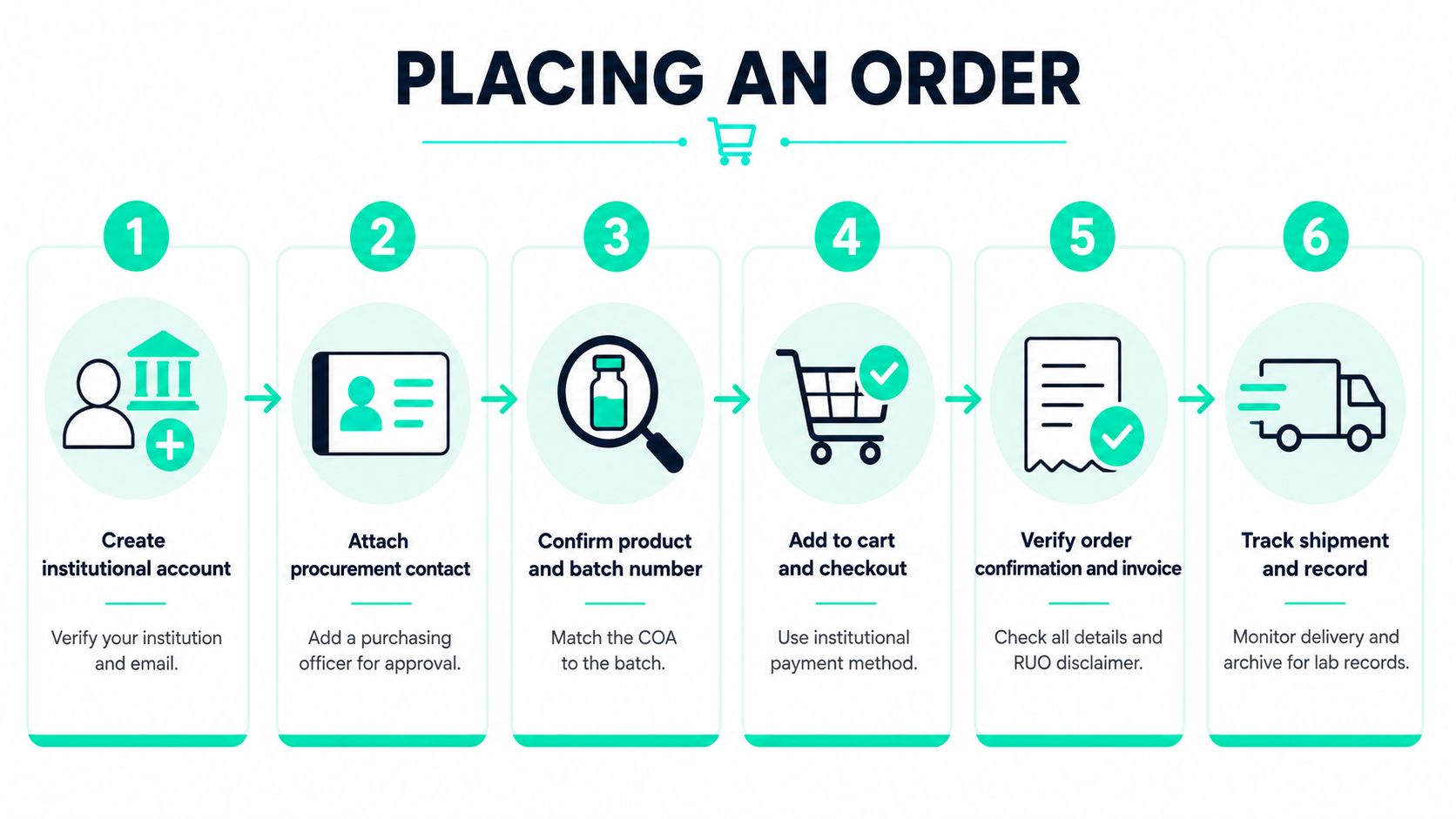
Before submitting payment, compare the product code against the COA lot number. If the vendor says the COA is representative rather than batch-specific, ask for the actual lot report or remove the item from the order. A photograph showing multiple vials also shouldn't be treated as proof that the displayed quantity will arrive.
Recheck the shipping address, purchase-order reference, invoice recipient, and research-use declaration. Suppliers may delay or reject an order during compliance review if those fields conflict. That delay is preferable to receiving material that your lab can't document.
Lyophilized material is generally easier to ship than an aqueous solution, but “stable powder” doesn't mean “ignore transit conditions.” The important variables are seal integrity, residual moisture, and cumulative warm exposure.
Independent stability guidance reports that properly sealed lyophilized peptides usually tolerate several days at room temperature and short exposures around 30–40°C without measurable purity loss. The same shipping and cold-chain reference identifies residual moisture, seal integrity, and total time above approximately 30°C as the practical control points. That evidence concerns lyophilized peptides, so apply it as a logistics principle, not as a compound-specific stability guarantee for SLU-PP-332.
Open the shipment in the laboratory, not at a personal residence or an uncontrolled storage area. Record the delivery time, exterior condition, temperature indicator or shipping log, packaging configuration, and any visible damage.
Inspect the vial for an intact stopper, undamaged glass, an uncompromised seal, and the expected powder appearance. Check that the lot number on the vial matches the COA and packing slip. A collapsed vial, broken seal, unexplained discoloration, missing desiccant, or mismatched label should trigger quarantine and a supplier query.
| Stage | Temperature | Max Duration | Integrity Check |
|---|---|---|---|
| Transit for properly sealed lyophilized material | Follow the supplier's validated shipping terms | Use the documented transit window | Review temperature record and seal |
| Short-term active-use storage | Use the supplier's validated range, with 2–8°C reserved for temperature-sensitive material | Follow the vendor's stability instruction | Confirm stopper, label, and dry powder |
| Longer-term storage | Consider −20°C or −80°C only where supported by compound-specific documentation | Don't invent a shelf life | Prevent moisture and repeated warming |
| After reconstitution | Use the validated solvent and storage condition | Follow stability data for the actual formulation | Record preparation, concentration, and container |
Don't automatically place every shipment into a cold chain. The cited guidance recommends 2–8°C for especially temperature-sensitive sequences, while properly sealed lyophilized material can often tolerate ordinary transit. For SLU-PP-332, ask the supplier for compound-specific stability data rather than borrowing peptide assumptions.
Handle the powder with appropriate laboratory PPE, containment, and ventilation based on the SDS and institutional risk assessment. Reconstitute only under an approved procedure, record the solvent and preparation details, and log any delay between opening and use. For additional handling context, see this guide to storing reconstituted research materials, while recognizing that SLU-PP-332 isn't a peptide.
Buying SLU-PP-332 is a research procurement decision, not a consumer transaction. The product's preclinical status makes that distinction essential. The peer-reviewed literature describes research in mouse models involving metabolic syndrome, energy expenditure, fat mass, and insulin sensitivity, but the published study record doesn't establish human efficacy, a validated human dose, or an approved clinical use.
Research Use Only labeling supports legitimate laboratory activities such as in vitro experiments, assay development, analytical characterization, and preclinical research conducted under institutional controls. It does not authorize human administration, veterinary administration, personal experimentation, or marketing the material as a treatment or performance product. “Exercise mimetic” is a research description of biological interest, not a permission slip for consumer use.
Your purchase order should identify the institution, end-use category, principal investigator, receiving department, and responsible contact. Keep the quote, invoice, COA, SDS, import documents, customs correspondence, shipping record, and receipt inspection together. That chain protects the buyer during an audit and gives the vendor a clear record of the intended use.
For cross-border orders, ask the supplier how it will describe the material to customs and which documents it provides. Your institution should separately determine whether the compound triggers controlled-chemical, precursor, import, or institutional biosafety requirements in the destination jurisdiction. Don't rely on a seller's statement that “research chemicals ship worldwide.”
Ethical boundary: A vendor that markets SLU-PP-332 for personal weight loss, endurance, or physique enhancement is not demonstrating flexibility. It's demonstrating poor compliance discipline.
Disclose relevant conflicts of interest, document custody from receipt through disposal, and restrict access to trained personnel. If the supplier refuses to state the end-use restriction, avoids customs documentation, or encourages human use through coded language, choose another supplier. The best price is irrelevant if the material creates a legal, ethical, or reputational problem for the laboratory.
Keep this list open while reviewing a quote. Treat each line as a procurement gate, not a suggestion.
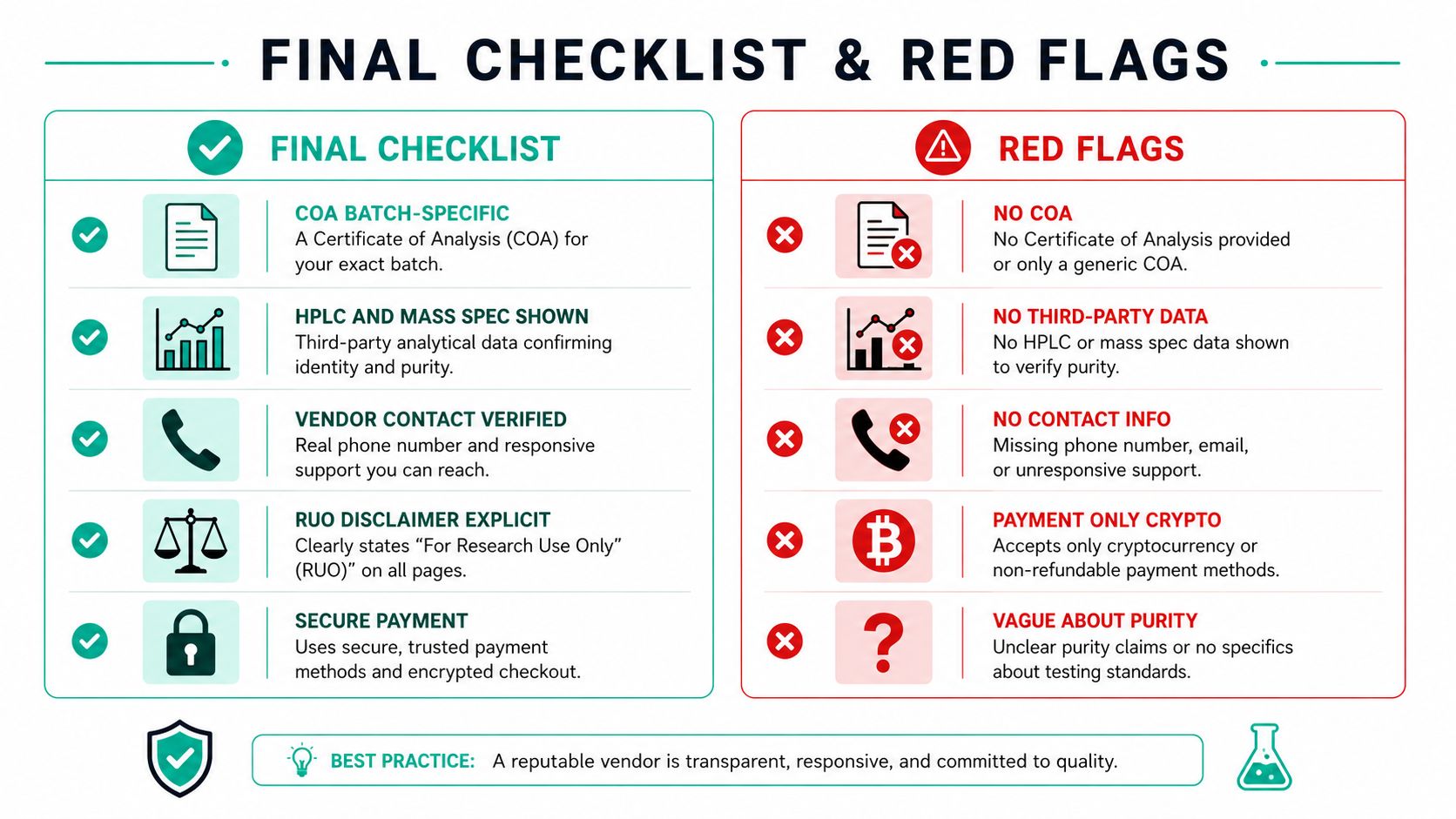
The final decision should be blunt. If identity, batch documentation, independent testing, RUO controls, contactability, or payment records fail, don't buy. A low price can't compensate for an untraceable material, and a polished COA can't resolve a mislabeled compound.
Synthetic research materials require independent confirmation because purity alone doesn't guarantee reproducibility. Guidance on peptide batch variability notes that even lots both reported at 99% purity can differ in impurity profile, counter-ion content, and water content, potentially shifting assay behavior, as explained in this batch-variability reference. Apply that principle here: verify identity, lot, method, storage, and intended use as one connected record.
Celonyx Labs offers research materials through an online laboratory supply catalog, with stated 99% purity and independent third-party testing for its peptide products, plus published ordering and shipping policies. Visit Celonyx Labs to review the catalog and contact the team about documentation, procurement requirements, and research-use ordering.
In the United States, typhoid fever fell from about 100 cases per 100,000 people in

You've found a listing for SLU-PP-332, the page calls it a peptide, and the vendor
The most popular advice about third party testing labs is also the least useful: look
FOR RESEARCH USE ONLY. Products sold by Celonyx Labs are intended exclusively for laboratory and scientific research. They are not intended for human or veterinary use, consumption, diagnosis, treatment, cure, or prevention of any disease. By purchasing from this site, you acknowledge that you understand the intended research purpose of these materials and agree to comply with all applicable laws and regulations.