

Is bacteriostatic water the same as sterile water? No 2026
Is bacteriostatic water the same as sterile water? No. Compare preservatives, vial handling and peptide

Most advice about tirzepatide glp 1 gip starts in the wrong place. It treats tirzepatide as if it were just a stronger version of a GLP-1 drug, then skips straight to headline outcomes. That shortcut hides the reason the molecule matters in the lab, which is that it acts as a dual GIP/GLP-1 receptor agonist and changes how you should think about receptor assays, batch verification, and product sourcing from the underlying pharmacology.
A new lab member might look at tirzepatide, see the weight-loss data, and assume the molecule is basically a more powerful GLP-1 agonist. That instinct is understandable, but it leads to bad experimental framing. Tirzepatide is built around two incretin pathways, not one, and that means the signal you are studying is a rebalanced biology rather than a simple dose-up on a familiar class.
GLP-1 drugs and tirzepatide both influence glucose control and appetite, but they do not arrive there by identical receptor logic. Tirzepatide engages both GIPR and GLP-1R, so any readout that assumes “more GLP-1 equals better outcome” can oversimplify what the molecule is doing. That matters before you even open a plate reader, because receptor context shapes the interpretation of downstream signaling.
Practical rule: if your assay is designed around a single receptor story, don't let a dual agonist masquerade as that story.
That point is easy to miss because many explainers stop at the clinical comparison. A more useful mental model is to treat tirzepatide like a carefully tuned instrument, not a louder version of the same instrument. The bias between receptor activities changes what the molecule may do in different cell systems, and that difference is exactly why researchers need cleaner sourcing and stronger analytical confirmation.
For readers who want a broader view of incretin drug evolution, the progression from single agonists to multi-receptor designs is laid out well in this overview of GLP-1 therapy development. That framing helps explain why tirzepatide deserves its own category in bench discussions.
The key takeaway is simple. If you call tirzepatide “just a stronger GLP-1,” you'll miss the biology that makes it interesting in the first place. The rest of the interpretation depends on that distinction.
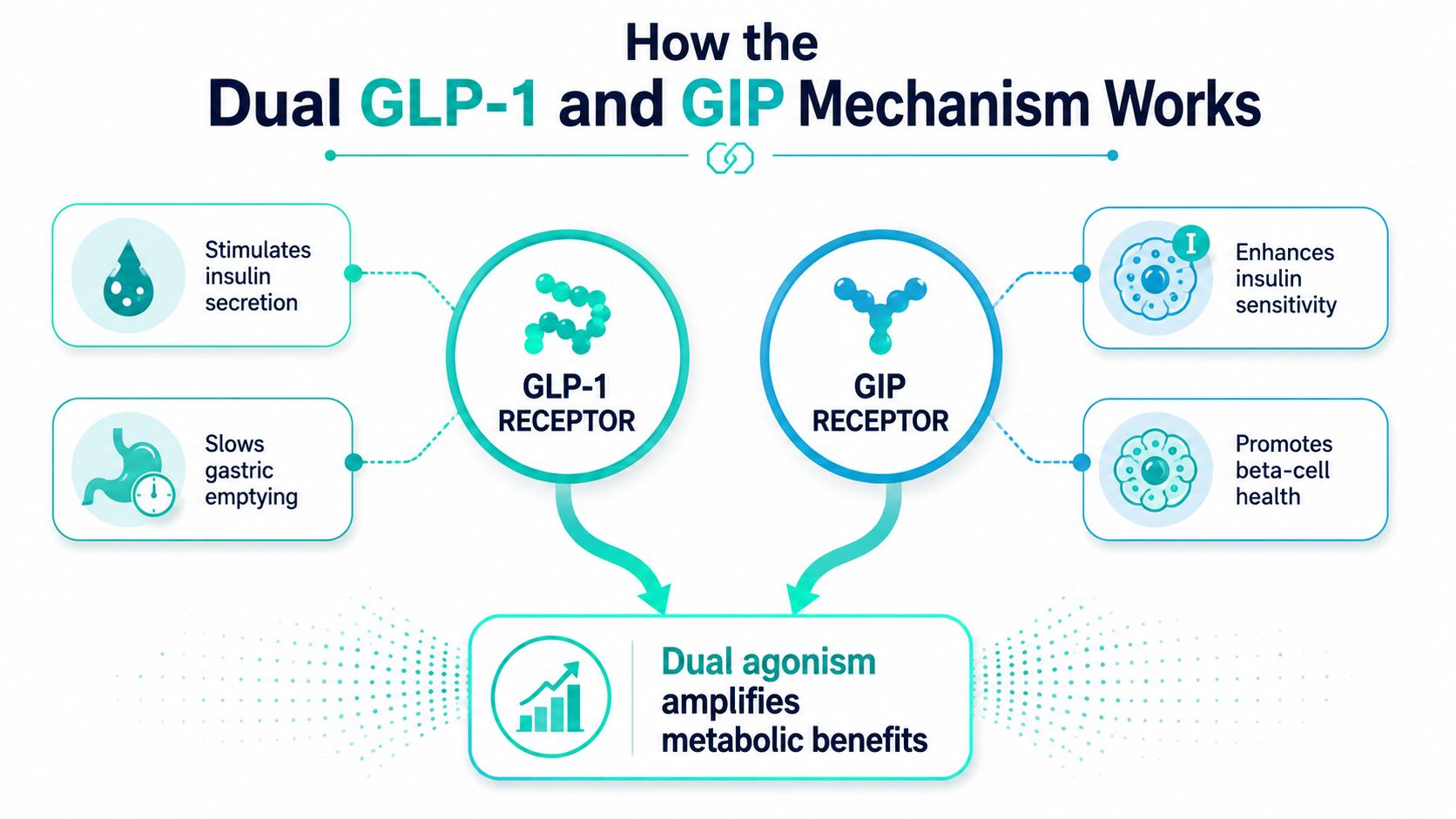
Tirzepatide is better understood as a molecule that distributes its signal across two incretin receptors, rather than as a simple amplification of one pathway. The verified pharmacology describes it as an imbalanced co-agonist, with stronger engagement of GIPR than GLP-1R as summarized in mechanistic studies. That imbalance is part of the design, and it helps explain why tirzepatide does not behave like a standard GLP-1-only compound.
Receptor binding numbers make the distinction easier to see. One clinical review reports Ki = 0.135 at GIPR, similar to native GIP, and Ki = 4.23 at GLP-1R, about 5-fold weaker than native GLP-1 in the receptor review. On paper, that suggests a molecule with less direct GLP-1 receptor affinity. In practice, it still produces useful incretin signaling because the two receptor inputs work together rather than competing for the same lane.
A useful lab analogy is a two-input control panel. One input can be easier to drive than the other, yet the output you care about depends on how both inputs are wired into the system. If you only inspect one receptor, you miss the combined effect that defines the molecule's behavior.
Mechanistic work also describes GLP-1R signaling bias toward cAMP generation over β-arrestin recruitment, which is associated with less receptor internalization than native GLP-1 and potentially prolonged signaling in mechanistic studies. That matters because two compounds can look similar in a surface-level assay while producing different intracellular kinetics. A single time point can hide that difference.
Assay context changes interpretation quickly. Receptor density, species, and sampling time can all shift the result enough that the molecule appears to “perform” differently even when the underlying pharmacology has not changed. For researchers sourcing tirzepatide, that means analytical confirmation and batch-level verification matter just as much as the headline mechanism.
Bench takeaway: if a result changes with receptor density, species, or assay timing, the molecule may be telling you more about signaling context than about absolute potency.
That is why “stronger GLP-1” is the wrong shorthand. Tirzepatide is better described as a rebalanced incretin signal, one that uses GIP and GLP-1 together rather than asking GLP-1 alone to carry the full effect. For a researcher, that distinction is not semantic, it is the difference between choosing the right readout, trusting the right control, and evaluating the right supplier documentation.
The clinical picture became hard to dismiss once the results moved beyond modest glycemic improvement and into consistent effects across diabetes and obesity studies. In the phase 2b trial, tirzepatide produced dose-dependent HbA1c reductions up to 2.4% and body-weight reductions up to 11.3 kg versus -0.4 kg with placebo and -2.7 kg with dulaglutide in the JCEM review of early development. That was the first clear sign that the molecule was behaving unlike a routine incretin follow-on.
The later SURPASS program strengthened that signal across five type 2 diabetes trials. Those studies reported HbA1c reductions of 1.24% to 2.58% and weight loss of 5.4 to 11.7 kg at weekly doses of 5 to 15 mg, with 23.0% to 62.4% of patients reaching HbA1c below 5.7% and 20.7% to 68.4% losing more than 10% of baseline body weight in the same clinical review. For translational researchers, that means the molecule was not only lowering glucose. It was shifting metabolic endpoints in a way that separated it from earlier single-pathway agents.
The practical lesson is simple. A flat dose curve would have made tirzepatide easy to file away as another glucose-lowering peptide. The actual pattern forced a different interpretation, because the response changed in parallel with dose and across more than one metabolic readout. That is the kind of profile that should make a researcher ask whether the assay is capturing the full biology or only one slice of it.
The obesity data pushed tirzepatide into a different conversation. A large randomized trial published in 2022 enrolled 2,539 participants and ran from December 2019 through April 2022 in the NEJM report. At the primary endpoint, 85%, 89%, and 91% of participants on 5 mg, 10 mg, and 15 mg achieved at least 5% weight loss, compared with 35% on placebo, and average weight reductions reached 19.5% with 10 mg and 20.9% with 15 mg, versus 3.1% with placebo same trial.
| Trial / Program | Population | Doses | Headline Efficacy |
|---|---|---|---|
| Phase 2b | Type 2 diabetes | Dose-ranging weekly treatment | HbA1c reductions up to 2.4%, weight loss up to 11.3 kg JCEM review |
| SURPASS | Type 2 diabetes | 5 to 15 mg weekly | HbA1c reductions of 1.24% to 2.58%, weight loss of 5.4 to 11.7 kg JCEM review |
| 2022 obesity trial | Obesity | 5 mg, 10 mg, 15 mg weekly | 85% to 91% reached at least 5% weight loss, mean loss 19.5% and 20.9% at higher doses NEJM trial |
For a researcher, the takeaway is not just that tirzepatide works. The stronger point is that the dose-response curve was large enough to move it from a diabetes-centered agent to a leading obesity-therapy candidate. That affects how you choose comparators, define endpoints, and decide whether your assay should be tuned for glucose biology, adiposity biology, or both.
Dual agonism changes how you interpret almost every downstream readout. A cell line with abundant GLP-1R can point in one direction, while a human islet preparation with a different receptor balance can point in another. The molecule has not changed. The assay context has.
A useful way to read tirzepatide data is to treat it as a rebalanced incretin signal. One receptor system may dominate in one model, while the combined GLP-1 and GIP activity becomes clearer in another. For a researcher sourcing material, that means the question is not just whether the label says tirzepatide. It is whether the material, the assay, and the analytical record are aligned closely enough to support the interpretation you want to make.
Mechanistic work has shown that tirzepatide can look different in human and mouse systems, with outcomes shaped by receptor expression context, species differences, and assay design as described in translational work. For a wet-lab team, the practical lesson is simple, a rodent result does not automatically map onto a human one, even when the endpoint name is the same.
That matters because preclinical readouts are not all measuring the same layer of biology. If you are looking at beta-cell signaling, receptor density can change how much of the dual signal appears in the assay. If you are looking at tissue-level responses, the signal may reflect receptor distribution, ligand bias, and downstream amplification together rather than a single clean measure of activation. A direct comparison between tirzepatide and a GLP-1-only agent can therefore mislead unless you state the system very clearly.
Before interpreting a preclinical figure, a careful researcher should ask three questions.
A simple analogy helps here. A receptor assay is like listening to one instrument in an orchestra, while a tissue assay is closer to hearing the whole arrangement. If the instrument and the full mix are not separated clearly, the result can sound stronger or weaker for reasons that have nothing to do with the molecule itself.
For source vetting, the same logic applies to analytical verification. A vendor packet should let you check identity and purity, not just accept a product name at face value, and a clear HPLC and mass spectrometry analysis record is far easier to defend than a vague summary of “tested material” HPLC and mass spectrometry analysis.
That is the practical bridge from mechanism to experiment. Tirzepatide produces a different signaling fingerprint because it is not a GLP-1-only molecule, and that difference can show up in receptor behavior, desensitization, and downstream biology. The assay has to be chosen with that in mind.
A label that says “tirzepatide” is not enough for research use. The question is whether the vial is chemically what it claims to be, whether it is consistent from lot to lot, and whether the documentation is strong enough to survive a lab audit. For peptide work, the answer starts with purity, but it does not end there.
At minimum, a serious vendor packet should let you verify HPLC or UPLC purity, confirm identity by mass spectrometry or LC-MS, and review the batch-specific certificate of analysis. If those documents are missing, the material is hard to defend in a reproducibility-focused setting. If they are present but thin, the remaining risk shifts to whether the assay matches the label claim.
The useful thing about analytical testing is that it gives you orthogonal evidence. Chromatography tells you whether the sample looks clean. Mass-based identity testing tells you whether the molecule is the one you expected. When both line up, you have a much better basis for interpreting a downstream result.
A practical reference point is a published workflow for HPLC and mass spectrometry analysis, since those are the kinds of methods a lab should expect to see described clearly rather than implied vaguely. That matters more than a marketing claim because the documentation becomes part of your experimental record.
Batch review should be specific, not ceremonial.
Practical rule: if you can't tie the vial in your hand to a lot-specific report, you don't really know what you bought.
Formulation details matter too. Buffer composition, lyophilized versus reconstituted state, and storage expectations all affect how confidently you can use the material. A “high-purity” label doesn't help if the sample arrives without enough analytical context to support your workflow.
Research peptide handling is mostly about preserving the material you paid for and keeping it in a state that's usable for the experiment. That usually means minimizing unnecessary freeze-thaw cycles, protecting the vial from avoidable contamination, and keeping the documentation close at hand. It also means drawing a hard line between research-grade material and any product intended or labeled for human use.
A vial that is fit for a bench assay isn't automatically fit for clinical substitution, and the reverse is also true. Even if the active sequence is the same, the intended use, regulatory status, and documentation burden are not interchangeable. A lab should never treat a research-labeled material as if it were a pharmaceutical product just because the name on the label looks familiar.
That distinction matters for procurement as much as for science. Institutional buyers should ask for the product identity, lot traceability, shipping records, and the policies attached to the sale. If a supplier can't clearly separate product category, intended use, and supporting documentation, the burden lands on the lab later.
The best handling routine is the one that matches the supplier's instructions and the lab's own SOPs. If the material is lyophilized, the reconstitution process should be documented before anyone opens the vial. If the material is shipped cold, the receiving team should inspect the package condition before sign-off. If a product is unstable under ordinary bench conditions, the lab should treat that as a control problem, not a convenience issue.
There's also a quality-control boundary here that people skip too fast. Purity ≥99% on a product page is not the same thing as “fit for purpose” in your model system. Purity tells you one part of the story, but stability, identity, formulation, and intended use determine whether the peptide will behave the way you need it to behave.
Choosing a supplier is a documentation exercise, not a catalog exercise. A transparent vendor should make it easy to verify what was shipped, how it was tested, and how the lot can be traced if a result later needs to be defended. That matters even more in a market where the FDA has warned about unapproved GLP-1 products used for weight loss, along with quality concerns, adverse-event concerns, and the need to report product issues through MedWatch in its alert on unapproved products.
A supplier review should begin with the certificate of analysis, then move to traceability. Check whether the lot number on the COA matches the vial and the invoice. If those identifiers do not align, the paper trail breaks down quickly, and any later interpretation becomes harder to defend. After that, look at whether testing was done only in-house or whether the vendor also provides independent third-party verification.
For a practical framework on sourcing standards, see our guide on sourcing GMP-adjacent research peptides.
Shipping and support matter too. A supplier's handling process should be clear enough that a receiving lab can document the condition of the shipment, and customer support should be reachable when an order needs clarification. Institutional buyers should also look for published terms, refund policies, and contact details that are easy to verify.
A transparent profile is easier to judge than a polished one. Published quality attributes like 99% purity, independent third-party testing, clear shipping and refund policies, and visible contact information are the kinds of signals that let a procurement team do its job without guessing. Celonyx Labs publishes that type of information, including a listed address at 1194 Twin Stacks Drive, Unit B, Dallas, PA 18612 and direct support at 570-761-6154 and the posted email contact, which is the sort of operational clarity labs should ask for from any supplier.
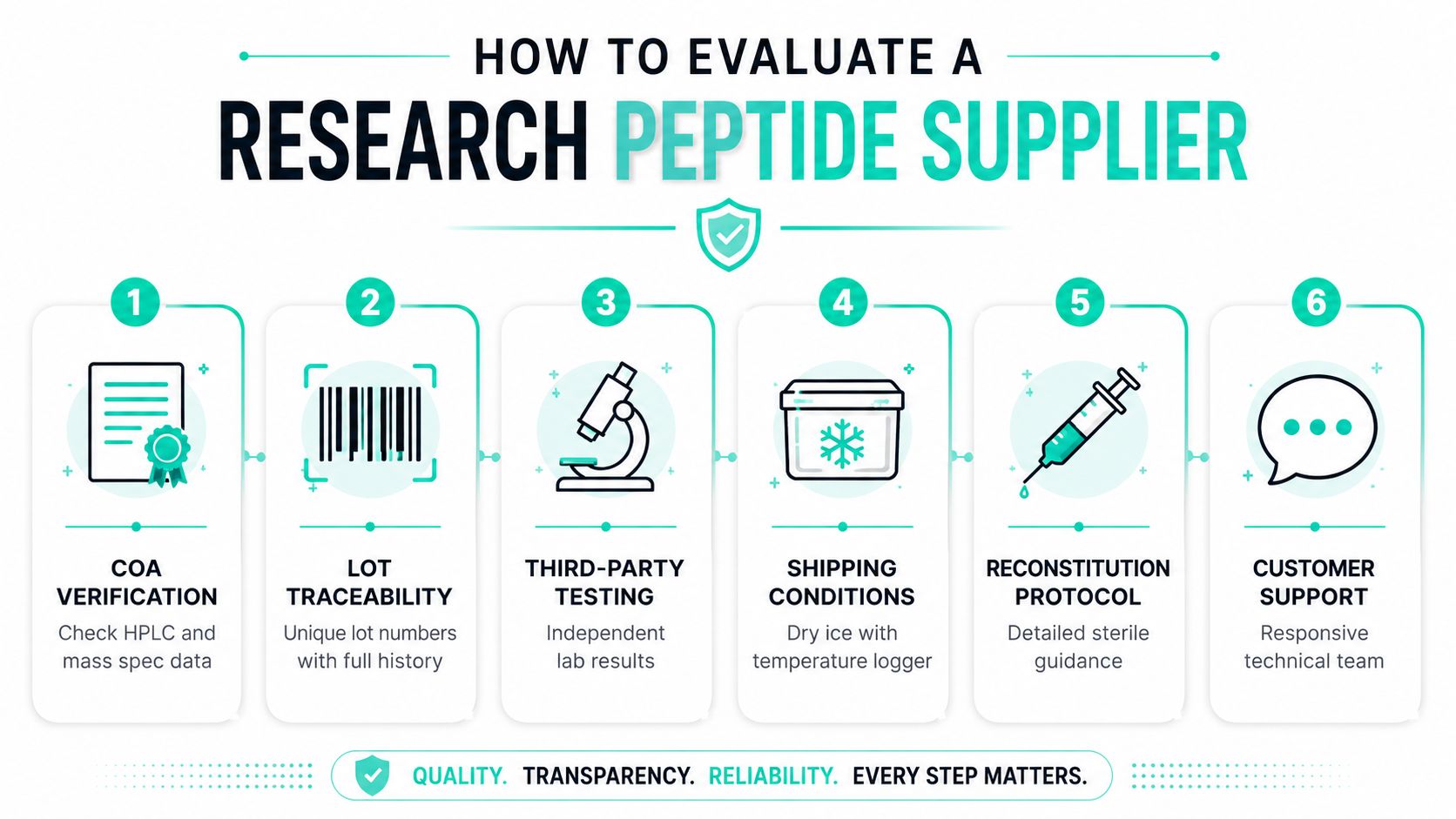
If you want a structured framework, use this sequence.
The best supplier is the one that makes verification easy before the order, not the one that offers the most reassuring language after the fact.
The internal sourcing standard should be simple. If the product cannot be traced, tested, and supported in writing, it is not ready for serious bench work.
Tirzepatide only makes sense if you hold two ideas at once. Biologically, it is not just a stronger GLP-1, it is a rebalanced incretin signal with meaningful GIP and GLP-1 activity. Operationally, that same nuance means a lab should buy it the way it would buy any high-consequence research reagent, with attention to identity, purity, provenance, and documentation.
The market is still crowded with unapproved or poorly described GLP-1 products, so provenance matters more now than it did when tirzepatide was just another peptide on a list. For reproducible research, the molecule's receptor story and the supplier's paper trail belong in the same conversation.
If your lab needs research peptides with clear documentation, batch transparency, and support that answers technical questions before an order is placed, visit Celonyx Labs. You'll find a catalog built for research workflows, plus the quality signals and supplier details that make procurement easier to defend.
Is bacteriostatic water the same as sterile water? No. Compare preservatives, vial handling and peptide

How do you know if a peptide vial has gone bad? Quarantine changes, check storage

Can too much bacteriostatic water ruin a peptide vial? Yes, if it overfills the vial
FOR RESEARCH USE ONLY. Products sold by Celonyx Labs are intended exclusively for laboratory and scientific research. They are not intended for human or veterinary use, consumption, diagnosis, treatment, cure, or prevention of any disease. By purchasing from this site, you acknowledge that you understand the intended research purpose of these materials and agree to comply with all applicable laws and regulations.