
Research peptide subcutaneous injection: Not safe in 2026
Is subcutaneous injection safe for research peptides? No—purity does not establish human safety. Learn what
You've got the vial on your bench, the supplier's PDF says 99% purity, and the project timeline is already tight. That's usually the moment people stop trusting the paperwork and start asking the right question, what's in the vial I received?
For peptide work, that question matters more than vendor branding or a polished Certificate of Analysis. Independent peptide-testing evidence shows why third-party verification has become a procurement standard, not a nice-to-have, and why the specific vial in hand deserves more scrutiny than a generic document ever can. Celonyx Labs' third-party testing page fits squarely into that reality, because the core issue is always the same, match the paperwork to the material.
A supplier sends a clean-looking PDF. The purity number reads high, the sequence looks right, and the lot number matches the label. Then your assay drifts, your cell phenotype changes, or your replicate set stops agreeing with itself. That is the moment a Certificate of Analysis stops being reassurance and starts becoming a liability if nobody has verified the vial in hand.
The gap is real. Vendor paperwork can describe what was claimed at release, while the vial on your bench can contain a different impurity profile, a mislabeled sequence, or material that no longer matches the original lot. In peptide-testing reviews, analysts have reported a wide gap between supplier claims and what samples pass on independent review, which is why a COA alone should never be treated as proof. When the sample itself is the thing that matters, the lab's job is to test the actual vial, not the version a vendor says it shipped.
A vendor COA may tell you what was claimed when the material left the source. It does not prove that the vial you received still contains that material, and it does not prove the original claim was accurate in the first place. That gap matters most when the problem is not an obvious failure, but a hidden impurity, a mislabeled lot, or a sequence close enough to pass a shallow check.
Practical rule: treat vendor documentation as a starting point, not a conclusion.
That is why traceable third-party methods matter so much in procurement decisions for labs and CROs. Independent analysis of active research-peptide vendors found that many published Certificates of Analysis, but fewer made those CoAs verifiable at the testing lab's source, and only a small share disclosed sterility or endotoxin results (source). If the report cannot be traced back to the lab that generated it, you are left with marketing dressed up as quality control.
That is also where a third-party check matters. A documented, independent review gives you a cleaner read on whether the vial matches the claim, and Celonyx Labs' third-party tested peptides are a useful example of how buyers should think about verification before they trust the paperwork.
The right mental model is simple. Identity testing, traceable CoAs, and independent verification are the minimum that keeps you from building experiments on unverified material. When results matter, the only document that counts is the one tied to the exact vial and the exact method that examined it.
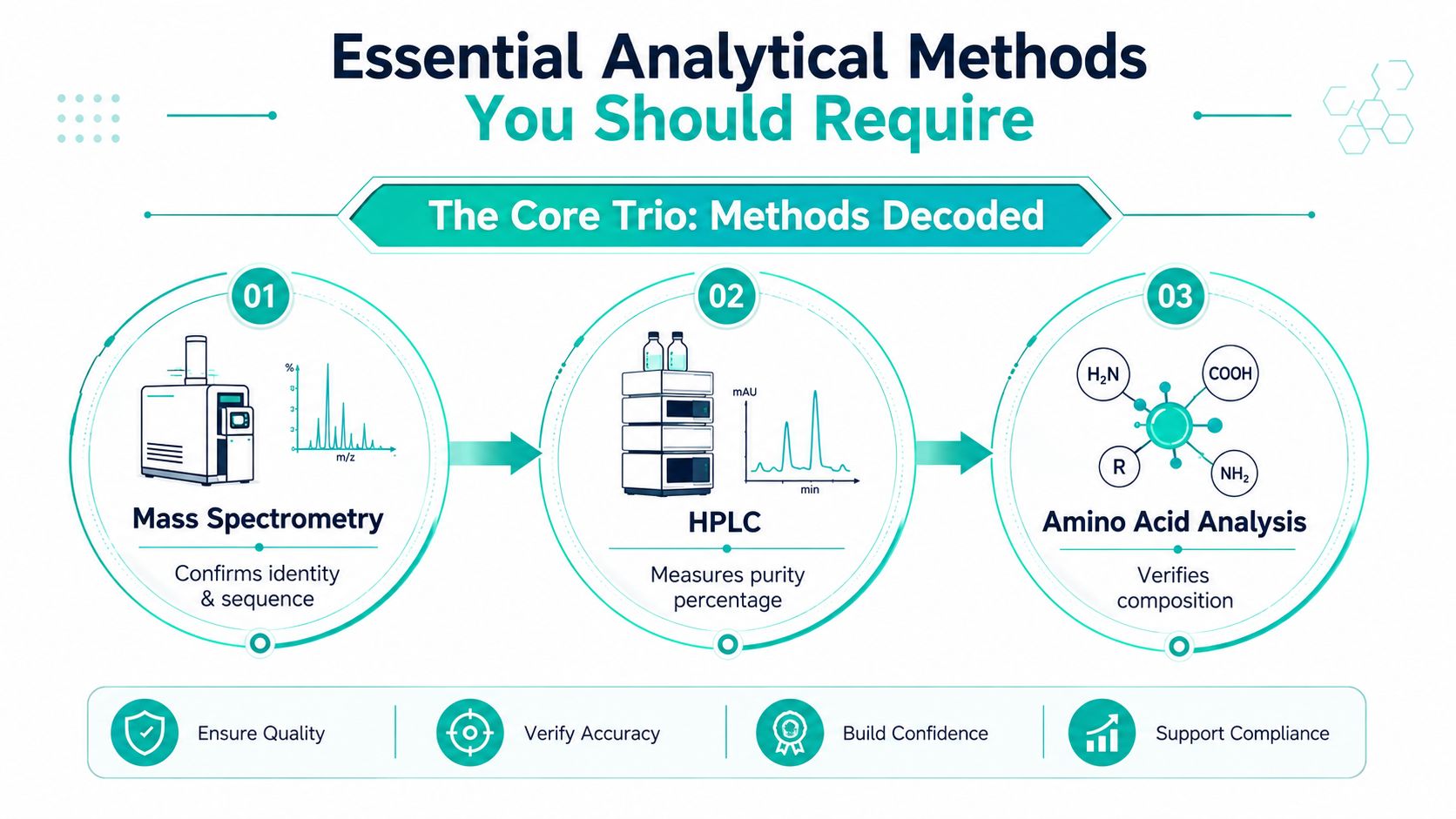
Buyers get into trouble when they ask for “testing” without demanding a method set that answers the right questions. A purity percentage alone does not prove the vial contains what the label claims. Good peptide testing labs build the report around separate checks for purity, identity, and composition, because one method never tells the whole story.
HPLC is the first pass for impurity profiling. It separates the sample into peaks, so you can see whether the vial is relatively clean or whether extra material is riding alongside the target peptide. Ask for the full chromatogram, not just a headline purity figure. A stripped-down summary can hide co-eluting impurities under a clean-looking number, and that is exactly how weak reports create false confidence. For a tighter look at how labs handle impurity profiling, review this guide to peptide impurity profiling methods.
That same source notes that labs commonly request about 10 to 20 mg for a full analytical panel, and basic HPLC purity testing is often quoted at $100 to 200 per sample, with standard turnaround around 5 to 7 business days and rush service shortening that to 2 to 3 days (source). Those figures help with planning, but they do not change the main point. HPLC tells you whether the sample looks clean enough to proceed, not whether the sequence is correct.
Mass spectrometry is the identity check. It shows whether the measured molecular weight matches the expected peptide, and it catches the wrong sequence, truncations, or substitutions that purity testing can miss. Expert reviews commonly use tight mass tolerance, often around ±2 Da, as a practical benchmark for matching expected identity (source).
The same benchmark set gives you a useful way to read purity thresholds. >98% purity is typically treated as pharmaceutical-grade equivalent for research decision-making, 95 to 98% is high-quality, and below 90% is a major red flag (source). If a report does not show both chromatographic evidence and a mass spectrum that supports the claim, reject it. A pretty CoA does not fix a wrong vial.
Amino acid analysis is the composition check that keeps the rest of the panel honest. It is not required for every project, but when you need stronger confirmation of how much material is present, it adds a layer that HPLC and MS do not fully replace. Independent lab work across six laboratories found close agreement among methods, with mean measured amounts of 1.807 mg by HPLC, 1.798 mg by qNMR, and 1.73 mg by amino acid analysis, and a mean across the six labs of 1.807 mg with a 95% confidence interval of 1.769 to 1.845 mg (source).
A report that combines these methods is harder to fake and easier to defend. That matters when a peptide goes into a sensitive assay, a formulation study, or any workflow where one bad vial can waste an entire round of data.
A vendor CoA can look tidy and still miss the point. The key question is whether the lab can prove what is in the specific vial you received, and whether it can handle formats that go beyond a simple linear sequence. That matters because the same product class now includes modified, cyclic, PEGylated, stapled, and conjugated peptides, and those samples need more than a generic checkbox review.
The strongest peptide testing labs document what their instruments can show for your sample. They also show how they separate a real analytical result from a seller's paperwork. A lab with real throughput is useful, but throughput alone does not tell you whether the report will hold up when the vial is unusual or the batch history is unclear.
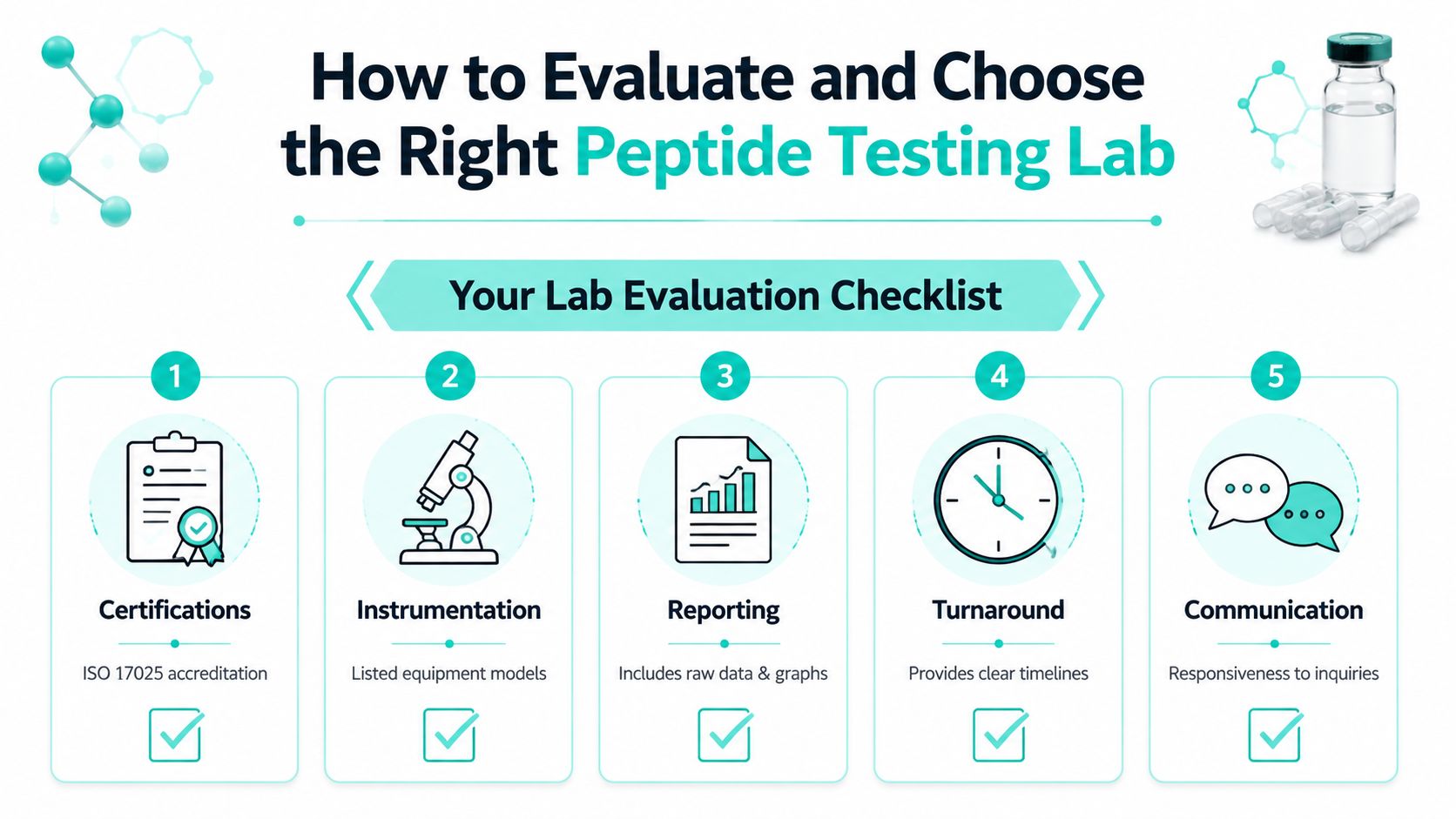
Ask for a sample report before you ask about price. Look for traceability, raw data, and a clear description of the methods used. If the lab only gives you a polished summary page, that is a weak sign.
A credible lab should also confirm whether it tests the actual sample you send rather than leaning on generic vendor documentation. That distinction is the whole issue. Third-party testing only helps when it applies to the vial in your hand, not a template result attached to a product listing. If you want a straightforward example of how a supplier-facing workflow can present those methods, see Celonyx Labs' HPLC and mass-spec analysis page.
Simple peptides are easy. Complex formats are where weak labs get exposed.
Modified, cyclic, PEGylated, stapled, and conjugated peptides can produce chromatograms and spectra that need careful interpretation, and not every lab can explain that work clearly. Ask how the lab handles unusual structures, what it does when the chromatogram shows unexpected peaks, and whether it can connect the mass data back to the exact construct you submitted.
Use this shortlist when you vet a provider:
The lab should be able to explain what failed, not just say it failed.
The problem is the exact vial. A vendor-supplied CoA may describe a batch, but it does not always resolve substitution risk or hidden contamination in the specific vial you received. That is why a lab that checks the actual material, documents the chain of custody, and gives you interpretable raw data is worth more than one that talks about quality in broad slogans. The report has to stand on its own.
Bad submissions waste good instruments. A vial with weak labeling, too little material, or missing context forces the lab into delays, repeat requests, or a report that answers the wrong question. Good peptide testing labs still need a clean sample packet. Without it, even strong methods produce messy results.
For a full analytical panel, labs commonly ask for about 10 to 20 mg of material. Send less and you invite a partial answer or a request for more. Send an opened vial when the lab asked for an unopened one, and you weaken the chain of custody while making representative sampling harder to defend.
Use the simplest defensible path. The lab receives the sample, confirms the identifiers, logs the material, and tests the unopened vial against the requested panel. That process protects you if anyone later challenges whether the vial tested was the vial you meant to evaluate.
At minimum, include batch numbers, lot numbers, chain-of-custody records, and a clear declaration of intended use. Say whether you want a purity panel, identity confirmation, or both. If sterility or endotoxin matters for your workflow, state that plainly instead of assuming the lab will infer it.
Practical rule: if the lab has to guess what you need, you've already lost time.
The common mistakes are predictable. People mislabel vials, forget to specify the test panel, or send a sample with no background documents at all. Others assume one report covers every future lot, which is a bad habit that only shows up after a problem batch slips through.
A useful submission packet gives the lab three answers immediately, what the sample is, what you want measured, and how the result should be interpreted. If any one of those is unclear, the report becomes less useful and the turnaround gets longer.
Cost matters, but it should not drive the decision by itself. A low quote can hide a weak panel, slow review, or a report that will not answer the question about what is in the vial. Pricing for peptide products can vary sharply across vendors and formats, so a cheap testing quote is not proof of value (source).
Basic HPLC purity testing is often quoted at $100 to 200 per sample, with standard turnaround around 5 to 7 business days (source). Rush service can shorten that to 2 to 3 days (source). Those numbers only matter if the method matches the decision in front of you.
If you are screening a straightforward linear peptide, a basic purity and identity panel may be enough. If the material is modified, conjugated, cyclized, or otherwise more complex, buy the deeper panel up front. That is the point where labs separate themselves, because complex formats can look acceptable on a narrow COA while the actual vial contains something different enough to matter.
The contract should spell out what happens when the sample fails, when the chromatogram shows unexpected impurities, and whether the report includes raw data. Leave no room for vague promises of “fast turnaround” or “premium quality.” Those phrases do not protect your timeline, and they do not protect your budget.
Use a simple procurement lens:
I prefer a lab that gives a precise, modest quote and then honors it over one that advertises broad capabilities without service discipline. That matters even more in peptide work, because a wrong result costs more than a higher invoice. It also matters when the vial is not a simple linear sequence, since contract labs that handle only routine cases often miss the edge conditions that drive procurement mistakes.
When supplier claims and independent results diverge, don't panic and don't hand-wave it away. Treat the discrepancy as data. The first move is to decide whether you're looking at a testing artifact, a sampling problem, or a real quality failure.
A deceptively clean single number can hide synthesis byproducts, truncations, or incorrect sequence material. That's why the chromatogram matters. If the purity number looks good but the trace shows extra peaks or odd peak shape, the report is telling you something the summary line is trying to flatten.
If the mass spectrum doesn't match the expected mass within tight tolerance, the identity claim is weak even if the purity number looks reassuring. That's the trap. A material can look neat on paper and still be wrong in practice.
Don't negotiate with a bad report until you've seen the raw data.
Retest when the problem looks procedural, like missing identifiers, a questionable sample prep step, or a report that lacks raw data. Reject the vendor when the evidence points to a material problem, especially if the chromatogram, identity data, or additional QC outputs don't support the claimed spec. If you're in doubt, document everything before you ask for a second opinion.
The fastest way to clean up future decisions is to keep a simple roadmap in mind. Check the actual vial, not just the vendor PDF. Demand HPLC plus mass spectrometry, and add amino acid analysis when the project needs stronger quantitative confirmation. Verify that the lab can handle the peptide format you're using, whether it's linear, cyclic, PEGylated, stapled, or conjugated. And don't buy silence where you should expect raw data, because a report without proof isn't a report you should use.
Celonyx Labs supplies research peptides and publishes quality-focused product information, which makes it relevant to the procurement side of this decision. If you want to compare how a supplier presents documentation, testing, and support in one place, visit Celonyx Labs and use the same standards you'd apply to any peptide testing lab.
Is subcutaneous injection safe for research peptides? No—purity does not establish human safety. Learn what

Does 99 percent purity mean a peptide is safe for research? No. Learn what purity

Can research peptides be shipped internationally? Yes, subject to import and export rules. Learn the
FOR RESEARCH USE ONLY. Products sold by Celonyx Labs are intended exclusively for laboratory and scientific research. They are not intended for human or veterinary use, consumption, diagnosis, treatment, cure, or prevention of any disease. By purchasing from this site, you acknowledge that you understand the intended research purpose of these materials and agree to comply with all applicable laws and regulations.