

Best GHK-Cu peptides for skin and wound healing research 2026
Choose the best GHK-Cu peptide format for laboratory skin and wound-healing research. Compare documentation, assay
A researcher has a wound-repair assay ready, cells booked, and a protocol that depends on a copper peptide behaving consistently. The supplier's page lists GHK-Cu 50mg peptide, but the questions start after the product name: Is the material correctly identified? Does the certificate apply to the exact lot? How should the lyophilized powder be stored and reconstituted without introducing avoidable variation?
For a laboratory, a 50 mg presentation isn't a wellness decision. It's a procurement, documentation, and handling decision. The amount affects how you plan stock solutions and aliquots, while copper coordination affects how you think about formulation and experimental controls. This guide treats GHK-Cu as research material, not as a treatment or self-administration product. If you're new to peptide purchasing, the overview of what research peptides are provides useful context for research-only catalog products.
A new researcher may search for “GHK-Cu 50mg peptide” after seeing the compound appear in a tissue-repair paper or a preclinical assay. The immediate temptation is to compare vial size and headline purity, then place the order. A senior lab manager usually asks a different first question: What result must this material support, and what records will prove what entered the experiment?
That distinction matters because GHK-Cu has a long experimental history but a comparatively small direct human evidence base. GHK-Cu was first isolated in 1973 by Loren Pickart from human plasma albumin, after younger plasma was observed to influence older liver tissue toward a more youthful protein-synthesis pattern. Later characterization identified the active molecule as glycyl-L-histidyl-L-lysine, a tripeptide that binds copper and forms GHK-Cu. The historical account is described in this review of GHK-Cu biology and discovery.
For an academic laboratory, CRO, or biotech team, the practical implication is straightforward. Treat the vial as a defined experimental input. Record its lot, identity documentation, stated purity, appearance, storage conditions, reconstitution solvent, concentration, and freeze-thaw history. Those details let another scientist distinguish a biological effect from a preparation artifact.
The 50 mg quantity doesn't tell you the right working concentration. It tells you how much total material is available before reconstitution, losses, sampling, and aliquoting. A small in-vitro project may need only a fraction of the vial, while a broader preclinical program may require a carefully managed stock strategy. The correct plan depends on the assay, validated concentration range, solvent compatibility, and institutional protocol.
GHK-Cu should remain within a research-use-only workflow. That means trained personnel, appropriate personal protective equipment, documented handling, and review by the lab's safety and compliance personnel. It also means avoiding the common mistake of treating cosmetic familiarity as proof that every route, dose, population, or exposure duration has been established in humans.
A sound purchasing decision therefore begins before checkout. Define the experiment, specify the records your quality system requires, and decide how you'll protect the material from handling variability. Then evaluate the chemistry, evidence, product documentation, and workflow together.
GHK-Cu is easiest to understand by separating the peptide from the copper complex. The peptide portion is glycyl-L-histidyl-L-lysine, often shortened to GHK. When it coordinates with copper(II), the resulting complex is called GHK-Cu. The copper isn't decorative packaging. Copper binding is closely connected to the complex's biological activity and behavior in aqueous research systems.
Think of GHK as a small carrier designed by chemistry to hold copper in a controlled arrangement. Free copper can participate in unwanted reactions when it is poorly controlled. In the GHK-Cu complex, the peptide acts more like a chaperone, keeping the metal associated with a defined molecular partner while making the complex available for biological investigation. This analogy isn't a substitute for coordination chemistry, but it helps explain why “GHK plus copper added separately” shouldn't automatically be treated as equivalent to a characterized GHK-Cu complex.
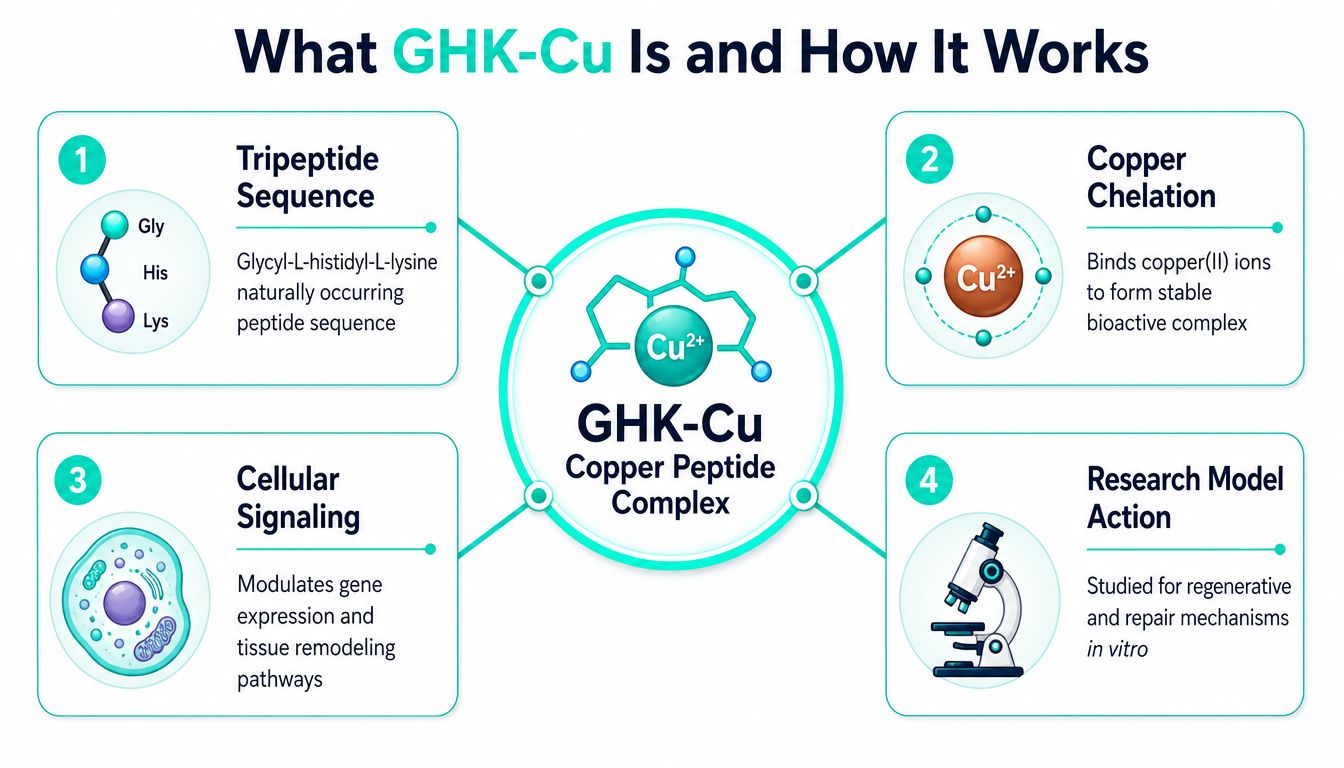
A major review describes GHK-Cu as a copper(II)-chelating tripeptide and links its activity to tight copper binding. The same review reports that the complex remains stable across physiologic pH conditions and describes stability in water from pH 4.5 to 7.4 for at least two weeks at 60°C under the reported conditions, as documented in the review of GHK-Cu structure and stability. That finding doesn't authorize a universal storage or incubation protocol. It does show why researchers should discuss pH, solvent, temperature, and exposure time rather than treating every aqueous preparation as interchangeable.
In a cell model, the relevant question isn't whether the powder dissolves. You need to know whether the prepared material remains chemically appropriate for the assay, whether the solvent affects the cells, and whether the copper-peptide complex is the intended test article. The same logic applies to extracellular-matrix experiments, where changes in fibroblast behavior, collagen organization, or signaling may be sensitive to both concentration and preparation history.
GHK-Cu is naturally occurring in human plasma and can be released from tissues after injury, according to the discovery and biology literature. That background makes it scientifically interesting, but it doesn't turn a research vial into a clinically validated product. Researchers still need controls that distinguish peptide-specific activity from copper-related effects, vehicle effects, contamination, or changes caused by preparation.
A useful experimental plan may therefore include the GHK-Cu complex, a matched vehicle control, and any comparison material needed to answer the biological question. The control design belongs to the principal investigator and the validated protocol. The purchasing decision should make the test article as identifiable and reproducible as possible.
The following video offers additional visual context for the copper-peptide concept:
GHK-Cu is most useful in research when the model matches the question. A wound-closure assay, an endothelial migration experiment, and a fibroblast extracellular-matrix study may all involve tissue repair, but they don't measure the same biological event. Choose the readout first, then decide whether GHK-Cu's copper-peptide biology fits the model.
Wound-healing models are the clearest application area in the available preclinical literature. Researchers may examine closure, tissue organization, vascular response, fibroblast activity, or inflammatory markers. These endpoints help separate a general change in cell growth from a more specific repair-associated effect.
One preclinical study reported VEGF expression increased 5.8-fold, endothelial cell migration increased 6.2-fold, and capillary density rose 81% in the reported model, as summarized in the research report on GHK-Cu wound-healing mechanisms. Those figures belong to that experimental context. They shouldn't be copied into a protocol as expected performance, because model species, cell type, exposure conditions, assay timing, and analysis method can all change the outcome.
For an angiogenesis-focused project, useful readouts may include endothelial migration and vascular-network or capillary-density measures. For a wound-closure project, track closure kinetics alongside viability and morphology. The key is to avoid calling every faster-moving cell population “healing” without confirming the relevant tissue-repair endpoint.
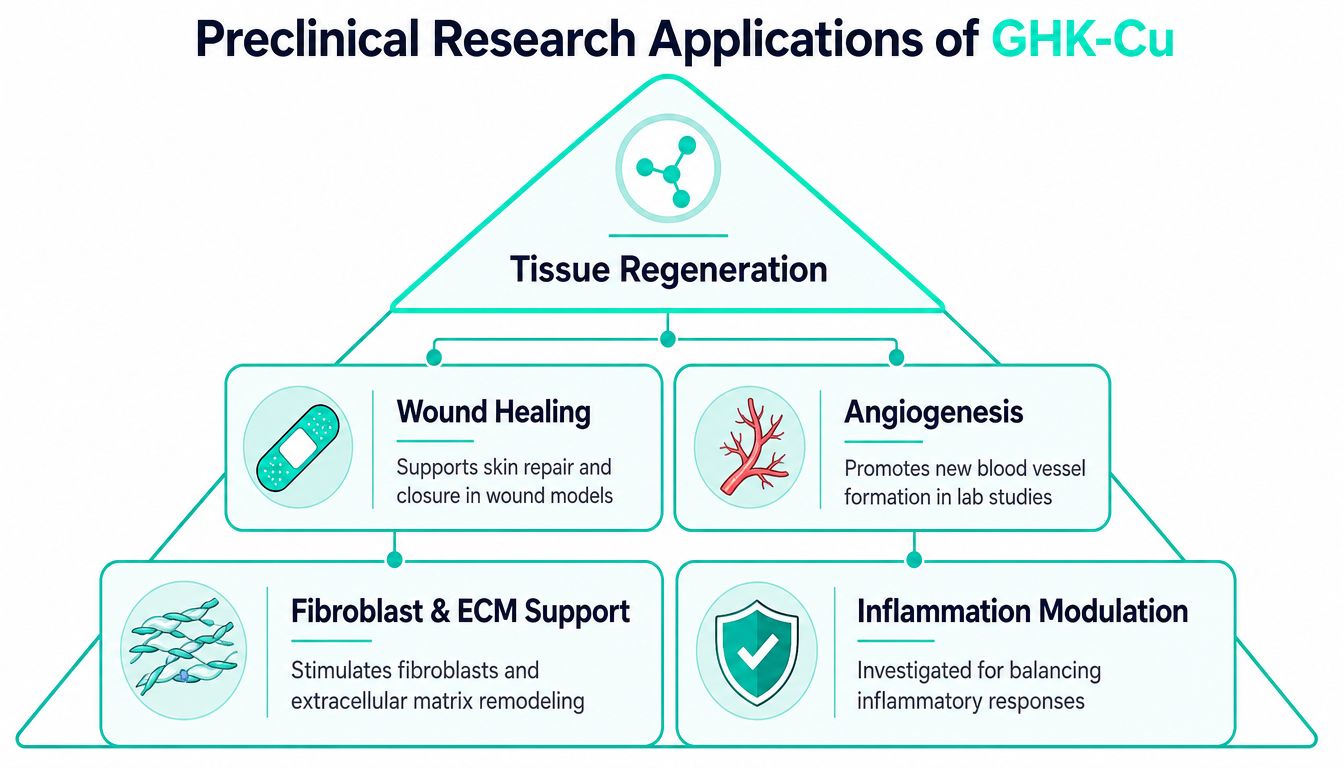
Fibroblasts provide another logical model because they help build and remodel the extracellular matrix. Reviews describe GHK-Cu as stimulating fibroblast-driven matrix production and modulating inflammation. In practice, a laboratory might pair fibroblast assays with collagen-related measurements, matrix organization imaging, or markers selected for the specific tissue model.
Preparation consistency becomes important. If one plate receives a freshly prepared solution and another receives material that has spent longer at room temperature, the resulting difference may reflect handling rather than biology. Use a defined stock process, document timing, and keep vehicle conditions matched.
GHK-Cu is also investigated for inflammation modulation. That doesn't mean every reduction in an inflammatory marker represents improved tissue repair. A repair model needs enough context to show whether inflammatory changes align with viability, matrix remodeling, and structural recovery.
Model-selection rule: Match the GHK-Cu experiment to a defined biological endpoint, not to a broad promise such as “regeneration.”
The human evidence deserves separate caution. A multicenter, randomized, evaluator-blinded, placebo-controlled study published in 1994 examined diabetic neuropathic plantar ulcers, and later reviews identify it as the only randomized controlled human wound-healing trial for GHK-Cu cited in those reviews. Outside that trial, clinical evidence is described as limited and mixed, with no large-scale clinical trial published since it, according to the summary of GHK-Cu wound-healing clinical evidence. Preclinical activity can justify a well-designed experiment, but it can't be presented as proof of a human therapeutic outcome.
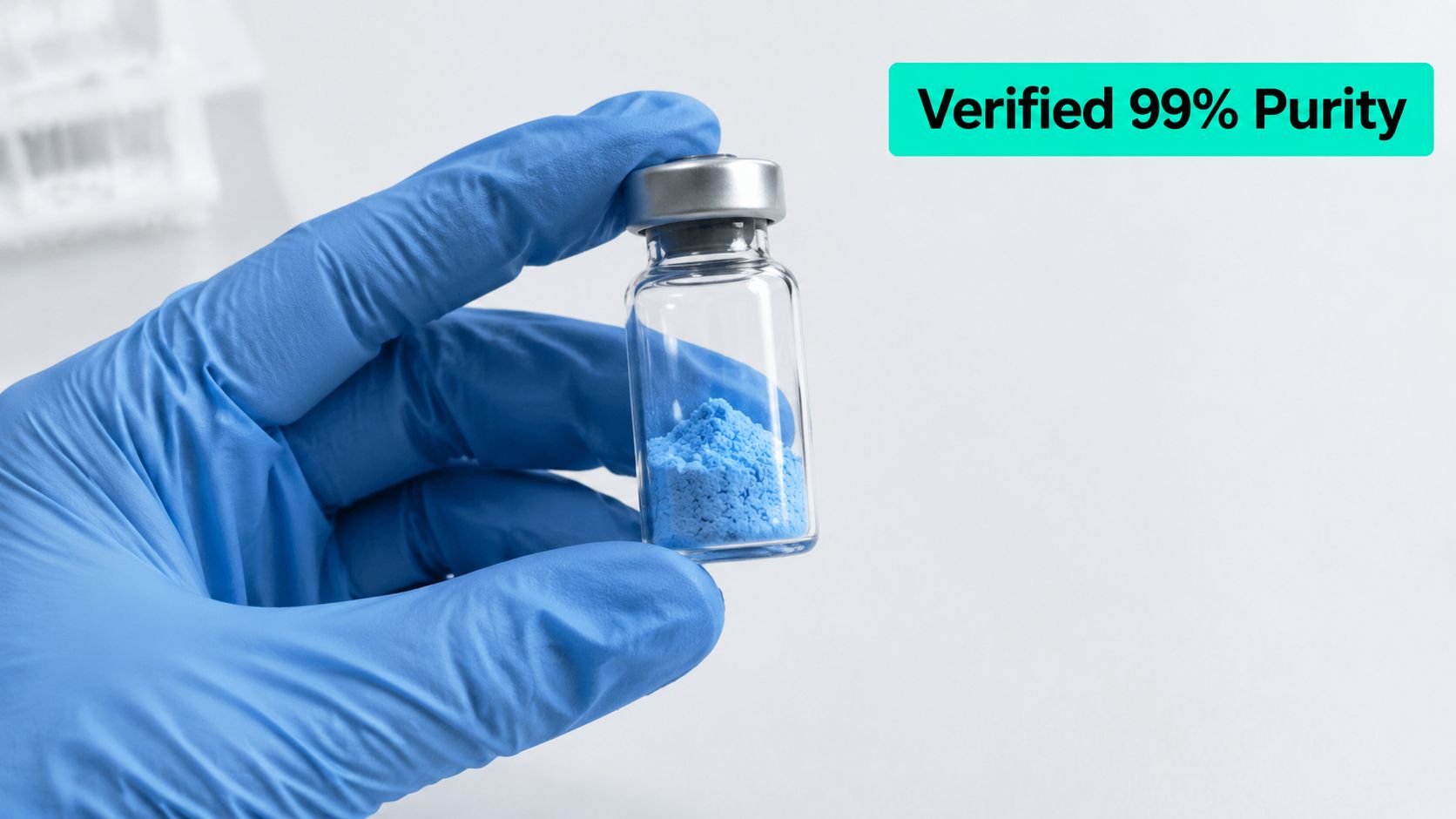
A label such as 99% purity is useful, but it isn't a complete quality file. It tells you the supplier's stated purity attribute. It doesn't, by itself, establish the peptide's identity, copper content, residual solvents, endotoxin status, sterility, stability after reconstitution, or suitability for a particular assay.
That distinction is easiest to see by comparing two purchasing records. A minimal record may list GHK-Cu, 50 mg, and a purity claim. A stronger record connects the exact lot to analytical documentation, testing methods, identity confirmation, impurity information, and storage guidance. The second record gives the laboratory something it can audit and investigate if results shift.
Use the product page as a starting point, not as the entire qualification package. Ask for documentation that answers these questions:
Independent testing adds an external check, but “third-party tested” still needs context. A laboratory should know what was tested, by which method, and whether the report is batch-specific. The third-party testing information from Celonyx Labs can be used as one reference point when building a supplier questionnaire.
Purity reduces one category of uncertainty. It doesn't remove biological variability, pipetting error, cell-line drift, assay noise, or degradation caused by poor storage. It also doesn't guarantee that a preparation is sterile or appropriate for use in people.
A purchasing decision combines the headline specification with identity, lot traceability, analytical detail, and handling instructions. If those records aren't available, document the gap before the material enters a controlled experiment. That decision may take longer at procurement, but it protects the interpretation of every downstream result.
Handling begins when the vial arrives, not when the first pipette tip enters the stopper. Inspect the container, compare the label and lot information with the purchase record, and photograph or document any unexpected condition according to your laboratory's receiving procedure. Keep the material sealed and protected from unnecessary light, moisture, and temperature excursions until the protocol is ready.
For lyophilized GHK-Cu, storage should follow the supplier's batch documentation and your institution's validated chemical-handling procedures. The supplied visualization describes sealed storage at -20°C in dry, dark conditions, but researchers should confirm the applicable instruction for the specific product and lot. Copper-peptide stability depends on the whole preparation environment, not just the number printed on a freezer display.
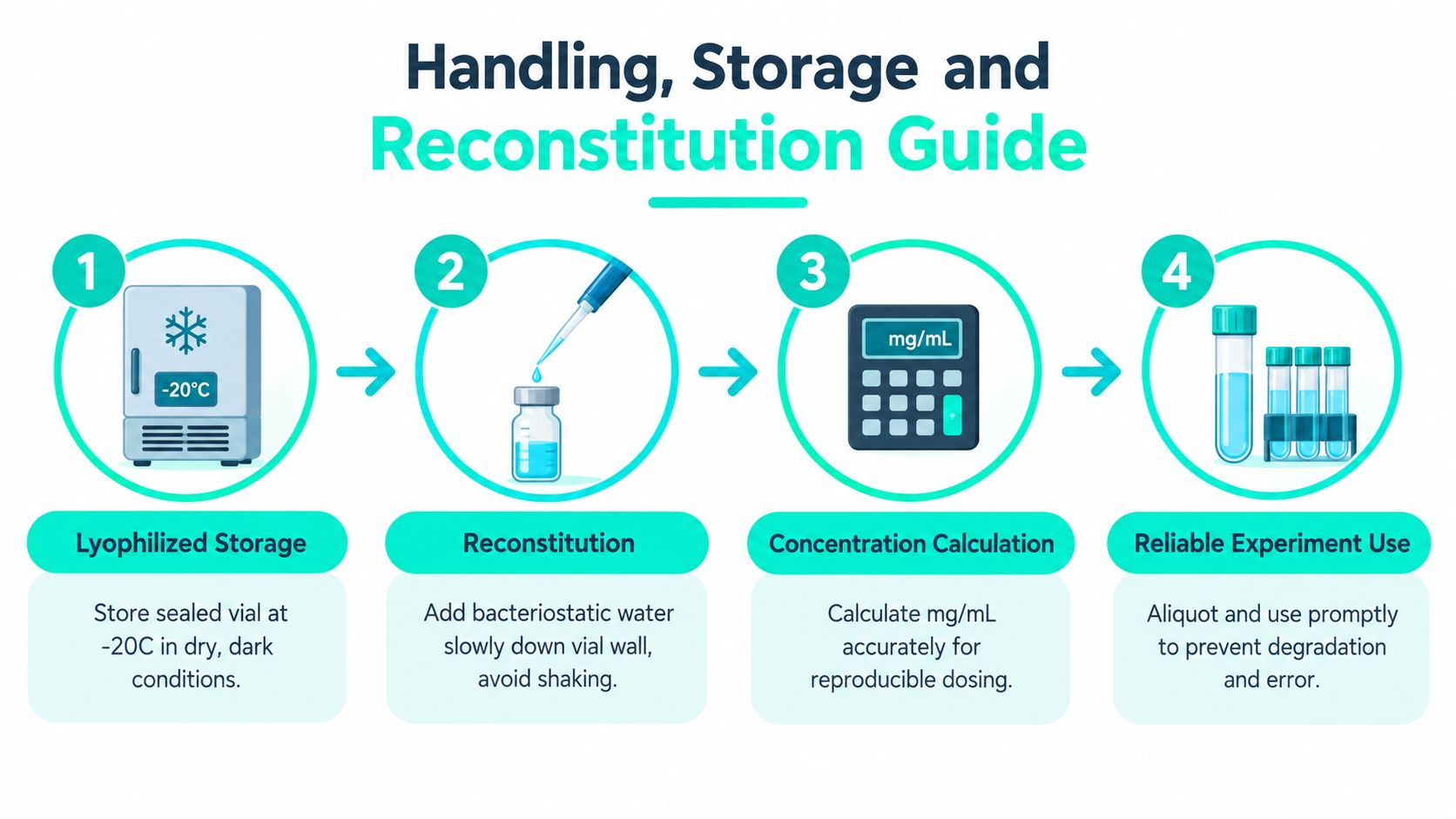
Bring the sealed vial into the approved preparation area. Let the container reach the planned working condition while sealed, reducing the chance that condensation enters the vial.
Select a compatible diluent. Use the solvent specified by the method, supplier documentation, and assay requirements. For cell work, confirm that the vehicle itself is compatible with the cells and controls.
Add the diluent slowly. Direct liquid down the vial wall rather than forcing it onto the powder. Allow wetting and dissolution to proceed gently, and avoid vigorous shaking unless your validated protocol specifically permits it.
Inspect and record. Note dissolution behavior, color, clarity, date, time, operator, final volume, and calculated concentration. Unexpected particles, persistent cloudiness, or a changed appearance should trigger a documented investigation rather than an improvised fix.
For a 50 mg vial, the basic calculation is:
Concentration in mg/mL = 50 mg ÷ diluent volume in mL
The reference values below are arithmetic examples for planning. They aren't recommended dosing instructions or proof that a particular concentration is suitable for an experiment.
| Diluent Volume | Resulting Concentration | Example Research Use |
|---|---|---|
| 1 mL | 50 mg/mL | Concentrated stock planning, if compatible with the validated method |
| 5 mL | 10 mg/mL | Intermediate stock preparation |
| 10 mL | 5 mg/mL | Lower-concentration stock planning |
| 50 mL | 1 mg/mL | Dilute stock planning, subject to solubility and assay requirements |
Prepare aliquots sized for the planned work so the primary stock isn't repeatedly opened and warmed. Label each aliquot with concentration, solvent, preparation date, lot, operator, and storage condition. Don't assume that a clear solution is still fit for the intended assay after an undocumented excursion.
The peptide reconstitution guidance from Celonyx Labs can supplement, but not replace, your institutional SOP. GHK-Cu products are for research use only. This information isn't medical advice, and it doesn't provide instructions for injection, treatment, cosmetic use, or human administration. Any route-specific work involving animals or human participants requires the appropriate institutional, veterinary, clinical, and regulatory oversight.
A lab receives more than a vial. It receives an identity record, a lot record, handling information, and a basis for deciding whether the material fits the study. Treat procurement like a chain of custody: each document should connect the ordered GHK-Cu 50mg product to the sample used in the experiment.
Build the request around your institution's quality system. A practical procurement file may include:
Before placing the order, ask whether the requested lot is available, how the analytical documents are delivered, and which contact handles a damaged shipment or record discrepancy. Phone and email support can shorten the path from a receiving issue to a documented resolution. Delivery speed helps scheduling, yet it cannot replace missing analytical records.
CRO and biotech teams should also standardize the material name across the purchase record, sample inventory, protocol, and final report. Use the same product and lot terminology throughout. Small naming differences can complicate reconciliation when several peptide lots are active at once.
Celonyx Labs lists GHK-Cu 50mg as a lyophilized research peptide and presents 99% purity and independent third-party testing as quality attributes. Verify those supplier-stated specifications against the lot documentation. Then assess whether the records meet the lab's acceptance criteria, retention requirements, and study plan. That decision belongs to the institution's procurement and quality process, not to the product label alone.
The powder doesn't dissolve immediately. What should the lab do? Stop adding solvent impulsively. Check the lot documentation, confirm the diluent and target concentration, inspect for visible particles, and record the preparation conditions. If the issue persists, contact the supplier with the lot number and preparation record rather than changing several variables at once.
The solution looks different from expected. Is it automatically unusable? Not automatically, but appearance alone can't confirm identity or fitness. Compare the received material with the documented description, review storage exposure, and follow the lab's deviation process. Don't filter, heat, or adjust pH casually, because each intervention can change the test article.
A freezer excursion occurred. Should the experiment continue? Quarantine the affected material until the responsible scientist or quality lead reviews the duration, temperature, container condition, and available stability information. The review cited earlier describes stability under specific conditions, but those findings don't establish a universal excursion allowance for every formulation or experiment.
Topical cosmetic use and systemic administration aren't interchangeable evidence categories. Available coverage describes decades of topical cosmetic use with few serious adverse events, while formal human safety information for injectable or systemic administration remains absent or very limited, including for pregnancy, lactation, and pediatric populations. The route-specific GHK-Cu safety discussion explains why a favorable topical history doesn't prove comparable safety for injections or prolonged systemic exposure.
It establishes the labeled quantity, subject to the supplier's documentation and testing. It doesn't establish regulatory suitability, sterility, clinical efficacy, or permission for human use. Regulatory treatment can differ by route and jurisdiction, and recent coverage describes injectable and non-injectable GHK-Cu routes as moving through separate compounding discussions before February 2027, a projected regulatory milestone described in this GHK-Cu FDA status overview. Labs should verify current requirements with their own regulatory and compliance personnel.
Investigation rule: If identity, concentration, storage history, or route-specific safety is uncertain, pause the work and resolve the uncertainty before interpreting the result.
For laboratories evaluating GHK-Cu 50mg peptide, Celonyx Labs offers a catalog-based research supply option with stated purity attributes, independent testing references, ordering support, and published operational policies. Review the product documentation and contact the team with your lot, shipping, and handling questions before visiting Celonyx Labs to place a research-use-only order.
Choose the best GHK-Cu peptide format for laboratory skin and wound-healing research. Compare documentation, assay

Choose lot-verified melanotan 1 peptide for pigmentation research. Compare material specifications, purity evidence, and documentation

Native oxytocin peptide is the default for behavioral research. Compare reference standards, labeled materials, and
FOR RESEARCH USE ONLY. Products sold by Celonyx Labs are intended exclusively for laboratory and scientific research. They are not intended for human or veterinary use, consumption, diagnosis, treatment, cure, or prevention of any disease. By purchasing from this site, you acknowledge that you understand the intended research purpose of these materials and agree to comply with all applicable laws and regulations.